The 42 hour gap: what actually happens to a lead between arriving and being answered
Slow lead response is not a discipline problem. It is a notification problem: arriving and being noticed are two different events, and in most small businesses only one of them is wired.
TL;DR
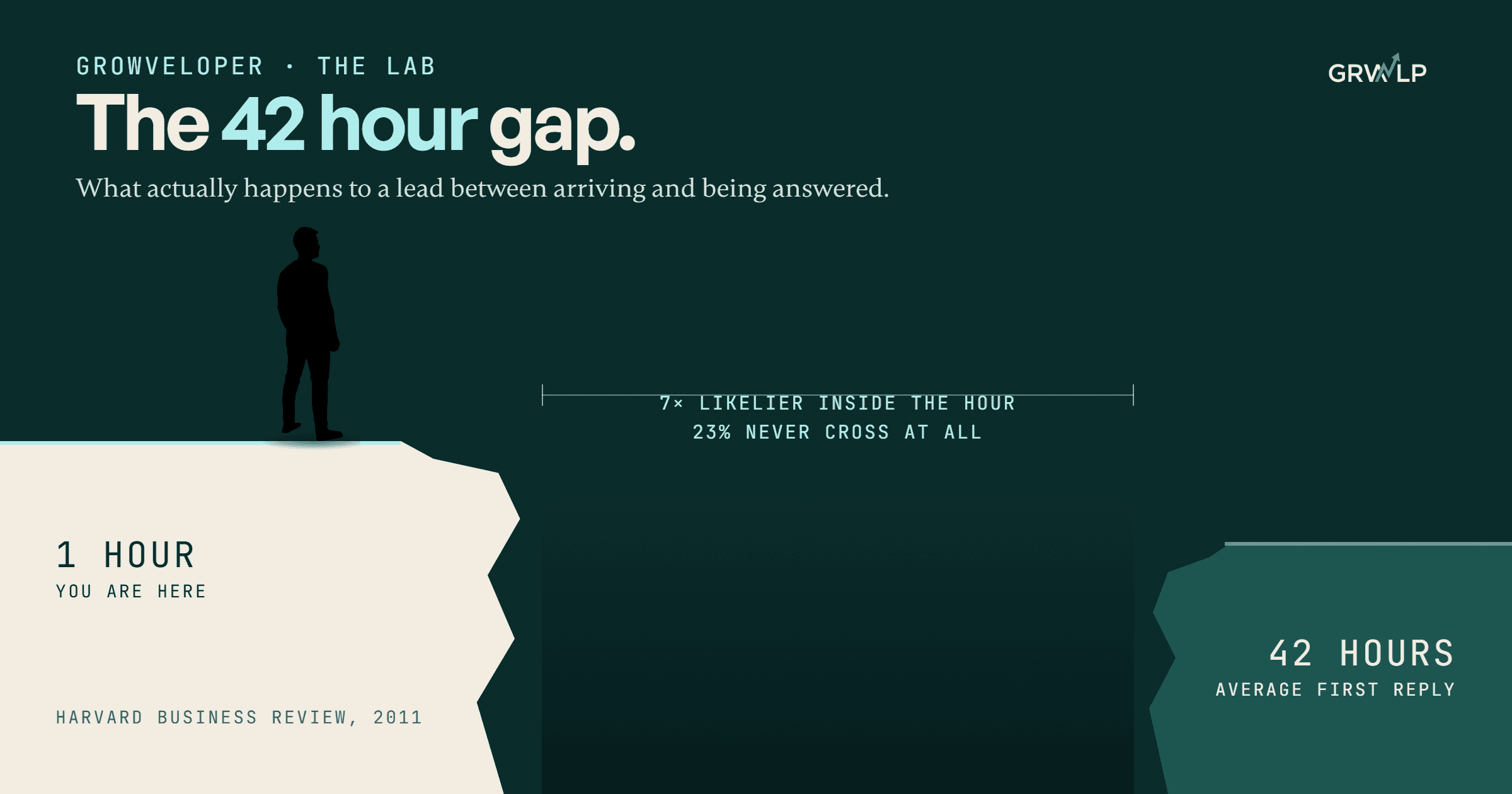
The average business takes more than 42 hours to answer a new enquiry, and almost a quarter never answer at all. Reaching a lead inside the first hour makes qualifying them around seven times likelier. The gap is not caused by slow people. It is caused by enquiries landing somewhere that never tells anyone they landed.
The average business takes more than 42 hours to answer a new enquiry, and almost a quarter never answer at all. Reaching a lead inside the first hour makes qualifying them around seven times likelier. The gap is not caused by slow people. It is caused by enquiries landing somewhere that never tells anyone they landed.
A lead arrived at 16:12. Nobody saw it until 09:07.
Not because anyone was lazy. The enquiry went into one person's inbox, that person was good at their job and busy with their job, and the email sat there until they next opened it.
That is seventeen hours in which somebody who wanted to buy something heard nothing back. They did not know they were waiting on one inbox. They just assumed nobody was interested.
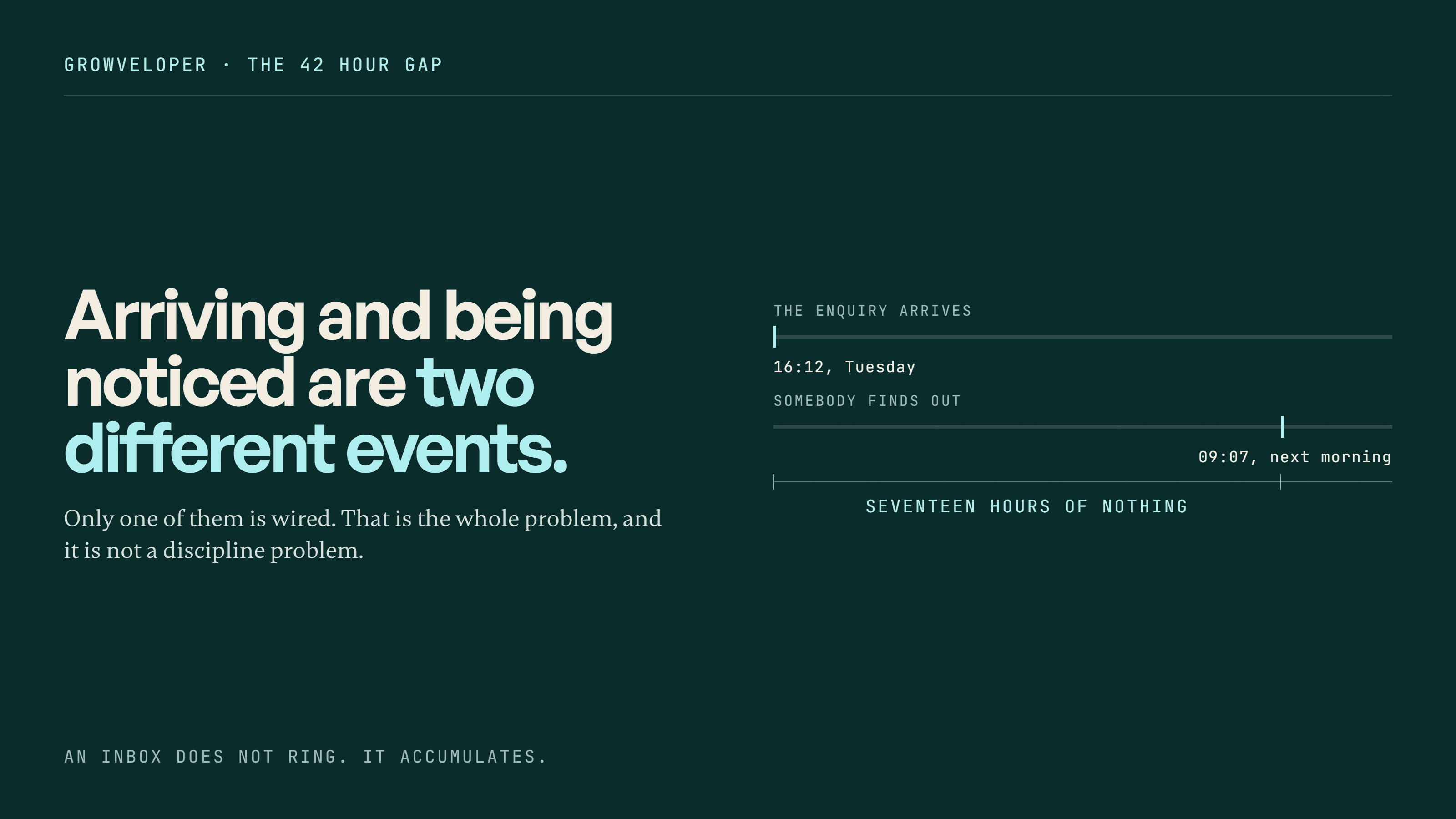
Nothing in that business was broken. There was no meeting where a seventeen hour delay got approved. It is simply what happens when arriving and being noticed are two different events, and only one of them is wired.
How long does the average business take to reply to a new lead?
Over 42 hours, measured across an audit of 2,241 companies published in Harvard Business Review in 2011. In the same research, 23% of those companies never responded at all.
Sit with the second number rather than the first. Not late. Never. Nearly one enquiry in four went into a business and nothing came back out.
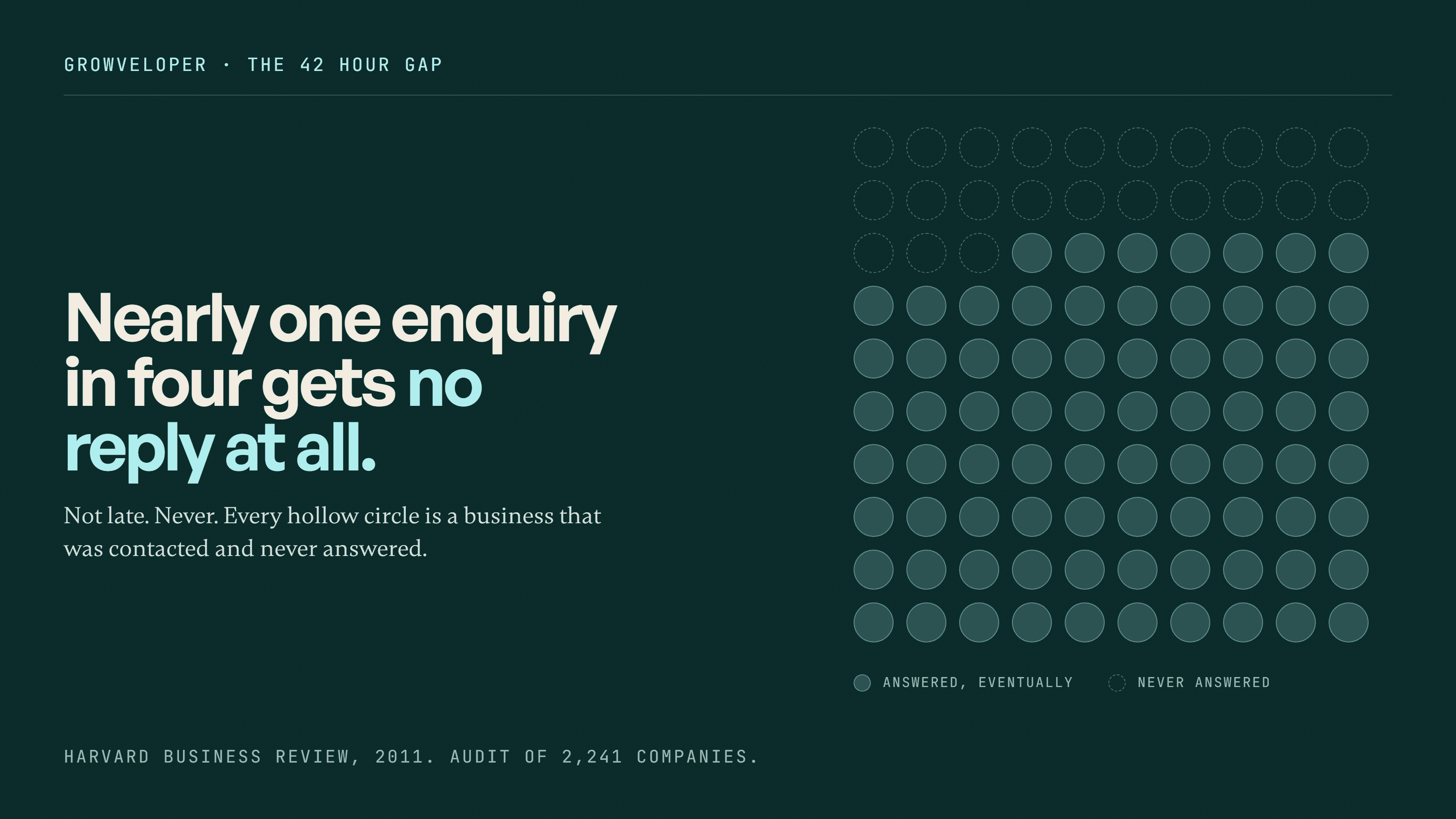
Two caveats before that number gets used for anything. It is from 2011, and it measured companies with sales teams, which is not the reader this is written for. It is here because it is the only large independent measurement of response time that traces back to a named study with a stated sample. This topic is full of newer, rounder, more dramatic figures that evaporate the moment you follow them anywhere.
Why does the first hour matter so much?
The same research analysed 1.25 million sales leads across 42 companies. Contact inside the first hour made qualifying that lead roughly seven times likelier than contact after an hour, and around sixty times likelier than waiting a day or more.
"Qualifying" is doing specific work in that sentence. The study measured whether a real conversation happened with somebody able to make a decision. It did not measure revenue, close rate or contract value, so anyone quoting it as a revenue multiplier is selling you something.
What it establishes is narrower and still worth knowing. The odds of ever having the conversation decay fast, and almost all of the decay happens while you are still deciding to get back to them.
Why do fast replies not happen, even when everyone agrees they should?
Because nobody chooses to be slow.
Your inbox does not ring. It accumulates. An email arriving is not a notification, it is a thing waiting to be noticed, queued behind every other thing waiting to be noticed, competing for attention with a supplier invoice and a school newsletter and the quote you promised somebody on Friday.
If the enquiry lands in an inbox, the reply happens whenever a human next opens the inbox. If it lands in a system that pings a named person, the reply happens in minutes. Nobody in either version is trying harder than the other.
This is why "we should be faster" never survives contact with a real week. It asks a person to stand in for a missing mechanism, and people make poor mechanisms at nine at night.
Where do leads actually get stuck?
Most small businesses do not have a front door. They have four, and nobody holds all the keys at once.
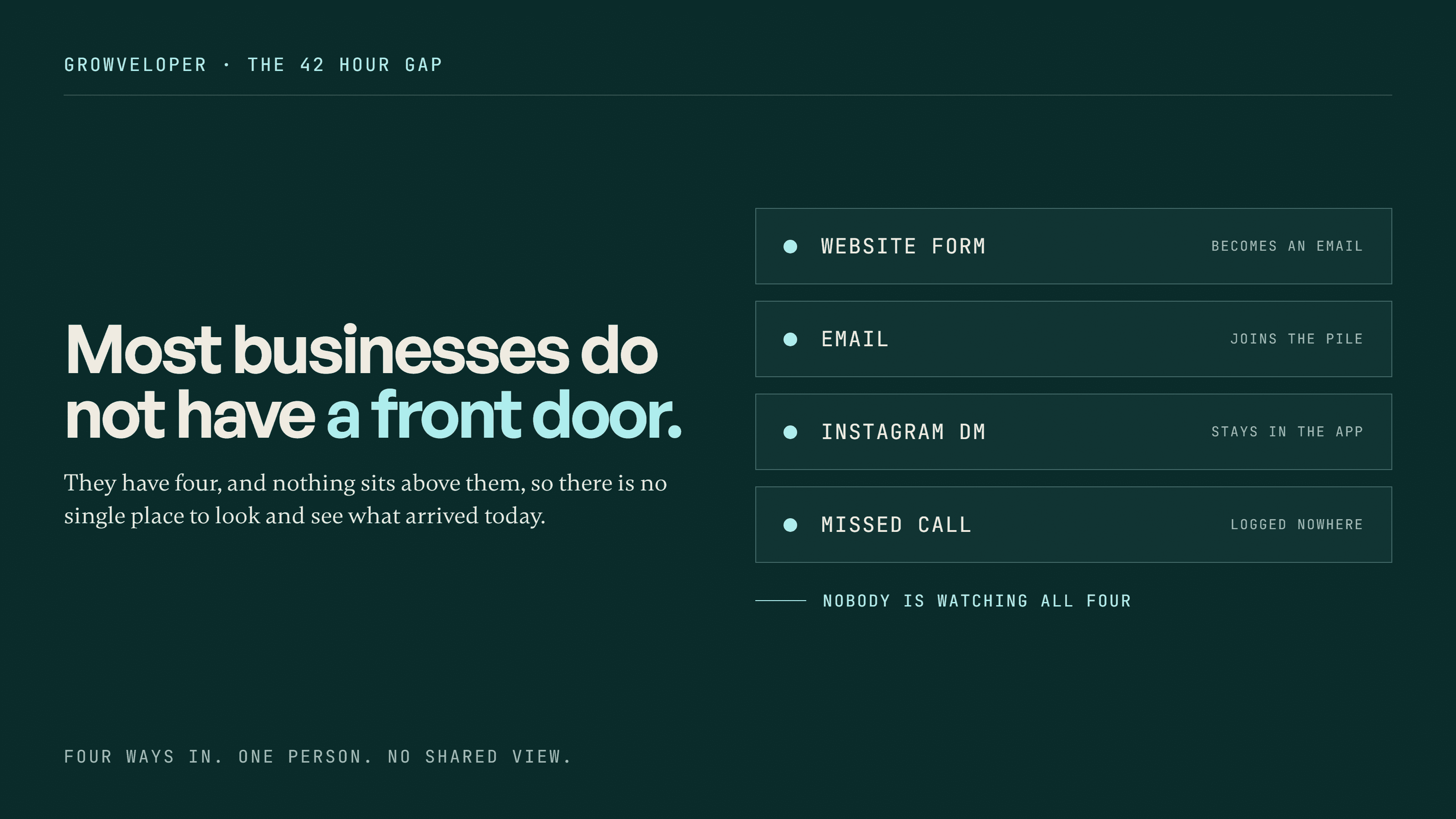
The website form becomes an email and joins the queue. The Instagram enquiry stays inside Instagram, visible only to whoever opens the app. The Facebook lead sits in Messenger, or in a Lead Ads form nobody has logged into since the day it was switched on. The missed call leaves a voicemail that exists in exactly one place and gets transcribed into none.
Nothing here is broken. Every one of these works precisely as designed. The problem is that nothing sits above them, so there is no single surface a person can look at to see what arrived today. The business has no inbox for itself.
What does closing the gap actually involve?
Less than you would think, and it is deliberately boring.
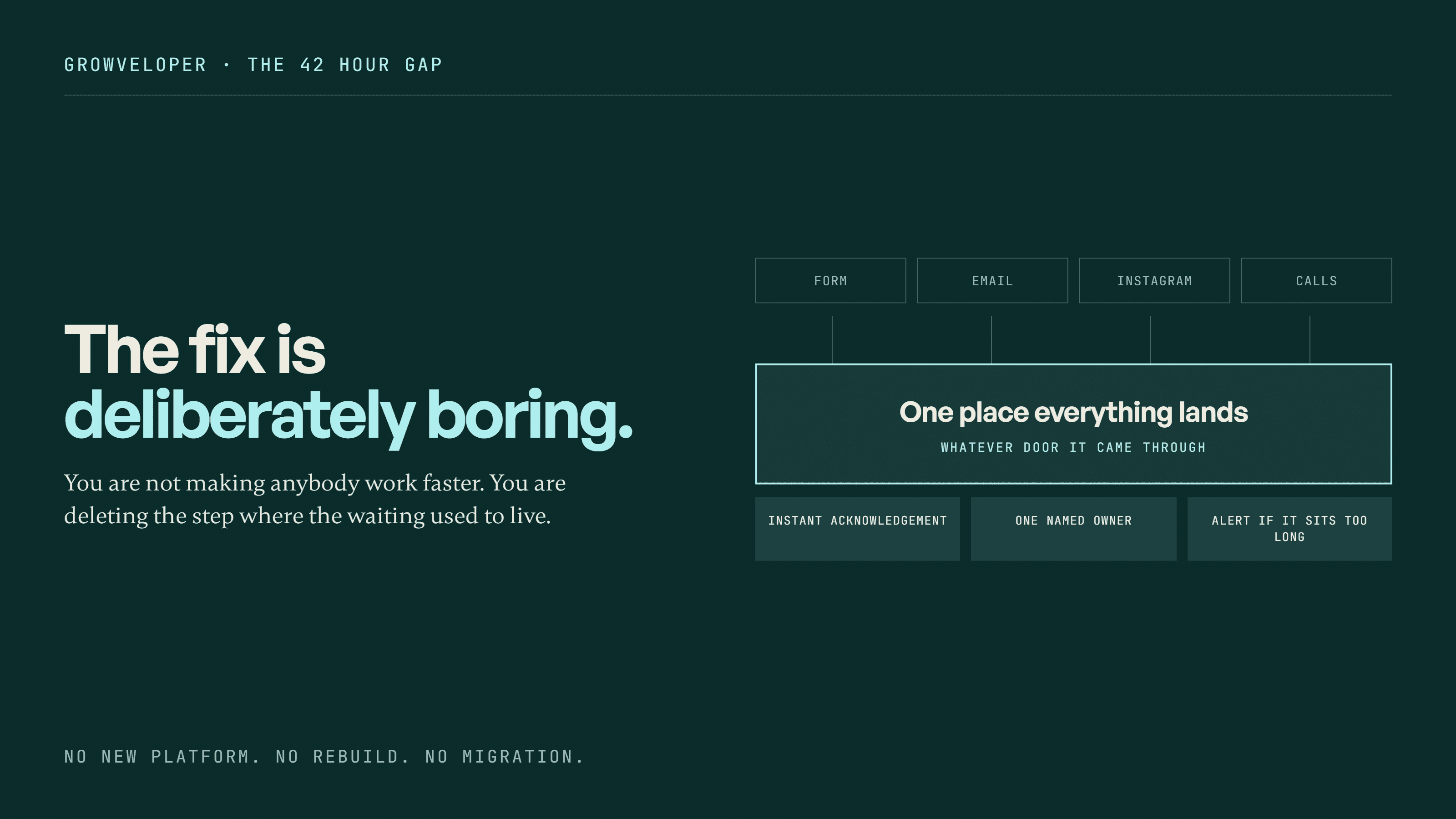
Every enquiry lands in one place, whatever door it came through. An acknowledgement goes out the moment it arrives, carrying a way to book time, so the person on the other end knows they have been heard while you are asleep. One named person owns each lead instead of "whoever sees it". And something raises its hand when a lead has been sitting too long, because the entire point is to stop depending on anyone noticing.
That is the whole fix. No new platform, no rebuild, no migration. You are not making anybody work faster. You are deleting the step where the waiting used to live.
It looks too small to matter, which is the reason it goes unbuilt for years. This is not a marketing problem or a discipline problem. It is a wiring problem, and wiring is cheap next to what leaks through it.
If none of your systems talk to each other yet, that is the same root cause I wrote about in what GTM engineering means for a business with no revenue team.
When is replying faster the wrong thing to fix?
When the leads are bad.
A fast reply to a badly qualified enquiry is still a wasted morning, and if you are drowning in people who were never going to buy, speed only helps you drown on schedule. Fix qualification first. A form that asks two useful questions beats an alert that tells you instantly about somebody you did not want.
It is also wrong if your volume is genuinely low and you already answer everything inside the day. Wiring a notification system to catch two enquiries a week is care spent on the wrong constraint. Go and get the third enquiry instead.
The test that takes ten minutes
Stop reading and go and fill in your own contact form. Then send yourself an Instagram message. Then leave yourself a voicemail. Do it on a normal working day, not at a moment when you are sitting there watching for it.
Then write down how long each one took to reach you. Not how long it took to reply. How long it took to find out. That number is the honest version of your response time and it is the only one worth having.
Most people are surprised by at least one channel. Usually it is the one they have been paying to advertise.
You do not need to answer in five minutes. You need to know in five minutes that there is something to answer. Those are different problems, and only one of them needs building.
If you want a second pair of eyes on which of your four front doors is leaking, the first call is free and takes thirty minutes. You leave with the number either way.
Where these numbers come from
Every figure here comes from one study: "The Short Life of Online Sales Leads" by James Oldroyd, Kristina McElheran and David Elkington, Harvard Business Review, March 2011. The qualification odds come from 1.25 million leads across 42 companies. The 42 hour average and the 23% non-response rate come from a separate audit of 2,241 companies inside the same research.
It measured whether a lead was contacted and qualified, meaning a conversation happened with somebody able to decide. It did not measure revenue or close rate, and nothing above claims it did.
Several figures circulating on this topic, including a 100x conversion claim and a 78% first-responder claim, could not be traced to any study with a stated sample. None of them appear here.
Written by Oyekola Obajuwon
Last updated