SEO and paid ads for a US small business: how do they work together?
How SEO and Google Ads work together for a US small business, using Google's own pause studies to decide where each dollar goes.
TL;DR
Run them as one plan: ads find out which searches turn into customers within weeks, and SEO wins those same searches for free over months. Google's own pause studies found only half of ad clicks were extra once a business ranked first organically, against 96% when it ranked fifth or lower, so move ad money off searches you already win.
Last updated 9 October 2026. Written by Oyekola Obajuwon, founder of Growveloper, a growth studio that builds the website, the marketing and the follow up for owner run businesses in the United States, the United Kingdom and Nigeria.
Run them as one plan: ads find out which searches turn into customers within weeks, and SEO wins those same searches for free over months. Google's own pause studies found only half of ad clicks were extra once a business ranked first organically, against 96% when it ranked fifth or lower, so move ad money off searches you already win.
SEO, search engine optimisation, is the work that gets your pages into Google's free results. Paid ads, often called PPC for pay per click, put you in the sponsored slots above them. Most pages that answer this question say the two "work together" and leave it there: ads for speed, SEO for the long run. That is true and not very useful. The useful part is how they share one budget, and Google has published the numbers that decide it.
How do SEO and paid ads work together for a small business?
They do two different jobs on the same searches. An ad can be live this week, so it tells you quickly which searches bring customers and which bring people looking for something else. SEO takes months, but once a page ranks, the clicks cost nothing each.
We call this scout and settle. The ad is a scout. It finds out which searches pay, fast and at a price. The page is the settler. It moves in slowly and then stays for free. When the settler arrives, the scout moves on to the next search.
That last step is the one most plans skip, and it is where a small budget leaks.
If I rank well on Google, do I still need ads on that search?
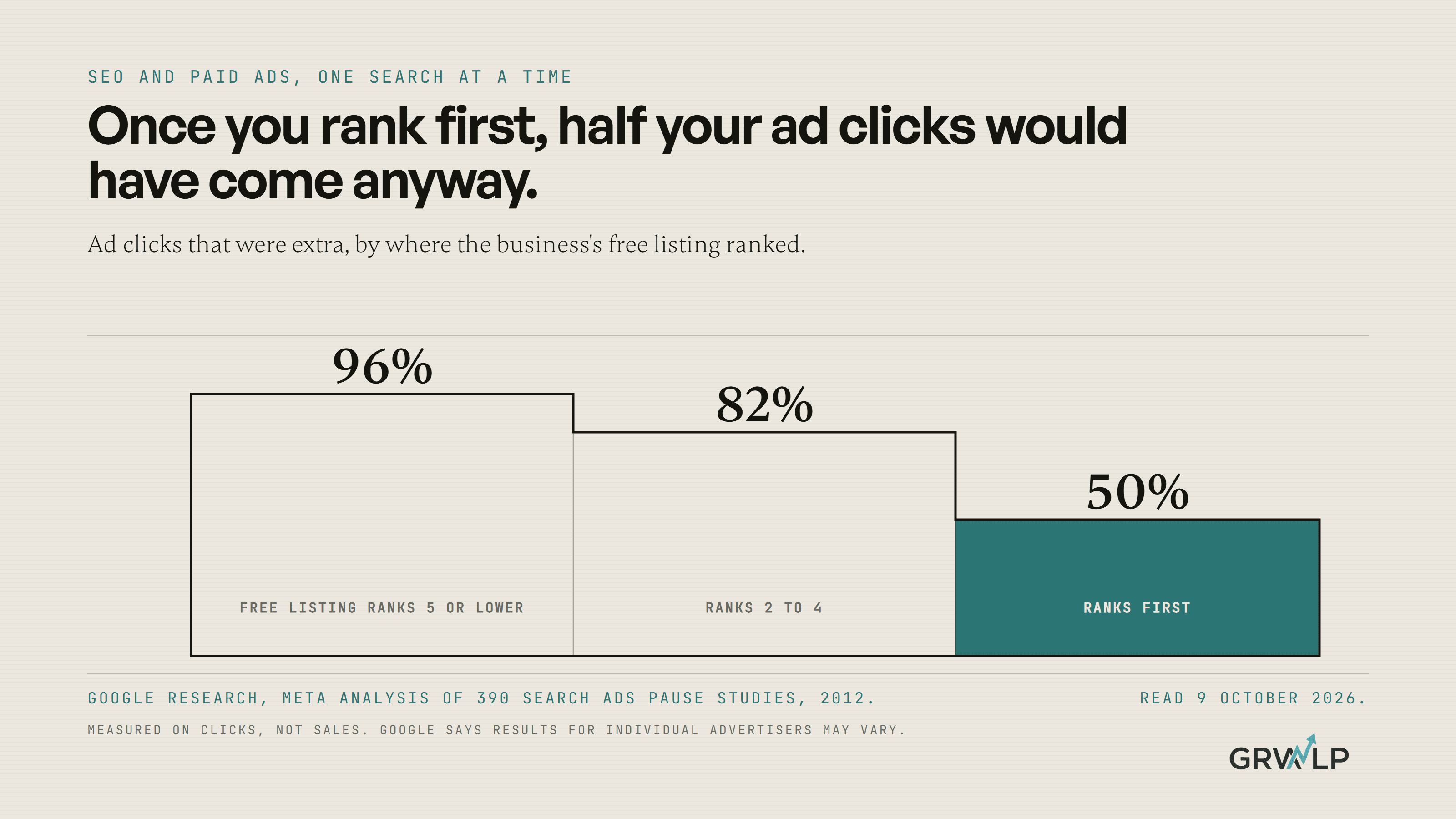
Less than you think, and Google's own research says so. In 2012 Google's statisticians published a meta analysis of 390 Search Ads Pause studies. Each study switched an advertiser's search ads off and counted how many of the lost ad clicks came back through the free listing. The clicks that did not come back are called incremental: the ones the ad really added.
How many ad clicks are extra, by where your free listing ranks
| Your free listing for that search | Ad clicks that were extra | What that means |
|---|---|---|
| No free listing on the page | 100% | Every ad click is one you would not get |
| Ranks 5 or lower | 96% | The ad does almost all the work |
| Ranks 2 to 4 | 82% | Most ad clicks are still new |
| Ranks first | 50% | Half the ad clicks would have come anyway |
Read the bottom row slowly. Once your page ranks first, the ad on that search is buying half its clicks twice: once in the free result you already earned, and again in the ad above it.
Three honest limits. The study is from 2012, before AI answers sat at the top of the page. Google itself warns that "results for individual advertisers may vary" and that "the study focuses on clicks rather than conversions." And Google sells the ads, so a study showing ads add clicks suits it. Even read that way, it is the only measured overlap we know of with a sample this size, and it points one way: spend ads where you do not yet rank.
The same study found that "81% of ad impressions and 66% of ad clicks occur in the absence of an associated organic result." For most searches a small business advertises on, there is no free listing to protect. That is where the scout belongs.
Does running Google Ads help my SEO ranking?
No. Google's page Do you need an SEO?, updated in June 2026, says it plainly: "Advertising with Google won't have any effect on your site's presence in our search results." It adds that Google "never accepts money to include or rank sites in our search results."
So anyone selling ads as a way to rank is wrong. What ads can do is indirect. They tell you which searches lead to calls and bookings, and that tells you which pages are worth the months SEO takes.
How do ads tell me which pages to build?
Through two free reports, once the accounts are connected.
The first is the search terms report. Google describes it as showing "the searches that trigger your ads and how those searches are performing." A search terms report is a list of what your customers said out loud. Sort it by conversions and the top rows are the pages your site should have. The rows that cost money and never convert go on a negative keyword list, which stops your ads showing for them again.
When we ran Google Ads for Securityplus Federal Credit Union, a US client of VIP Creative Studio, the account carried more than 500 negative keyword lists. Every one of those was the account paying to learn which searches were not customers. That lesson is worth the same to your SEO plan: do not write pages for those searches either.
The second is the paid and organic report. To use it you link Google Search Console, Google's free tool for your free listings, to Google Ads; the steps are in Google's help page on linking Search Console and Google Ads. The report, described on Google's page about measuring paid and organic search results, puts ad clicks and free clicks for the same search side by side. Google suggests looking for queries where you appear for free "with no associated text ads", which is the scout's next job, and it is also where you find the searches you are now paying for twice.
One catch: the report only holds free data "back to the date you started importing it." Link the accounts on day one, even before you need the report.
None of this works without tracking. When we rebuilt the site for Baye Business Solutions in Lagos, the old site had "No analytics. No Google tracking." We set up GA4 and Microsoft Clarity alongside the rebuild, and for the first time the company could see who visited and where they dropped off. Count the conversion before you spend a dollar on either channel; our piece on what has to be true before paid ads convert covers how.
How long does each one take to work?
Ads work in weeks, SEO in months. Our marketing page gives the timelines we quote clients: "Paid ads show initial data within 2-4 weeks. Optimization takes 60-90 days to reach full performance. SEO takes 4-6 months for meaningful rankings." Google's own SEO Starter Guide says some changes "could take several months."
That gap is the whole reason to run both. In the months SEO needs, ads pay for the answer to the only question that matters: which searches turn into customers.
What does a click cost a US small business?
It depends on the trade, and in some trades it is the strongest argument for SEO. Search Engine Journal's summary of WordStream by LocaliQ's tenth benchmarks report, covering campaigns across 20 industries from April 2025 to March 2026, puts the average cost per click at $5.42 and the average cost per lead at $66.69. Attorneys and legal services were the most expensive, at $9.87 a click and $131.63 a lead.
At $131.63 a lead, a law firm getting 20 leads a month from ads spends about $2,600 on the ads alone. If SEO wins even a few of those searches at the top of the free results, the table above says the ads on those searches lose about half their value. That money is the budget for the scout's next search.
A 90 day plan for running both
Here is how we would start a small US business on both channels at once.
A first 90 days of SEO and paid ads together
| Weeks | Paid ads | SEO |
|---|---|---|
| 1 to 2 | Count calls and forms as conversions; one Search campaign on your main service and area | Link Search Console to Google Ads; fix the pages for that same service and area |
| 3 to 6 | Read the search terms report weekly; add negative keywords | List the searches that convert; write or rebuild one page for each |
| 7 to 12 | Move budget to new converting searches you do not rank for | Check the paid and organic report; note searches where you now rank in the top four |
At day 90, the ads have paid for a list of searches that bring customers, and your site has a page for each. SEO keeps working on that list for months. Whenever a page reaches the top of the free results, look at the ad on that search again.
Should I bid on my own business name?
Sometimes. If you rank first for your own name, the study's bottom row applies: about half of those ad clicks would have come anyway. The reason to keep a small budget on it is a competitor bidding on your name, which pushes their ad above your free listing. Search your own name in an incognito window. If nobody else's ad appears, test switching yours off for two weeks and watch total calls, not ad clicks.
Should one agency run both SEO and paid ads?
Ideally the same person reads both reports, because the rule above only works if someone can see both sides of the same search. Two agencies who never compare notes will each report their own clicks, and nobody will notice the searches you pay for twice. Our piece on one growth studio or three agencies covers when splitting the work still makes sense, and our guide to choosing a Google Ads manager has the questions to ask either way. For the free side, start with the local SEO checklist.
If you want someone to look at both accounts with you, book a free 30 minute call. We will show you which searches you are paying for twice.
Let the ad find the search, let the page win it, and then send the ad off to find the next one.
“The ad is a scout. It finds out which searches pay, fast and at a price. The page is the settler. It moves in slowly and then stays for free.”
Written by Oyekola Obajuwon