What GTM engineering means for a business with no revenue team
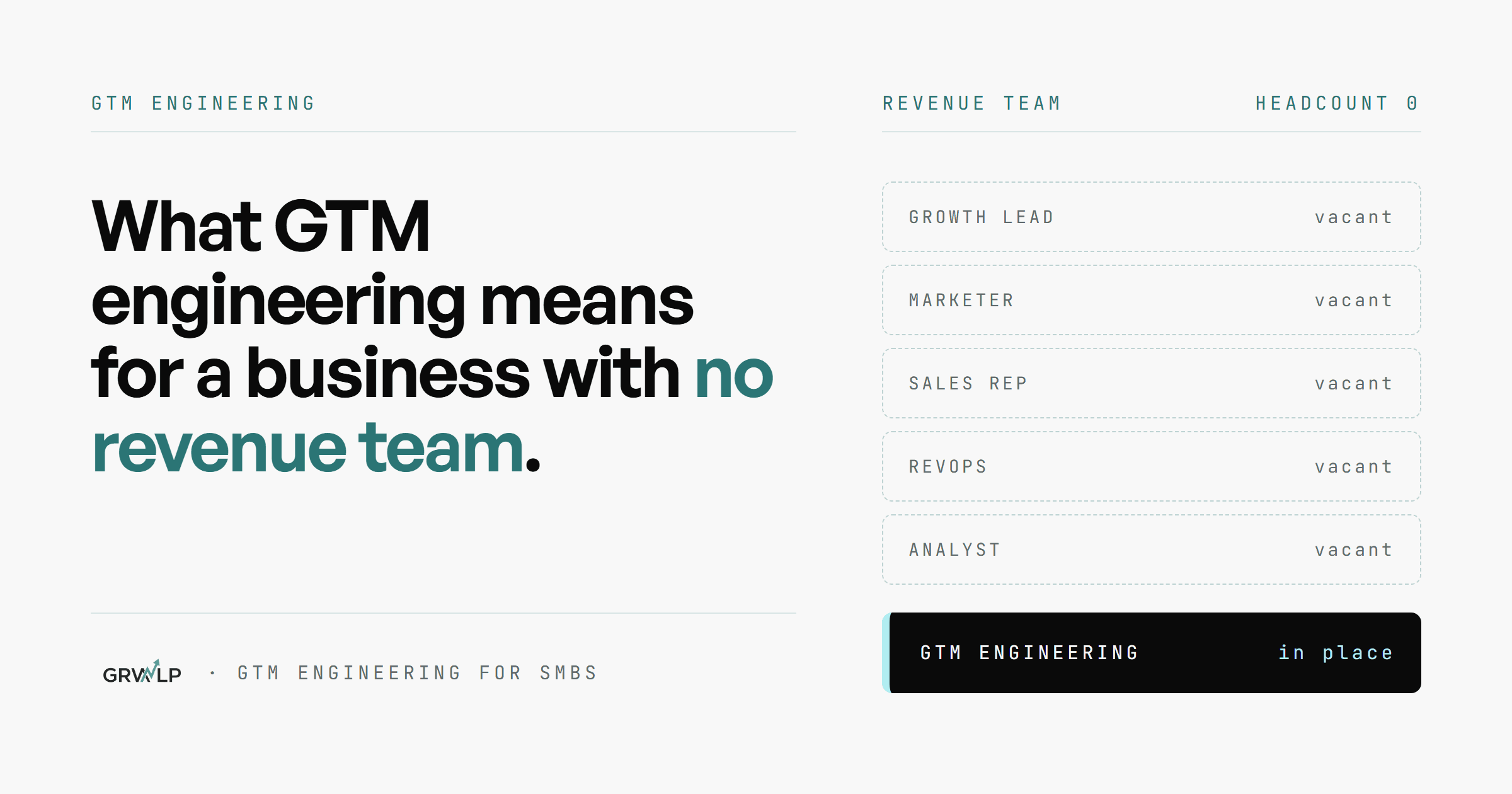
GTM engineering means one person building and owning the connections between the systems that bring you customers: your website, your ads, your inbox, your CRM and your follow-up. For a business with no revenue team, it is not a job title to hire. It is the work of closing the gaps where leads and hours currently disappear.
Most of what is written about GTM engineering is written for companies that already have a revenue team. It assumes SDRs, a CRM administrator, a pipeline review and an ARR number. If you are a founder doing $800K with a bookkeeper and a part-time VA, none of that describes you, and the advice does not transfer.
This piece is the version for you.
What is GTM engineering, in plain language?
GTM stands for go-to-market: everything that gets a stranger from not knowing you exist to paying you. GTM engineering is the practice of treating that path as a system to be built rather than a set of separate jobs to be hired.
In a large company, that means a technical person sitting between marketing and sales, automating the handoffs. In a business with no revenue team, the same job exists, but the handoffs are different. They run between:
- the form on your website and wherever enquiries actually land
- your inbox and whatever you use to remember who to chase
- the three or four places leads arrive from, none of which talk to each other
- the quote, the invoice and the thing that tells you it was paid
Nobody is assigned to those seams. So you do them. That is the job GTM engineering removes.
Is this just RevOps with a new name?
No, and the difference is the whole point.
RevOps is a function inside a company that has revenue operations to operate: multiple teams, a pipeline, a forecast. Its job is alignment. It coordinates people who already exist.
GTM engineering is a craft, not a department, and it is defined by building. The output is not a process everyone agrees to follow. The output is a system that runs whether anyone remembers it or not.
For a business your size the distinction is simple. RevOps assumes people to align. You do not have people to align. You have tools that do not talk, and one person holding them together, and that person is you.
That is why I use this term rather than calling it automation or operations. It names the thing precisely: engineering applied to the path a customer takes to reach you.
What does "no revenue team" actually look like?
It looks like being the integration layer yourself.
One business owner described it this way in a public forum thread: "I felt like I was the human bridge between my tools. If I didn't manually move the data, the business stopped moving."
That is not a rare complaint. Salesforce's Small and Medium Business Trends Report, a survey of 3,350 SMB leaders across 26 countries, found that the average SMB runs 7 different applications, that 53% say too many tools complicates their workflows, and that 44% have data inconsistencies across systems. In the same research, 76% increased their technology budgets year over year.
Read those two numbers together, because that is the whole problem. Spending went up. The complexity did not go down.
Where do the leads actually go?
Into the gaps between systems, mostly.
Harvard Business Review published a study in March 2011 by James Oldroyd, Kristina McElheran and David Elkington that examined 1.25 million leads across 42 companies. Contacting a lead within an hour made qualifying that lead roughly 7 times more likely. Separately, across 2,241 companies audited for response time, the average first response took 42 hours, and 23% never responded at all.
That study is from 2011 and we are citing it with its date attached, because it remains the only large, independent measurement of this that we could trace to a primary source. Plenty of newer-sounding statistics circulate on this topic. We checked the most-quoted one, followed its citation chain through four different sites, and found it terminates at a company with no published study behind it. We removed that statistic from our own website rather than keep using it.
Is my website part of this?
Yes, and this is the part the category consistently gets wrong.
The published stack diagrams for GTM engineering list data platforms, enrichment tools, sequencers and CRMs. They do not include the website. For a business with a revenue team, that omission is survivable, because a salesperson is the first human contact anyway.
For you, the website is the first contact. It is often the only one before someone decides whether to bother.
Research commissioned by Duda and run by Global Surveyz, surveying 300 SMB owners with 1 to 99 employees across the US and Europe, found that 88% see significant value in having their website integrated with their backend technology, and 98.7% consider their website an important revenue source. The demand is not in question. The wiring is.
What gets built first?
The boring things. Deliberately.
There is a line from a practitioner in a public discussion that is the best summary of this we have seen: "flashy automations are designed to be sold and boring automations are designed to be used."
A sensible first pass for a business with no revenue team, in order:
- Order: 1 · What gets built: Website form writes directly into your CRM · What it removes: Retyping, and the lead that never got typed
- Order: 2 · What gets built: Automatic acknowledgement and booking link on submission · What it removes: The hours between arrival and first contact
- Order: 3 · What gets built: One inbox for every channel leads arrive through · What it removes: Leads sitting unseen in a DM or a Messenger thread
- Order: 4 · What gets built: Alerts when something has not been followed up · What it removes: The lead you meant to chase on Friday
None of that demos well. All of it pays.
Survey work by Parseur with QuestionPro in July 2025, covering 500 US professionals, put the cost of the manual version at more than 9 hours a week on manual data transfer, which they valued at $28,500 per employee per year.
What this looked like on a real project
VIP Creative Studio is a fractional marketing agency serving credit unions and financial institutions in the United States. They sell marketing for a living.
When we started, their entire web presence was a single landing page on Wix. No service breakdown. No case studies. No blog.
No contact form.
A marketing agency, with no way for an interested visitor to raise their hand.
That is what this problem looks like from the inside. It is not incompetence. It is that nobody owned the seam, so the seam did not exist, and everything arrived through channels that lived in somebody's personal inbox.
We rebuilt it as 13 pages across 5 service verticals on Next.js and Sanity, with over 100 fields their team can edit without calling a developer. Six weeks of build.
The marketing side ran in parallel. I managed Google Ads for one of their clients, Securityplus Federal Credit Union, at more than $16,000 a month, with over 500 negative keywords refined across the account. In one two-month window that work produced more than 28,800 page views and 250 credit card application events.
Those two things are usually bought from two different companies who never speak. Doing them as one system is the only reason the second number exists, because the campaigns had somewhere to land.
The team closed a new client shortly after launch. The engagement is still running.
What it looks like when a person is the connection
Before we built anything, RideOn ran on WhatsApp.
A customer would text the founder. He would go and find a driver, which meant posting into a WhatsApp group and waiting to see who answered. Then he would introduce the two of them. If the customer wanted a car as well as a driver, there was another conversation to have, this time with the partner who owned the car. Three separate chats to move one booking, and he was the only thing joining them together.
He was doing this from Canada, for a business operating in Lagos.
That was never a technology problem. Every part of it worked. The messages sent, the drivers answered, the cars existed. What was missing was anything connecting them, so a person stood in the gap and became the connection. That is what being the integration layer actually looks like, and it does not feel like a systems failure while you are doing it. It feels like doing your job.
When we replaced it, we did not replace WhatsApp. We built four ways in, one each for the customer, the driver, the partner and the admin, so the founder stopped being the switchboard between them. Your version of this is smaller than four portals. It is usually one form and one inbox. The shape of the problem is identical.
When do you NOT need this?
Three honest cases.
You are pre-revenue. If you do not yet have customers and a validated offer, connecting systems is premature. The bottleneck is the offer, not the plumbing.
Your volume is genuinely low. If you get four enquiries a month and you answer all four within the hour, you do not have a seams problem. You have a demand problem, and automation will not fix it.
One channel dominates and it is working. If nearly everything comes from a single source and it converts, specialist help on that one channel will usually beat an integrated rebuild.
We would rather tell you that now than take the project and have you find out.
What does it cost, and how does this actually start?
It starts with a free 30 minute consultation. No pitch and no deck.
That call is the lightweight version of the audit. We go through what you have, name the places work is falling through, and name the automations that would close them. You leave with that list whether you hire us or not.
Then the automations get priced.
This matters more than the numbers below, so it is worth saying directly. Most of what gets sold in this space is a package built for somebody else, resized to fit you. We do the opposite. We start from the specific thing that is broken in your business, and we build for that.
If you already know what you need built, you do not need a package either. Name the specific request and it gets scoped and quoted as one fixed number before any work starts. One thing, one price, no retainer attached to it.
The call and the paid audit are not the same thing at two prices. They do different jobs.
The call is a conversation. Thirty minutes, we talk, you leave with a list in your head and a number for the obvious fixes.
The audit is an artifact. Twenty five to forty pages written down, a recorded walkthrough you can replay, a sixty minute session, and a thirty, sixty and ninety day roadmap. It is what you want when the problem is bigger than one workflow, when someone else in the business needs convincing, or when you want the findings on paper whether or not you ever hire us. The $500 comes back off any project you sign within sixty days.
- What: Consultation · Price: Free, 30 minutes · Use it when: You want to know if there is anything here at all
- What: A specific build you name · Price: Quoted per request, fixed before work starts · Use it when: You already know what needs building
- What: Growth Audit · Price: $500 flat, credited against a project · Use it when: You want the whole picture written down and portable
- What: Website builds · Price: $2,000 to $10,000 and up · Use it when: Scoped after the consultation
- What: Marketing retainers · Price: From $1,500 a month · Use it when: Ongoing, month to month, no lock-in
You get a number before work starts. Always.
Why is this happening now?
Because the roles are collapsing into one.
In April 2026, the venture firm a16z announced a Growth Engineer Fellowship on the explicit thesis that the roles of growth marketer, product manager and engineer are converging. That is being framed as a hiring trend for funded companies. For a business with no revenue team, it is something more useful: if one person can now do all three, then one person is who you need, rather than three vendors who do not talk to each other.
Sources and method
Every number in this piece traces to a named primary source. Where we could not trace one, we removed it rather than repeat it.
- Salesforce, Small and Medium Business Trends Report. Survey of 3,350 SMB
leaders across 26 countries. Source of the 7 applications, 53%, 44% and 76% figures.
- Harvard Business Review, March 2011. Oldroyd, McElheran and Elkington,
"The Short Life of Online Sales Leads." 1.25 million leads across 42 companies; 2,241 companies audited for response time. Source of the 7x, 42 hours and 23% figures. Cited with its 2011 date because that is how old it is.
- Duda, research run by Global Surveyz. 300 SMB owners, 1 to 99 employees,
US and Europe. Source of the 88% and 98.7% figures.
- Parseur with QuestionPro, July 2025. 500 US professionals. Source of the
9+ hours per week and $28,500 per employee per year figures.
- a16z Growth Engineer Fellowship announcement, April 2026. Source of the
role-convergence thesis.
On one statistic we removed. A widely quoted claim that "78% of customers buy from whoever responds first" appears across this industry. We traced its citation chain through four sites and found no primary study behind it. It was on our own website. We took it down. If you see it quoted at you, ask for the study.
Written by Oyekola Obajuwon, founder of Growveloper. Five years building websites, running paid media and automating operations for small and mid-sized businesses, including managing more than $16,000 a month in ad spend for a US marketing agency serving credit unions, and building a four-portal mobility platform from scratch.
Published: 2026-08-04. Next review: 2026-11-04.
Written by Oyekola Obajuwon
Last updated