How fast should a home services company reply to a new lead?
Reply within the hour and acknowledge within five minutes. The famous speed numbers were measured on sales teams, never on a trade.
TL;DR
Reply to a home services lead inside one hour during working hours, and acknowledge it automatically inside five minutes. There is no published benchmark measured on home services companies. Every number in circulation comes from business to business sales research, so treat one hour as the target and your own notification time as the number to fix.
Last updated 14 September 2026. Written by Oyekola Obajuwon, founder of Growveloper, who builds the website, the marketing and the follow up for owner run businesses in Nigeria, the United States and the United Kingdom.
Reply to a home services lead inside one hour during working hours, and acknowledge it automatically inside five minutes. There is no published benchmark measured on home services companies. Every number in circulation comes from business to business sales research, so treat one hour as the target and your own notification time as the number to fix.
That is the short answer. The rest of this page is where those numbers came from, which of them survive being checked, and what to do about the two hours you spend under somebody's sink with your phone out in the van.
What counts as a fast reply for a home services lead?
It depends on which of three things just arrived, and treating them as one thing is how good companies lose jobs they were going to win.
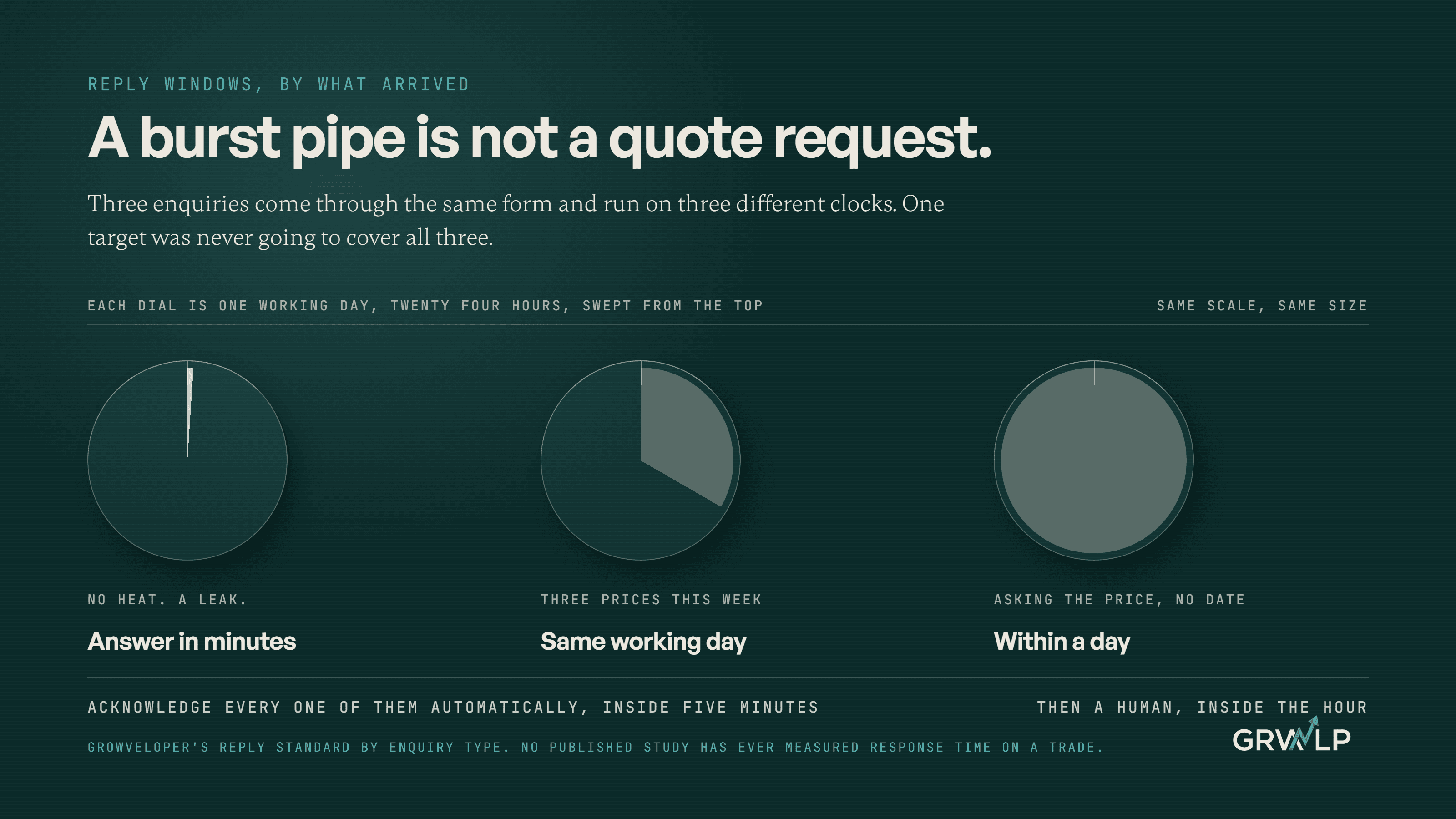
A burst pipe is not a quote request. Somebody asking what a bathroom costs is not somebody whose heating died in February. They arrive through the same form and they run on completely different clocks.
Three enquiries, three clocks
| What arrived | What that person is doing right now | Acknowledge within |
|---|---|---|
| Emergency, no heat, a leak, no powerMinutes, even if the answer is that you cannot come | Working down a list of numbers until somebody picks up | Instantly, or answer the phone |
| Quote for planned workThe same working day | Collecting two or three quotes this week | 5 minutes, automatically |
| Price question with no date attached24 hours, with a range and a question | Comparing, and may never buy at all | 5 minutes, automatically |
Most advice on this subject gives you one number and it is usually five minutes. One number is easy to sell and impossible to hit, so owners hear it, know they cannot do it, and go back to checking the inbox at lunchtime. Three numbers you can actually hit beat one number you will miss every day.
Why is the answer three numbers instead of one?
Because the cost of being slow is different in each case, and only one of the three is genuinely urgent.
On an emergency, being slow does not lose you a job that was otherwise yours. It loses you a job you never knew about. That person is not waiting. They are dialling the next number on the maps listing, and the winner is whoever picks up, which is the argument the emergency trades page makes at length: search intent at the moment a boiler dies is the shortest funnel in the business.
On a quote for planned work, speed does something narrower and still valuable. It keeps you in the set. The homeowner has decided to get three prices. Reply the same day and you are one of the three. Reply on Thursday and you are the fourth quote for a decision that was made on Wednesday.
On a price question, speed barely matters at all and the reply is what matters. Somebody asking what a job costs, with no date and no address, is at the start of thinking about it. A number and a question back does more than a fast nothing.
Where does the "reply within five minutes" rule come from?
It comes from research into outbound sales teams, and the version that can actually be traced to a primary document says one hour, not five minutes.
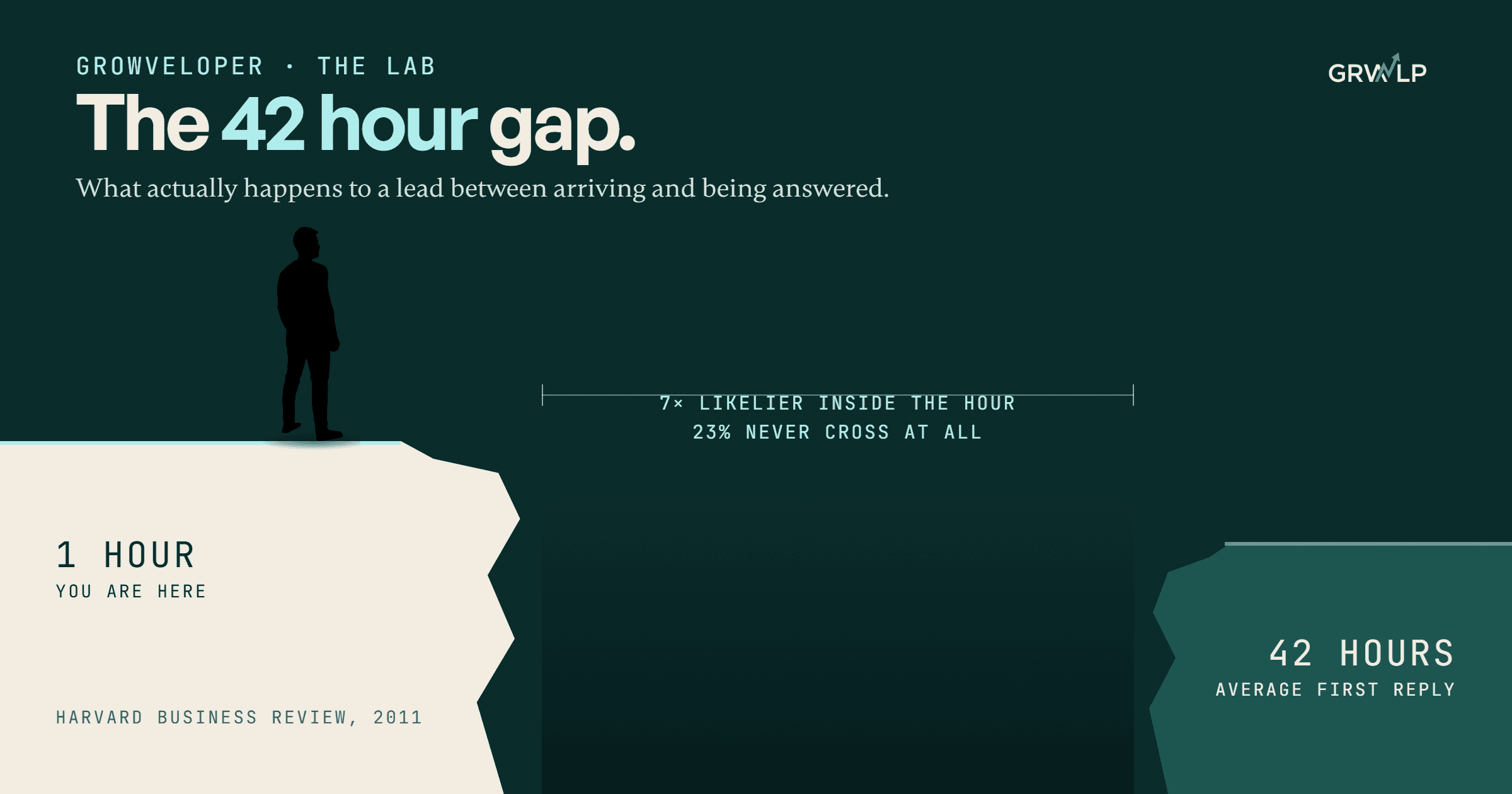
The document is The Short Life of Online Sales Leads, published in the Harvard Business Review in March 2011 by James Oldroyd, Kristina McElheran and David Elkington. It is a real study and it is worth reading rather than reading about. Two datasets sit inside it. The first is an audit of 2,241 United States companies, timing how long each took to answer a test lead sent through their own website. The second is 1.25 million leads across 42 companies, comparing what happened when firms made contact within the hour against later.
The hour is the number in the paper. Companies that tried to make contact inside the first hour were nearly seven times likelier to qualify the lead than those that tried an hour later, and more than sixty times likelier than those who waited a day.
Five minutes is not in that paper. It circulates in a dozen forms attached to a dozen different attributions, and when Growveloper ran a source audit on 31 July 2026 and tried to follow the five minute versions home, none of them landed on a study with a stated sample and a published method. That does not prove the number is wrong. It means nobody can show you where it came from, and a number you cannot follow home has no business inside a decision about how you run your week.
There is also something worth knowing about the study that does check out. One of its three authors was the chief executive of a company selling lead response software at the time, and the article says so in its own byline. The research is still real and still citable. The interest just deserves stating out loud, which is more than most of the pages quoting it manage.
Is it true that 78% of customers buy from whoever responds first?
No. That number has no traceable source, and it is repeated on more pages about this subject than any other figure in it.
Growveloper tried to follow it home properly. It is credited on the web to three different organisations, Lead Connect, InsideSales and the Harvard Business Review, and a real statistic does not have three different parents. The Harvard article does not contain it and never measured who anybody bought from. Lead Connect turns out to be a LinkedIn outreach tool with no research page, no report and no survey anywhere in its entire archived history. The earliest first hand appearance anybody could find sits on an InsideSales blog post from June 2016, where it is introduced with the words "industry data suggests", which is an author declining to name a source.
So it is folklore. Good folklore, in that it points at something true, and still folklore. The full chain, hop by hop, is written up in Growveloper's own source audit, and the reason it matters here is simple. If a company will quote you a number it cannot defend to win your business, ask what else it is telling you that it has not checked.
What did the lead response research actually measure?
Three datasets, none of which contains a single plumber, roofer or electrician.
Who the lead response benchmarks were actually measured on
| The study | Who was measured | What it found |
|---|---|---|
| Harvard Business Review audit, March 2011Whether anybody bought | 2,241 United States companies, web form leads | Average reply 42 hours, 23% never replied at all |
| Harvard Business Review qualification study, March 2011Revenue, close rate, or any trade | 1.25 million leads across 29 consumer and 13 business to business companies | Contact within the hour, about 7 times likelier to qualify the lead than an hour later |
| XANT survey, February to March 2016Anything outside media | More than 50 United Kingdom media companies | 62% replied at all, 11 hours by phone and 36 hours by email, 1.8 attempts each |
| A home services companyEverything | Nobody has published one | Nothing |
Read the last row again, because it is the honest headline of this page. Nobody has ever published a response time study measured on plumbers. The benchmarks you are being shown were measured on sales teams with dialers, sitting at desks, whose entire job was answering leads.
Why does none of this describe a company like yours?
Four differences, and every one of them moves the answer.
The person who has to reply is holding a tool
A sales rep is at a desk with a screen open. You are on a roof, or under a sink, or driving between the two with a phone in a cradle. This is not a discipline gap and no amount of being told to reply in five minutes closes it. It is a physical constraint, and the only thing that respects it is separating the acknowledgement from the reply.
Your enquiries do not arrive through one door
The studies measured web forms. Your work arrives by phone call, missed call, web form, WhatsApp, a maps listing, Facebook, and a neighbour who gave somebody your number. Each door has its own notification behaviour and most of them are silent, which is the whole subject of the 42 hour gap.
Your buyer is comparing exactly three of you
Business to business buyers research for weeks. A homeowner with a job to do usually contacts two or three companies in one sitting and picks from whoever comes back. That makes reply order, not reply speed, the thing that decides it, and reply order is a race you can actually win. It is also why the local services page treats the quote form and the follow up as one purchase rather than two.
Sometimes the job is on fire
No study in this literature has an emergency category. For a trade, urgency is not a spectrum, it is a switch, and a business that handles both planned and emergency work is really running two response systems that happen to share a phone number.
What do I do when I am up a ladder and cannot answer?
You separate two jobs that most owners have welded together. Acknowledging is a machine's job. Replying is yours.
The acknowledgement goes out in seconds, automatically, and it does one thing: it stops the person shopping while you climb down. It should confirm what they asked about, say when a human will come back, and give them something to do in the meantime. The reply comes from you, later, and it is where the actual job gets won.
The wiring for that is an afternoon of work with tools you probably already pay for. It is the first automation any trade business should build, before anything clever, and the full build order is in the lead follow up guide. A form or a missed call triggers a notification to a phone, Zapier or something like it carries the message, WhatsApp or SMS delivers it, and a booking link lets them pick a slot without waiting for you.
One rule saves this from being spam. Never send more than one automatic message before a human has said something. The line between an acknowledgement and a sequence nobody asked for is exactly one message wide.
What does this look like on a business that already tried it?
RideOn Nigeria is not a trade, and saying so first is the point of using it.
It is a premium chauffeur and car rental service in Lagos, and when the work started its bookings arrived over WhatsApp, its drivers signed up through a basic form on a static site, and the partners who supplied the vehicles had no portal at all. Admin lived in spreadsheets and chat threads. The owner was running the whole operation from Canada, which meant every request had to survive a time zone before anybody saw it.
The tempting move was to build an app and make everybody move to it. That is a development project, and it usually ends with a channel nobody uses while the WhatsApp thread carries on regardless. The decision that worked was the other one: keep the door people were already walking through, and build the dispatch behind it so a request arriving became an event rather than a message sitting in a list. Four user types, four portals, mapped end to end before any code. The full account is in the RideOn case study.
What transfers to a trade is not the portals. It is the order of operations. A booking service with a customer waiting and an owner on another continent has the same core problem as a plumber on a roof, which is that the business cannot rely on a human noticing. What does not transfer is the scale of the build. Most home services businesses need the notification and the acknowledgement, which is days of work, and nothing like four portals. Buying the big version first is the most common way this project stalls, which is why the automation service page prices single workflows separately from platforms.
Should I reply at night and at weekends?
Only if you are genuinely willing to work then, and the honest answer for most trades is no.
An enquiry that arrives at eleven at night for a repaint does not need a human at eleven at night. It needs a message that says you have it and that somebody will call in the morning, and it needs that message to be true. A promise you keep on a bad week beats a fast reply you cannot repeat.
Emergency work is different, and it is a business model decision rather than a response time decision. Either you answer the phone at three in the morning, charge for it, and say so on your site, or you do not, and your automatic reply names the hours plainly so nobody sits waiting on you. Pretending to be available and then not being available is worse than either.
Set your hours, publish them, and hold them. Being predictable is worth more than being fast, and it is the only version of this a one van business can keep up for a year.
What should the first message actually say?
Short, specific, and impossible to mistake for a mass mailout.
Hi James, thanks for getting in touch about the boiler service at the Camden flat. I have your message and I will call you back myself before six this evening. If it is urgent and the heating is off completely, ring 020 rather than waiting for me. If it can wait, you can pick a time that suits you here, and a photo of the boiler and its model number will let me give you a real price rather than a guess.
Read that out loud. It names the job, it commits to a time you can keep, it tells an emergency what to do instead of waiting, it offers a booking link, and it asks for the one thing that makes the real quote faster. Nothing in it pretends a human typed it and nothing in it pretends a human did not.
The photo request does more work than it looks like it does. Half the delay in quoting trade work is not laziness, it is not having enough information to price the job, so the acknowledgement that collects the missing piece turns your slow quote into a fast one.
Does replying faster actually win more jobs?
Sometimes, and it is worth being precise about what speed can and cannot do, because the software industry is not.
What the research measured was qualification, meaning a conversation happened with somebody able to decide. It did not measure sales. So the defensible claim is narrow: replying sooner gets you a conversation more often. That is worth a lot, and it is not the same as winning.
Speed keeps you in the comparison. It cannot fix a price that is wrong for the work, a quote nobody can read, an empty reviews page, or a van that turns up on the wrong day. If you are first to reply and still losing, the problem moved downstream and more speed will not find it. That is the point at which a paid diagnostic is cheaper than another month of guessing, and if you are not sure whether you need one, the call that works out which costs nothing.
And there is a version of fast that actively costs you work. A quote produced in four minutes, for a job nobody looked at properly, is how trades end up doing work at a loss. Fast acknowledgement, careful quote. Never the other way round.
How do I find out my own response time this week?
Ask somebody to hire you, and two of your competitors, on the same afternoon.
That is the whole test. A friend or a relative who is not in your phone requests a quote from your business and from two firms you know you compete with, on a normal working Tuesday, through whichever door your customers actually use. Then they write down one thing: the order the replies arrived in.
Not the wording. Not how polished anybody's email was. The order. That is the only ranking your customers ever see, and it is the one number in this entire subject that was measured on your business rather than on somebody's sales team.
Then wire the acknowledgement, and run it again a fortnight later with different competitors. Most owners find they were second or third, and almost none of them were being lazy. They were up a ladder, exactly where they should have been, with nobody minding the door.
“Nobody has ever published a response time study measured on plumbers. The numbers you are being shown were measured on sales teams with dialers.”
Written by Oyekola Obajuwon