Take you out and nothing connects: what a small business gets back when the software finally talks to itself
The cost of disconnected software is not the subscriptions. It is that a person becomes the connection, and a business whose connection is a person cannot let that person go anywhere.
TL;DR
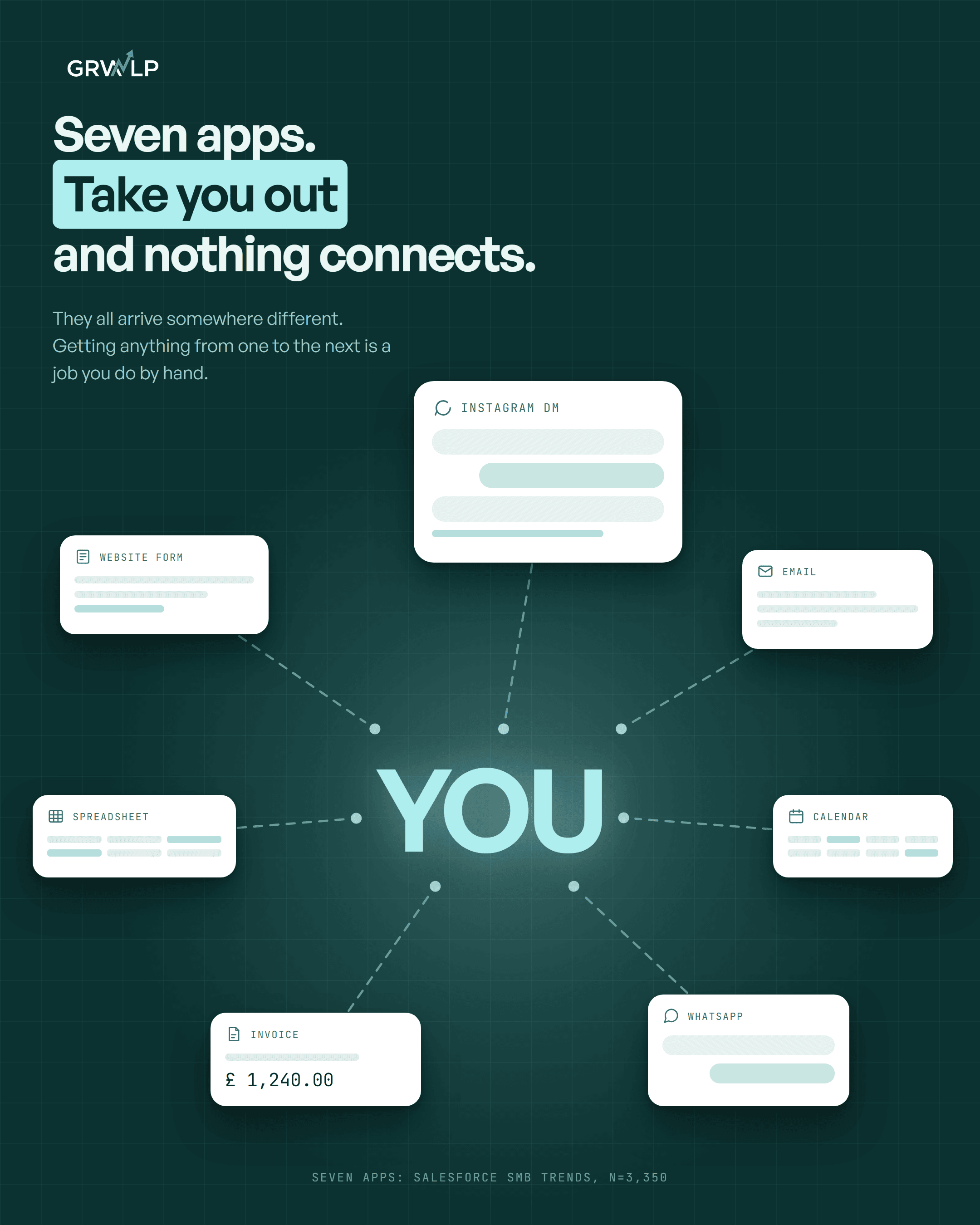
The average small business runs seven different applications to get through the day. The expensive part is not the seven subscriptions. It is that somebody has to carry information between them by hand, and in a small business that somebody is usually the owner. What you get back when the software finally connects is not saved minutes. It is the ability to be absent.
The average small business runs seven different applications to get through the day. The expensive part is not the seven subscriptions. It is that somebody has to carry information between them by hand, and in a small business that somebody is usually the owner. What you get back when the software finally connects is not saved minutes. It is the ability to be absent.
How many different applications does a small business actually run?
Seven. The figure comes from Salesforce's Small and Medium Business Trends report, sixth edition, a survey of 3,350 business leaders across 26 countries.
Three more numbers from the same survey matter more than the seven:
- 53% say too many tools complicates their workflows.
- 44% report data inconsistencies across their systems.
- 76% increased their technology budget year over year.
Read them in that order and the shape of the problem appears. More than half say the tools are making the work harder. More than four in ten say their own systems disagree with each other about basic facts. And three quarters spent more money anyway.
Nobody bought seven applications by accident. Each one was bought on a good Tuesday to solve a real problem, and each one did. The trouble is that seven solved problems do not add up to a working business. They add up to seven islands and a boatman.
One caveat on the source, because it matters. Salesforce sells software to small businesses, so this is vendor research and should be read as vendor research. It is here because the sample is large, global and disclosed, which is more than can be said for most numbers in this territory.
Why does buying more software make the work harder?
Because every tool solves its own job perfectly and none of them owns the space between jobs.
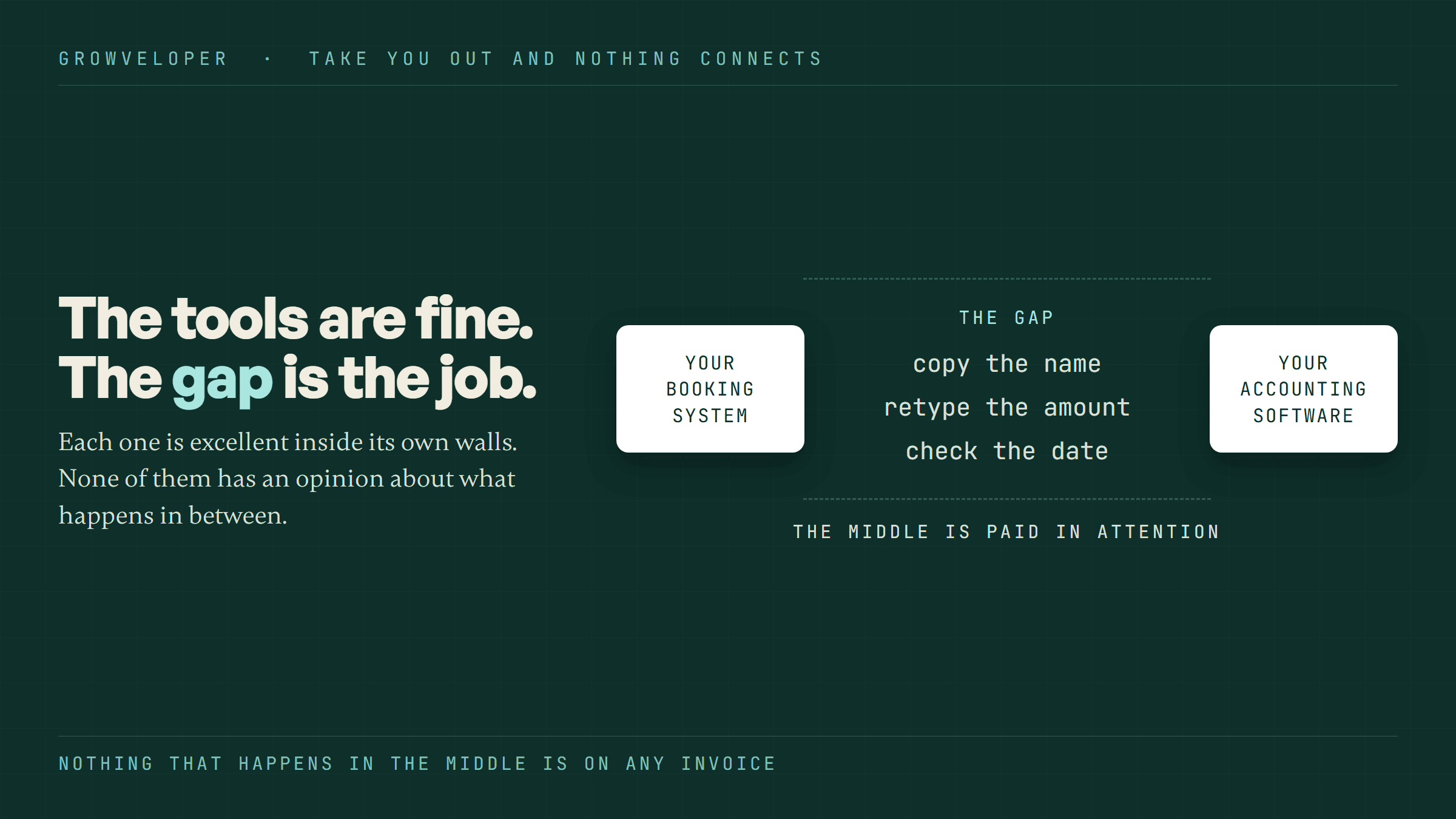
Your booking system knows about bookings. Your accounting software knows about invoices. Your inbox knows about emails. Each is excellent inside its own walls. None of them has an opinion about what should happen when a booking becomes an invoice, so a human forms that opinion, by hand, every single time.
That space between the tools is where the work actually lives, and it never appears on a bank statement. You can tell me to the penny what your seven tools cost. You cannot tell me what the gaps between them cost, because the gaps are paid for in somebody's attention, and attention does not send you an invoice at the end of the month.
What does it mean to be the integration layer?
It means you are the part of the system that carries information from one place to another, and there is no version of the business where you stop.
The best description of it I have read was written by somebody on Reddit describing a colleague, with nothing to sell:
"that's not a reporting problem, it's a context assembly problem. someone's brain is acting as the integration layer between those systems, and that cost is invisible until that person is out sick or leaves."
Someone else in the same research put it shorter. "I felt like I was the human bridge between my tools. If I didn't manually move the data, the business stopped moving."
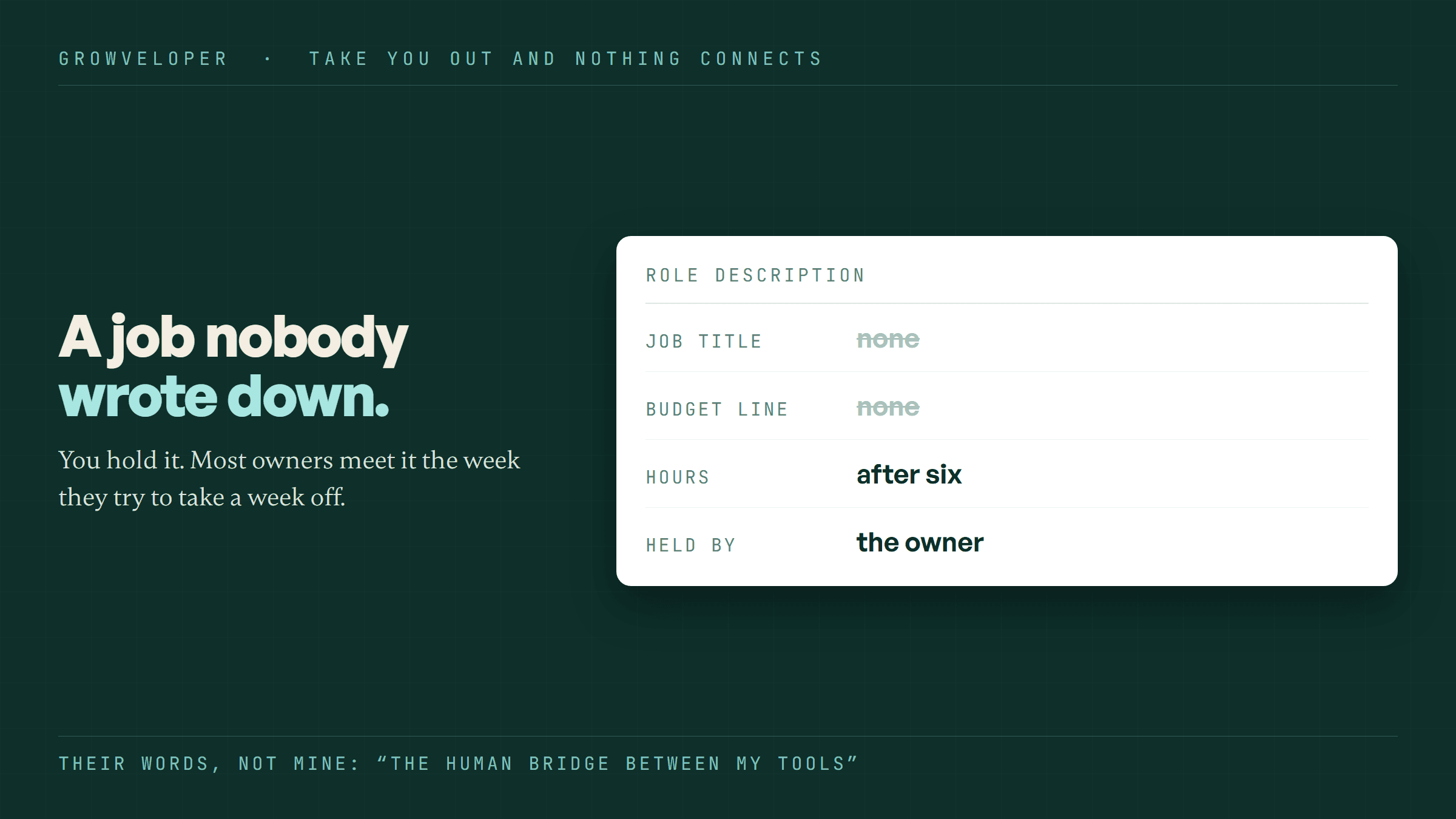
Both are describing a real job. Nobody was hired into it. It has no title, no line in the budget and no handover document. Most owners only discover they hold it the week they try to take off, when things quietly stop and nobody can say exactly why.
What does this look like in a real business?
VIP Creative Studio is a marketing agency. They serve credit unions and financial institutions in the United States, which is to say their entire job is generating enquiries for other people.
Their own website was one page.
Not one page and a few others. One. A Wix landing page. No service pages, no case studies, no blog, and no contact form.
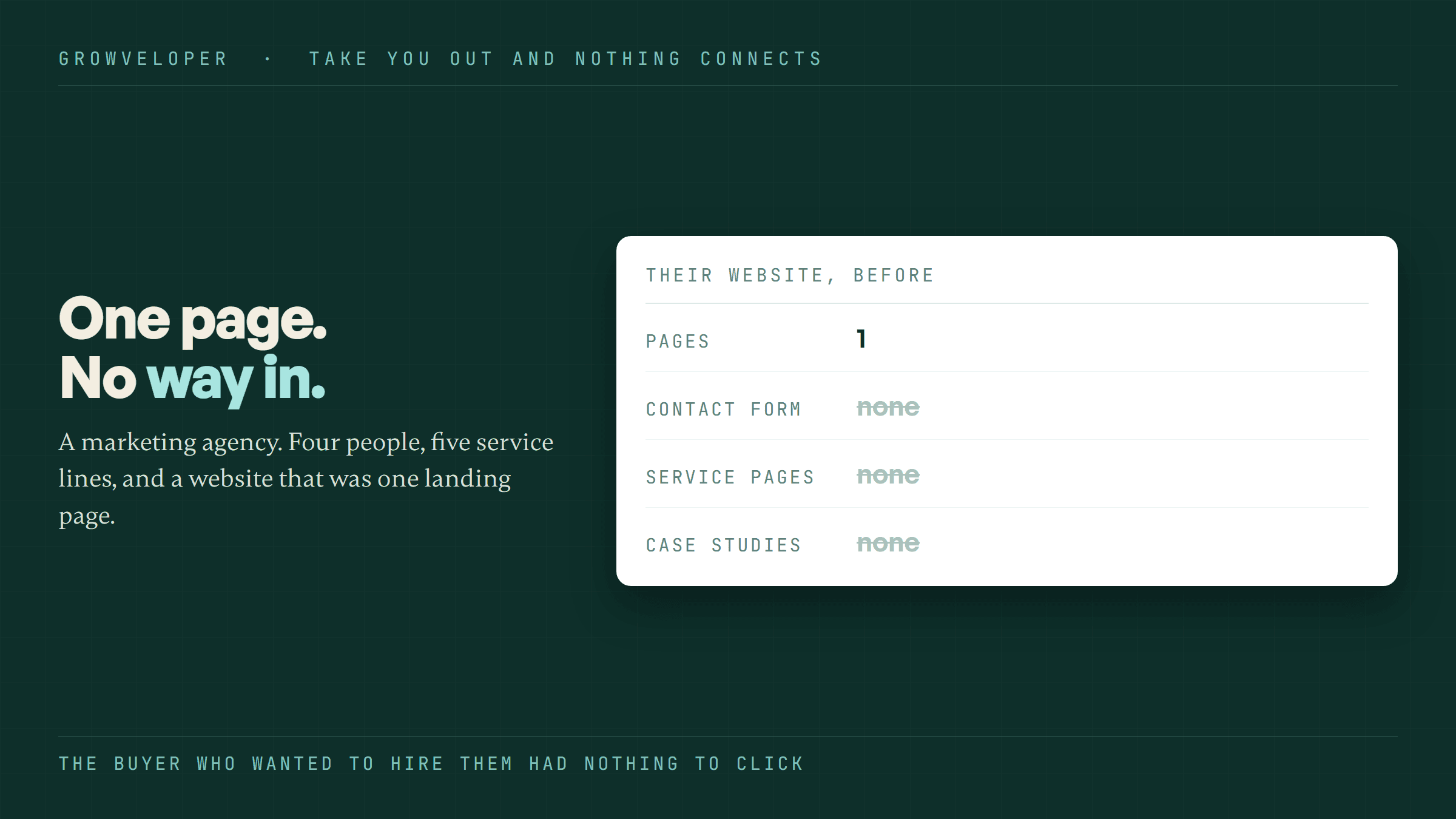
Sit with the last one, because it is the whole argument standing in a doorway. A buyer could read that page, decide these were the people, and then have nothing to click. The only route in was to find an email address somewhere and hope it reached whoever should see it. An agency that sells lead generation had no way of receiving a lead.
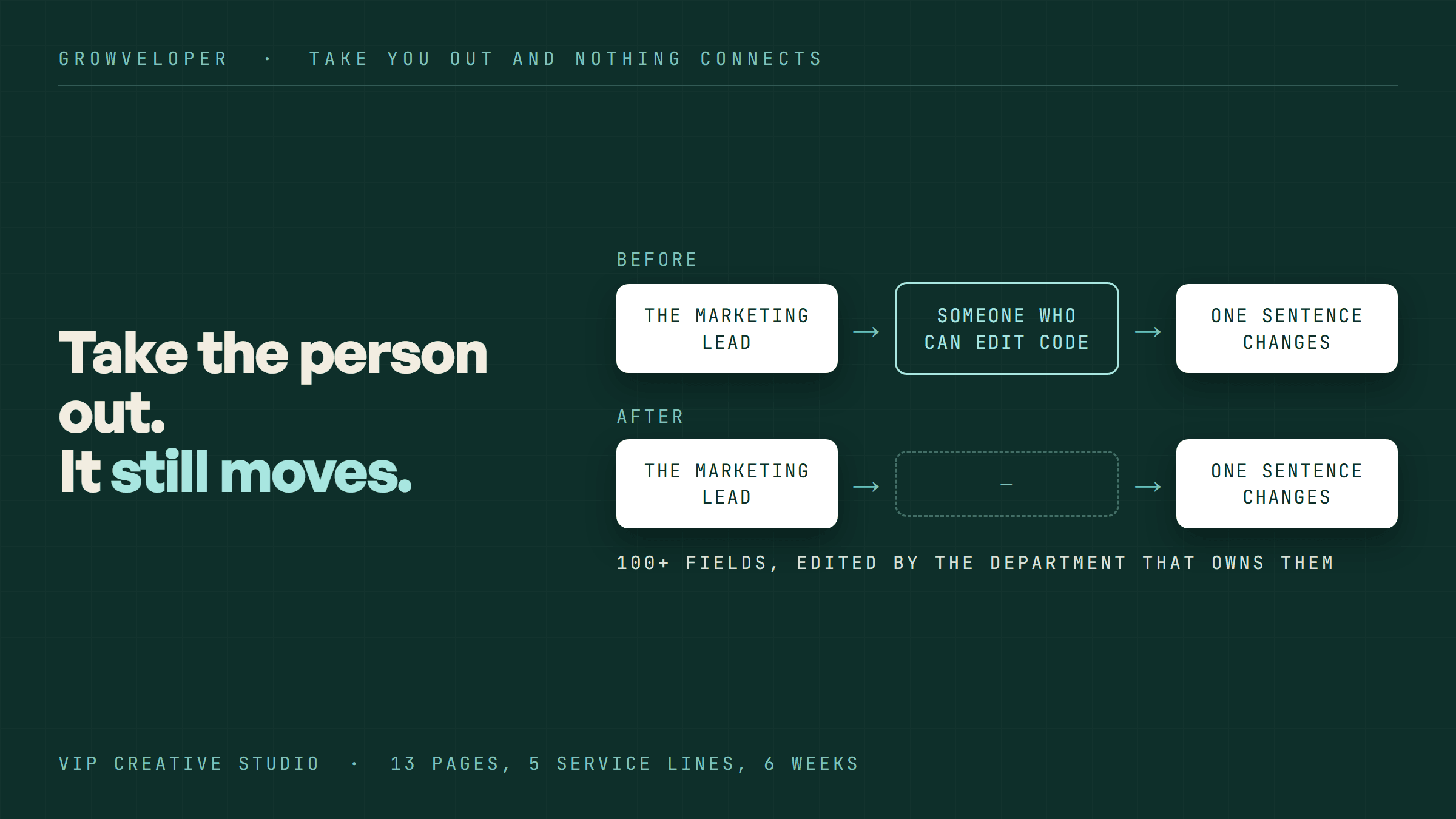
Behind the page was the same problem wearing a different hat. Four people run that business between them, one on marketing, one on projects, one on design, and the owner. Five separate service lines. Not one of those people could add a page, change a headline, or fix a sentence without going through somebody who could edit code.
So it was not really a website. It was a request queue with a picture on it.
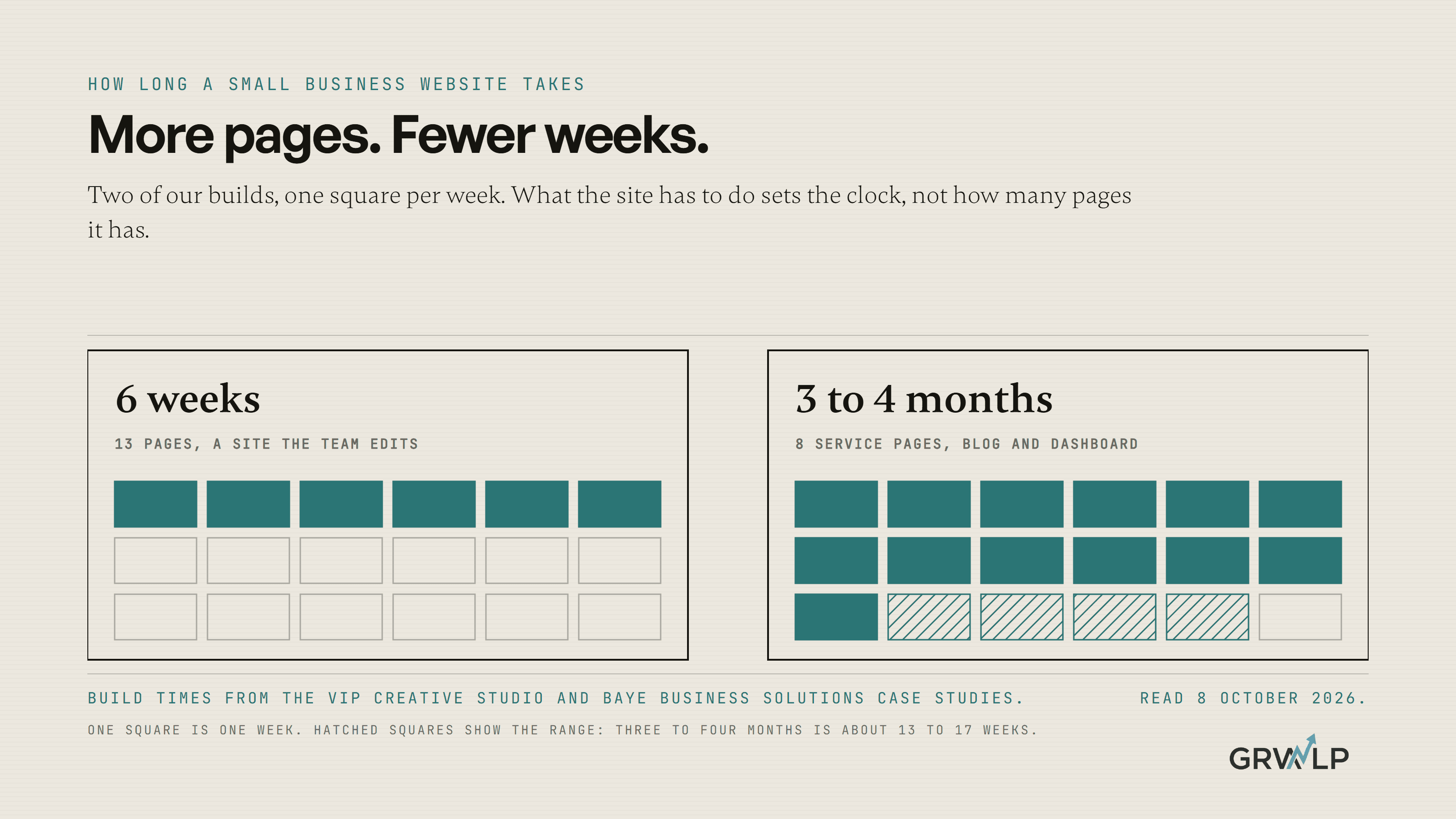
We rebuilt it over six weeks. Thirteen pages across the five service lines, Next.js with Sanity behind it, and more than a hundred fields that anyone on the team can edit without touching anything technical. The service cards were built as small interactive pieces rather than the stock photography every other firm in financial marketing uses. It shipped with a written guide for people who are not developers, because a system nobody can operate is not a system.
The part that carries this argument is the smallest part of all of that. Their marketing lead can change a headline now. She does not ask me. There is no ticket, no queue, and no me.
Here is what the owner said about it, and it is on the record rather than paraphrased by me:
"The website went from a single landing page to a full platform we control entirely. Every headline, testimonial, and service description is editable from the CMS without touching code." Victor Provencio, CEO, VIP Creative Studio
The word doing the work in that sentence is "we".
And the front door works, which mattered faster than any of the rest of it. The team closed a new client shortly after launch.
What do you actually get back?
Here is where almost every article on this subject stops. Fifteen published pieces on connected systems for small businesses were read while researching this one, and not one has a section describing what the owner has afterwards. They all end at the build, which is the part that interests the builder and nobody else.
Four things come back.
Your evenings, but that is the smallest one. The hours are real and they are the reason people start looking. They are also the least interesting thing on this list, and if hours were all you got I would tell you to hire a part-timer instead and save yourself the project.
Numbers that agree with each other. That 44% reporting data inconsistencies is not an abstraction. It is the moment your invoice total and your booking total are different and you have to decide, on the spot, which of your own systems is lying to you. When one system writes to the others, that argument stops happening, and you can make decisions on Tuesday instead of auditing yourself until Thursday.
Speed that does not need you awake. A buyer who wants to hire you at eleven at night can hire you at eleven at night. That is the other half of the 42 hour gap: an enquiry nobody sees is the same as an enquiry that never arrived. Nobody has to be watching. The difference between an enquiry that lands somewhere and an enquiry that lands nowhere is not a feature, it is whether the enquiry exists at all.
Growth that does not need a new hire. The reason the manual version breaks is that it scales linearly. Twice the enquiries is twice the typing. Once the handoff is built, twice the enquiries is the same amount of typing, which is none. That is the difference between a business that gets harder as it grows and one that gets easier.
Do you have to replace your tools to fix this?
No, and replacing them is usually the expensive wrong answer.
The instinct when seven tools are fighting is to buy the eighth one that promises to replace all seven, or to hire a third agency to sit on top of the other two, which is its own expensive mistake. It rarely works, because the seven were each chosen by somebody who understood one job well, and the all-in-one understands seven jobs adequately. You trade a connection problem for a capability problem and you pay for a migration to do it.
The cheaper move is to leave the tools where they are and build the handoffs between them. Your booking system stays. Your accounting software stays. What changes is that one of them tells the other, and no person is standing in between with a keyboard.
Is this the same as automation, or is it just Zapier?
Sometimes it is genuinely just Zapier, and when it is, use Zapier.
Copying a record from one tool to another when something happens is a solved problem and no-code tools solve it well. What VIP needed was different in kind. The words on that site had to be editable by four non-technical people, in five service lines, without any of them being able to break the page. That is not a connection between two tools. That is a system with permissions and structure, and it has to be built.
The honest way to tell them apart is to ask whether the step needs judgement. Moving information needs none, so wire it. Making a decision needs judgement, so it either needs rules good enough to write down, or it needs to stay with a person on purpose.
Be careful with the middle ground, because it arrives with a bill. The research behind this month turned up several owners describing the same landing place: a stack of connected no-code tools costing hundreds a month that still broke, and still needed somebody watching it. That deserves its own piece, and it is the one I am writing next.
How do you find where you are the integration layer in your own business?
Give it one week and a notepad. This costs nothing and you do not need me for it.
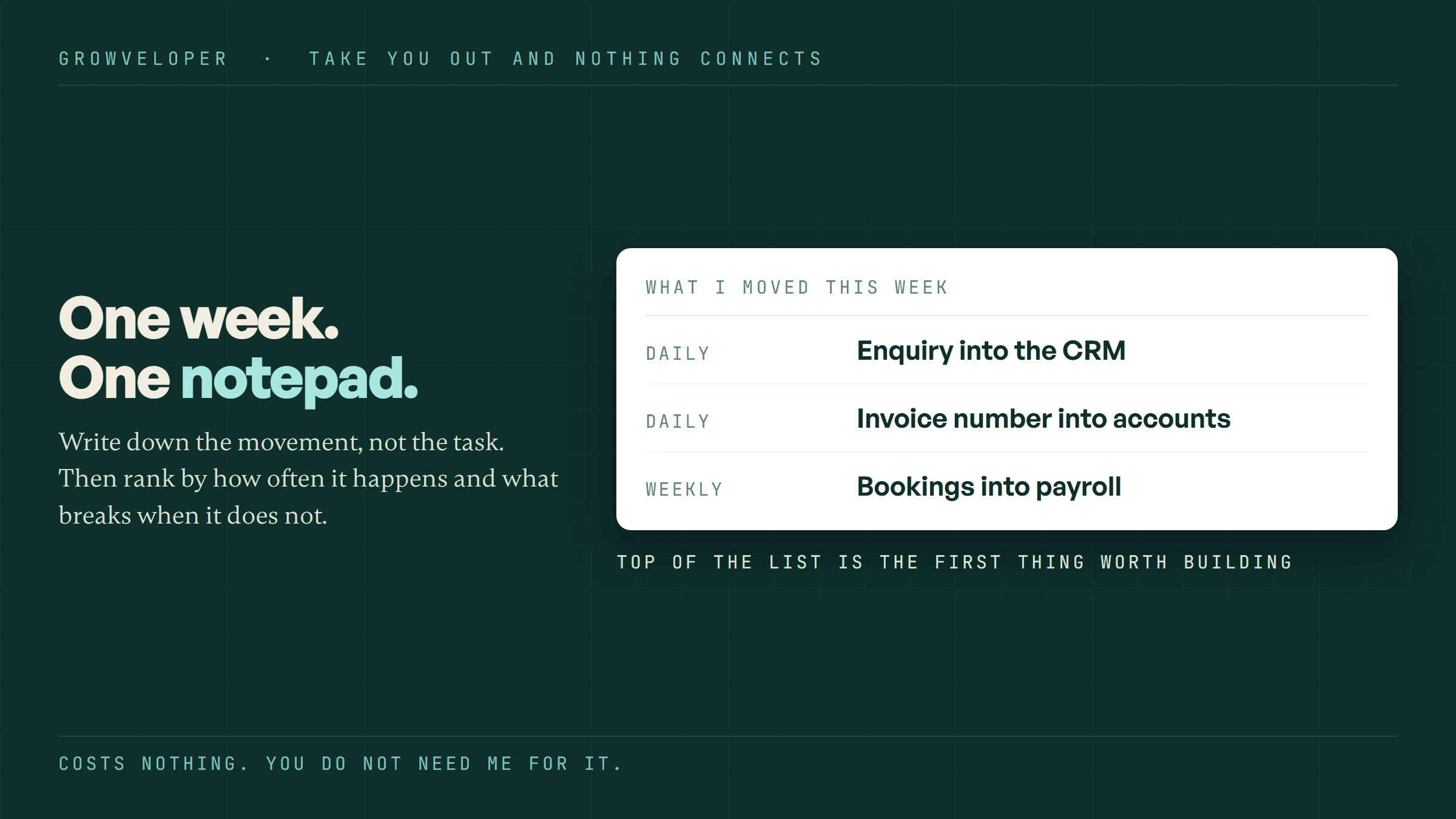
Every time you move a piece of information from one place to another, write down what you moved, where it came from and where it went. Not the task, the movement. "Copied Thursday's bookings into the payroll sheet." "Retyped the invoice number into the accounting software." "Sent the new headline to the person who can put it on the site." "Rebuilt the same status report from four places, again."
At the end of the week you will have a list. That list is your real job description, the one nobody ever wrote down, and in most small businesses it runs somewhere between four and twelve lines.
Now rank it, and not by how much you hate each line. Rank by how often it happens and by what breaks when it does not. The line at the top is the first thing worth building. In my experience it is almost never the impressive one, and the impressive one is almost never worth building first.
When is this the wrong thing to fix?
Three times, and I would rather say so here than in a proposal.
When the volume is not there yet. Building a connection to carry six enquiries a week is care spent on the wrong constraint. Go and get the seventh enquiry. The typing is not what is holding you back.
When the process is still changing. Automating a workflow makes it permanent, so if you are still arguing internally about how the thing should work, you are about to set the argument in concrete. Settle the process on paper first. It is far cheaper to change your mind in a document.
When the person is the point. Some handoffs are exactly where your business is good. If the reason customers stay is that you personally call them back, do not put a system in that gap. Put the system either side of it and protect the middle.
Sources and method
The survey figures. The seven applications, the 53% workflow complication, the 44% data inconsistency and the 76% technology budget increase all come from one source: Salesforce's Small and Medium Business Trends report, sixth edition, sample of 3,350 SMB leaders across 26 countries. It is vendor-commissioned research published by a company that sells business software, which is stated in the piece rather than buried down here. The sample size and geography are disclosed by the publisher, which is why it was used over several rounder figures in this territory that disclose neither.
The community language. The two quotations about being the human bridge and about a brain acting as an integration layer are taken verbatim from public discussion threads written by small business owners, gathered in a research sweep for this month's writing. They are quoted as description, not as data, and no count or percentage is drawn from them.
The client work. VIP Creative Studio is a real Growveloper engagement, published as a case study on this site with the client's agreement. The counts given here, one page before, thirteen pages after, five service lines, over a hundred editable fields, six weeks, come from the project record. Victor Provencio's quotation is his own, given as a testimonial and published with his name on it.
What was not measured. No before-and-after timing study was run. There is no "hours saved per week" figure in this piece because nobody measured one, and inventing a plausible number would undo the point of the rest of the page. "The team closed a new client shortly after launch" is what the record says and it is not presented as attribution: a new client after a launch is a sequence, not a proof, and anyone telling you otherwise is selling you something.
What Growveloper has and has not verified. The Salesforce figures were read through a published summary of the report rather than the report PDF itself, and are flagged internally for confirmation against the primary document. Nothing else here rests on them. Remove all four numbers and the argument still stands on the client work.
The line that decides it
Take yourself out of the business for a week. Not on your phone, not checking in at night. Out.
Now name every place where information stops moving.
If the honest answer is "most of them", you are the integration layer, and every tool you have bought so far has quietly made that job bigger rather than smaller. That is worth knowing, because it is fixable, and because of what sits on the other side of fixing it.
Once you can remove yourself, you stop being self-employed and start being an entrepreneur.
Written by Oyekola Obajuwon
Last updated