How long does a small business website take to build?
How long a small business website takes to build, from three real builds, plus the outside waits for domains, Google and payments no quote includes.
TL;DR
A small business website built for you usually takes six to ten weeks, and page count barely moves that. What the site has to do moves it. Our three builds took six weeks, three to four months, and four months. Then add the outside waits no quote includes: domain, Google verification and payment approval.
Last updated 8 October 2026. Written by Oyekola Obajuwon, founder of Growveloper, a growth studio in Lagos that builds the website, the marketing and the follow up for owner run businesses in Nigeria, the United States and the United Kingdom.
A small business website built for you usually takes six to ten weeks, and page count barely moves that. What the site has to do moves it. Our three builds took six weeks, three to four months, and four months. Then add the outside waits no quote includes: domain, Google verification and payment approval.
Most pages on this question give you a range and stop. Elementor's guide, updated in June 2026, says four to eight weeks for a professional small business site. A New York agency, iDesign, says ten to sixteen weeks for ten to twenty pages. Both are honest. Neither tells you which end you will land on, or what happens after the developer says "done".
How long does a small business website take to build?
Six to ten weeks for a typical rebuild of a business site with a handful of pages, a contact or quote form, and a way for you to edit it yourself. A template you fill in on your own can be up in a week or two. A site that takes bookings, payments or logins takes months.
Our own development page breaks the work into three stages: one to two weeks of discovery, four to eight weeks of building and review, and one week of testing and launch. Add those up honestly and you get six to eleven weeks, not the six to ten we quote elsewhere. The extra week is the testing stage landing on top of a long build. We would rather print the arithmetic than round it away.
Why did our three builds take six weeks, four months and four months?
Because each site had a different job, and the job set the clock. Here is what each one was.
Three Growveloper builds, page count against build time
| Build | What it had to do | Build time |
|---|---|---|
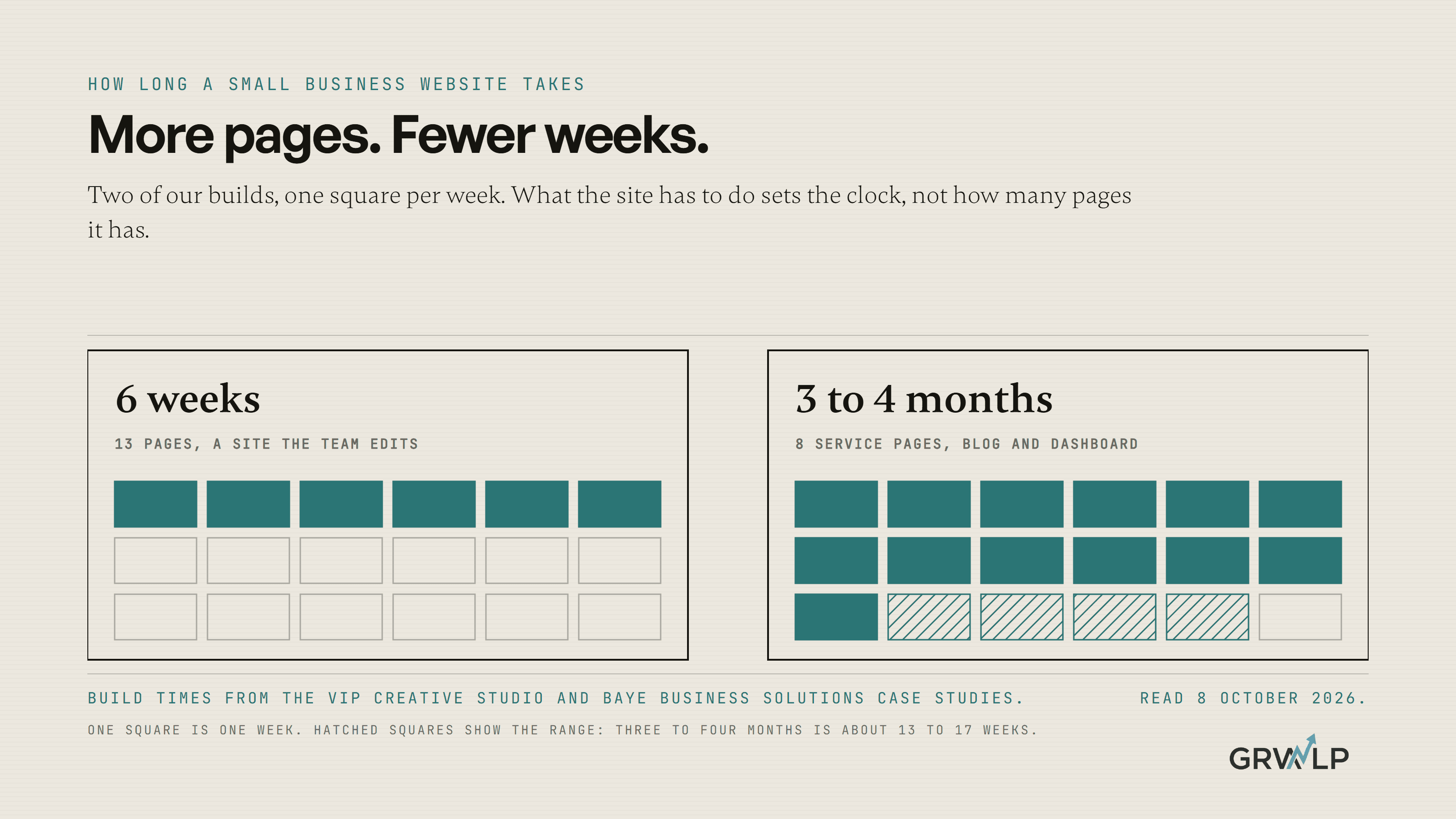
| VIP Creative Studio | 13 pages, a site the team edits itself | 6 weeks |
| Baye Business Solutions | 8+ service pages, a blog and an admin dashboard | 3 to 4 months |
| RideOn Nigeria | 4 portals for customers, drivers, partners and admin | 4 months |
Thirteen pages took six weeks. Eight service pages took three to four months. The count of pages was never the clock.
VIP Creative Studio had a single Wix landing page and needed a real site to win clients. Thirteen pages sounds like a lot, but pages that show and explain are quick once the words exist. The six weeks went on structure, more than a hundred fields the team could edit, and a guide so people who are not technical could run it.
Baye Business Solutions, a Lagos cloud services company, needed fewer public pages but a lot more underneath: a blog the team publishes to, a dashboard to manage it, and analytics from zero. The plan was a PostgreSQL database. It was built on MongoDB Atlas instead, because PostgreSQL was, in the case study's words, "too complex for the timeline." That is what deadline pressure looks like from the inside: a decision changes so the date holds.
RideOn Nigeria was not a website in the usual sense. Bookings had lived in WhatsApp threads and spreadsheets, and the build replaced them with four portals, each with its own logins and rules. Four months for that was quick.
So when you ask a developer how long, describe what the site has to do, not how many pages it has.
Where do the weeks go?
Less than half of them go on building. The first one or two are decisions: what you sell, to whom, what each page must get a visitor to do. Then design and structure. Then the build itself, with the forms and the editing system. The last stretch is loading content, testing on real phones, setting up redirects if you are moving from an old site, and checking the analytics fire.
The words are the slow part almost everywhere. iDesign calls content "the most common bottleneck in website projects", and that matches what we see. A developer can build a services page in an afternoon. Nobody can build it until someone has written what the service is.
What waits sit outside the build?
This is the part no quote includes, and it is why the developer's last day is not your launch day. We call it the outside clock: the waits set by registries, Google and payment providers, which start only when you apply and do not care when your developer finishes.
The outside clock, wait by wait
| Wait | How long | Who sets it |
|---|---|---|
| Moving a domain to a new registrar | Can be refused in the first 60 days after registration | ICANN transfer policy |
| Google Business Profile review | Up to 5 business days; postcard codes mostly within 14 days | |
| Google finding a new page | A few days to a few weeks | |
| Payment gateway approval in Nigeria | No fixed time published | Flutterwave and Paystack |
Domains
If your domain was registered recently, the ICANN transfer policy lets the current registrar refuse to move it to another one within 60 days of its creation date, and within 60 days of a previous transfer. That is for domains like .com. If the plan involves moving a new domain, find out on day one, not launch week.
Your Google listing
Google's own help page on verifying a Business Profile says "verification reviews take up to 5 business days", and if you are verifying by post, "Most codes arrive within 14 days." For a local business, that listing is often worth more than the website on day one. Apply for it while the site is being built.
Being found on Google
A live site is not a found site. Google's page on asking it to recrawl says "Crawling can take anywhere from a few days to a few weeks." So a site that goes live the morning of your event may not show up for the people searching that week.
Taking payments in Nigeria
Here is the one that catches owners out. Flutterwave's onboarding requirements for Nigeria ask a limited liability company for its Certificate of Incorporation, its Memorandum and Articles of Association, and "a verifiable website". A payment provider that wants to see your website before your website can take its payments. Paystack's activation guide says "The document requirements vary by country and by business industry." Neither publishes a fixed approval time.
The fix is to put the site up early, even half finished, with your real business name and contact details on it, so the application can start while the checkout is still being built.
What makes a website project run late?
Three things, nearly every time. Copy that nobody was given the job of writing. Feedback that arrives in pieces from different people over several weeks. And new features added halfway through, each one sensible on its own.
None of them is the developer's to fix alone. Before you sign, name the person who writes the words, name the one person who approves, and agree that anything new goes on a list for after launch. Our guide to choosing a web developer in Lagos covers what the quote should say about this before you pay.
Can a website be built in one or two weeks?
Yes, if it is a template you fill in yourself, or a very small site where every word and photo is ready on day one. Kolonell's Lagos price guide lists a five page starter site at two weeks. What you trade for the speed is fit: the template decides what the page can do. Our piece on what a small business website costs sets out where a template is the right buy and where it costs more later.
Is it different in Nigeria, the US and the UK?
The build is the same. The outside clock is not. In Nigeria the payment gateway can be the longest wait, because Flutterwave asks a company for its documents and a live site before it approves it. In the US and the UK, check what your own payment provider asks for before you set a date, because each publishes its own list. Everywhere, the words are still the slowest part.
If you are moving from an old site, add the redirects and the checks in our guide to moving off Wix without losing rankings. A move done in a hurry is how a new site launches on time and then loses its Google traffic.
How do I get my website launched on time?
Start the outside clock in week one. Register or confirm the domain, apply for the Google Business Profile, and, if you will take payments, put a holding page up with your business details and apply to the gateway. Then give the developer the words, one person to approve, and a list for everything that arrives late.
If you have a launch date and want to know if it is realistic, there is a free 30 minute call. We will tell you which wait is the long one for your business.
Ask your developer how long the build takes, then ask yourself how long the outside clock takes, and start that one first.
“Thirteen pages took six weeks. Eight service pages took three to four months. The count of pages was never the clock.”
Written by Oyekola Obajuwon