What is growth engineering, and when does a small business need it?
Growth engineering is building the website, the marketing and the follow up as one system, and here is the point a small business starts needing it.

TL;DR
Growth engineering is the practice of building a business's website, its marketing and its follow up as one connected system instead of three separate projects. A small business needs it at the point where enquiries can arrive without anyone noticing them, usually the moment marketing starts working and the handoffs start losing leads.
Last updated 10 September 2026. Written by Oyekola Obajuwon, founder of Growveloper, who builds the website, the marketing and the follow up for owner run businesses in Nigeria, the United States and the United Kingdom.
Growth engineering is the practice of building a business's website, its marketing and its follow up as one connected system instead of three separate projects. A small business needs it at the point where enquiries can arrive without anyone noticing them, usually the moment marketing starts working and the handoffs start losing leads.
That is the whole answer. The rest of this page is what it looks like in practice, what a growth engineer actually does on a Tuesday, and the honest version of when you do not need one.
What is growth engineering?
Growth engineering is one person, or one small team, owning the entire path a customer takes and building it as a single machine. The page they land on. The thing that brought them to it. The form they fill. The message that reaches them afterwards. The record that says who they are and what they asked for.
The word engineering is doing real work in that sentence. A marketer plans the path. An engineer builds it and can see where it breaks. Growth engineering is the same person doing both: someone who can decide the quote form should ask three questions instead of nine, and then go and change the form, the database and the reply that goes out afterwards, in the same afternoon.
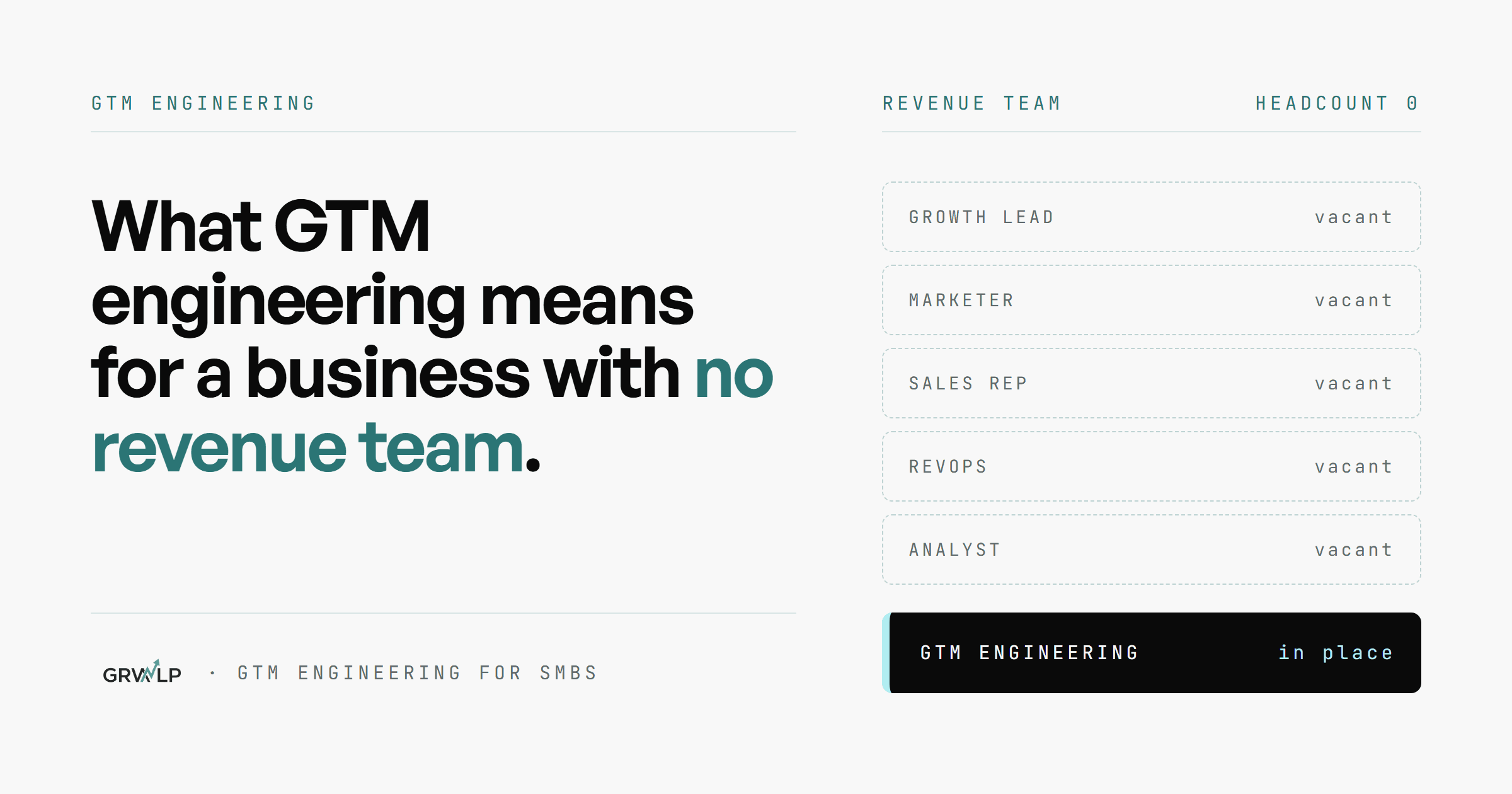
Most definitions you will find describe a role inside a company that already has a growth team, sitting between marketing and product, wiring up experiments. That is a real job and it is not this one. In a business with no revenue team, growth engineering is not a seat on an org chart. It is a decision about how the work gets bought: as one system with one owner, or as three projects with three invoices and nobody responsible for the space between them.
What does a growth engineer actually do?
Builds the thing people land on
Not a brochure. A page that states what the business does in the first five seconds and offers one clear next step, built to load fast and to be edited by the owner without a developer. If a visitor has to scroll to work out what you sell, the rest of the system has nothing to work with.
Brings the right people to it
Search, maps, AI answers, ads, referrals. A growth engineer picks one or two of these to start rather than all of them, because a small business cannot feed five channels and none of them work half fed. Which two depends on how your buyers actually look for you, which is a question with a real answer, not a preference.
Wires what happens after the form
This is the part that gets skipped, and it is the part that loses money. When an enquiry arrives, something has to notice it, acknowledge the person, put the request somewhere a human will see it tomorrow, and offer a time. Arriving and being noticed are two different events. In most small businesses only the first one is wired, which is the whole subject of the 42 hour gap.
Makes the whole thing report on itself
Not a dashboard nobody opens. Four or five numbers the owner can read in five minutes: how many people came, how many asked, how fast we answered, how many became work, what it cost. If a business cannot say which channel produced last month's jobs, every spending decision after that is a guess.
How is a growth engineer different from a marketing agency, a web developer or an automation consultant?
Each of the other three is genuinely good at its own piece. The difference is not skill, it is where the boundary of the job sits, and every boundary is a place a lead can fall through.
Who owns what when a small business buys growth work
| Who you hire | What they own | What they are genuinely good at | Where the gap opens |
|---|---|---|---|
| Marketing agency | Traffic and campaigns | Getting attention, media buying, creative, reporting on reach | They send people to a site they did not build and cannot change, and they stop caring at the form |
| Web developer or design studio | The site as a build | Design, speed, structure, a site you can be proud of | The project ends at launch, before anyone knows whether the site produces work |
| Automation consultant | Workflows between tools | Connecting the tools you already pay for, saving hours of admin | They automate what exists, including a bad process, and they rarely touch the page or the offer |
| Growth engineer or growth studio | The path end to end | Changing the page, the channel and the follow up as one decision | One person's capacity, and a real limit on how many channels can run at once |
That last column matters. A growth studio is not the right answer for everything, and the honest limit is capacity. One studio running your site, your search and your follow up cannot also run six ad platforms and a video team. If your problem is scale on a single channel you already know works, an agency that specialises in that channel will beat a generalist. The one studio model wins when the problem lives in the joins.
Is growth engineering the same as growth hacking, GTM engineering or marketing engineering?
They overlap, and the names came out of different rooms.
Growth hacking is the 2010s startup word, and it mostly meant cheap acquisition experiments run by someone technical. Go to market engineering, or GTM engineering, is the current name in business software, and it usually means tooling a sales motion: enrichment, routing, sequences, the machinery behind a sales team. Marketing engineering, or marketing operations, is the person who owns the marketing stack inside a company big enough to have one.
Growth engineering as this page uses it is the same underlying skill pointed at a business that has no growth team, no sales team and no marketing ops seat, where the website itself is the funnel. If you want the version of that argument written for a company with no revenue team at all, it is here.
When does a small business need growth engineering?
Four triggers. If you recognise two of them, you are past the point where more of any single service will help.
"People visit the site and nobody calls"
Traffic exists and enquiries do not. That is almost never a traffic problem, and buying more traffic makes it more expensive rather than better. Something between arriving and asking is broken: the offer is unclear, the next step is buried, or the form asks for more than a stranger will give.
"A lead came in on Friday and we replied on Monday"
The enquiry arrived. Nobody was told. It sat in an inbox nobody treats as a queue while the person who sent it messaged two competitors. This is the cheapest thing on this list to fix and the most expensive to leave.
"Marketing is working and the business cannot keep up"
Good news that turns bad. The channel produces more enquiries than one person can qualify, so the quality of every reply drops, and the channel starts looking like it stopped working when what actually happened is the follow up stopped scaling.
"Nobody can tell me what is working"
Three vendors, three reports, three different definitions of a lead. The site does not tell the marketing where the work came from, and the marketing does not tell the site who arrived. That is the argument behind the three vendor tax: the coordination cost between vendors is a real line item that never appears on any of the three invoices.
What does growth engineering look like on a real business?
RideOn Nigeria is a premium chauffeur and car rental service in Lagos, with an owner who runs it from Canada. Before the work started, customers booked over WhatsApp, drivers onboarded through a basic form on a static site, the partners who supplied the vehicles had no portal at all, and the admin team worked out of spreadsheets and chat threads.
The tempting move is to build an app and force everyone onto it. That is a development project. The growth engineering decision was different: keep the way bookings actually arrived, and build the business around it. Four user types, four portals, mapped end to end in Figma before a line of code got written. Web first rather than native, deliberately, because a pre booking business does not need app store approval cycles and cannot afford the maintenance. Brand strategy ran alongside the build, and the positioning moved from ride hailing, where the competitor is Bolt, to professional mobility, which is a different category with different buyers.
Four months later the business had four portals, three service flows and an owner who could run the whole operation from another continent. When the platform launched, drivers and customers started using it without a marketing push, because it was built around what they were already doing. The full account is in the RideOn case study.
That is the shape of the thing. Not a website project, not a marketing project, not an automation project. One decision about how the business actually runs, executed across all three.
What does a growth engineer build first?
Order matters more than ambition here, because each step makes the next one measurable.
First, the reply. Before anything else, make sure an enquiry cannot arrive without a person and a message going out. This takes days, not weeks, and it changes the number this month.
Second, the page the enquiries land on. One offer, one next step, fast on a phone, editable by you.
Third, one channel, properly. Search or maps or one ad platform. Not three.
Fourth, the record. Every enquiry in one place with where it came from attached, so month two can be compared with month one.
Fifth, the report. Five numbers, monthly, in language you would use out loud.
Anything that skips step one to get to step three is building a wider pipe into a bucket with a hole in it.
What does growth engineering cost?
Growveloper publishes its ranges rather than quoting on discovery. A website build runs from $2,000 to $10,000 and up, quoted as one fixed number after the consultation, with rebuilds shipping in six to ten weeks. Growth marketing retainers start at $1,500 a month, rolling monthly, and start with one or two channels rather than all of them. Individual automations are quoted per request and usually go live in one to four weeks each. The current figures live at growveloper.com/pricing.md, dated 3 September 2026, and the paid diagnostic that tells you which of these you actually need is the Growth Audit at $500 flat, credited against any project signed within sixty days.
The comparison worth doing is not studio against agency on price. It is the total of what you already pay, across every vendor and every subscription, against what the joins between them cost you in enquiries that arrived and were never answered.
When do you not need a growth engineer?
Say this plainly, because for a lot of businesses the answer is no.
You do not need one if you are full and your work comes by referral. Fix that when it stops being true, not before.
You do not need one if you have not settled what you sell and who to. No system survives a moving offer. You will pay to build it, then pay again to rebuild it around the answer you land on six months later.
You do not need one if you get three enquiries a week and answer all three within the hour. There is nothing there to automate. You are already the system, and at that volume you are a good one. Spend the money on getting more enquiries instead.
And you do not need one if what you actually need is a single specialist: someone to fix a technical search problem, or to run a channel you already know converts. Buy the specialist. Growth engineering is for the problem that sits between specialists.
That is really the whole test. Nobody should buy growth engineering because it sounds like the modern way to do things. You buy it the day you work out that the leak is not in the website, and not in the marketing, and not in the follow up, but in the gaps between the three, and that not one of the people you are paying believes those gaps are their job.
“A marketer plans the path. An engineer builds it and can see where it breaks. Growth engineering is the same person doing both, in the same afternoon.”
Written by Oyekola Obajuwon