Should a small business hire one growth studio or three separate agencies?
Buy specialists when the problem is depth in one channel. Buy one studio when the problem is the handoffs. Here is the test.
TL;DR
Hire three specialist agencies when your problem is depth inside one channel you already know converts. Hire one growth studio when your problem is the handoffs between them. The test is how many hours a week you personally spend relaying messages between vendors. Four or more and you are already doing the studio's job for free.
Last updated 14 September 2026. Written by Oyekola Obajuwon, founder of Growveloper, who builds the website, the marketing and the follow up for owner run businesses in Nigeria, the United States and the United Kingdom.
Hire three specialist agencies when your problem is depth inside one channel you already know converts. Hire one growth studio when your problem is the handoffs between them. The test is how many hours a week you personally spend relaying messages between vendors. Four or more and you are already doing the studio's job for free.
Everything below is how to tell which of those two describes you, including the cases where hiring three agencies is plainly the better decision and this page says so.
What is the actual difference between three agencies and one studio?
Not skill. Scope, and who is responsible for the space between the scopes.
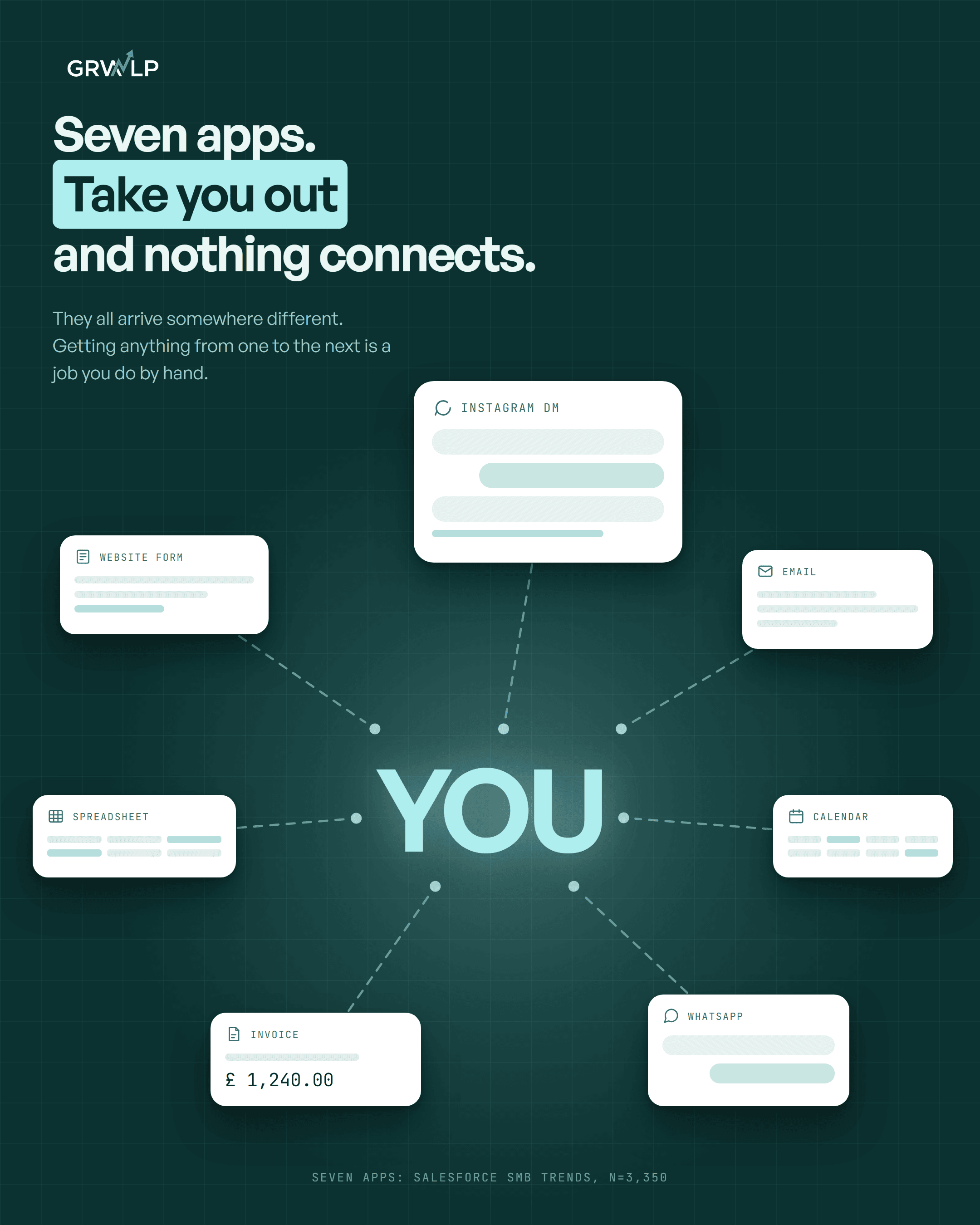
Three agencies means a marketing agency owning traffic, a web company owning the site, and an automation consultant owning the workflows. Each is usually good at its piece. Each writes a contract describing its piece. None of them has a line in that contract about the piece next to it.
One studio means a single operator owning the path from the advert to the page to the form to the reply. Fewer people, one contract, one set of numbers, and a hard ceiling on how much can be run at once.
The reason this matters is that leads do not fall out of the middle of anyone's scope. They fall out of the joins. An advert sends somebody to a page the agency cannot edit. A form submits into a system the developer does not touch. A workflow fires a message nobody wrote. All three vendors are doing their jobs correctly while the enquiry dies between them, and all three invoices are accurate.
That gap has been measured, just never in these words. When the Harvard Business Review audited 2,241 companies in 2011, the average time to answer a web enquiry was 42 hours and 23% were never answered at all. An enquiry that has to cross two suppliers before anybody is accountable for it is not going to beat that average. It is going to set it.
Three ways to buy the same work
| How you buy it | Who owns the result | Who does the coordinating |
|---|---|---|
| Three specialist agenciesOne version of the numbers, and speed | Each owns its scope, nobody owns the outcome | You, in hours nobody pays you for |
| One growth studioDepth on any one channel, and capacity | One operator owns site, marketing and follow up | Them |
| One studio plus one specialistSome of the saving, and it needs a referee | Studio owns the system, specialist owns the channel | The studio, if you write it down |
How do I know if I am already paying the coordination cost?
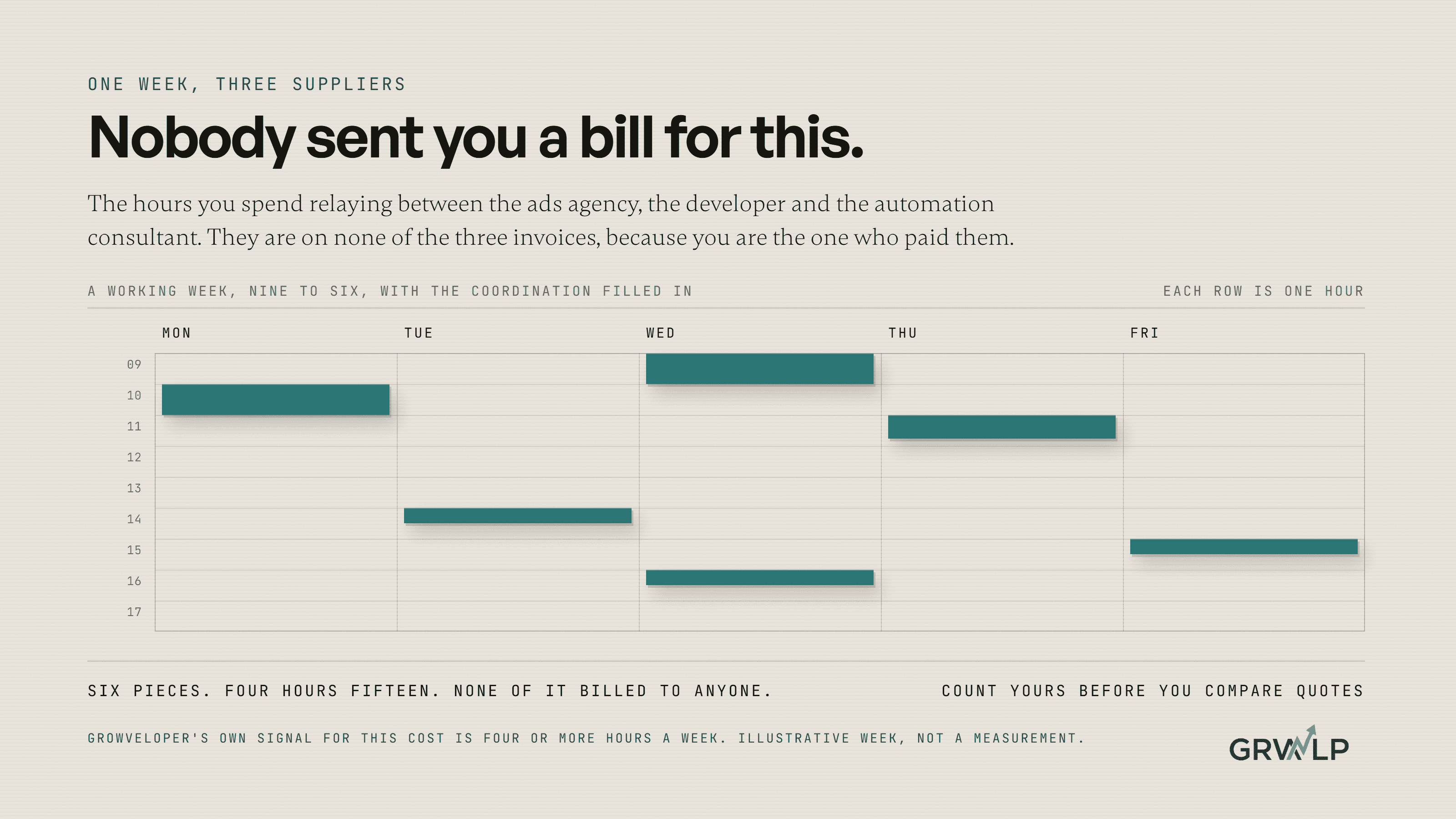
Open your calendar and your sent folder for last week. Count the time.
Not the retainers. You already know those. Count the minutes you spent forwarding a message from the developer to the ads agency, explaining to one vendor what another one changed, sitting on a call that existed only because two suppliers needed to hear the same thing, or waiting on a task that could not start until somebody else finished.
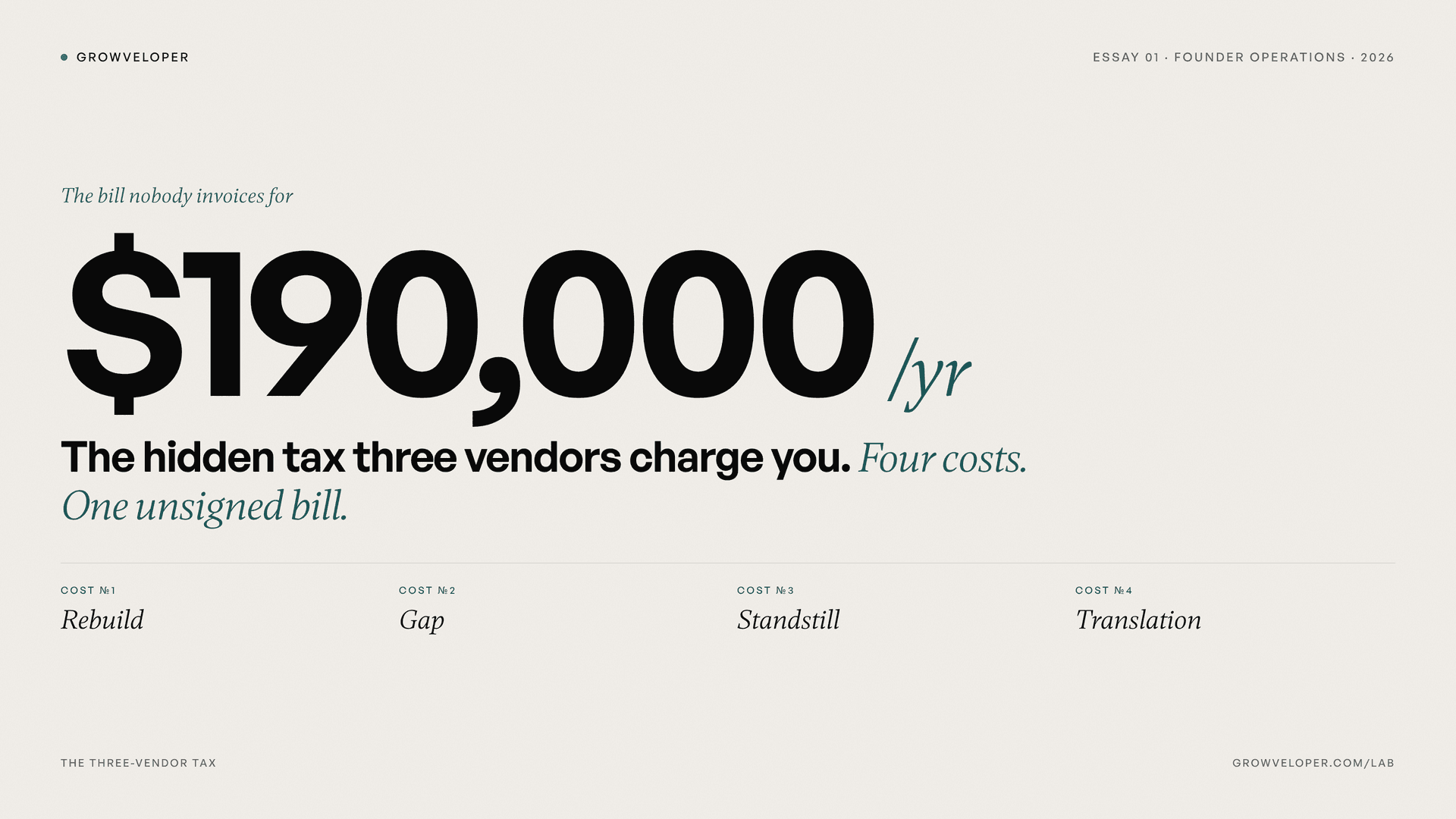
Growveloper's own published test uses three signals: your vendors' dashboards report different numbers for the same month, launches slip because one supplier is waiting on another, and you spend four or more hours a week coordinating. Two of the three means yes. The full argument, with the cost broken out line by line, is the three vendor tax.
The reason to count hours rather than read a statistic is that this cost is genuinely yours and genuinely invisible. It never appears on any of the three invoices, because the person paying it is you, in hours you do not bill anyone for. An owner who spends six hours a week as an unpaid project manager has hired a fourth vendor and given the job to themselves.
Now put a number on those hours. Not a market rate. What an hour of yours is worth when you spend it on the work only you can do, which is quoting, selling and deciding. Multiply. That figure is the real price difference between the two models, and it is almost always larger than the gap between the quotes.
What does the "12% of revenue" figure on this site actually mean?
It is a model, not a survey, and the difference is worth saying out loud on a page that is asking you to trust it.
The three vendor tax post works out that a business turning over about $1.5 million, buying all three services at mid range prices and carrying the coordination costs behind them, ends up around $190,000 a year, which is roughly 12% of the top line. Every input in that calculation is stated in the post. It is arithmetic done in the open, and you can disagree with any assumption in it and get a different answer.
What it is not is a measured finding about businesses in general. Nobody surveyed a thousand companies and discovered they pay 12%. If you see that number quoted anywhere as though somebody did, including on this site, read it as our worked example for a business of that size rather than as a statistic about yours.
Run your own version instead. Your three retainers, plus your hours, valued honestly. That number is worth more than ours because it is about you.
When are three separate agencies the right answer?
More often than a studio's website will tell you, and there are four situations where it is not close.
You already have one channel that works and it needs depth
If you are spending real money on a single paid channel that already returns more than it costs, the job is no longer connecting things. It is squeezing a channel, which is a specialism, and a team that does only that all day will beat a generalist at it. Scale on a proven channel is a depth problem.
The rules are the job
Financial services, healthcare, anything where the advertising rulebook is strictest. In those markets a large part of the work is knowing what will get rejected before it gets rejected, and that knowledge lives with people who work inside that rulebook constantly.
You need more hands than one operator has
Six ad platforms, a content team, a video operation, three languages. No single studio has that capacity and any that says it does is describing agencies it has not hired yet. This is the honest limit of the model, and it does not move.
You already have an in house marketer
If somebody internal owns the outcome and has the authority to change things, the joins are already owned. Specialists reporting to that person is a good structure, and buying a studio on top of it duplicates the role.
Which way to buy, by what is actually wrong
| Your situation | The better buy | Why |
|---|---|---|
| Real spend on one paid channel that already converts | Specialists | Depth beats breadth once a channel is proven |
| Advertising inside a strict rulebook | A specialist in that rulebook | Knowing what gets rejected is the work |
| Site, marketing and follow up all half working | One studio | The leak is in the joins, not in any one part |
| Nobody can tell you what produced last month's work | One studio | One owner, one definition of a lead |
| You need six platforms, video and a content team | Agencies | Capacity, and no single operator has it |
| Your offer is still changing every month | Neither, yet | No system survives a moving offer |
When does one studio win?
When the thing that is broken is a relationship between two parts rather than either part on its own.
The signature is easy to recognise once you have seen it. Every vendor's report is green and the business is not growing. The ads agency shows clicks going up. The developer shows a fast site. The automation consultant shows workflows running. Nobody shows enquiries turning into work, because nobody was asked to.
One studio wins there because the fix usually crosses a boundary. The form asks nine questions and should ask three, which is a page change driven by a marketing insight and delivered as a code change and measured in the workflow. Three vendors turn that into a six week thread. One operator does it in an afternoon. That is the whole argument of what growth engineering is and, in its most concrete form, the integration layer.
What does it look like when one person owns both halves?
The clearest example on this site is a marketing agency that had a single Wix landing page.
VIP Creative Studio is a fractional marketing agency working with credit unions across the United States. Strategists, a designer, a project manager, embedded into their clients' marketing departments. Their entire web presence was one page: no service breakdown, no case studies, no contact form. A company selling marketing to cautious financial institutions, with a website that argued against them.
The build was thirteen pages in six weeks, on Next.js with Sanity behind it, so more than a hundred fields could be edited by the team without a developer. On the same engagement, the paid media ran for one of their credit union clients: Google Display and YouTube campaigns, more than five hundred negative keywords, budgets above $16,000 a month. Securityplus Federal Credit Union recorded over 28,800 page views and 250 credit card application events inside a two month window.
The part worth noticing is not the numbers, it is that both halves were the same decision. The person choosing the keywords could see what the landing page said, and change it. Split that across two suppliers and the ads run against a page nobody can edit, which is the ordinary condition of most small business marketing. The full write up is the VIP Creative Studio case study.
Is there an option between the two?
Yes, and almost nobody will offer it to you because neither side makes money recommending it.
One studio owning the system, plus one specialist owning the channel that deserves depth. The studio holds the site, the follow up, the tracking and the reporting. The specialist runs the channel. The studio is named, in writing, as the one who reconciles the numbers and who can change the page the specialist sends traffic to.
For a business with one strong channel and a set of joins that keep failing, this is often the right answer, and the failure mode is predictable: without a named referee it degrades into two vendors and you in the middle again. Write down who reconciles, who can change the page, and whose number wins when two reports disagree. Three sentences in an email is enough.
What does each option cost?
Growveloper publishes its own ranges, and will not quote you a market rate for agencies it cannot source.
A website build runs from $2,000 to $10,000 and up, quoted as one fixed number after the free consultation, with rebuilds shipping in six to ten weeks, on the web development page. Growth marketing retainers start at $1,500 a month, rolling monthly, starting with one or two channels rather than all of them, on the growth marketing page. Individual automations are quoted per request and usually go live in one to four weeks, on the AI and automation page.
What you will not find here is a table of what three agencies cost, because the honest answer is that it varies more than any published figure admits and this lane does not print numbers it cannot follow home. Get three quotes. Add your coordination hours. Compare that against a single quote for the same outcome.
There is one piece of outside evidence worth putting next to this, and it comes with caveats attached. In Salesforce's 2024 survey of 3,350 small and medium business leaders, fielded between 3 August and 16 September 2024, growing businesses were about twice as likely to have an integrated technology stack than businesses that were not growing, 66% against 32%. Read that carefully. It is self reported, it is published by a company selling integration software, and it shows two things happening together rather than one causing the other. Growth might build the integrated stack rather than the other way round. It is a signal, not a proof, and anyone presenting it to you as a proof is selling. Salesforce's current small business trends page adds a figure that rings truer to most owners: 88% say they feel overwhelmed by having too many business tools.
What should I ask before signing with either?
Five questions, and the answers tell you more than any portfolio.
Who owns the number, and what number is it?
Ask each vendor to name the single figure they are accountable for. If two suppliers name clicks and impressions and nobody names enquiries or booked work, you have found the join that will fail.
What happens when the problem is not yours?
Ask what they do when the fix sits in somebody else's scope. Good answers describe a process and a named person. Bad answers describe an email.
Can you change the page?
Ask the marketing agency directly whether they can edit the landing page they are sending traffic to. If the answer is no, you have just discovered who will be doing that work, and it is you.
What do I get to keep?
Ask what leaves with you if the relationship ends: the accounts, the domain, the pixel data, the written deliverable, the source code. Anything that only lives inside their systems is leverage, and you should know that going in.
Would you tell me to keep my current vendors?
Ask anybody offering an audit whether their audit could conclude that you are fine. A diagnostic that can only ever recommend buying the thing being sold is a sales call with a document attached. That is why the Growth Audit is a paid deliverable you keep rather than a free proposal.
How do I switch without breaking what already works?
Slowly, and by taking ownership of the accounts before anything else.
Before any notice is given, make sure the business owns its own advertising accounts, its analytics, its domain registration, its hosting and its content management login, with the vendor holding access rather than the other way round. This single step is where most switches go wrong, and it is easiest to fix while everybody is still friendly.
Then move one thing at a time. Consolidating the site and the follow up first is usually right, because those two are most entangled with each other and least entangled with a live campaign. Leave a channel that is currently producing work exactly as it is until the new arrangement has proved itself on something less expensive to get wrong.
Expect a quarter. Not because the work takes a quarter, but because you need a full month of clean numbers under the new setup before you can compare anything, and the month during the changeover is never clean. Anybody promising a transformation in three weeks is describing the build, not the evidence.
What if the honest answer is neither?
Sometimes it is, and this is the section a studio's marketing usually leaves out.
If you are full and your work comes by referral, buy nothing. Fix that when it stops being true. If you have not settled what you sell and who to, no system survives it: you will pay to build it, then pay again to rebuild it around the answer you land on in six months. If you get three enquiries a week and answer all three within the hour, there is nothing here to automate. You are already the system and at that volume you are a good one, which is a version of the argument the 42 hour gap makes from the other direction.
And if what you actually need is one specialist to fix one thing, buy the specialist. Nobody should hire a growth studio because integration sounds like the modern way to do things.
The test never really changes. Spend ten minutes counting last week's hours. If the answer is that you spent most of your coordinating time chasing one vendor about one channel, hire better at that channel. If you spent it explaining each supplier to the others, you have already been doing this job for months, and the only question left is whether you would like to stop.
“The coordination cost never appears on any of the three invoices, because the person paying it is you, in hours you do not bill anyone for.”
Written by Oyekola Obajuwon