Is Next.js worth it for a small business website?
Next.js does not make a site fast or good by itself. It is worth paying for when the site must do something a template cannot.
TL;DR
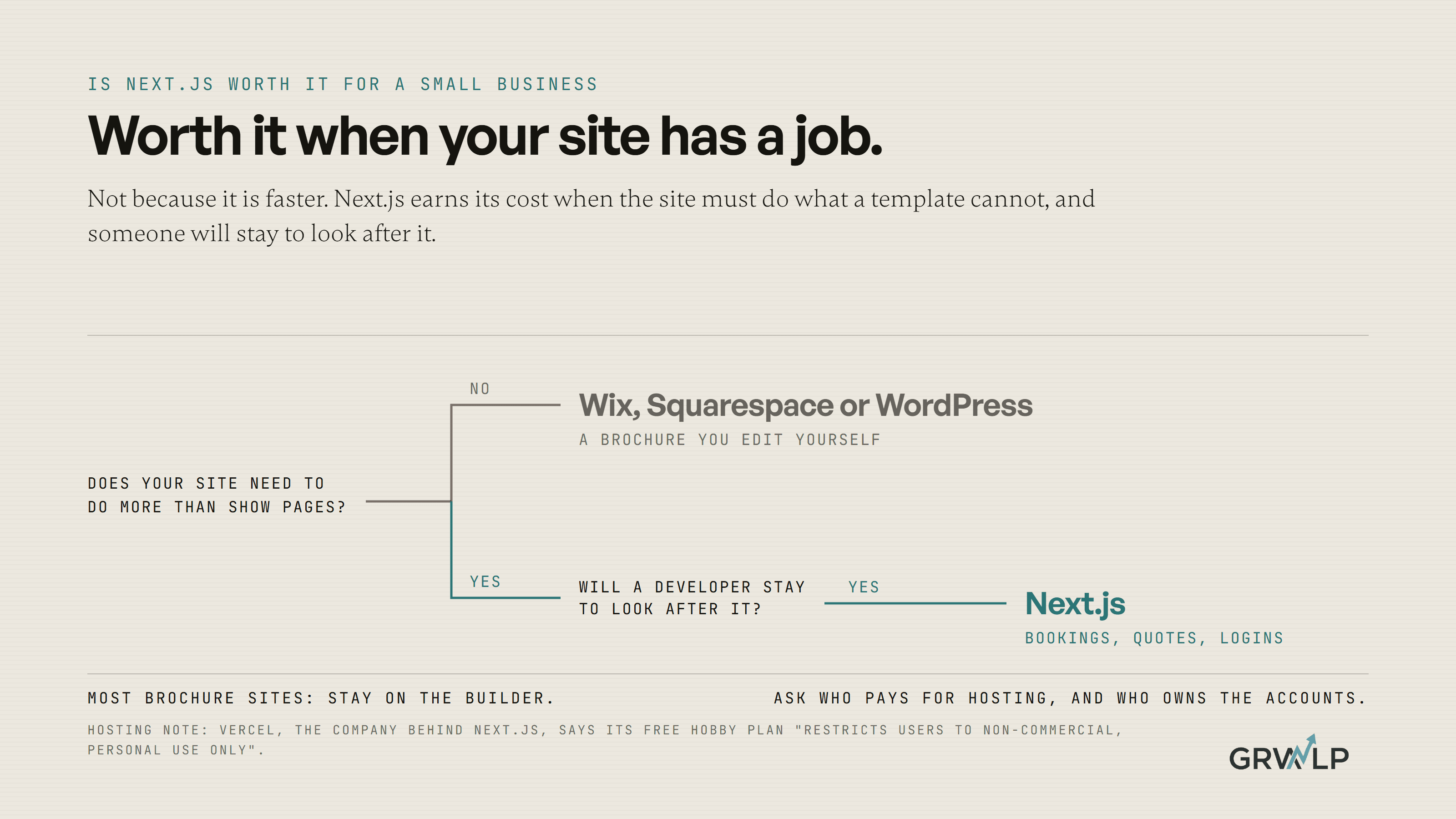
Next.js is worth it when your website has to do something a template cannot, such as bookings, quotes, logins or several kinds of user, and a developer will stay with it. For a five page brochure you update yourself, Wix, Squarespace or WordPress is usually enough. The framework is a staffing choice as much as a technical one.
Last updated 25 September 2026. Written by Oyekola Obajuwon, founder of Growveloper, who builds the website, the marketing and the follow up for owner run businesses in Nigeria, the United States and the United Kingdom.
Next.js is worth it when your website has to do something a template cannot, such as bookings, quotes, logins or several kinds of user, and a developer will stay with it. For a five page brochure you update yourself, Wix, Squarespace or WordPress is usually enough. The framework is a staffing choice as much as a technical one.
We should say up front that we build in Next.js. So take this as advice from someone with a side, who will still tell most owners reading it that they do not need what we sell.
What is Next.js, in plain terms?
It is a set of building blocks developers use to make websites and web apps, maintained by the company Vercel. Next.js describes itself as "the React framework for the web". A framework is a kit of ready made parts a developer builds on, so they are not starting from an empty file.
What matters for an owner is what it is not. It is not a website builder like Wix or Squarespace, where you drag blocks around a page. There is no editor screen until a developer adds one. Everything a Next.js site does, someone wrote. That is the source of its strengths and of its costs.
Is a Next.js site faster than WordPress or Wix?
It can be. Nobody can show you it usually is, and that includes us.
The best public measurement of real websites is the HTTP Archive's yearly Web Almanac. Its 2024 chapter on content systems looked at real visits in June 2024 and counted how many sites passed Google's speed tests on phones. WordPress sites passed 40% of the time, Wix 57%, Squarespace 60%. The chapter has no row for Next.js, because it measures website builders and content systems, not the frameworks developers build with. We looked for a Next.js figure we could follow back to its source and did not find one. Pages that quote one cite third party tools, and their numbers disagree.
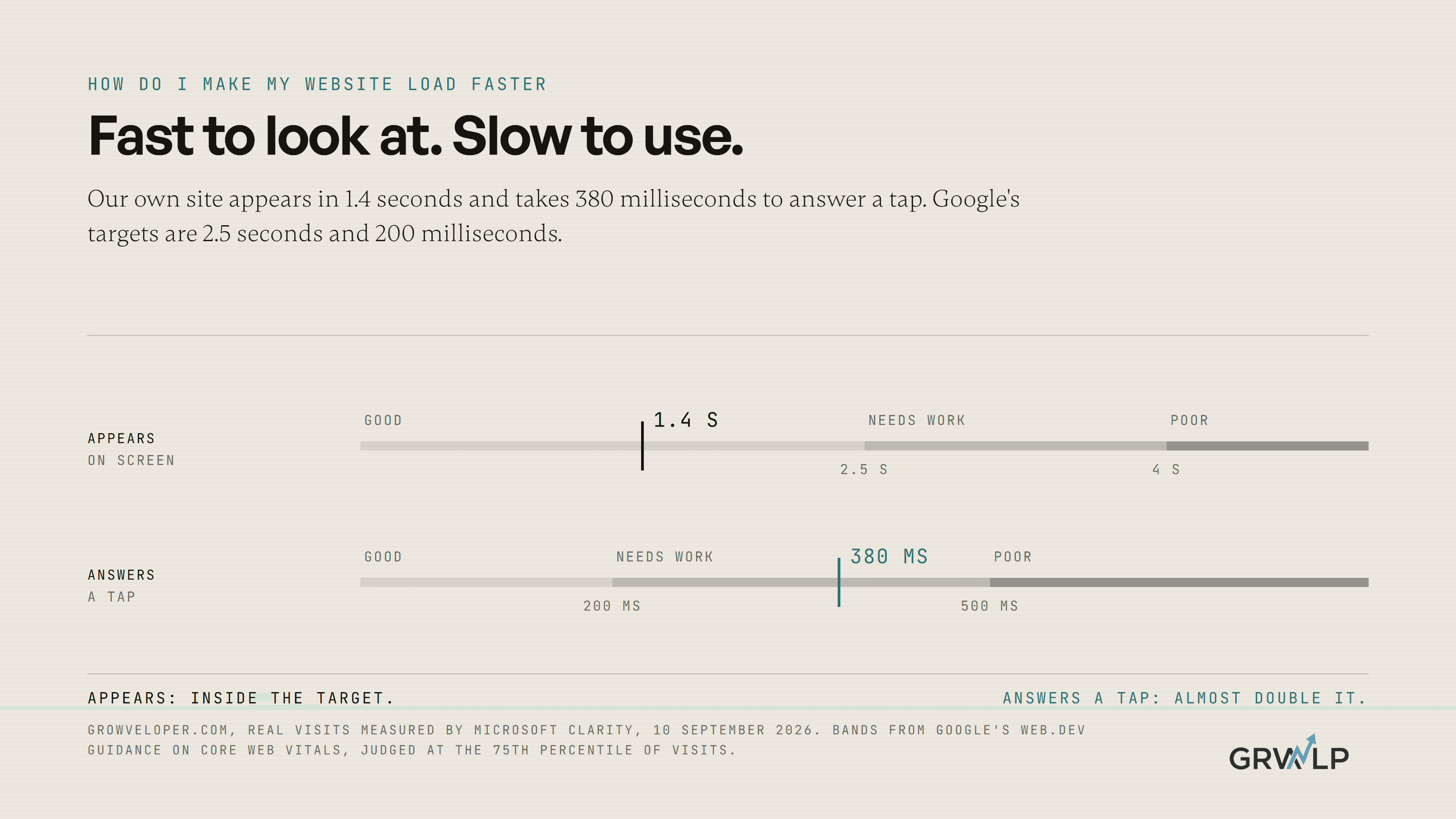
Here is the number we can give you. Our own site, growveloper.com, is built in Next.js. When Microsoft Clarity measured real visits on 10 September 2026, pages took 1.4 seconds to appear, well inside the 2.5 seconds Google's Core Web Vitals guidance asks for. The same visits took 380 milliseconds to respond to a tap, against Google's target of 200. One test passed, one failed, on a site built by people who build fast sites for a living.
That is the honest answer. Next.js gives a developer more control over speed than a builder does. It does not make the site fast. The images, the scripts and the chat widgets you add decide that, and we walk through which kind of slow you have in how to make your website load faster.
Can I edit a Next.js website myself?
Only if your developer builds you a way to. On its own, a Next.js site has no editing screen, so changing a price means asking a developer.
The fix is a content system attached to the site, a separate editor where you change words, prices, photos and pages without touching code. Our own site uses Sanity for this. The VIP Creative Studio build in our work section is the clearest example: it started as a single Wix landing page and ended as a Next.js site their team controlled. Their CEO's words on our web development page: "Every headline, testimonial, and service description is editable from the CMS without touching code."
So the question to ask a Next.js developer is not "can I edit it?" It is "show me, on a phone, how I change a price."
What does hosting a Next.js site cost?
Less than the build, and more than zero, whatever you have heard.
Vercel, the company behind Next.js, runs the hosting most Next.js sites use. Its free Hobby plan is often mentioned as the reason Next.js hosting costs nothing. Vercel's own Hobby plan page says the plan "restricts users to non-commercial, personal use only". A business website is commercial, so it belongs on the paid Pro plan, which the same page prices at $20 per developer seat per month, plus usage. Other hosts exist, but the rule is worth knowing before anyone tells you hosting is free.
If you are in Lagos, note that Vercel prices in US dollars. Ask your developer whether hosting is inside their monthly fee or billed to your card, and in which currency.
When is WordPress, Wix or Squarespace enough?
When your website's job is to be found and to show people what you do, and you want to change it yourself this afternoon.
A five page site for a cleaner, a clinic or a consultant, with services, prices, reviews, a map and a contact button, is exactly what builders are good at. You will launch sooner, pay less up front, and change your own opening hours without phoning anyone. The Web Almanac figures above show builders can pass Google's tests, and a small site on a builder that you keep up to date beats an expensive site nobody touches. We made the full case for staying put in should I use Wix or hire a developer.
When is Next.js worth the money?
When the website stops being a brochure and starts doing a job.
Next.js or a website builder, for an owner deciding what to pay for
| What your site needs | Wix, Squarespace or WordPress | Next.js |
|---|---|---|
| Five pages you update yourself | A good fit | More than you need |
| Bookings, quotes, logins or payments built around how you work | Plugins and workarounds | Built for it |
| Several kinds of user, such as customers, staff and partners | Hard or impossible | Built for it |
| Editing prices and text yourself | Built in | Only with a content system added |
| Hosting | Inside your plan | A separate bill, paid plan for business use |
| Someone to fix it | The platform's support | A developer you can reach |
The middle rows are where Next.js earns its cost. RideOn Nigeria is the clearest case we have built. A premium chauffeur service in Lagos that began with bookings on WhatsApp needed a customer booking app, a driver side, a partner side and an admin dashboard, four separate portals sharing one set of records. No builder does that. For a site like that, the choice is not Next.js or Wix. It is Next.js or something equally custom.
The last row is the one owners forget. A builder is looked after by the company that makes it. A Next.js site is looked after by whoever built it. That is the staffing choice.
What happens if my Next.js developer disappears?
Then you need another developer who works in Next.js, and they will need to read someone else's work before they can change anything. That takes time, and you pay for it.
Protect yourself before the build, not after. Make sure the code sits in an account you own, the hosting is in your name, and the content system login is yours. Our web development page promises "full access to your CMS, your code, and your analytics on day one". Whoever you hire, ask for the same in writing.
Does Google rank Next.js sites higher?
No. Google does not reward a framework. It rewards pages that answer the search and load well on real phones, and it measures the second part with the same tests described above, whatever the site is built with. A Next.js site with slow pages ranks no better than a slow Wix site. The advantage is only that a developer has more room to fix what is slow.
What should I ask a developer who builds in Next.js?
Three questions, before you sign anything.
First, "What will this site do that a builder cannot?" If the answer is only "it will be faster", ask to see real phone speed numbers from a site they already built, not a lab score. Second, "Show me how I change a price from my phone." If there is no content system, you will be paying them for every edit. Third, "Who pays for hosting, in what currency, and who owns the accounts?"
What the build itself should cost is covered in how much a small business website costs, and there is a free call if you want to put those three questions to us. If the answers are good, Next.js will give you a site that fits your business instead of a business bent to fit a template. If they are vague, stay on the builder, and spend the difference on the thing your site is actually missing.
“Our own Next.js site passes one of Google's speed tests on real phones and fails another. The framework did not do the work for us.”
Written by Oyekola Obajuwon