How do HVAC companies get more leads online?
How a heating and air conditioning company gets more leads online in 2026, from Google's own HVAC rules to the tax credit that ended.
TL;DR
HVAC companies get more leads online by preparing for the two calls the trade gets. The breakdown goes to whoever is trusted and answers first. The planned replacement goes to whoever proves they are qualified. Show your licence and certifications, answer within minutes, set Google's ads to the jobs you do, and delete any tax credit that has ended.
Last updated 1 October 2026. Written by Oyekola Obajuwon, founder of Growveloper, a growth studio in Lagos that builds the website, the marketing and the follow up for owner run businesses in Nigeria, the United States and the United Kingdom.
HVAC companies get more leads online by preparing for the two calls the trade gets. The breakdown goes to whoever is trusted and answers first. The planned replacement goes to whoever proves they are qualified. Show your licence and certifications, answer within minutes, set Google's ads to the jobs you do, and delete any tax credit that has ended.
Google says the first part out loud. In its screening rules for Local Services ads, HVAC is "considered an urgent category because consumers often call HVAC professionals for time-sensitive, urgent needs, such as a heater that is broken in freezing temperatures." Most advice about HVAC leads is the advice a hairdresser gets: reviews, a Google profile, a mobile website. All true, and all covered in our local SEO checklist for service businesses. This piece is the part that only applies to heating and cooling.
What are the two kinds of HVAC lead?
The breakdown and the replacement. They ring the same phone and want different things.
The breakdown
The air conditioning dies in a heat wave, or the heating goes out on the coldest night of the year. The homeowner is searching on a phone, uncomfortable, and deciding in minutes. They want someone they can trust in their house tonight, and the next company on the list is one tap away. According to the US Energy Information Administration, 88% of US households used air conditioning in its 2020 housing survey. On a hot day, most houses on your street are one failed part away from being this customer.
The replacement
A new system, a heat pump, a boiler swap. The homeowner has days or weeks, gets several quotes and reads everything. They want proof you are qualified, a sense of the price, and the truth about any grant or credit. It is a bigger job decided more slowly, and it is won by what your website proves before anyone picks up the phone.
Why does Google screen HVAC companies harder than other trades?
Because the customer is letting a stranger into their home in a hurry. Google's screening page lists what an HVAC company in the United States must pass before its Local Services ads run: a business check, an owner check and a service professional check; general liability and professional liability insurance; and a state level business licence and owner licence.
The service professional check, a background check on the people you send out, is the extra level. Google adds it because the category is urgent. That screening is the reason Local Services ads deserve a look. Someone with no heat at 11pm has little time to read testimonials. On these ads, Google has done some of the checking before they arrive.
Are Google Local Services ads worth it for an HVAC company?
Worth testing, if someone will answer the phone. You do not pay per click. Google's page on how leads work says "you're charged for each valid lead you receive through your Local Services ad," and that lead prices "may vary depending on your location, the job type, the type of lead, or your bidding mode." A lead can be a call, a message, a voicemail or a booking request.
Two changes matter more than anything in the older guides.
Google stopped refunding leads for jobs you do not do
Google's page on lead credits says it "no longer supports credits for 'job type not serviced' and 'geo not serviced' leads." Leads Google judges invalid or low quality are still not charged. But if your profile says you clean ducts and you do not, or your service area runs two towns past where you will drive, those calls are yours to pay for. Set the job types and the area to exactly what you will do on a busy Tuesday in July.
What an HVAC company pays for on Google Local Services ads
| What comes in | Do you pay? | What to do |
|---|---|---|
| A call or message about a job you do | Yes | Answer it within minutes |
| A lead Google judges invalid or low quality | No | Nothing, Google filters it first |
| A lead for a job type you do not offer | Yes, and Google no longer credits it | Untick that job type |
| A lead from outside your service area | Yes, and Google no longer credits it | Draw the area you will really drive to |
The ads are moving into Performance Max
Google is moving Local Services ads into Performance Max, its automated campaign type, still paid per lead. Its transition page lists HVAC among the trades moving: select US businesses from August 2026, service area businesses later in 2026, and accounts outside the US in 2027. Manual bidding is being retired, a weekly budget becomes a daily average (the old weekly figure divided by seven), and Google emails advertisers 14 days and 7 days before their account moves. If you run these ads, watch that inbox, and check the new daily number the week it switches.
When I ran paid media at VIP Creative Studio, one US credit union's Google Ads account ended up with more than 500 negative keywords, each one a search we told Google not to show the ads for: close enough to trigger them, wrong enough to waste the money. On Local Services ads the job types and the service area do that filtering for you. Now that Google has stopped refunding the wrong ones, they deserve the same care.
What should an HVAC website show before anyone calls?
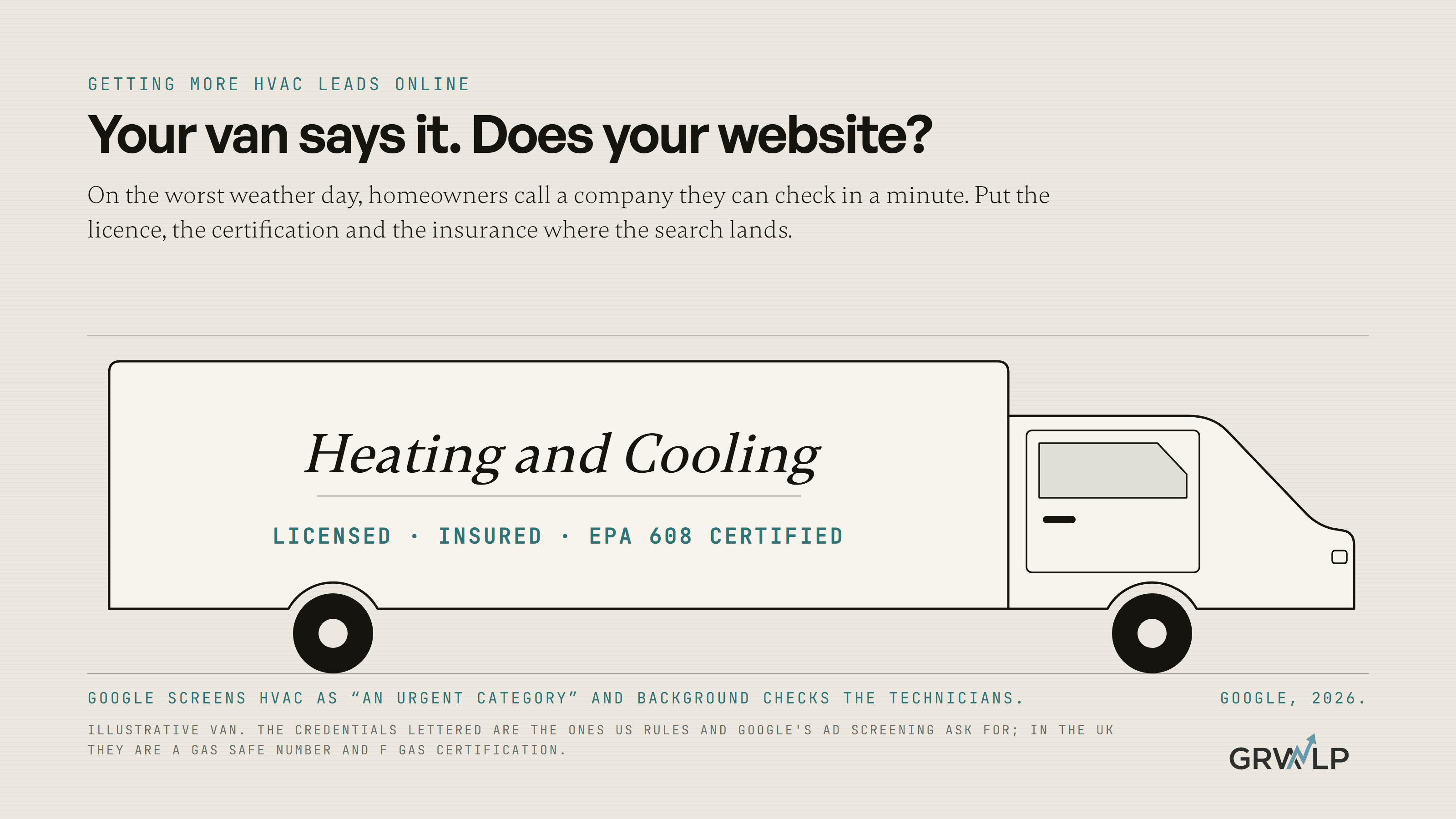
What the homeowner cannot check from their sofa: that you are allowed to do the work, insured, and qualified to handle the refrigerant or the gas. If your van door already says licensed and insured, put the same facts on the home page and on every service page, as numbers a customer can check, next to a phone number they can tap. Our guide to turning phone searches into calls covers the tapping half.
What an HVAC website should prove, in the US and the UK
| What the customer is checking | United States | United Kingdom |
|---|---|---|
| Allowed to do the work | Your state licence number | Your Gas Safe Register number, for gas work |
| Qualified with refrigerant | Technicians certified under EPA Section 608 | Your company's F gas certification |
| Insured | General and professional liability | Your public liability cover |
| Help with a heat pump | No federal tax credit for installs after 2025 | Boiler Upgrade Scheme, £7,500 off an air source heat pump |
In the United States, the EPA's Section 608 rules say that "technicians who maintain, service, repair, or dispose of equipment that could release ozone depleting refrigerants into the atmosphere must be certified." A line on your service pages saying your technicians hold that certification costs nothing to write.
Is your website still promising a tax credit that ended?
Check today. From 2023, US homeowners could claim the federal Energy Efficient Home Improvement Credit, up to $2,000 a year for a qualifying heat pump. The IRS page, last reviewed on 28 April 2026, now says the credit "is allowed for qualifying property placed in service on or after Jan. 1, 2023, and before December 31, 2025."
If your website, your ads or your quote template still say "save up to $2,000 with the federal tax credit", take it down. A customer who installs in 2026 because your page promised money back finds out at tax time, and your name is on the promise. The replacement buyer is the one reading everything. Give them a page with nothing on it that has expired.
What should a heating engineer in the UK do differently?
Three things are different in the UK.
Show the registration the law requires
For gas, the Health and Safety Executive is plain: "for a gas engineering business to legally undertake gas work that is within the scope of the Regulations they must be on the Gas Safe Register." Registered engineers carry an identity card "which consumers are encouraged to ask an engineer for before they have gas work carried out in their home." Put the number on the website so the check happens before the visit. For air conditioning and heat pumps, GOV.UK's F gas guidance says "your company, including sole traders, must be certified by an approved body to service stationary equipment containing F gas operated by others."
Say that you handle the heat pump grant
The Boiler Upgrade Scheme gives "£7,500 towards an air source heat pump", and GOV.UK's how to apply page says "the installer will apply on your behalf on the Ofgem website." The same page tells homeowners to "contact suitable MCS certified installers to get quotes for the work." So the installer who says, on the page, that they are MCS certified and will handle the application has answered the buyer's first two questions before the first call.
Expect no refunds on Google's leads
If you run Local Services ads in the UK, Google's credits page says "lead credits aren't available for health care verticals, tax specialists, or advertisers in EMEA", which is Europe, the Middle East and Africa, and includes the UK. Every lead you are charged for stays charged, so the job types and the area matter even more.
What happens when the call comes at 9pm in a heat wave?
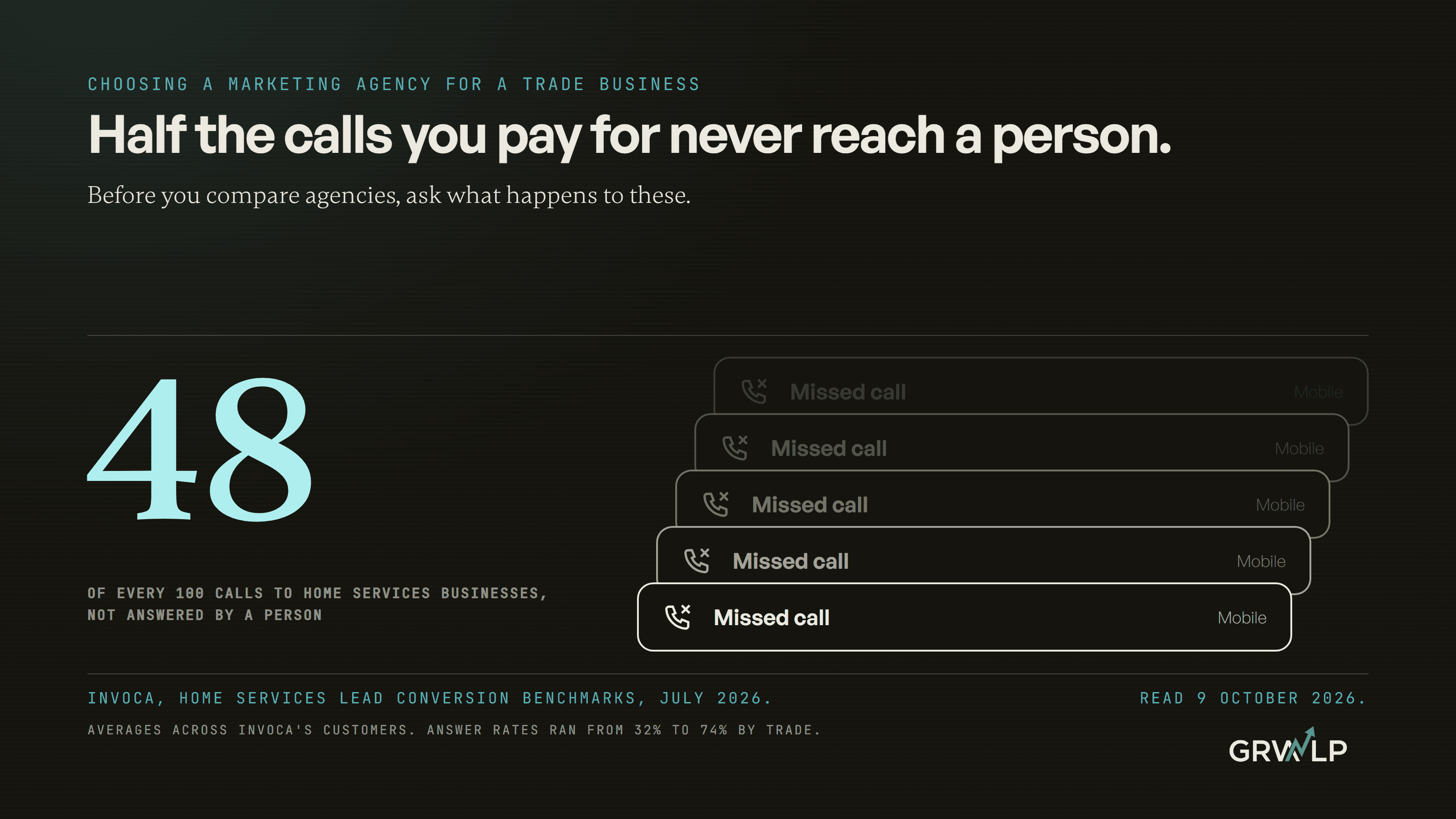
That is the lead all of the above was for. It arrives while you are on a job, under a house, or asleep.
The fix is the same as for any trade, and our piece on how fast a home services company should reply sets it out: an automatic reply within minutes, a person within the hour, and a record of every call you missed. For HVAC, add one line to the website. If you take emergency calls after hours, say so, and say what it costs. If you do not, say when you will call back. A homeowner choosing at 9pm can live with "first thing tomorrow" if they read it before they ring. Not after twenty rings.
We build this as one system for local service businesses: the website, the local search and ads through our growth marketing work, and the automatic replies. Our page for HVAC companies shows what that looks like. We should also say what we have not done: we have not published an HVAC build for a client, and nothing in this piece claims one. If you want a second pair of eyes on your job types, your service area or your credentials page, there is a free call.
When the weather turns, the work goes to the company that was already vetted, already proven, and still picking up.
“The HVAC lead you want arrives on the worst weather day of the year. Be the company that is already vetted and still picking up.”
Written by Oyekola Obajuwon