Local SEO for service businesses: the checklist that matters
Two of the five biggest map ranking factors you cannot change and a third breaks Google's rules. Here is what is left, in order.
TL;DR
Local SEO for a service business is mostly your Google Business Profile plus your own website. Pick the most specific primary category, keep your hours true, set your service areas honestly, earn reviews steadily, and give each service its own page. Distance to the customer matters too, but you cannot change it, so stop fighting it.
Last updated 24 September 2026. Written by Oyekola Obajuwon, founder of Growveloper, who builds the website, the marketing and the follow up for owner run businesses in Nigeria, the United States and the United Kingdom.
Local SEO for a service business is mostly your Google Business Profile plus your own website. Pick the most specific primary category, keep your hours true, set your service areas honestly, earn reviews steadily, and give each service its own page. Distance to the customer matters too, but you cannot change it, so stop fighting it.
Most checklists give you fifteen things and treat them as equal. They are not equal, and some of them are not yours to change. Here is the short list, in the order that matters.
How does Google decide which local businesses to show?
Three things, and Google says so in its own words.
Its help page on how local results are ranked names them: relevance, which is how well your profile matches what someone searched for; distance, which is how far you are from the person searching; and prominence, which is how well known your business is, including how many reviews you have and how good they are.
The same page says one more thing worth pinning to your wall: there is no way to request or pay for a better local ranking on Google. Anyone who tells you otherwise is selling you something Google says does not exist.
What can I not change?
More than most guides admit.
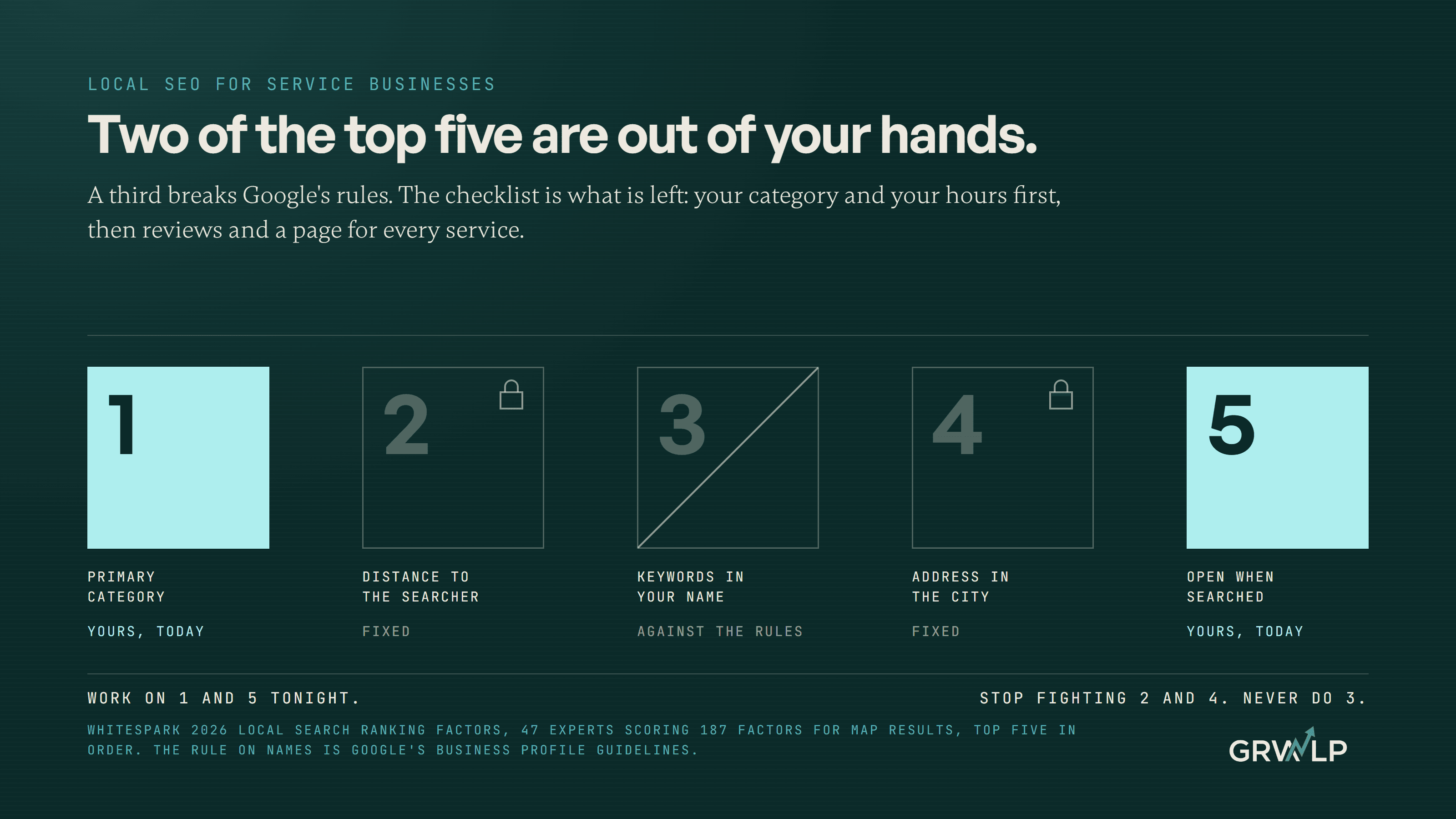
Whitespark runs the best known survey of local search specialists. Its 2026 Local Search Ranking Factors report asked 47 of them to score 187 factors, and published the top of the list for the map results. It is expert opinion, not a measurement of Google's code, but it is the most careful opinion there is. Here are the top five, with a column the report does not have.
The five things experts rate highest for Google's map results, and whether you control them
| Rank | Factor | Can you change it? |
|---|---|---|
| 1 | Your primary Google Business Profile category | Yes, today |
| 2 | How close your address is to the person searching | No |
| 3 | Keywords in your business name | Only by breaking Google's rules |
| 4 | Having an address in the city being searched | Rarely, you would have to move |
| 5 | Being open at the time of the search | Yes, with true hours |
Read the middle column slowly. Two of the five are about where you are, and you cannot fix where you are with marketing. A roofer ten miles away will lose some searches to a roofer next door, and that is the system working as designed.
The third one is a trap. Stuffing "Emergency Plumber London" into your business name works well enough that experts rank it third, and Google's guidelines for representing your business say that including unnecessary information in your name is not permitted and could get your profile suspended. A suspended profile ranks for nothing. Use your real name.
That leaves two items in the top five you fully control, and the rest of this checklist.
What is the local SEO checklist, in order?
Do these in this order. The first three take under an hour.
1. Choose the most specific primary category
Your primary category tells Google what you are, and the experts rank it first. Google's help on choosing categories asks you to pick the one that describes your business as a whole, as specifically as possible, and not to use categories as keywords. "Plumber" beats "Contractor". If you mostly clean offices, "Commercial cleaning service" beats "Cleaning service", which is one of the choices we walk through for cleaning companies. Add a few secondary categories for real services you offer, not for every job you have ever done.
2. Make your hours true, including the ones you answer the phone
Being open at the time of search is now in the experts' top five. So if you genuinely take emergency calls at night, your hours should say so. If you do not, do not pretend: a customer who calls at midnight and gets voicemail becomes a bad review, which costs you more than the ranking earned.
3. Set your service area honestly
If you go to your customers rather than them coming to you, hide your address and list the areas you serve. Google's help on managing service areas allows up to 20 of them and says the overall area should not be more than about two hours' driving time from where you are based. Listing every city in the state does not make you closer to any of them.
4. Earn reviews every week, not in bursts
Google's ranking page says more reviews and better ratings can help your local ranking. The system that gets them is simple: ask at the moment the job is finished, with a direct link, and send exactly one reminder. We set out the whole workflow, with the messages, in how to get more Google reviews. Never pay for reviews or only ask the customers you expect to be happy; Google's policies forbid both.
5. Give each main service its own page on your website
Your profile links to your website, and your website is where Google checks what you actually do. One page for boiler repair, one for installation, one for servicing, each saying what you do, where, and roughly what it costs, will match more searches than one page that lists everything. If you serve two or three distinct towns, a page for each is worth it when you have something real to say about working there.
6. Keep your name, address and phone number identical everywhere
The same business name, the same phone number and, if you show it, the same address on your profile, your website, your Facebook page and any directory you are listed in. Small differences make it harder for Google to be sure all those listings are the same business.
7. Make sure Google has actually found your pages
This is the one everybody skips, including us, and it gets its own section.
What went wrong with our own local pages?
We built six pages for local trades: cleaning companies, HVAC companies, roofing contractors, solar installers, private clinics and personal trainers, plus a hub page for local service businesses. Each one speaks its trade's language. Our page for HVAC companies opens on the homeowner searching the moment the air conditioning dies.
When we reviewed our own search results on 24 September 2026, three weeks after those pages went live, Google had not crawled them. Not ranked badly. Not visited at all. Pages about how to be found locally, invisible to the search engine they were written for.
The likeliest cause was plain once we looked: very little on the rest of the site linked to them, so Google had no strong path to follow. We added links to all six in the footer of every page, resubmitted the sitemap and asked Google to index them.
The lesson for your checklist: a service page Google has never visited cannot rank for anything. Search Google for the exact name of one of your service pages. If it does not appear, link to it from your home page and your main menu before you write another word.
Do directories and citations still matter?
Less than the checklists suggest, and more in some countries than others.
Being listed with the same details on the main review and trade directories in your country helps Google trust that your business is real and where it says it is. A handful of the ones your customers actually use is enough; a hundred listings nobody reads is not better than ten. Most of the long directory lists in local SEO guides are American. If you are in Lagos or Abuja, do not spend a weekend trying to match a list built for Ohio. Put that effort into your profile, your reviews and your own website.
How long does local SEO take to work?
Nobody publishes a timeline that holds across trades and towns, so be wary of anyone who promises one. Profile fixes such as a better category or true hours take effect once Google accepts the edit. Reviews and new service pages build slowly, because Google has to find the pages and your review count has to grow. Treat it as a monthly habit, not a project: an hour to set it up properly, then a few minutes each week asking for reviews and answering them.
Who should do my local SEO?
For most owner run service businesses, you should do the profile yourself, and it is less work than you have been told.
The first four items on the checklist, category, hours, service area and reviews, happen inside your Google Business Profile, need no technical skill, and cost nothing. Nobody knows your services, your hours and your area better than you. An agency charging a monthly fee mainly for profile updates is charging you for an hour's work you could do tonight.
Where paying someone makes sense is the website side: building a proper page for each service, making sure Google can find them, and wiring your enquiries so a customer who finds you gets a reply before they call the next roofer on the list. A fast reply matters as much as the ranking, and the evidence on that is in how fast a home services company should reply to a lead.
We should be plain about our interest. We build that website side, and there is a free call if you want to talk it through. But the most important item on this list is the first one, it takes five minutes, and you do not need anyone to do it for you.
Open your profile tonight and check your primary category. If it is not the most specific true description of what you do, change it. Everything else on this list builds on that one choice.
“Two of the five things that move the map most are out of your hands. The checklist is what is left.”
Written by Oyekola Obajuwon