How do I work out who my ideal customer is?
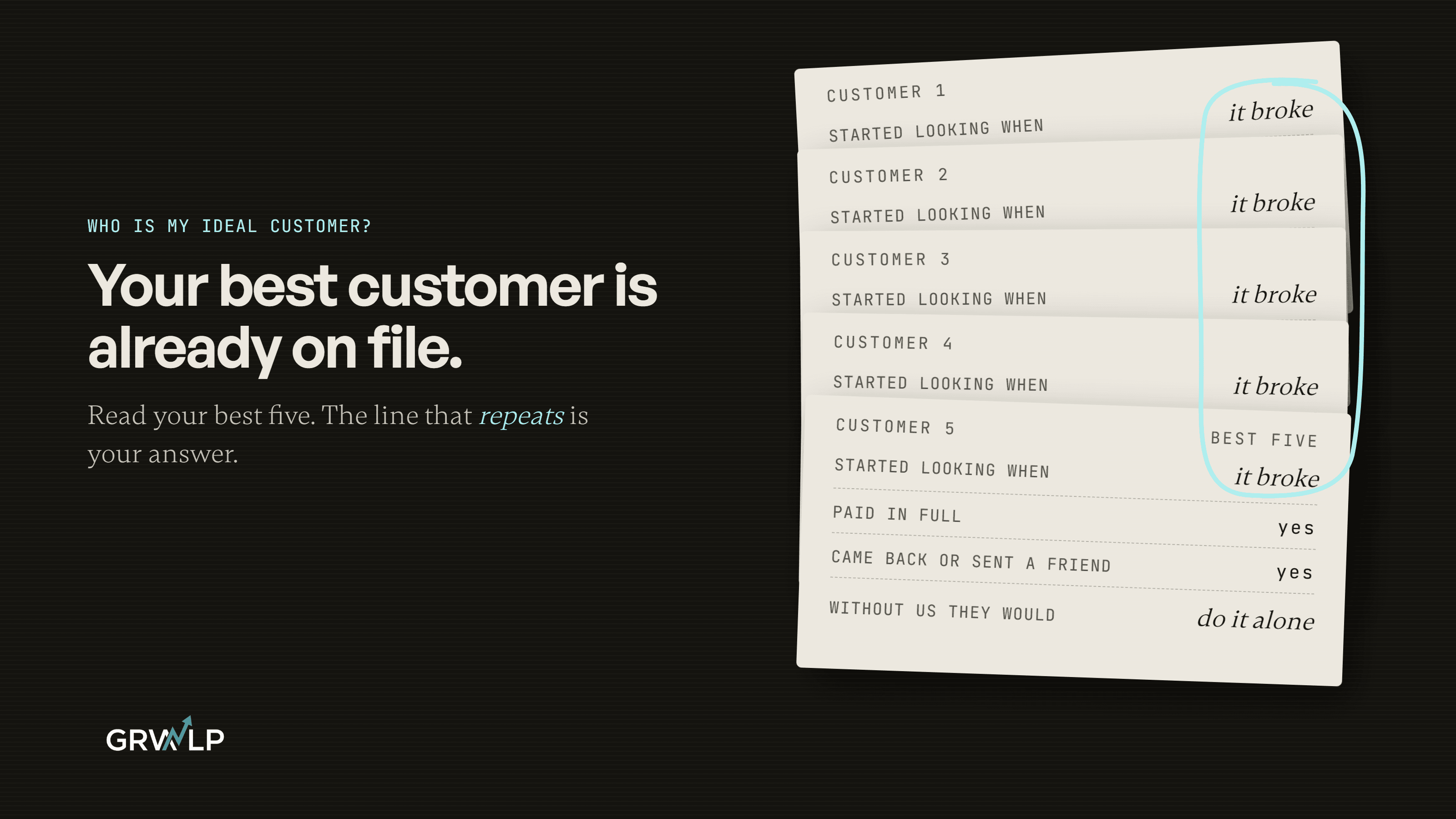
Your ideal customer is not a made up persona. It is the pattern hiding in the five best customers you already have.
TL;DR
Your ideal customer is already in your list of past customers, not in a persona template. Pick the five you would happily serve again: they paid without a fight, got the result, and came back or sent a friend. Write down what they share and what made them start looking. That pattern is your ideal customer.
Last updated 3 November 2026. Written by Oyekola Obajuwon, founder of Growveloper, a growth studio that builds the website, the marketing and the automation for owner run businesses in the United States, the United Kingdom and Nigeria.
Your ideal customer is already in your list of past customers, not in a persona template. Pick the five you would happily serve again: they paid without a fight, got the result, and came back or sent a friend. Write down what they share and what made them start looking. That pattern is your ideal customer.
Where do I start if I want to find my ideal customer?
Start with your invoices, not a template. Open the last year of customers and pull out the five you would serve again tomorrow. Three tests decide who makes the list:
- They paid what you asked, on time, without a long fight over the price.
- They got the result you promised, and said so.
- They came back, or they sent you someone.
A customer who passes all three is not just a sale. They are proof that your offer fits a certain kind of person, and that is the thing you are trying to find. If you have more than five, good: pick the five you enjoyed most. If you have fewer, use the ones you have and read the section on starting from zero below.
What should I write down about each one?
Four lines per customer, and none of them is age or income. Put the five side by side, and the lines that repeat are your answer.
The four questions to answer for each of your best customers
| Question | Why it matters | Where the answer is |
|---|---|---|
| What happened the week they started looking? | It tells you when to show up | Their first message to you |
| What would they have done without you? | It names your real competition | Ask them |
| Where did they find you? | It tells you where to spend | Your enquiry notes |
| What did they say it fixed? | It gives you the words for your ads | Reviews, thank you messages |
The trigger is the line that matters most
Age and income tell you who someone is. The trigger tells you when they will pay. A salon owner whose receptionist quit, a contractor who lost a big job to a rival with a better website, a founder whose investor asked for the numbers: those moments repeat across customers far more than birthdays or postcodes do. When you know the trigger, you know what to say and when to say it.
What they would have done without you
This is the question positioning writer April Dunford builds her method around. Your real competitor is often not another business like yours. It is a spreadsheet, a nephew who does websites, or doing nothing. Once you know that, you know what you are being compared to.
Why do customer personas mislead small businesses?
Because most of a persona is invented. The templates ask you to give your customer a name, a job title, a hobby and a stock photo. That feels like progress and tells you almost nothing about why anyone pays. Dunford puts the useful version in one line: "Your best-fit target customers are customers that really care a lot about your unique value."
Notice what that sentence leaves out. No age, no gender, no favourite podcast. It is about how much someone cares about the thing you do differently, and her next point is the one owners skip: "certain customers care a lot more than others". Your job is to find the ones who care most and go after more of them.
What if I have no customers yet?
Talk to people before you build a profile. Ten conversations with people who have the problem you solve will teach you more than any worksheet. The best short guide to running them is Rob Fitzpatrick's The Mom Test. Its core idea is simple: ask people about their life and what they actually did the last time the problem came up, not whether they like your idea. People are polite about ideas. They are honest about last Tuesday.
Write down the same four lines from the table for every conversation. After ten, the trigger that keeps coming up is your first guess at an ideal customer. It is a guess, so treat your first five paying customers as the test.
How do I know I have picked the right ideal customer?
Write it as one sentence: I help this kind of business, when this happens, get this result. If you cannot fill all three blanks from your notes, you are not done.
Then use the sentence for 30 days. Put it at the top of your website, say it in every post and reply, and count the enquiries. More of them should sound like your best five, and fewer should be the ones who haggle and vanish. If nothing changes, go back to the table and look at the trigger again. I walk through what to measure in the monthly marketing report a business owner should get.
How did I work out mine?
The same way. Across every engagement I have had, one thing held: I worked directly with the founder or the owner, every day. That is my best five's shared line, and Growveloper is written for exactly that customer: owner run businesses, from one person up to mid sized, and most of them have between 1 and 49 people. The articles in this Lab are written for an even narrower group: solo founders and teams of 1 to 5, because that is who reads them.
The form on the free call page asks one question before anything else about the project: "What's your biggest growth challenge right now?" It also asks what you have already tried and what success would look like. That is the trigger and the alternative from the table, asked in plain words, and it is how I can tell in a few lines whether we are a fit.
What do I do with my ideal customer once I know it?
Use it to say no to things. It tells you which channel to try first, which posts to write, and what your website's first line should say. If your site gets visitors and no calls, the cause is often a page written for everybody; why a website is not producing leads goes through that. If you are doing all the marketing yourself, how to market a business when you are a team of one shows where to spend the few hours you have. And if sales have gone flat and you cannot tell why, start with how to find what is holding a business back.
You do not have to turn other customers away. You just stop building your marketing around them. Redo the exercise every 90 days, because the best five change as the business does.
If you want someone to read your customer list with you and turn it into a website and a plan, the offer is a free 30-minute call, no pitch, and 20% off if we build, booked at cal.com/growveloper/30. You can see the kind of work that follows in the VIP Creative Studio case study.
Your next customer will look a lot like your best one. Go and find out what your best one looked like the week they called you.
“Age and income tell you who someone is. The trigger tells you when they will pay.”
Written by Oyekola Obajuwon
ideal customer · ideal customer profile small business · who is my target customer · best fit customer · customer persona · positioning small business