Shopify or a custom website for a small online store?
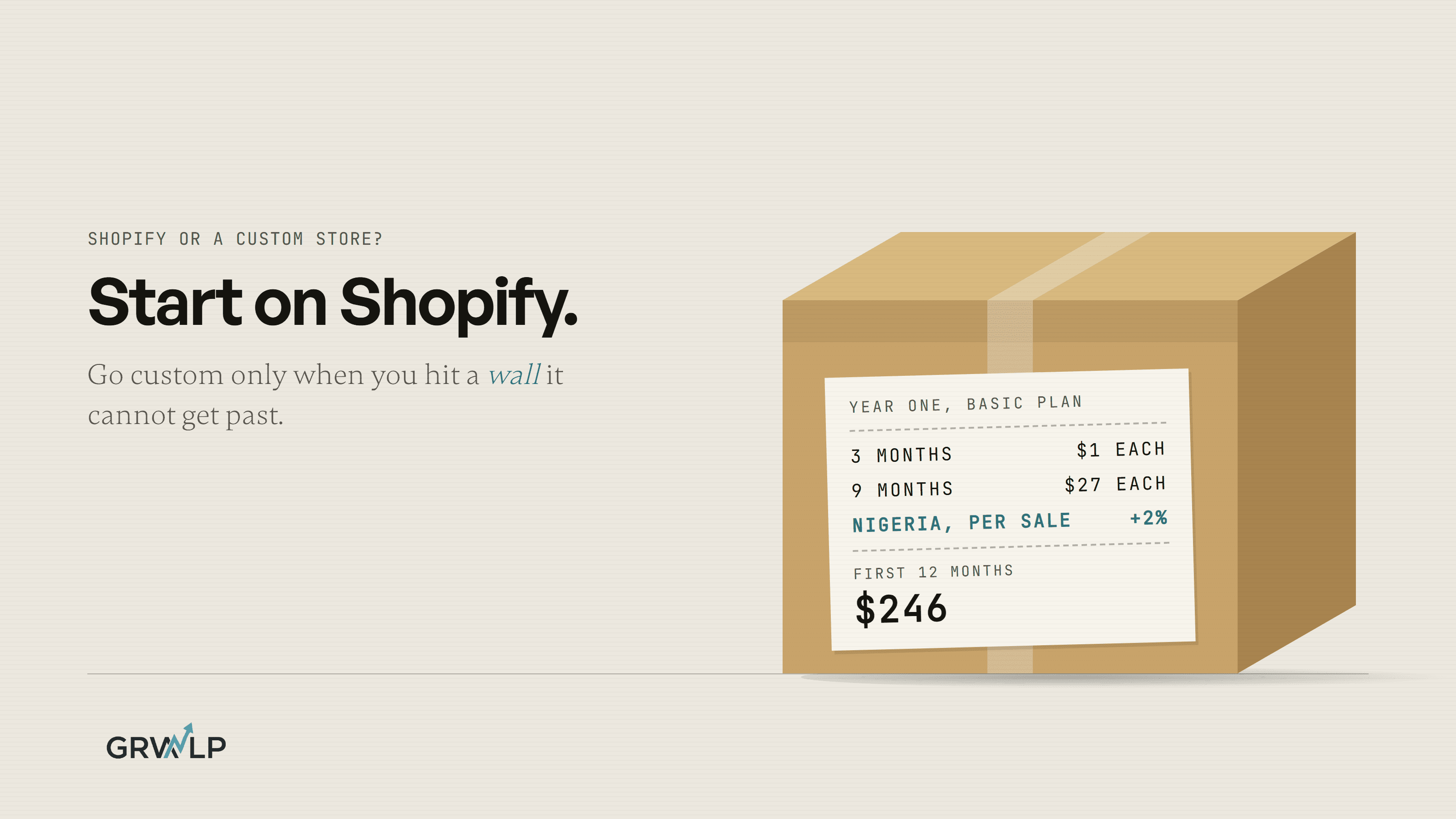
Start on Shopify. Build custom only when you hit one of three walls, and in Nigeria count the extra 2% before you choose a plan.
TL;DR
For a small online store, start on Shopify. It costs $27 a month on the Basic plan, handles payments, security and updates, and gets you selling in days. Build a custom store only when you hit a wall Shopify cannot get past. In Nigeria, budget for an extra 2% per sale on Basic.
Last updated 3 November 2026. Written by Oyekola Obajuwon, founder of Growveloper, a growth studio that builds the website, the marketing and the automation for owner run businesses in the United States, the United Kingdom and Nigeria.
For a small online store, start on Shopify. It costs $27 a month on the Basic plan, handles payments, security and updates, and gets you selling in days. Build a custom store only when you hit a wall Shopify cannot get past. In Nigeria, budget for an extra 2% per sale on Basic.
I build custom websites for a living, so this is not the answer I am paid to give. It is the right one for almost every store with a few hundred products or fewer.
What does Shopify cost a small store in the first year?
About $246 on the Basic plan if you pay monthly, before payment fees and apps. Shopify's pricing page says: "Try 3 days free, then $1/month for 3 months." After that, Basic is $27 a month. Three months at $1 and nine at $27 comes to $246 for the first 12 months. Paid yearly, Basic is $19 a month.
On top of that you pay a card fee on each sale, and some apps charge their own monthly price. Add the apps one at a time, only when a customer problem asks for one.
Shopify Basic or a custom store, the first year for a small shop
| Cost line | Shopify Basic | Custom store |
|---|---|---|
| Monthly platform | $27, or $19 paid yearly | Hosting, often small |
| Build | A theme, days of setup | From $2,000, weeks of work |
| Extra fee with a third party payment provider | 2% of each sale | None from a platform |
| Security, updates, checkout | Shopify runs them | You or your developer |
What does a custom online store cost?
More than the number on the quote. A custom website from me starts at $2,000, and what a small business website costs in 2026 explains what moves that number. A store adds a cart, a checkout, stock, tax, delivery rates and order emails, and each of those is work that has to be built, tested and kept running.
I have not built a custom store for a retail client, and I will tell you that before you ask. What I have built is a platform that takes payments. I built RideOn Nigeria's four portal platform alone, payments included, and six production cron jobs kept it running on schedule. You can read how that build went. What it taught me is simple: every job Shopify does for you becomes a job someone has to run. Checkout breaks at 2am on a Saturday? On Shopify that is Shopify's problem. On a custom store it is yours.
When is a custom store worth it?
When you hit one of three walls, and not before.
The product cannot be sold the way Shopify sells things
Made to measure items with a price that changes with every choice, rentals with deposits and return dates, a mix of bookings and products in one basket. Apps cover some of this. When you find yourself paying for four apps to fake one feature, the wall is real.
The store is a small part of a bigger website
If most of your visitors come to read, book or learn, and buying is one page of twenty, a custom site built around the content can make sense, with the shop kept on a platform behind it. That is closer to a website question than a store question; Wix or hire a developer covers how to decide.
The fees grow bigger than a build
This only happens at real volume. A store using a third party payment provider on Basic pays Shopify 2% of sales on top of the card fee. At $10,000 a month in sales, that is $200 a month. Before you leave Shopify over it, check the plans: Grow costs $45 a month more than Basic and drops the fee to 1%, so for a store on a third party provider it is the cheaper plan once sales pass $4,500 a month. That is my arithmetic on Shopify's own numbers.
Does Shopify work for an online store in Nigeria?
Yes, but it costs more per sale than it does in the US or the UK. Shopify Payments, Shopify's own way of taking cards, is only for businesses "located in one of the supported countries listed on this page". The US and the UK are on that list. Nigeria is not.
So a Lagos store takes payments through a provider like Paystack, which Paystack's own guide shows you add from Shopify's payment settings. Shopify's pricing page is plain about what that means: "Third-party transaction fees may apply when you use a third-party payment provider (instead of Shopify Payments)." On Basic, that fee is 2%.
What one order costs in fees
Take a NGN 20,000 order paid by a Nigerian card. Paystack's pricing page lists local transactions at 1.5% + NGN 100, with the NGN 100 waived under NGN 2,500 and every fee capped at NGN 2,000. Paystack's fee is NGN 400. Shopify's 2% is another NGN 400. That is NGN 800, or 4% of the order, before the monthly plan, which Shopify bills in dollars. My arithmetic, from the two pricing pages read on 3 November 2026. International cards cost more on Paystack: 3.9% + NGN 100.
None of that makes Shopify the wrong choice in Lagos. It makes the fee the number to check before you pick a plan, and the reason to keep selling through Instagram and WhatsApp until the store is paying its way.
Which Shopify plan should a small store start on?
Basic, paid monthly, until you have three months of real orders. Then look at two numbers: your monthly sales and whether you use Shopify Payments. If you do, Basic usually stays right for a long time. If you do not, and sales are over $4,500 a month, Grow is cheaper. Switch to yearly billing only for a plan you know you will keep.
Can I move from Shopify to a custom store later?
Yes, and that is the strongest reason to start on Shopify. Shopify's help pages show how to export your products, customers and orders as spreadsheet files, so the decision is not forever. Keep your own domain name in your own account from day one, so the address your customers know moves with you; do I own my website if a developer built it covers the logins to hold on to. And budget for upkeep whichever way you go; what website maintenance costs each month has the numbers.
If you are not sure which wall you are near, that is a 30 minute conversation, not a project. The web development work I do starts with a free 30-minute call, no pitch, and 20% off if we build, booked at cal.com/growveloper/30. Often the answer is to stay on Shopify and fix the store you have.
Sell first. The store you need will tell you what it is missing.
“Every job Shopify does for you becomes a job someone has to run.”
Written by Oyekola Obajuwon
Shopify or custom website · Shopify vs custom ecommerce · small online store platform · Shopify pricing 2026 · Shopify Nigeria Paystack · custom online store cost