My website doesn't produce leads. What do I check first?
Four checks in the order a customer meets your website, the free tool for each, and why the leak is rarely where the design is.
TL;DR
Check four things in the order a customer meets them: whether anyone is arriving, whether a stranger can tell what you sell within ten seconds, whether there is one obvious next step that works on a phone, and whether a real person replies within the hour. Fix the first one that fails, not the one you can see.
Last updated 23 September 2026. Written by Oyekola Obajuwon, founder of Growveloper, who builds the website, the marketing and the follow up for owner run businesses in Nigeria, the United States and the United Kingdom.
Check four things in the order a customer meets them: whether anyone is arriving, whether a stranger can tell what you sell within ten seconds, whether there is one obvious next step that works on a phone, and whether a real person replies within the hour. Fix the first one that fails, not the one you can see.
That last sentence is the whole article. The rest is how to run each check in an afternoon, for free, and what to do when one fails.
Why does the order matter so much?
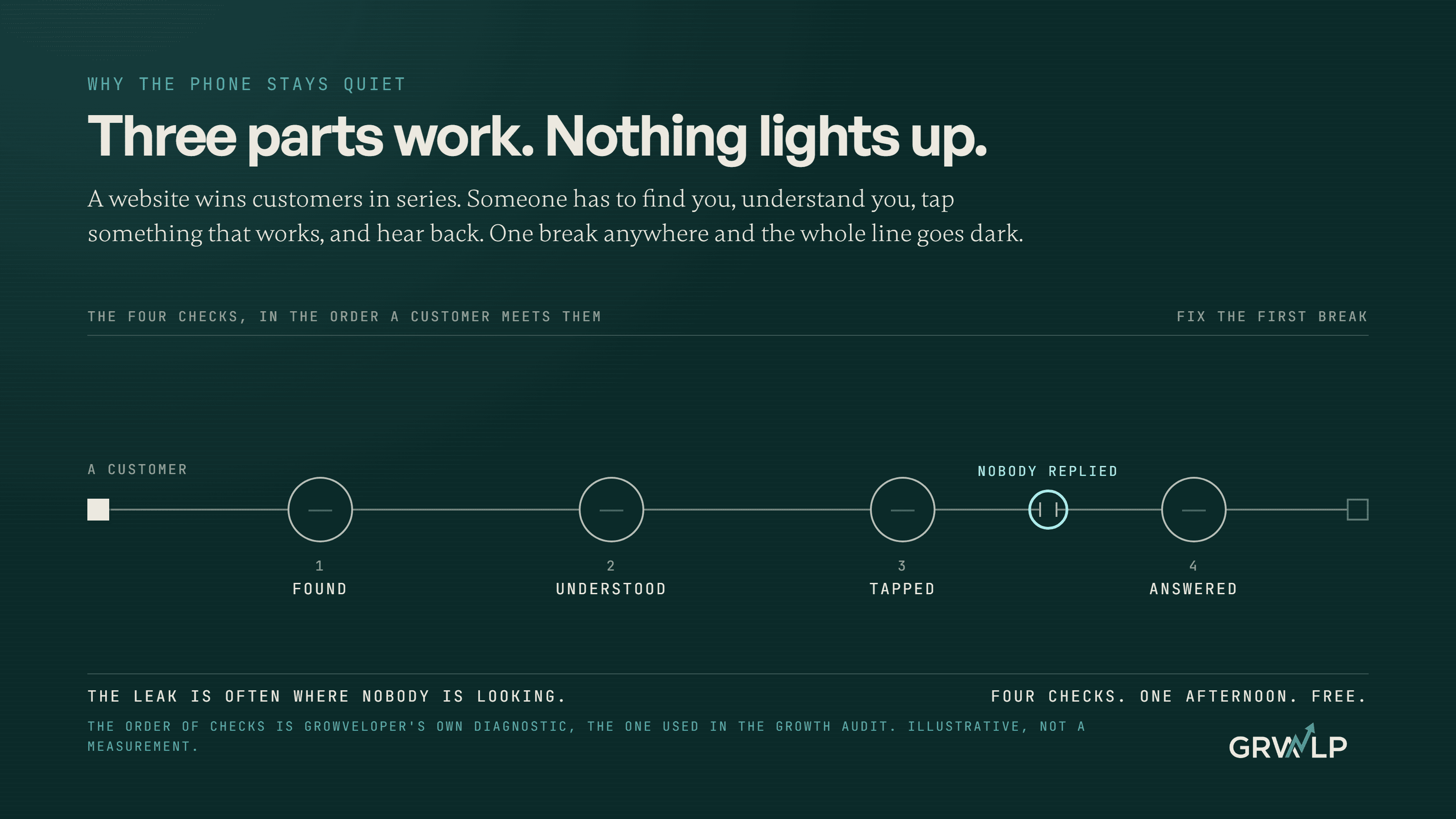
Because a customer walks through your website in a line, and a line is only as good as its first broken link.
Think of it as four gates. Someone has to find the site. Then they have to understand what you sell. Then they have to see what to do next and be able to do it. Then somebody at your end has to answer. Lose them at gate one and it does not matter how beautiful gates two to four are, because nobody reaches them.
The temptation is to start at gate two, because gate two is the one you can see. The homepage looks dated, a competitor's looks better, and a redesign feels like progress. Sometimes it is. Often it produces a lovely shop with the lights on and the door locked, and the owner concludes that websites do not work.
So go in order, and stop at the first gate that fails.
Is anyone actually arriving at my website?
This is check one, and it takes five minutes.
Open Google Search Console, which is free, and look at the Performance report for the last three months. Two numbers matter: how many times your site appeared in Google, and how many people clicked. If you use Google Analytics as well, note last month's visitors. Then write a second number beside it: how many enquiries you received in the same month.
Now you have the honest picture, and it usually lands in one of two places.
Almost nobody is arriving
Then the website is not your problem yet. A redesign makes a nicer room that nobody walks into. The work is being findable: your Google Business Profile, a page for each service you sell and each area you serve, and reviews. For a local service business that is most of the game, and none of it is a design job.
Plenty arrive, and nobody enquires
Then gate one is fine and the leak is further along. Keep going.
You will notice there is no benchmark here telling you what "plenty" means. That is deliberate. Published conversion rates mix industries, countries and definitions of a lead so freely that any single number would mislead you more than it helped. Your own two numbers, side by side, are the benchmark that matters.
Can a stranger tell what I sell within ten seconds?
Check two. It needs one other person and a phone.
Nielsen Norman Group, the usability research firm, found that people often leave a web page within 10 to 20 seconds, and that a page has to make its value clear inside those first seconds to earn a longer visit. That was published in 2011, and phones have not made anyone more patient since.
So run the test. Hand your homepage, on a phone, to someone who does not know your business. Give them ten seconds, then take it back and ask three questions. What do we sell? Who is it for? Where do we work?
If they cannot answer all three, you have found your leak. The fix is almost always words, not design: a headline that names the thing you do and the place you do it, instead of a line about passion and excellence. "Emergency plumbing in Ikeja, at your door within the hour" beats "Quality you can trust" every time, because the second sentence could sit on any website in the world.
Is there one obvious next step, and does it actually work?
Check three. This is where perfectly good websites quietly fail.
Look at your homepage on a phone and ask: what is the one thing I want a visitor to do? Call, fill in a quote form, send a WhatsApp message, book a slot. Now check that the one thing is visible without scrolling, that it is one thing and not six, and that it works.
Then test it properly. From your phone, on mobile data, fill in your own form with your thumb. Tap your own phone number and see whether it dials. Tap the WhatsApp button and see whether it opens a chat or an error. This is the check most likely to surprise you, because on plenty of websites nobody has tried the form since the day the site went live.
If you want to see what real visitors do rather than guess, install Microsoft Clarity, which is free. It records sessions and flags "dead clicks", places people tapped where nothing happened, and "rage clicks", the same spot tapped again and again in frustration. A button that looks like a button but is not one shows up within a week.
Does anyone actually reply, and how fast?
Check four, and the one owners skip, because it is not on the website at all.
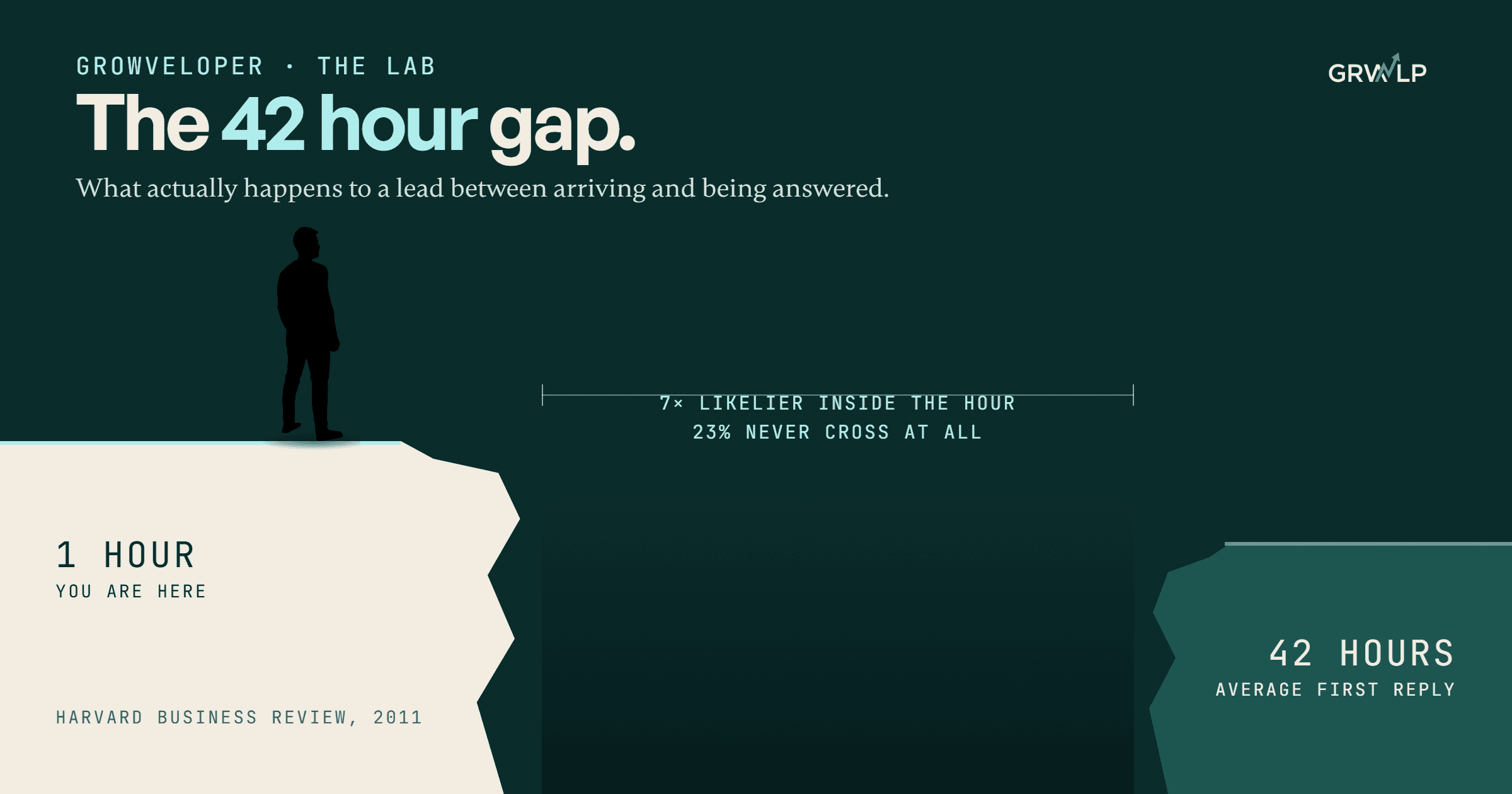
The form works. The email lands. And then it sits, because the reply depends on a person noticing an inbox between jobs. When Harvard Business Review audited 2,241 United States companies in 2011, the average time to answer a web enquiry was 42 hours, and 23% of the companies never answered at all. The same article reported a separate study of 1.25 million leads: firms that tried to reach a new enquiry within an hour were nearly seven times as likely to have a real conversation with the decision maker as firms that waited even one hour more.
Two honest notes on those numbers. They are fifteen years old. And one of the authors ran a company that sold lead response software, which the article discloses. The research is still real, and still the best published measurement of this. The direction it points has never been seriously disputed.
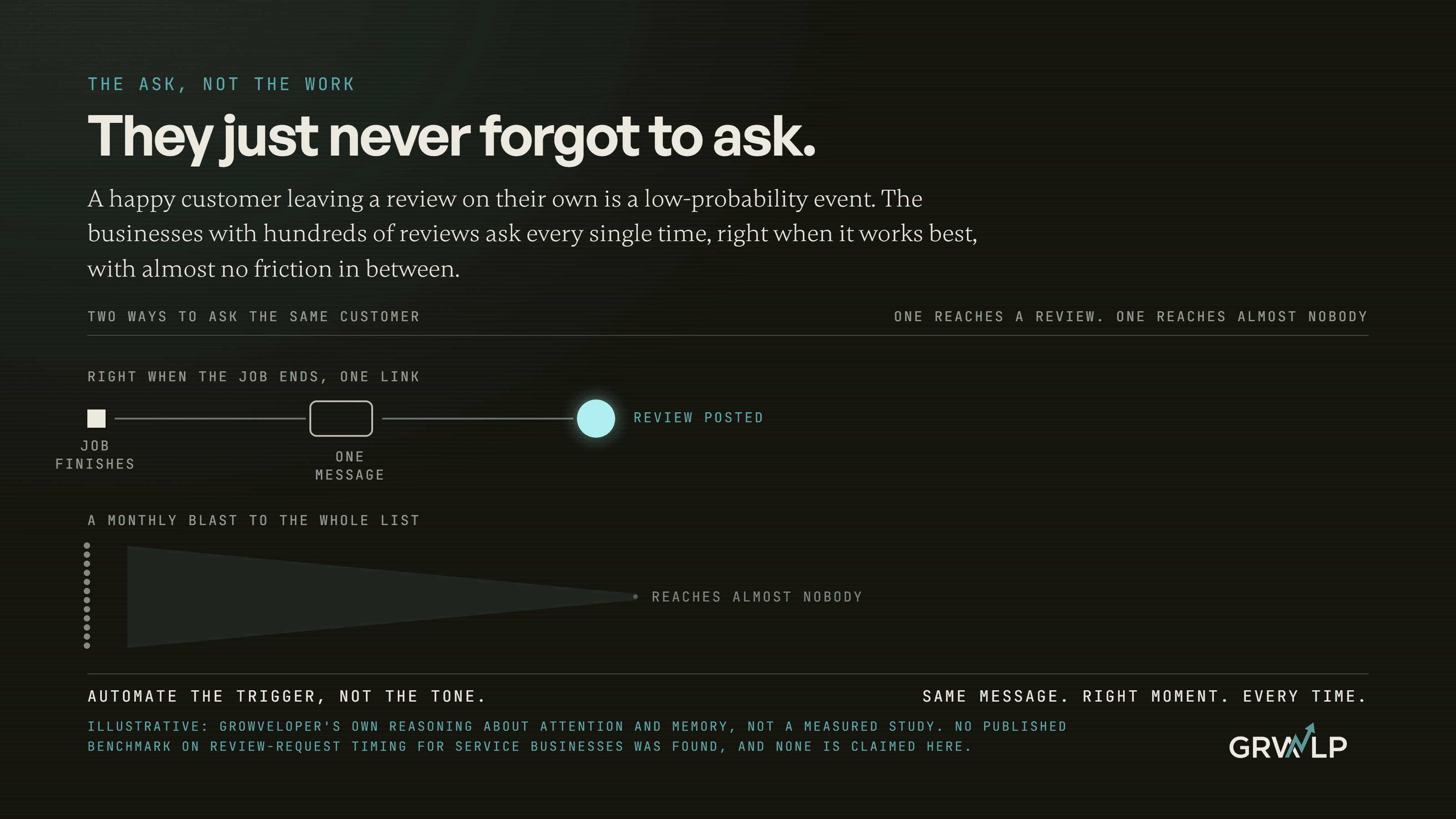
So send yourself an enquiry, the way a customer would, and time how long it takes a human to answer. If the answer is "tomorrow", your website may be producing leads right now. They are just going cold before anyone sees them. We have written about the gap between an enquiry arriving and anyone noticing, and the fix is covered step by step in how to automate lead follow up: an instant acknowledgement, a booking link, and an alert to whoever is on duty.
The four checks, in the order a customer meets them
| Check | What you notice | What to measure | Free tool |
|---|---|---|---|
| 1. ArrivingGet found first. Do not redesign yet | Nobody calls, and the site feels quiet | Clicks from Google last month | Google Search Console |
| 2. UnderstandingRewrite the headline in plain words | People visit but do not stay | Can a stranger name what you sell in 10 seconds | Another person and your phone |
| 3. ActingOne obvious next step that works | Visitors browse and leave | Does your form, call button and WhatsApp link work on a phone | Your own thumb, then Microsoft Clarity |
| 4. Being answeredInstant reply and an alert, before any design work | Enquiries arrive, sales do not | Minutes from enquiry to a human reply | A test enquiry and a clock |
What happened when a business could not even see its own leak?
The clearest example on this site is a Lagos company that could not have run check one if it wanted to.
Baye Business Solutions is a cloud services and IT company of about twenty five people, a Microsoft Cloud Solutions Provider with partnerships across Microsoft, Adobe, Kaspersky, Cisco and others. Real clients, real expertise. None of it showed up online. The website had broken links, "Microsft365" misspelled in the navigation, and eight categories of service with not one page of their own. It had no analytics, no Google tracking and no intake forms.
Read that list again as a diagnosis. Gate one could not be measured, because nothing was counting visitors. Gate three did not exist, because there was no form to fill in. A business in that position does not know whether its website is failing. It only knows the phone is quiet.
The rebuild gave every service its own page, added a blog, and put analytics and Microsoft Clarity in from the first day. The line in the Baye Business Solutions case study that matters most is not about design at all: for the first time, the company could see who visited and where they dropped off. Everything after that was fixing things they could finally see.
Should I just redesign my website?
Only if check two or check three failed, and only after check one and check four have passed.
A redesign is the most expensive fix on this list and it addresses two of the four gates. If nobody is arriving, it cannot help. If nobody is replying, it cannot help either, and it can make things worse, because a better site sends more enquiries into the same silent inbox.
When a rebuild is the right call, it is usually because the thing you need next is something your current platform will not let you do. That decision has its own article in should I use Wix or hire a developer, and what we build and what it costs is published on our web development page.
Is it my website or my marketing?
Checks one and four are marketing and operations. Checks two and three are the website. That split is useful, because it tells you who to call.
If gate one fails, you need someone who can make you findable: search, maps, reviews, and paid ads only once the rest works. If gate four fails, you need a system that answers for you in the minutes after an enquiry lands. If two and three fail, you need words and a working page. If only one gate failed and the other three held, that is good news. It means the fix is small.
Our growth marketing page covers the first case. The trouble starts when the three are bought from three different people who never compare notes, and the leak sits in the gap between them.
When is it time to get help?
When you have run the four checks and either cannot tell which gate failed, or know exactly which one and do not have the hours to fix it.
The Growth Audit is this same diagnosis done properly: every gate measured, the leak named, and a written plan you keep whether or not you hire us. If you would rather just talk it through, the free call is thirty minutes and no pitch.
But run the checks first. Most of them cost nothing but an afternoon. Pick up your phone, open your own website on mobile data, and try to become your own customer. The place you get stuck is the place your customers got stuck first.
“A redesign fixes the step you can see. The leak is usually at the step nobody is measuring.”
Written by Oyekola Obajuwon