What is answer engine optimization, and how does a small business do it?
Answer engine optimization is writing pages an AI assistant can quote. The five things for a one person business, and how to check yours.
TL;DR
Answer engine optimization is writing pages an AI assistant can quote when somebody asks a question you can answer. For a one person business it is five things: one page per question, the answer in the first paragraph, one fact only you have, the same business details everywhere, and a mention on a site you do not own.
Last updated 15 September 2026. Written by Oyekola Obajuwon, founder of Growveloper, who builds the website, the marketing and the follow up for owner run businesses in Nigeria, the United States and the United Kingdom.
Answer engine optimization is writing pages an AI assistant can quote when somebody asks a question you can answer. For a one person business it is five things: one page per question, the answer in the first paragraph, one fact only you have, the same business details everywhere, and a mention on a site you do not own.
None of that is new work. What is new is which of it gets rewarded, and this page includes the part where we tried it on ourselves and do not yet know if it worked.
What does answer engine optimization actually mean?
It means being quotable. That is the whole shift in one word.
Search used to end with a list of links, and your job was to be high on the list. A growing share of searches now end with a written answer that mentions two or three businesses and moves on. Nobody scrolls, because there is nothing to scroll. So the job changed from being ranked to being quoted.
Kevin Indig of Growth Memo describes the change as a swap of three verbs. The old pipeline was crawl, index, rank. The new one is retrieved, cited, trusted. A retrieval system decides which pages are even candidates, the model picks which of those candidates to quote, and the reader decides which quote to act on. You can be findable and never be quoted, which is exactly the position most business websites are in right now.
Answer engine optimization, usually shortened to AEO, is the work of moving from findable to quoted. It is not a product, it is not a plugin, and for a business under twenty people it is mostly writing.
Is it different from SEO, and what about GEO?
Barely, and the honest answer matters because the difference is what people are being overcharged for.
Nathan Gotch, who has spent years inside search optimisation, puts it plainly: there is no successful GEO or AEO without effective SEO. The foundations do not change. A page still has to be reachable, load properly, and be about something. Google says the same thing about its own AI features. Its guidance on generative AI features in Search states that those features run on core Search ranking, that no AI specific markup or file is required, and that writing separate content aimed at AI risks falling foul of its scaled content abuse policy. When the platform owner tells you there is no secret handshake, believe the platform owner.
The three acronyms, in the words a business owner needs
| The term | The question it answers | What actually changes for you |
|---|---|---|
| SEO, search engine optimisationNo | Will Google show my page in a list of links | Nothing. It is still the floor everything stands on |
| AEO, answer engine optimisationNo, it is SEO with the answer moved up | Will an assistant quote my page inside its answer | Move the answer to the top of the page and write one page per question |
| GEO, generative engine optimisationNo, it is the same discipline named after a different engine | Will a generated answer mention my business at all | The same work, plus being mentioned on sites you do not own |
So treat the acronyms as marketing. If somebody quotes you separately for SEO, AEO and GEO on the same website, you are being billed three times for one job.
Why would a small business bother?
Because this is the one search surface where being small stops being a disadvantage, and there is a number behind that.
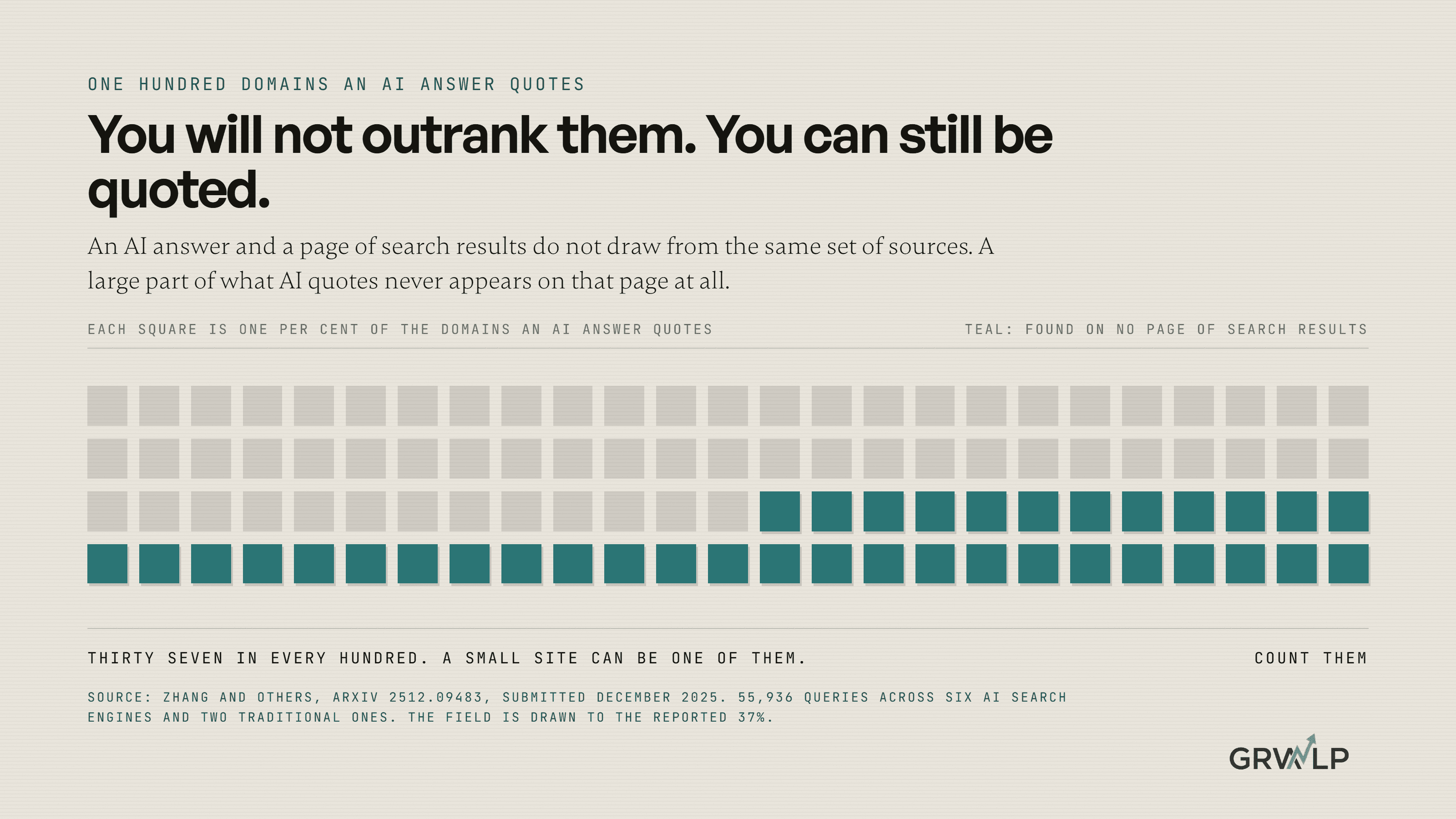
A team at Queen Mary University of London and collaborators compared what AI search engines cite against what traditional search engines return, across 55,936 queries on six AI search engines and two traditional ones, in a paper submitted in December 2025. Their finding: AI search engines cite a wider spread of sources, and 37% of the domains they cite are unique to them.
Read that slowly, because it is the most useful sentence in this article. More than a third of what AI quotes never appears in traditional search results for the same question. On Google you are queuing behind whoever has fifteen years of links. In an AI answer, a page that answers the question cleanly can be quoted without ever ranking.
That is not a promise that it will be. It is the reason the odds are better here than anywhere else on a small budget, and it is why a one person business in Lagos or Leeds should spend an afternoon on this rather than dismissing it as something enterprises do.
What are the five things that actually matter?
Five, in this order, and all five are free.
One page per question, and the question is the title
Not one page per service. One page per thing a customer actually asks. "How much does a small business website cost" is a question. "Solutions" is not.
This sounds obvious until you check your own site. Baye Business Solutions, a cloud services company in Lagos with about twenty five staff, offered eight service categories and had a page for none of them. Their navigation had "Microsft365" misspelled in it and a link that pointed at an unrelated domain. Real expertise, real clients, and nothing on the web that could be quoted about any of it. The rebuild gave every service its own page, and a blog, and analytics for the first time, which is written up in the Baye Business Solutions case study. Nobody can quote you on a question you have never answered in public.
The answer in the first sixty words
Put the answer at the top. Then explain it, argue it, and tell the story underneath.
This is the single most consistent trait we found in pages that get cited, and we did not read it in a blog, we measured it. On 31 July 2026 we opened nine pages that AI search was citing on our own topics and inspected each one. All nine opened with the answer. Not one opened with a story or a scene. Several signposted it with a heading that said so outright, the plainest being a literal "TL;DR" sitting above everything else.
It feels wrong to write. It gives away the ending in the first line. Do it anyway. A reader who stops after your first paragraph got what they came for, and an assistant that reads only your first paragraph has something it can lift.
One fact only you have
The strongest single differentiator we measured was not length, structure or schema. It was original data.
The shortest page in our audit was 910 words, had almost no structured data, no questions block and no question shaped headings. It got cited anyway, because it published its own survey of 228 practitioners across 32 countries with a stated method. It was competing against 3,000 word guides from companies worth billions, and winning on the strength of having counted something itself.
You can count something. How many enquiries you got last month and how fast you answered them. What five jobs actually cost in your trade in your city this year. How long a permit really takes. Publish it with your method and the date, and you own a fact that cannot be paraphrased from anybody else.
The same business details in every place they appear
Your business name, your address, your phone number and your one line description, identical everywhere: your own site, your Google Business Profile, your directory listings, your social profiles.
This is dull and it is the mechanism. An AI system builds a picture of who you are by seeing the same details agree across many places. Three slightly different company names and two old addresses do not read as three mentions, they read as uncertainty. Our baseline measurement found directories cited in every single topic we tested, which is why a listing on somewhere like Clutch earns its afternoon.
One mention on a site you do not own
Your own page is not the finish line. Gotch's point is that an AI answer is typically assembled from around thirty five citations, so your own site is one voice in a crowd, and the crowd is where the argument is won.
For a small business that means one genuinely helpful answer in a forum where your customers ask questions, one comment under a video on your trade, one mention in a local publication. Not a link campaign. One place a month where your business is discussed by somebody who is not you.
The five things, by what they cost you
| What to do | How long | What it costs |
|---|---|---|
| Retitle one page as the question a customer typesEvery page we saw cited answered a question a person would type | An hour | Nothing |
| Move the answer into the first sixty words of that pageAll nine cited pages we opened did this; none opened with a story | An hour | Nothing |
| Publish one number you counted yourselfA 910 word page with its own survey outcompeted 3,000 word vendor guides | A day | Honesty |
| Make your name, address and description identical everywhereDirectories were cited in all five topics we measured | A morning | Nothing, or a directory fee |
| Get discussed once somewhere you do not ownYour own page is roughly one citation out of about thirty five | Ongoing | Time, not money |
What does a page that gets quoted look like?
Less polished than you would guess, and the surprise in our audit was what did not matter.
Length did not matter. The cited pages ran from 910 words to 4,860, so nothing about volume predicted anything. Structured data did not gate it either. The most disciplined page in the set, from a company selling sales software, carries no structured data at all and still gets quoted. Meanwhile the smallest domain in the set used the fullest structured data stack and won its top spot with it, which reads as structured data helping a small site punch up rather than being a requirement.
What every cited page had was the answer at the top, headings shaped like questions, and either named sources or its own data. Three things. That is the actual specification, and it is a writing brief rather than a technical one. The long version of this measurement, page by page, is in how to get your website cited by ChatGPT.
What happened when we ran this on ourselves?
We got zero. It is worth telling you that properly, because every other page on this subject is a success story.
On 9 and 10 September 2026 we ran 62 prompts through ChatGPT across five topics we sell into: growth engineering, web development for small business, growth marketing and search, AI and automation, and local service businesses. Growveloper was cited zero times. Not in one topic. Not once in 62.
Then we looked at who was cited instead, and the pattern was uncomfortable and useful. Every source quoted was one of three things: a directory, a tool vendor, or an article that answered the exact question in its first paragraph. And service pages were never cited, in any topic. Our own services are described on perfectly good service pages. They were invisible, because a page that describes what you sell does not answer anything.
Worse, when we audited our best page against the rules above, it passed almost all of them. Answer in the first 33 words. Questions as headings. Sixteen named outside sources. A number we had worked out ourselves. It had been cited zero times too.
So we started publishing articles that answer one question each, two a weekday. This is the seventh. Our own growth marketing page tells clients to expect first citations in 60 to 90 days. We are six days in, the count is still zero, and that is exactly what the sixth day of a sixty day process should look like. When the number moves we will put it on this page. If it does not move we will put that here too, which is a promise worth more than a case study.
How do I tell whether it is working?
Three checks, and two of them are free.
Ask the assistants yourself, deliberately and in writing. Write down ten questions a customer would type before hiring you, put each one into ChatGPT and into Google, and record who gets named. That list is your baseline. Repeat it monthly. This is unglamorous and it is the only measurement nobody can sell you a distorted version of.
Then watch where the visits come from. Microsoft Clarity, which is free, and Google Search Console, also free, will both show you traffic arriving from AI tools, and Clarity additionally reports which prompts and which cited domains it sees on your topics. That second report is the one this whole article is built on.
Then judge it on enquiries, not on visibility. There are figures circulating that claim visitors arriving from AI convert several times better than visitors from search. We have not been able to trace any of them to a study with a stated sample, so this page will not print one, including the version of it on our own marketing page. What is true without needing a statistic is narrower and still worth having: an answer that names your business reaches somebody who was choosing a supplier, whether or not they click.
What is not worth your time?
Three things people will sell you, in rising order of annoyance.
A separate AEO retainer on top of an SEO retainer, for the reason in the third section: it is one job. A file added to your website for the benefit of AI crawlers, which no major engine has committed to reading and which Google's own guidance says is unnecessary, so it costs an hour and proves nothing. And a tool that promises to monitor your AI visibility across every engine, which for a business with zero mentions tells you what you already know, at a monthly price.
Buy none of those until the five free things are done. That order is the actual advice, and it is the opposite of what anybody with a product to sell will give you.
The one technical item worth checking is speed, because a slow page can be dropped from consideration before any of this matters. Indig treats a server response under 200 milliseconds as pass or fail for entering the candidate set at all. That is a hosting question rather than a writing one, and it belongs on the list of things to ask whoever runs your website.
Where should a small business start on Monday?
One page. Not a strategy, not an audit, one page.
Pick the question you are asked most often on the phone, the one you answer so routinely that you have stopped hearing it. Write the page whose title is that question in the words the customer uses. Put your answer in the first sixty words. Add one number you counted yourself. Link it to the service it belongs to, and to the two other pages on your site that touch it. That is a morning.
Then do the second one next week. Ten pages in, you have the thing the 62 prompts showed us was missing from almost every small business site we looked at: somewhere to be quoted from. The broader argument for treating your site, your marketing and your follow up as one system rather than three is in what growth engineering is, and if you would rather have somebody run the measurement for you, that is what the Growth Audit is and it arrives as a document you keep.
But you do not need any of that to start. Open the page on your own site that should answer your most common question. If it takes you more than ten seconds to find the answer on it, an assistant reading that page never found one either, and now you know precisely what Monday morning is for.
“More than a third of the domains AI search engines cite never appear in traditional search results for the same query. That is the door a small business can walk through.”
Written by Oyekola Obajuwon