Who runs Google Ads for small businesses that actually convert?
How to choose someone to run your Google Ads: what a conversion really is, what the Partner badge measures, and who should own the account.
TL;DR
Hire the Google Ads manager who asks what a customer is worth to you, and how you will know one came from the ads, before they mention keywords. The Google Partner badge and the optimisation score measure an agency's spending and how much of Google's advice it acted on, not your customers. And keep the account in your own name.
Last updated 1 October 2026. Written by Oyekola Obajuwon, founder of Growveloper, a growth studio in Lagos that builds the website, the marketing and the follow up for owner run businesses in Nigeria, the United States and the United Kingdom.
Hire the Google Ads manager who asks what a customer is worth to you, and how you will know one came from the ads, before they mention keywords. The Google Partner badge and the optimisation score measure an agency's spending and how much of Google's advice it acted on, not your customers. And keep the account in your own name.
You have probably seen the report. Impressions, clicks, a click through rate, a cost per click, and a line called conversions with a respectable number beside it. What it did not have was the number of people who paid you. That gap is the whole subject of this piece, and it has a short name: it is not the ads, it is the tracking.
Who runs Google Ads for small businesses that actually convert?
Freelancers, agencies and studios all do, and the label tells you very little. What tells you more is three habits you can check before you sign: they decide with you what a conversion is, they connect those conversions to people who paid, and they leave the account in your name. The rest of this piece is how to check.
What does "conversion" mean inside a Google Ads account?
Whatever someone set it to mean. Google's own explanation of conversions says it plainly: "You choose what you identify as valuable, like a purchase, sign-up, or phone call." A conversion can be a paid order. It can also be a visit to a thank you page, a tap on a phone number, or a call that lasted long enough.
That last one is a setting too. For calls from ads, Google's phone call conversion page says "you set a minimum call length, and every call that lasts at least that long is counted as a conversion." For taps on a call button in an ad, it counts "based on Google's estimation of whether a meaningful phone call occurred."
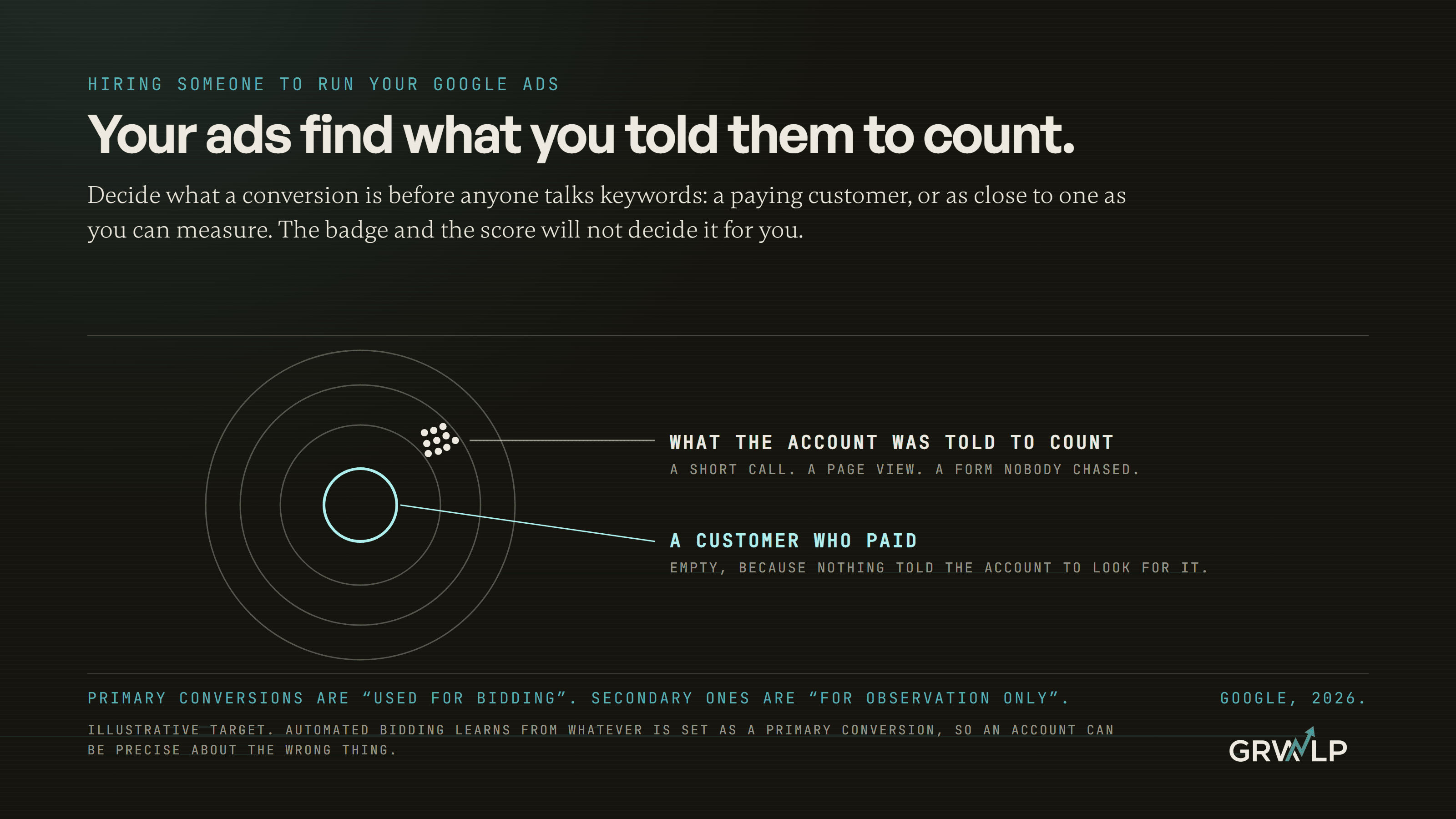
Here is why it matters more than anything else in the account. Google splits conversion actions into primary and secondary. Primary ones are "reported in the 'Conversions' column in your reports and used for bidding". Secondary ones "are for observation only." So the automated bidding, the part that decides how much to offer for each search, is trained on the primary conversions. Set it to count short calls and it will get very good at finding short calls. Set it to count a page visit and it will find you visitors.
What does the Google Partner badge actually mean?
That the agency spends enough, has certified staff, and keeps its accounts in line with Google's recommendations. Google's Partner requirements are three: a "minimum optimization score of 70%", "a 90-day ad spend of $10,000 USD across managed accounts", and "a minimum of 50% of your account strategists certified in Google Ads". Google checks them "on a daily basis."
Read the second one again. Ten thousand dollars over three months, across every account the agency manages, put together. Nothing in the three requirements is about any client's leads, customers or cost per customer. The badge tells you the agency is real and active on Google's platform. It does not tell you your phone will ring.
What the signals in a Google Ads pitch actually measure
| Signal | What it measures | What it does not tell you |
|---|---|---|
| Google Partner badge | Spend across all managed accounts, certified staff, a 70% optimisation score | Whether any client got customers |
| Optimisation score | How the account is set up against Google's own recommendations | What a customer costs you |
| Conversions in the report | Whatever was set as a primary conversion | Whether those people paid |
| Clicks and impressions | Attention | Anything about revenue |
Is a high optimisation score a sign of a good account?
It is a sign of a tidy one. Google's definition is "an estimate of how well your Google Ads account is set to perform", calculated from the account's "statistics, settings, and the status of your account and campaigns, the relevant impact of available recommendations, and recent recommendations history." Applying or dismissing a recommendation changes it. The score rewards attention to Google's suggestions, which is worth something, but it is Google's view of the setup, not your view of the results.
I can say this with some feeling. When I ran paid media at VIP Creative Studio, the Google Ads account for one of its US credit union clients sat at a 99.9% optimisation score. It is in my notes as a proof point and it is the least useful number there. The useful one is in the case study: 250 credit card application events. That number exists only because someone set up tracking to count a submitted application, not just a click or a page view.
How do I know which leads became customers?
You tell Google, after the fact. A form or a call is a lead. Whether it became a customer is something only your business knows, usually a day or a month later. Google's enhanced conversions for leads exist for exactly this: the business imports which leads became customers, matched by details such as the email address the person gave, so the bidding can learn from the leads that paid rather than every form.
That needs one thing most ad accounts are missing: a single record where each lead lands and gets marked as won or lost. Our piece on what a connected website and marketing setup actually means walks through that chain, and automating lead follow up covers making sure each lead gets answered at all. An ads manager who never asks where your leads end up cannot do this part.
What is a good conversion rate or cost per lead for a small business?
There is no honest single number, and the best known one shows why. LocaliQ, which sells advertising, publishes home services search benchmarks from 3,211 US campaigns run by its own customers between April 2024 and March 2025, using medians: a 7.33% conversion rate and $90.92 per lead overall, and $127.74 per lead for air conditioning installation and repair. The page does not say what counted as a lead. Each campaign counted whatever it was set to count, which is the problem this whole piece is about.
Use benchmarks as a rough range for cost per lead, then measure the number no benchmark can give you: what a paying customer cost. If you run a heating and cooling company, our guide to getting more HVAC leads online covers Google's pay per lead ads, where the counting works differently.
Whose name should the Google Ads account be in?
Yours. An agency can do everything it needs as a user on your account or through its own manager account linked to yours. Google's page on manager account ownership says "the client account still owns its data and has the ability to remove ownership access by unlinking," and that "a manager should be made owner if and only if the manager account requires these privileges."
The account's history, every conversion it has learned from, is the part you cannot rebuild quickly. If the agency opened the account and keeps it, that history stays with them when you leave. The same rule applies to your domain and your website, which our piece on freelancers, agencies and studios sets out.
What should I ask before I hire someone to run my Google Ads?
Ask these in order. The order matters: the last one is the easiest to answer well.
Questions to ask a Google Ads manager, in order
| Ask | A good answer | A worrying answer |
|---|---|---|
| What will count as a conversion? | Something you agree is a customer, or close to one | "We track all conversions" |
| How will we know which leads paid? | Importing won leads back into Google | "The algorithm learns automatically" |
| Whose name is the account in? | Yours, with them as a user or linked manager | Theirs |
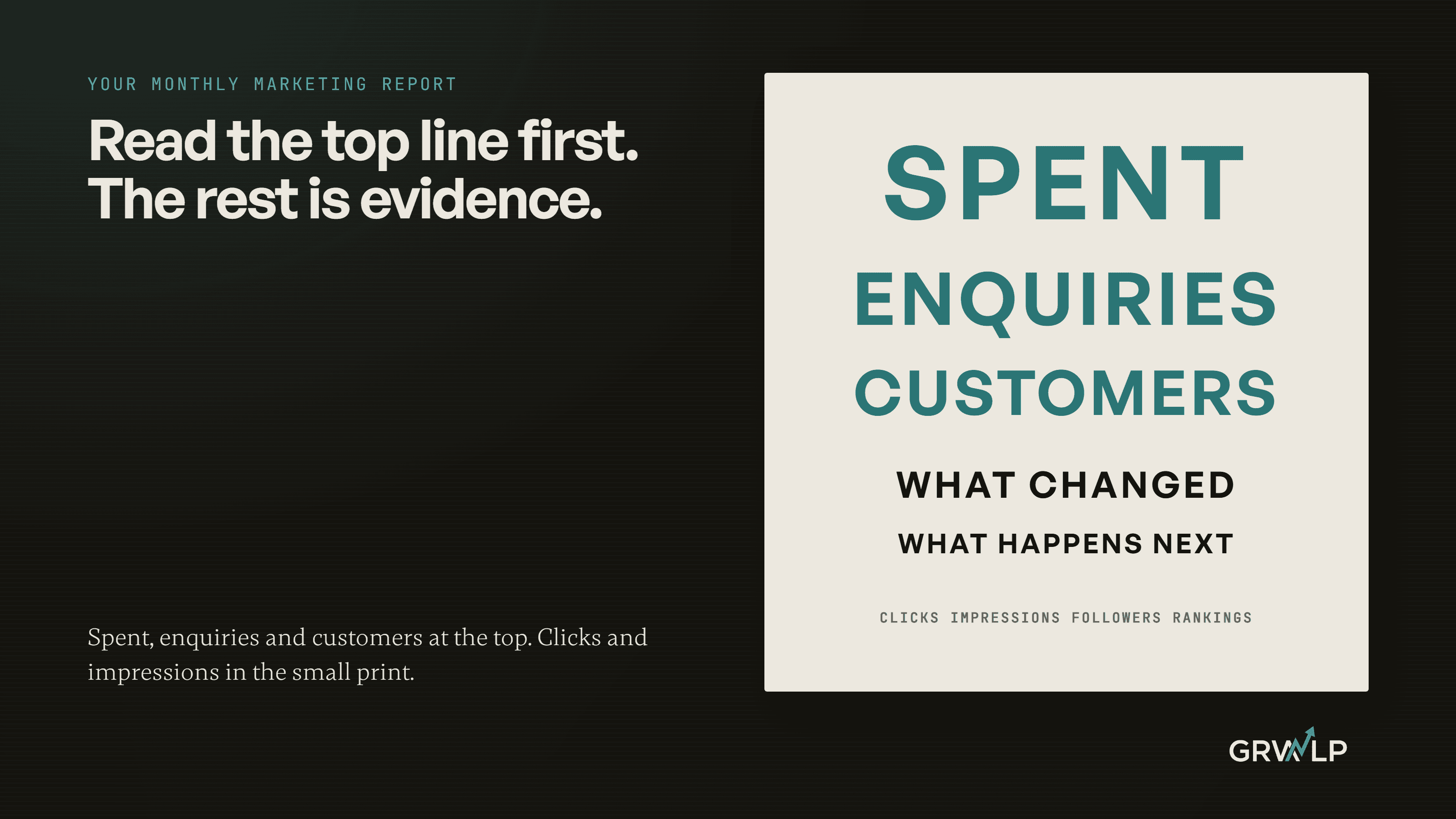
| What will the monthly report show? | Cost per lead and per paying customer | Impressions, clicks and the score |
| Which keywords and budget? | Comes after the four above | Comes first |
Running ads like this is part of our growth marketing work, and the paid Growth Audit looks at an existing ad account's structure and tracking if you want a second opinion before hiring anyone. Our interest is stated: we sell this. The questions work just as well on whoever you choose instead.
A Google Ads account gets very good at finding whatever you told it to count. Hire the person who asks you what that is before they ask for your budget.
“A Google Ads account gets very good at finding whatever you told it to count. Decide what that is before anyone spends a dollar.”
Written by Oyekola Obajuwon