My website and my marketing should be connected. What does connected actually mean?
What "connected" really means, the ad, the page, the form, the CRM and the reply sharing one record, and where that chain usually breaks.
TL;DR
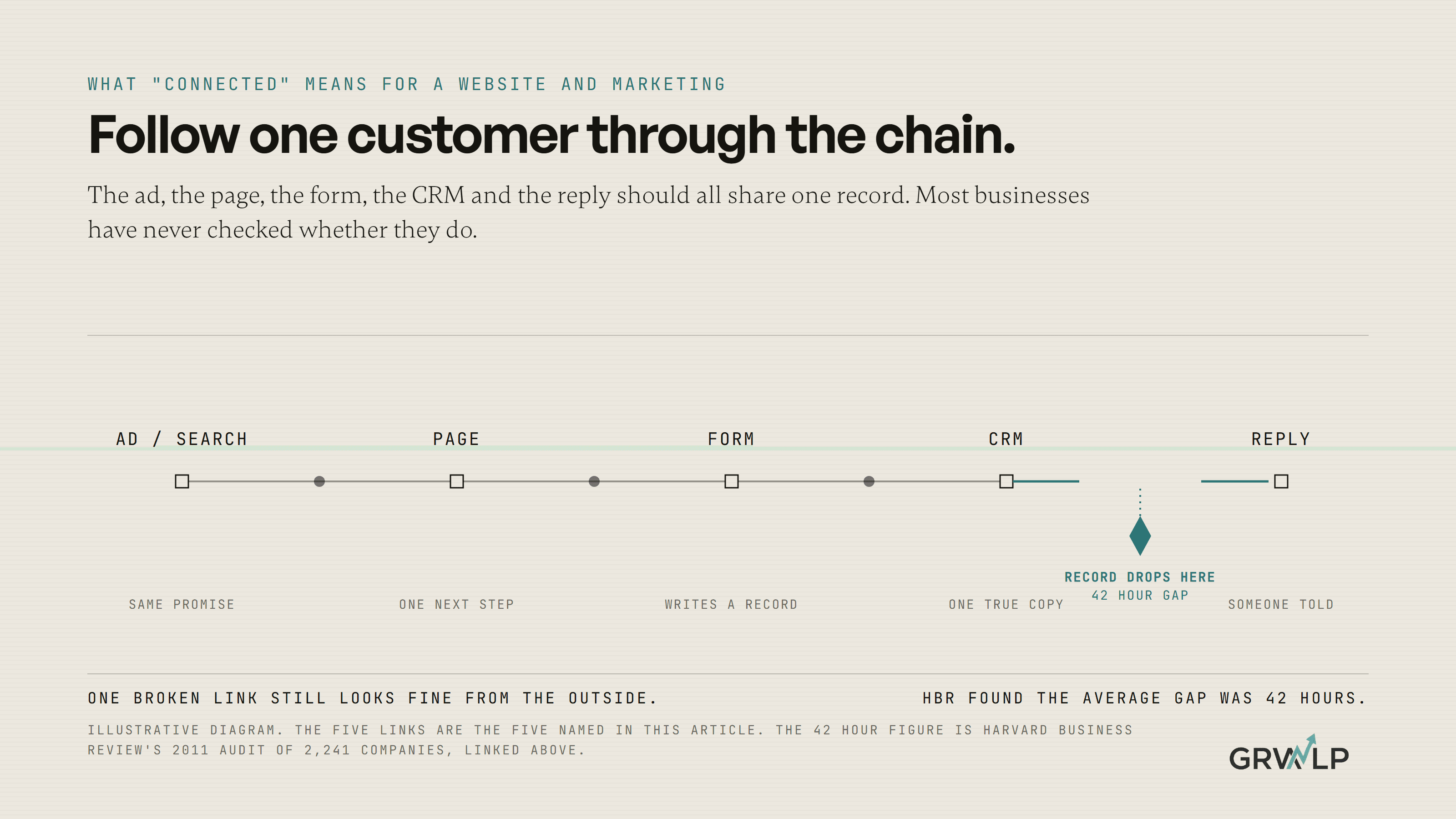
Connected means five things share one record: the ad or search result, the landing page, the form, the CRM, and the reply. Each is a link in a chain. When one link keeps its own copy of the customer instead of writing to the same record, the chain breaks there, usually silently.
Last updated 26 September 2026. Written by Oyekola Obajuwon, founder of Growveloper, who builds the website, the marketing and the follow up for owner run businesses in Nigeria, the United States and the United Kingdom.
Connected means five things share one record: the ad or search result, the landing page, the form, the CRM, and the reply. Each is a link in a chain. When one link keeps its own copy of the customer instead of writing to the same record, the chain breaks there, usually silently.
"Your website and your marketing should be connected" is true and useless in the same breath, because nobody ever says which five things, or how to check your own business against them. Here they are, and here is how to find the one that is not actually joined to the others.
What does "connected" actually mean for a website and marketing?
It means one customer stays one customer, all the way through.
Picture someone who searches for what you do, clicks your result, reads your page, fills in a form or messages you, and then waits to hear back. That is one person having one experience. "Connected" means every system that touches them along the way, the ad or listing, the page, the form, the CRM, and whoever replies, is working from the same record of that person, not five separate ones. The opposite of connected is not "no marketing". It is marketing that works, that brings someone to a page that works, that leads to a form that works, and still loses them somewhere in the middle because two of those four never agreed on who the customer was.
What is the first link: does the ad or search result match the page?
The promise and the page have to be the same sentence.
If your ad, your Google Business Profile listing, or your top search result says "same day plumbing repairs" and the page someone lands on is your homepage with a list of nine services and no mention of same day anything, you have already lost the connection, even though the ad and the page both technically work. Connected means whatever brought someone in, an ad, a search result, a WhatsApp forward, a business card, says the same thing the page says, in close to the same words.
What is the second link: does the page give one clear next step?
A page that answers everything and asks for nothing is not connected to anything.
Nielsen Norman Group's research on how people read web pages found that users often leave a page within 10 to 20 seconds, and a page has to make its value clear inside the first ten to hold their attention. A page can be beautifully written and still be a dead end if it never tells the visitor what to do next, call, message, book, or fill in a form, in one obvious place. If your page's only "next step" is a phone number in small type at the bottom, the page is not connected to the rest of your funnel. It is on its own.
What is the third link: does the form actually create a record?
A form that only sends you an email is not connected. It is a messenger with no memory.
The test is simple: when someone submits your form, does a system somewhere now hold their name, their question, and the date, in a place you or your team can find again next week? If the honest answer is "it's in my inbox somewhere", the form is disconnected from everything after it, no matter how well it was designed. How to connect your website to WhatsApp, your CRM and your calendar sets out exactly what "writing to a record" looks like for a form, a WhatsApp message and a booking.
What is the fourth link: is there one CRM, or three half-records of the same customer?
This is the link that breaks silently, because everything still looks like it is working.
A customer fills in your form, which creates a contact in tool A. They book through a separate link, which creates a contact in tool B. They message you on WhatsApp, and now a third, partial version of them exists in your phone. Nobody decided this. It happened because each tool did its own job well and none of them was told to write to the others. Connected means you can name, right now, the one system that is the truth about your customers, and every other tool either creates them there or updates the one that already exists.
What is the fifth link: does anyone reply, and how fast?
A record that nobody acts on is the same as no record at all.
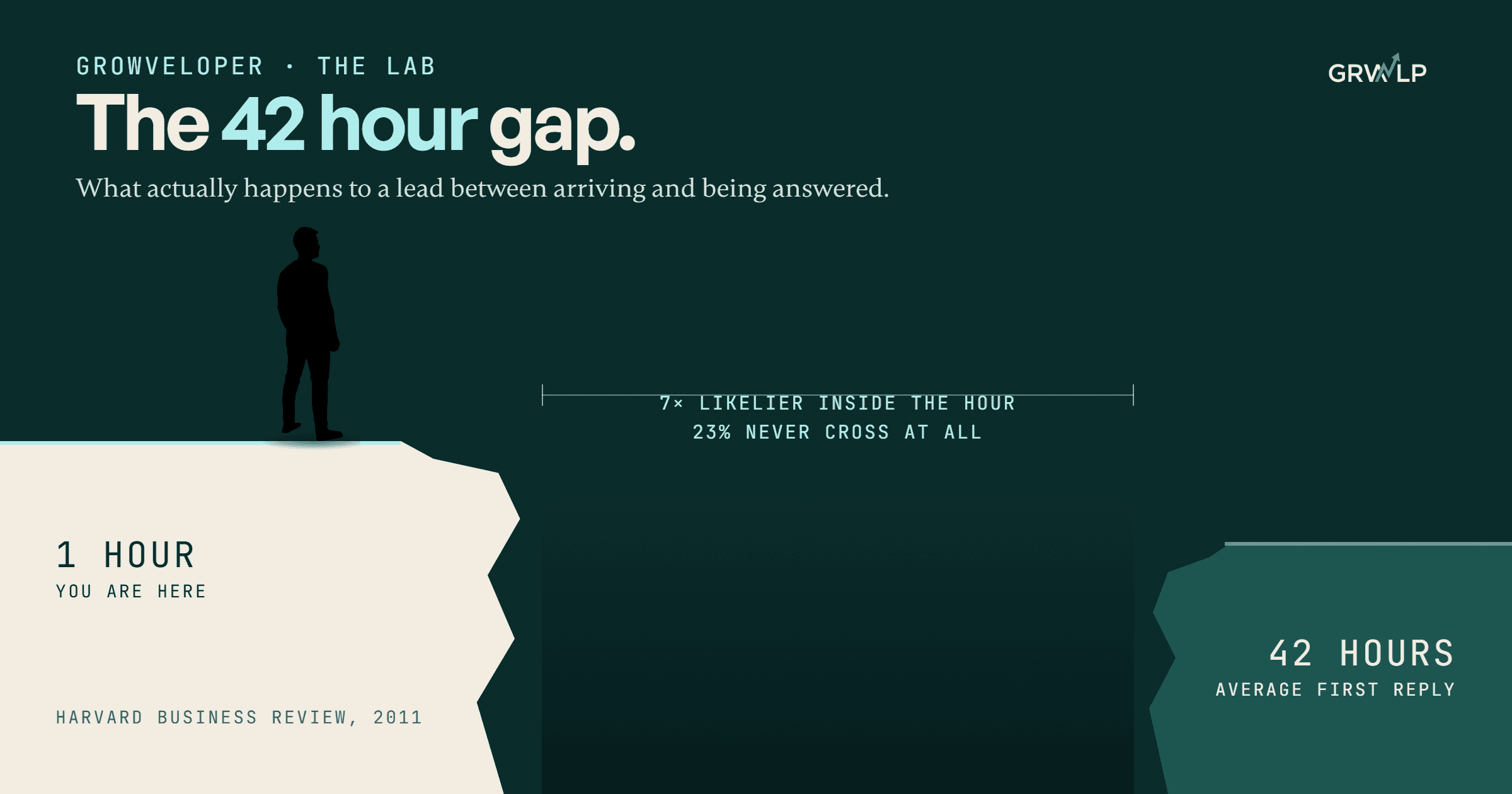
When Harvard Business Review audited 2,241 United States companies in 2011, the average time to answer a web enquiry was 42 hours, and 23% of the companies never answered at all. Every one of those companies had a website. Most of them had marketing bringing people to it. The chain still broke, at the very last link, because nothing told a person the moment a new enquiry existed. How to automate lead follow-up for your small business is the fix for this exact link.
The five links in the chain, and what breaks when one is missing
| Link | What connected looks like | What breaks when it's missing |
|---|---|---|
| The ad or search resultHigh traffic, high bounce | Says the same thing the page says | Visitors arrive expecting something the page does not offer |
| The pageTraffic but no enquiries | One clear next step | Visitors read and leave with nothing to do |
| The formLeads you know you had and cannot locate | Writes to a record, not just an inbox | The enquiry exists nowhere anyone can find again |
| The CRMThe same customer treated as a stranger twice | One system holds the truth about each customer | Two or three tools each hold a half-record |
| The replyThe 42 hour gap | Someone is alerted the moment a record appears | Nobody knows to respond |
What did a business with none of these links connected actually look like?
Baye Business Solutions, before Growveloper rebuilt it, is the clearest example this lane has, because it did not have a weak chain. It had no chain.
The live Baye Business Solutions case study states the business had "no blog, no analytics, no Google tracking, no intake forms." Read that against the five links. There was no reliable page to send an ad to. There was no form to write a record. There was no CRM to hold one, because there was nothing feeding it. And there was no way to measure a reply, because there was no analytics telling anyone a visitor had even arrived. The business was not failing to connect five links. It had never built the first three, so the last two had nothing to connect to.
VIP Creative Studio's live case study shows a narrower version of the same problem: a single Wix landing page with, in the case study's own words, "no service breakdown, no case studies, no blog, no contact form." The ad and search links could still work. The page and form links could not, because the form did not exist. One missing link was enough to break the whole chain for every visitor who reached it.
How do I check which link is missing in my own business?
Follow one real enquiry, end to end, tonight.
Pick the last new customer you remember hearing from. Ask, in order: what did they click or search to find you, and did the page they landed on say the same thing. Did that page give them one obvious next step. When they took it, did a system actually save what they told you. If they had contacted you twice, would your system have known it was the same person. And once their information existed somewhere, how long before a person actually replied. The first "no" in that sequence is your broken link, and it is very likely the same link that is breaking for everyone else too, because your systems do not change customer by customer.
Does fixing this mean I need one growth studio instead of separate vendors?
Not automatically. It means someone has to own the whole chain, whether that is one studio or you personally coordinating several vendors.
The coordination cost of separate vendors, and when three agencies are genuinely the better buy, is its own question with its own evidence, covered in should a small business hire one growth studio or three separate agencies. The undocumented cost of nobody owning the connections at all, whoever is doing the work, is covered in why nothing connects without an integration layer. This piece is about the five links themselves, not who should wire them.
Who can build this for me?
Connecting these five links for a small business is what our growth marketing and AI and automation work does together, and there is a free call if you want to walk your own funnel through the five links with us rather than alone. You can do the diagnostic above tonight without anyone. What it tells you, which link is broken, is the actual brief for whoever you hire to fix it.
“Connected is not a feature you buy. It is a test, follow one customer from the ad to the reply and see where the thread drops.”
Written by Oyekola Obajuwon