Freelance web developer vs agency vs studio: which should a small business in the US hire?
Freelancer, agency or studio: how a US small business should choose who builds its website, judged by year two rather than launch day.
TL;DR
Pick by what happens after launch, not by price. A freelancer suits a simple site you will rarely change, an agency suits a site that needs several specialists at once, and a small studio suits an owner who wants one accountable person. Whichever you hire, put the domain, hosting and code in your own name first.
Last updated 1 October 2026. Written by Oyekola Obajuwon, founder of Growveloper, who builds the website, the marketing and the follow up for owner run businesses in the United States, the United Kingdom and Nigeria.
Pick by what happens after launch, not by price. A freelancer suits a simple site you will rarely change, an agency suits a site that needs several specialists at once, and a small studio suits an owner who wants one accountable person. Whichever you hire, put the domain, hosting and code in your own name first.
Read ten articles on this question and you will find the same table ten times. Freelancers are cheaper. Agencies cost more and have more people. It depends on your needs. Almost every one of those articles is written by somebody selling one of the three options, and so is this one: Growveloper is a studio, and the studio is one person. I will tell you what that means for you further down, because it is the most useful thing on the page.
What is the actual difference between a freelancer, an agency and a studio?
A freelancer is one person who designs and builds the site, usually for several clients at once. You talk to the person doing the work.
An agency is a company with separate roles: someone who manages the project, a designer, one or more developers, often a marketing team. You usually talk to an account manager, and the work is done by whoever on the team has capacity that month.
A studio sits between them. It is small, and the founder does much of the work. The catch is that none of these words is regulated. Anyone can call one person working from a spare room an agency, and anyone can call twelve people a studio. So ignore the label and ask the only question that matters: how many people will touch my website, and what are their names?
How much does each cost in the US?
The best published numbers for agencies come from Clutch, a directory of service firms. Its web design pricing guide, updated 21 September 2026 and built from its database of more than 79,260 web design agencies and their client reviews, says web design companies there typically charge $100 to $149 an hour. It also says two things that look like they contradict each other. The average web design project costs $38,105. And most web design projects reviewed on Clutch cost less than $10,000.
Both are true, and the gap between them is the lesson. A few very large projects drag the average up, so the average describes almost nobody. If an agency quotes you against "the average", ask what a typical project for a business your size costs instead.
For freelancers, we could not find a rate survey we could follow back to how it was measured. Marketplaces publish ranges without saying where they came from, so we are not going to print one. What we can tell you is how common freelancing is: the US Bureau of Labor Statistics counts 18% of web developers as self employed, and puts the median wage for an employed web developer at $92,650 a year in May 2025. That second number is why most small businesses never hire one in house. A full time developer costs more than most small business websites do, before a single benefit is paid.
Our own range is published in our article on what a small business website costs in 2026: $2,000 to $10,000 and up, quoted as one fixed number before work starts.
What happens after launch?
This is the part every comparison skips, and it is where the three options really differ.
A website is not finished on launch day. Fourteen months later a plugin needs updating, the booking form stops sending emails, or you want a new page for a service you just started selling. Somebody has to do that. So before you compare anyone's portfolio, ask each of them what we call the year two question: something breaks a year from now, who fixes it, how fast, and what does it cost?
Listen to how each one answers.
A freelancer may be fully booked with newer clients, may have taken a full time job, or may simply not reply. You are relying on one person's calendar, and you have no say in it.
An agency will still exist, and it has more than one person who could fix it. But your small site competes for attention with bigger accounts, and the developer who built it may have left. You can end up paying a stranger to learn your site before they fix it.
A studio sits in the middle again. The person who built it is usually the person who fixes it, which is fast. But if that studio is one or two people, it carries the same calendar risk as a freelancer.
None of these is a dealbreaker. Not asking the question is. Our own web development page opens its list of problems with this line: "Your last developer built something, went quiet, and now nobody can work on the code they left behind." That sentence is what the year two question exists to prevent.
Who should own the domain, the hosting and the code?
You. Not the freelancer, not the agency, not us.
The domain is the one that bites hardest. ICANN, the body that coordinates domain names, says the person who registers a domain is the registrant, and its own page on registrant rights and responsibilities uses this exact case as its example: "a website designer registering a domain name for a client." In that case the designer is the name on the record, not you. Your business's address on the internet belongs, on paper, to somebody you hired.
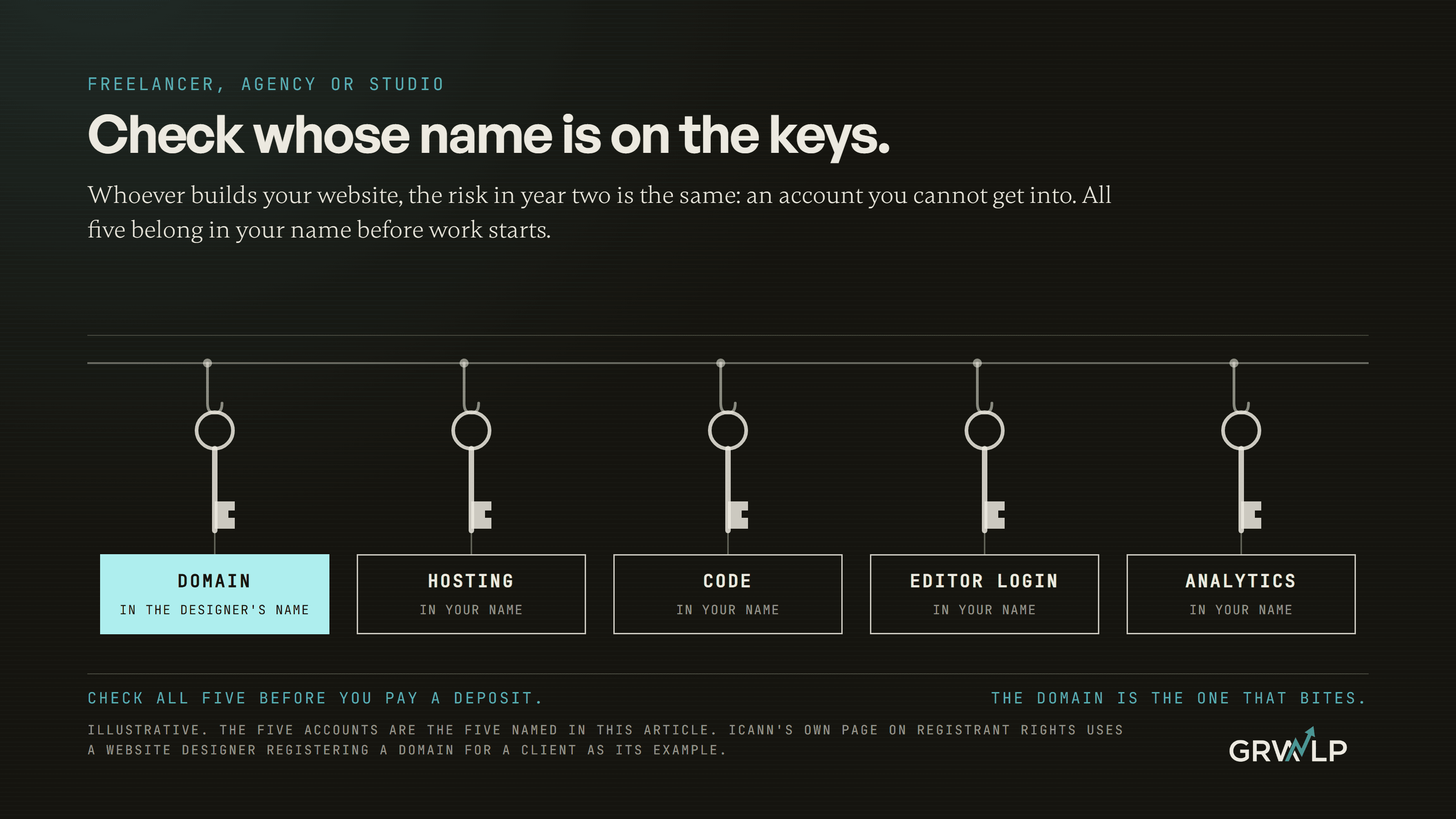
So before anyone builds anything, check five accounts:
The domain
Registered in your business's name, with an email address you control, at a registrar where you hold the login. If it currently sits in someone else's account, our guide to moving a site off Wix explains how a domain transfer works and how long it takes.
The hosting
An account in your name, with your payment card on it. Your developer gets invited as a user, and you can remove them.
The code
Kept in a repository your business owns, so a new developer can pick it up without asking the old one.
The editor login
An administrator account for whatever you use to change the words and pictures on the site, in your name, not a shared password.
The analytics
Your Google Analytics property owned by your Google account, so years of visitor history do not leave with the person who set it up.
A builder you can trust will agree to all five. If one will not, you have learned the most important thing about them before paying a deposit. Our own web development page states it as a promise: you get full access to your editor, your code and your analytics on day one.
Which one should a US small business hire?
Here is the verdict, tuned to a business of one to twenty people.
Who to hire, by what your website has to do
| Your situation | Hire | Why |
|---|---|---|
| A five page brochure you will rarely change | A freelancer, or a site builder you run yourself | Least to build, least to break |
| The site must bring in enquiries from search and ads | A studio | One person owns the whole path from visitor to reply |
| Several big things at once, on a hard deadline | An agency | Specialists can work in parallel |
| One channel already works and needs more depth | A specialist agency for that channel | Depth beats breadth there |
| You cannot get a straight answer on who owns the accounts | Nobody yet | Fix that before choosing |
If you are deciding whether you even need a developer, our piece on Wix or hiring a developer starts one step earlier. If the question is really one studio against a marketing agency, a web agency and an automation consultant, that trade is set out in one growth studio or three agencies.
What is the risk of hiring a one person studio?
Here is the honest part. Growveloper is a studio of one person, which means it carries a freelancer's biggest risk: if I am ill, you wait. Anyone who tells you a one person studio has no key person risk is selling you something.
What we do about it is make ourselves easy to replace. The five accounts above are in the client's name from day one. And the site is built so the owner does not need us for ordinary changes.
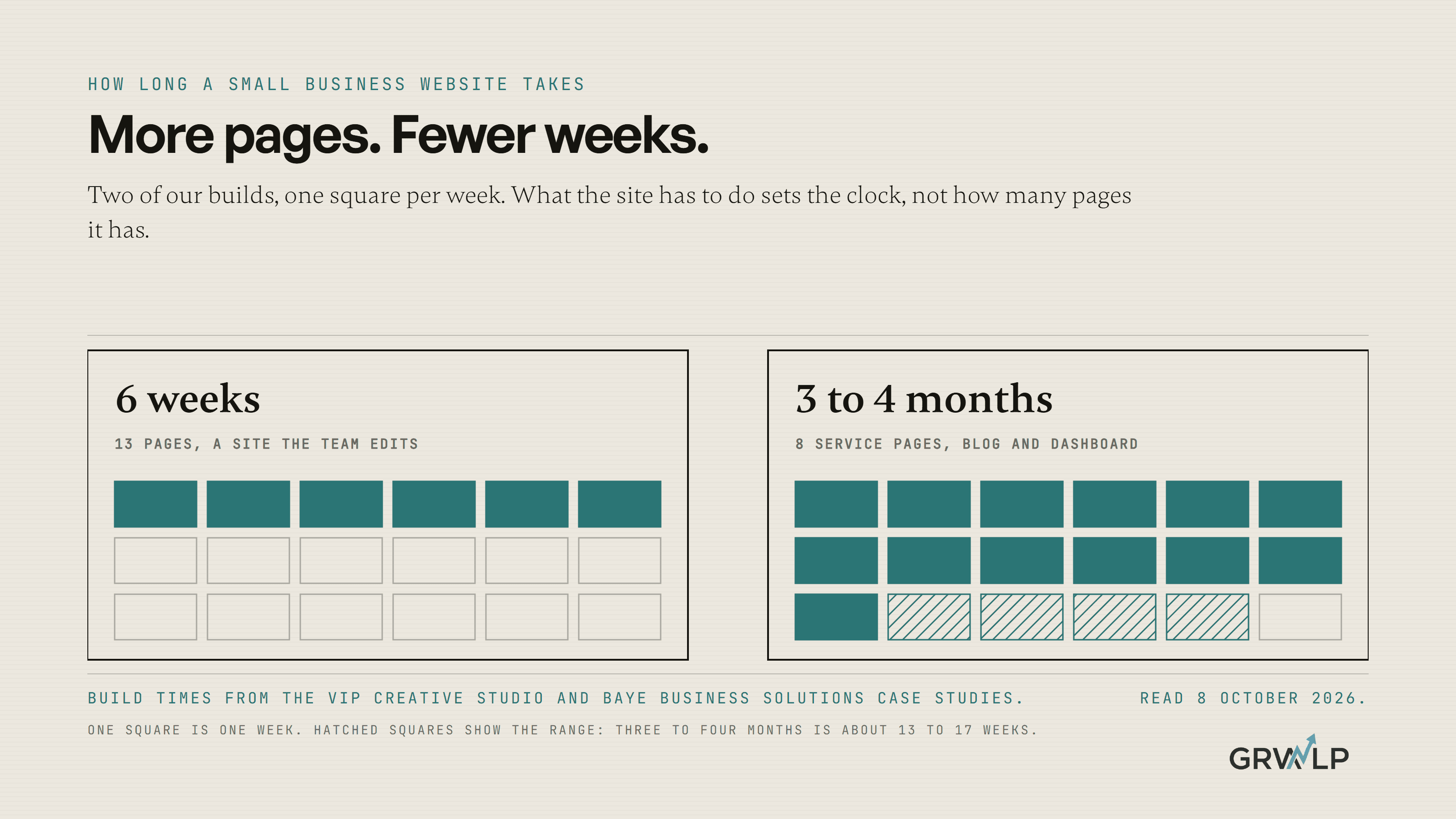
VIP Creative Studio is the clearest example. They are a fractional marketing agency working with credit unions and financial institutions across the United States, and when the project started, their entire web presence was a single Wix landing page. No service pages, no case studies, no contact form. We rebuilt it in six weeks as thirteen pages with more than a hundred fields their team could edit themselves, and wrote a full guide so the people who are not technical could manage everything without us.
That guide is the year two answer written down. The best protection against your developer disappearing is not needing them on an ordinary Tuesday.
What should I ask before I hire anyone?
Five questions. Ask all three kinds of builder the same five, and the differences will show themselves.
Whose name will the domain, hosting and code be in?
The only acceptable answer is yours.
Who fixes it a year from now, and what does that cost?
Get a name, a response time and a price, or an hourly rate with a ceiling.
How many people will touch my website, and who are they?
This sorts a real studio from a freelancer with a logo, and a real agency team from one overloaded developer.
What can I change myself without asking you?
Prices, opening hours, photos and new pages should all be on that list.
Is this one fixed price, or an hourly estimate?
A fixed price for a written scope protects you. An estimate with no ceiling protects them.
Whoever you hire, the test of the decision is not launch day. It is the first ordinary Tuesday after they stop answering, and whether you can still change your own prices. If you want to talk through quotes you already have, there is a free call, and we will tell you if the right answer is somebody else.
“The test of who you hired is not launch day. It is the first ordinary Tuesday after they stop answering.”
Written by Oyekola Obajuwon