How do I get more Google reviews for my service business?
More Google reviews come from automating the ask, not asking harder. Fire it the moment the job finishes, and send exactly one reminder.
TL;DR
Get more Google reviews by automating the ask rather than asking harder. Trigger the request the moment a job finishes, send one direct link that opens straight to the review box, and follow up exactly once if nobody clicks. Never offer anything in exchange for a review, and reply to every one you get.
Last updated 16 September 2026. Written by Oyekola Obajuwon, founder of Growveloper, who builds the website, the marketing and the follow up for owner run businesses in Nigeria, the United States and the United Kingdom.
Get more Google reviews by automating the ask rather than asking harder. Trigger the request the moment a job finishes, send one direct link that opens straight to the review box, and follow up exactly once if nobody clicks. Never offer anything in exchange for a review, and reply to every one you get.
That is the mechanism. The rest of this page is why each part matters, what the message should actually say, and the honest limit of what we can promise you about the result.
Why do some service businesses have hundreds of reviews and others have a dozen from three years ago?
Not because the quiet ones do worse work. Because the loud ones stopped relying on memory.
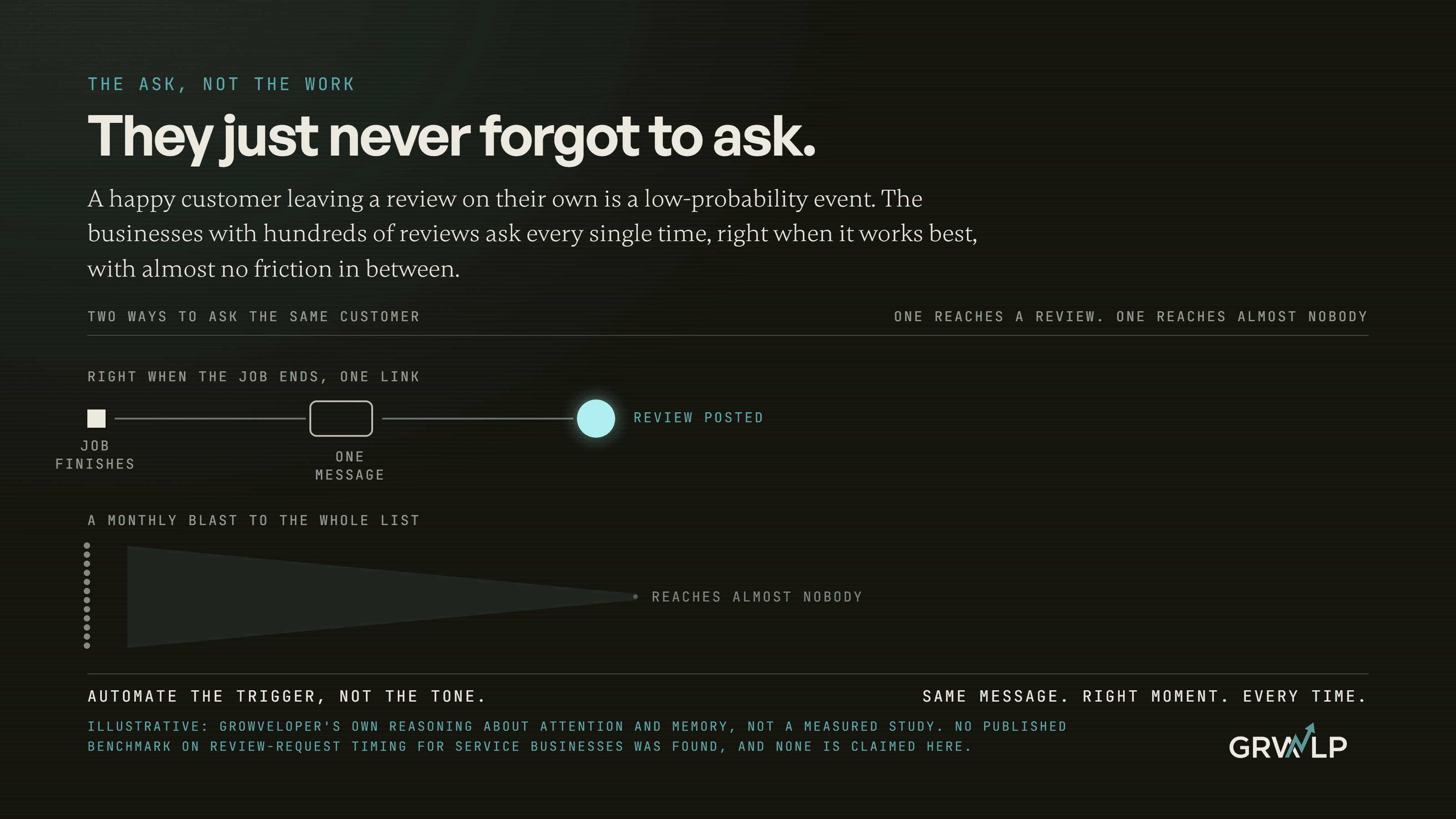
A happy customer leaving a review on their own is a low probability event. They have to think of it, find your listing, and take the time, all while nothing is pushing them to do it. A business with hundreds of reviews has usually not found a way to make customers happier than everyone else. It has found a way to ask every single time, at the moment asking works best, with almost no friction between deciding to help and the review actually posting.
When should I ask for a review?
As close to the moment of relief as you can get, and never as a monthly blast to your whole customer list.
When to ask, and what usually happens
| Moment | What it feels like to the customer | Result |
|---|---|---|
| Right when the job finishes, in person | The relief is still fresh, and it feels like a natural close to the conversation | Highest response, and it needs no software |
| Same day, by text or message, if you were not there to ask in person | Still fresh, and expected because you already have their number | Close behind asking in person |
| A monthly reminder sent to your whole customer list | Random, and arrives with no memory of the specific job attached | Lowest response, and it can read as spam |
The best moment is right when the job finishes and the customer is glad it is done, the leak fixed, the install working, the delivery arrived. Ask in person if you are there, or send the request within the same day if you are not. A generic reminder sent to a customer list once a month catches people at a random point in a memory that has already faded, and it reads as a mass email because it is one.
How much friction is too much?
Any friction you can remove, remove.
If the request says search for us on Google and leave a review, you have handed the customer three tasks: open the app, find your exact listing among several with similar names, and then write something. Most people complete the first task and quietly abandon the other two. The fix is a single link that opens straight into the star rating and text box, nothing else. Google Business Profile can generate this link for you directly from the profile dashboard, and once you have it, that one link is the entire mechanism. Send the same link every time.
What should the message actually say?
Short, specific to the job, and sent from wherever the conversation already happened.
Hi Grace, thanks for having us out for the boiler service today. If you have thirty seconds, a review here helps other people in the area find us: [your review link]. No pressure either way, and thank you again.
That message names the actual job, which is what makes it feel like it came from a person rather than a system, even though a system sent it. It asks once, states how long it takes, and does not chase.
Should I follow up if they don't leave one?
Once, and then stop.
Hi Grace, following up in case the first message got buried. No worries if now isn't the moment, here's the link again: [your review link].
One reminder respects that people are busy. A second and third reminder start to read as pressure, and pressure is exactly what turns a five star customer into someone who leaves a review about being chased instead of about the job.
Should I offer a discount for a review?
No. Treat every customer identically regardless of whether they leave a review, and never make the review conditional on a reward.
This is not only good practice, it protects the number you are building. A review earned with a coupon or a discount says as much about the incentive as about the work, and it is the first thing a competitor or a suspicious customer will point out. The version worth having is the one where the customer had nothing to gain except being helpful.
What do I do with a bad review?
Reply to it, in public, without getting defensive.
A single one star review among forty five star ones does more for your credibility than a spotless page, because it makes the other reviews look real. What you say back matters more than the review itself: acknowledge the specific complaint, say what you did or will do about it, and keep it short. Anyone reading your listing afterward is reading your reply as much as the complaint.
Where does this fit with the rest of a service business's marketing?
Underneath everything else, because reviews are the layer other people read before they read anything you wrote yourself.
A fast quote form and a same day reply matter for turning a phone search into a call, and a wired up enquiry alert matters for not losing the lead once it arrives. Reviews sit before both of those, at the moment someone is deciding whether to call you at all, whether they run a local service business or something else entirely. A five star listing with forty recent reviews and a one star listing with three old ones answer the same search completely differently, before either business has said a word.
Have you built this for a client, and did it work?
We have not built or measured a dedicated review request automation for a client yet, and the honest thing to do is say so rather than borrow a number that is not ours.
What we do have is one real result from a related discipline: getting the actual work right consistently enough that reviews take care of themselves once somebody is finally asked. RideOn Nigeria, a chauffeur and car rental service we built the platform and brand for, sits at 100 percent positive reviews on Facebook. That came from the driving experience and the professionalism of the service, not from a review automation, because none existed at the time. It tells you the ask is not fighting an uphill battle if the work is genuinely good. It does not tell you how many additional reviews an automated ask produces, because we have not measured that ourselves and have not found a study on service businesses specifically that we trust enough to print here.
Do I need software for this, or can I do it by hand?
By hand, for a while. The mechanism matters more than the tool.
A person can trigger this manually: finish the job, open WhatsApp or a text message, paste the template, send it. That works fine at low volume and costs nothing. It starts to fail exactly where every manual process fails, which is the day you are busy, tired, or short a person, and the ask quietly stops happening for a week. The point where it is worth wiring into your CRM automation or smart alerts is the point where you notice the ask has already been skipped more than once. That is a small, boring automation in the same family as routing an enquiry the moment it arrives, not a project.
What should I actually do this week?
Pick the last three jobs you finished and were happy with, and send the message today, by hand, using your own review link.
Do not wait to build the automated version first. Send three messages this afternoon and watch what happens. If even one becomes a review, you have just proven the mechanism works for your business specifically, and only then is it worth the afternoon of setting up the trigger that sends it automatically from now on.
“The businesses with the most reviews are not the ones with the best work. They are the ones that never forget to ask.”
Written by Oyekola Obajuwon
Last updated