Should I use Wix or hire a developer for my business website?
Wix is right until your site has to earn. The three signals it is time to hire a developer, and how to check yours.
TL;DR
Stay on Wix while your website is a brochure and you can make the changes you need. Hire a developer when a change you need is blocked by the platform rather than by your budget, when your site is slow and you have run out of things you are allowed to fix, or when enquiries arrive and nothing happens next.
Last updated 15 September 2026. Written by Oyekola Obajuwon, founder of Growveloper, who builds the website, the marketing and the follow up for owner run businesses in Nigeria, the United States and the United Kingdom.
Stay on Wix while your website is a brochure and you can make the changes you need. Hire a developer when a change you need is blocked by the platform rather than by your budget, when your site is slow and you have run out of things you are allowed to fix, or when enquiries arrive and nothing happens next.
Everything below is how to tell which of those describes you, measured on your own site rather than argued from either side.
What is actually being decided here?
Not quality. Permission.
Wix is a good product. Millions of businesses run on it and a large number of them should carry on running on it. The thing you are deciding is narrower than the reviews suggest: for the next year of your business, will the changes you need to make to your website be changes the platform lets you make?
That is a question about your business, not about Wix. A dentist who needs opening hours, a price list and a phone number on the page is asking very little of a website, and a page builder answers it completely. A cleaning company that needs a quote form which writes into a customer list, fires an instant reply, books a slot and tells the owner which advert produced the job is asking for something else entirely. Same budget, different machine.
So the useful version of the question is not "is Wix good". It is "is the next thing my business needs from its website something Wix will let me do".
When is Wix the right answer?
More often than a developer's website will admit, and there are four cases where it is not close.
Your site is a brochure and it is telling the truth
If what you sell is decided in person or on the phone, and the website exists so people can find you, check you look real and call you, a page builder does that job. Nothing about hiring a developer improves a phone call.
You are still working out what you sell
If the offer has changed twice this year, anything built to fit it will be rebuilt. Pay for a platform you can change yourself on a Tuesday afternoon, and buy the custom thing once the answer stops moving. This is the most expensive mistake in this whole decision and it is made by ambitious owners, not lazy ones.
Nobody in the business will ever open a text file
A developer build only stays cheap if someone can be bothered to use it. If your honest answer is that the site will be touched twice a year by whoever is least busy, a builder with a visual editor is the correct tool and paying for something more capable is buying a machine that will sit under a sheet.
The money has a better home right now
A website that gets forty visitors a month does not have a website problem. If nobody is arriving, a rebuild makes a nicer room that nobody walks into. Spend the money on being findable first, which is the argument what is growth engineering makes at more length.
What are the three moments that tell you it is time to leave?
They are specific, and you will recognise yours immediately.
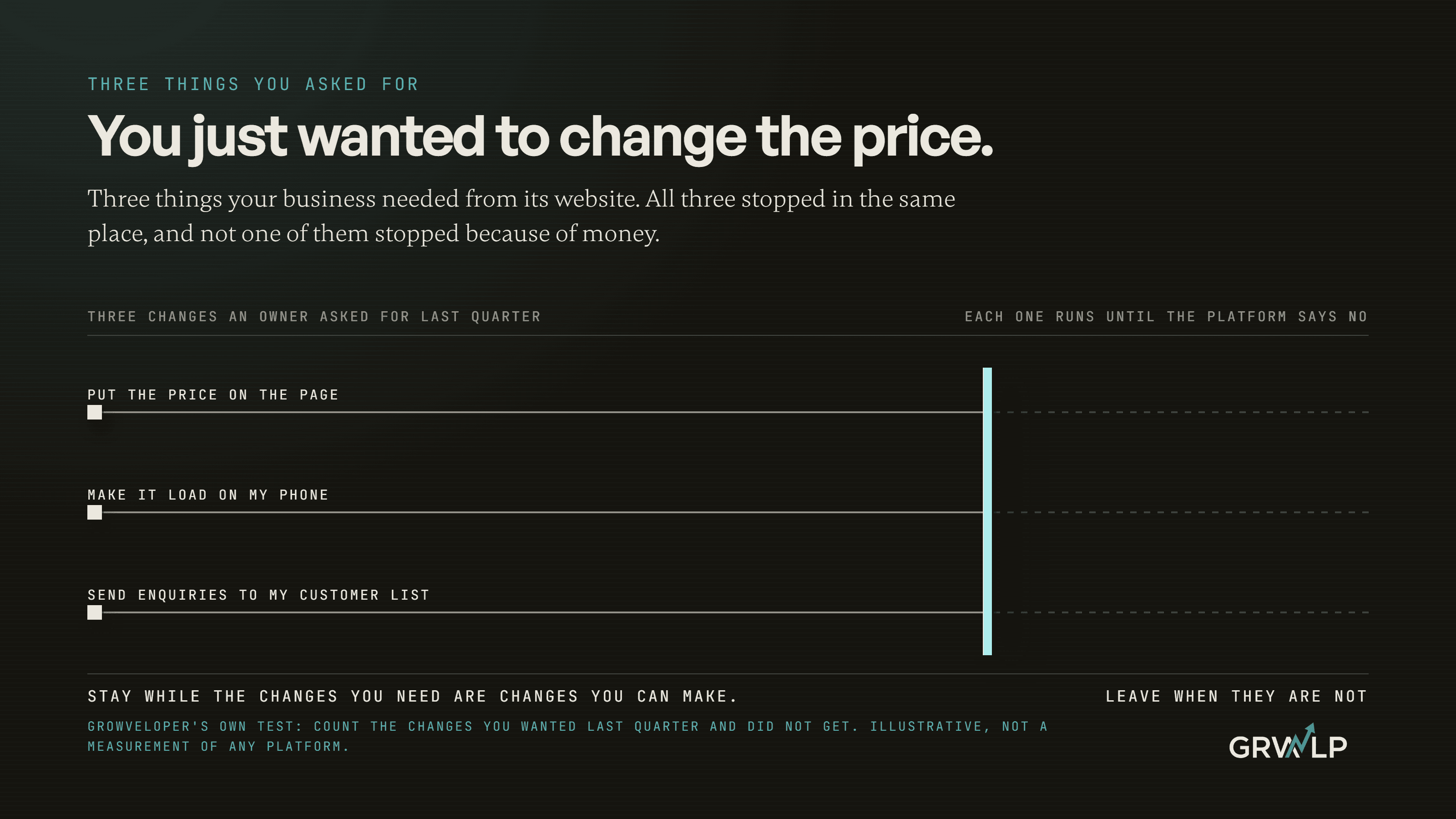
A change you need is blocked by the platform, not by your budget
This is the real line, and it is worth being precise about it. Every platform has things it will not do. The signal is not "it costs money to do that", it is "there is no way to do that here, or the only way is a monthly app that half works".
You need a second language. You need a quote calculator that does arithmetic on four inputs. You need the enquiry to go into your customer list and not only into an inbox. You need the same page to show different prices to two service areas. You ask, and the answer comes back as a paid add on you now have to maintain forever, or as no.
Count the changes you waited on last quarter. Not the ones you did not get around to, the ones you actually wanted and did not get. Three or more and the platform has stopped being the cheap option. It is now the thing costing you money, quietly, in work you cannot do.
The site is slow and you have run out of things you are allowed to fix
Every platform gives you some levers. Compress the images, drop the video header, remove the apps you stopped using. Pull all of them, then measure again.
If the number is still poor after you have done everything the platform permits, you have hit the ceiling rather than your own effort. On a page builder a real part of what loads is the builder itself, and you cannot uninstall the thing your site is made of. That is a fair trade for what a builder gives you. It is also a hard stop, and no amount of trying harder moves it.
Enquiries arrive and nothing happens next
This is the one owners misdiagnose most often, and it is usually not a website problem at all.
The form works. The email lands. And then it waits, because the reply depends on a human noticing an inbox. When the Harvard Business Review audited 2,241 companies in 2011, the average time to answer a web enquiry was 42 hours and 23% were never answered at all. Fifteen years later most small business forms still work exactly this way, which is why the gap between an enquiry arriving and anyone noticing is worth more attention than the platform the form sits on.
Here is the useful distinction. If the enquiry needs to trigger something, an instant reply, a booking link, a row in your customer list, a message to the person on site, then you need a system and the platform question follows from it. If the enquiry just needs you to answer your emails faster, you have a habit to fix and you can stay exactly where you are. The how to automate lead follow up piece has the build for the first case.
The three moments, and what to measure instead of guessing
| What you notice | What to measure | Where to measure it |
|---|---|---|
| I cannot change my own prices, hours or pagesThree or more and the platform is now the cost | Changes you wanted last quarter and did not get | Your own sent folder |
| It feels slow, especially on my phoneWhether you have hit the ceiling or your own to do list | Your busiest page, on mobile | Google PageSpeed Insights, free, no account |
| Enquiries come in and go quietOver an hour means speed of reply, not the platform | Minutes from form submitted to a human reply | Send yourself one and time it |
| Nobody arrives at allUnder a few hundred means a rebuild fixes nothing | Visitors last month | Google Search Console, free |
How do I check my own site this afternoon, for free?
Twenty minutes, no agency, no login you do not already have. Do this before you read another comparison page, including this one.
Open Google PageSpeed Insights, paste the address of your busiest page, and read the mobile tab rather than the desktop one, because that is where your customers are. Then open Google Search Console and look at how many people actually arrive from search in a month. Then fill in your own enquiry form, from your phone, with your thumb, and time how long until a human answers it.
Now the part that makes this honest, and it is about our own site.
Our web development page says pages load in 0.9 seconds. Microsoft Clarity measured real visitors on growveloper.com on 10 September 2026 and recorded a largest contentful paint of 1.4 seconds and an interaction delay of 380 milliseconds. Both figures are true and they are not the same measurement. The first is a build tested under laboratory conditions. The second is what happened on real phones, on real networks, including the ones crawling along on a bus. Every speed claim you will read, ours included, is one of those two things, and the gap between them is where sales copy lives.
So do not take anybody's number, ours or Wix's. Take yours. Whatever it is, it is the only one your customers experience, and it is free to find out.
What does a developer build actually cost, and how long does it take?
We publish our own numbers and will not invent anybody else's.
A website build with us runs from $2,000 to $10,000 and up, quoted as one fixed figure after a free call, with a full rebuild shipping in six to ten weeks. The scope, the process and the reasoning behind that range sit on the web development page, and the question of what moves a website price up or down has its own piece in how much a small business website costs in 2026.
Wix publishes its own plans and prices on its pricing page, and this article will not reprint them, because they change and because the interesting cost is never the headline plan anyway. It is the stack of monthly apps a growing site accumulates underneath it: the booking app, the review app, the form app, the pop up app, each one small, each one renewing. Add yours up once a year. Owners are regularly surprised, and not by the platform fee.
There is one piece of outside evidence worth putting beside that, with its caveats attached. In Salesforce's 2024 survey of 3,350 small and medium business leaders, fielded between 3 August and 16 September 2024, 88% said they felt overwhelmed by having too many business tools. Read it carefully: it is self reported, and it is published by a company that sells software to solve exactly that feeling. It is not proof of anything about your business. It does suggest the tool pile is a common experience rather than a personal failure of organisation.
Will I still be able to edit it myself afterwards?
Yes, if you make it a condition of the build. No, if you assume it.
This is where custom websites earn their bad reputation, and the complaint is fair. A developer disappears, the site becomes a museum, and two years later changing a phone number needs a quote. Our own development page names that failure out loud, because it is the most common reason a business ends up back on a page builder having paid for something better.
What prevents it is boring and specific. The site gets a content system behind it, every piece of text and every image lives in that system rather than in code, and somebody who has never opened a terminal can change a price at nine on a Sunday night. Ask for that in writing and ask for the guide that goes with it.
The test is not whether they say yes. It is whether they will show you the editor before you sign, and let you change something in it while they watch.
What happened when a client of ours moved off Wix?
The clearest example on this site is a marketing agency whose whole web presence was one Wix page.
VIP Creative Studio is a fractional marketing agency working with credit unions across the United States. Strategists, a designer, a project manager, embedded into their clients' marketing departments. Their entire website was a single landing page: no service breakdown, no case studies, no contact form. A company selling marketing to cautious financial institutions, with a website quietly arguing the opposite case.
The rebuild was thirteen pages in six weeks on Next.js with Sanity behind it, and the number that matters is not thirteen. It is that over a hundred fields became editable from a visual editor, with a written guide, so the team could publish a case study or swap a testimonial without asking anyone. On the same engagement the paid media ran for one of their credit union clients: Google Display and YouTube campaigns, more than five hundred negative keywords, budgets above $16,000 a month. Securityplus Federal Credit Union recorded over 28,800 page views and 250 credit card application events inside a two month window. The full write up is the VIP Creative Studio case study.
Notice what the Wix page was not guilty of. It was not slow, and it was not ugly. It simply could not hold a thirteen page argument, and the business had started needing to make one. That is the whole tipping point, in one client.
What each option is actually good at, for a site that is losing enquiries
| What you need | Wix | A developer build |
|---|---|---|
| Live this month, done by youA brief takes longer than a template | Yes | No |
| Cheapest possible first yearCompare year three, not year one | Usually yes | No |
| Change prices, hours and photos yourselfAsk to see the editor before signing | Yes | Only if a content system is in the build |
| Speed you can keep improvingYou cannot uninstall the builder your site is made of | Up to what the builder exposes | Yes, the whole page is yours |
| A form that writes into your customer list and replies instantlyThis is where most enquiries actually die | Through paid apps, with limits | Yes, built in |
| Anyone can pick it up after youAsk what leaves with you on day one | Yes, everybody knows Wix | Only if handover is written into the contract |
What happens to my Google rankings if I move?
They are at risk during the move and the risk is manageable, which is a different sentence from the one both sides will tell you.
Rankings attach to addresses. Move a page from one address to another without telling search engines where it went, and you have thrown away whatever that page had earned. The fix is unglamorous: keep your addresses identical where you can, redirect every old one to its new home where you cannot, change the words and the structure in a separate month from the move, and watch Search Console for four weeks afterwards.
Two honest notes. If your site currently gets very little search traffic, this whole risk is close to theoretical and you should stop worrying about it. And if it gets a lot, this is the single thing to interrogate a developer about, because a build quote that does not mention redirects is a quote from someone who has not done this before. The step by step version of this move is its own article and it is next in this series.
What should I ask before hiring anybody?
Four questions. The answers sort the field faster than any portfolio.
Can I see the editor I will be using?
Not a screenshot. The actual editing screen, with them watching you change a headline. If that cannot happen before you sign, assume it will not happen after.
What do I own on the day this ends badly?
The domain, the hosting account, the analytics, the content system login, the code. Every one of those should be owned by your business with the developer granted access, never the reverse. Ask it while everyone is friendly, because it is unanswerable later.
What is your plan for my current rankings?
You are listening for the word redirects, unprompted. If the answer is that the new site will be better so search will sort itself out, you have your answer about their experience.
Would you tell me to stay on Wix?
Ask it directly. Anybody who cannot describe a business they told to keep its page builder is not diagnosing, they are selling. This is also why our own Growth Audit is a paid document you keep rather than a free proposal: a diagnosis that can only ever recommend buying the thing being diagnosed is a sales call with a header on it.
Why would you trust a developer answering this question?
You should not, entirely, and it is worth saying which way the bias runs.
We build custom websites. We are paid when businesses decide to leave a page builder. That makes this the least trustworthy page on the internet to ask, and the only sensible response is to check the parts of it that can be checked. The two numbers we have put our name to here, the 42 hour finding and the Salesforce survey, both link to their primary sources, and one of them we have argued against on this site when it was misquoted. Our own speed claim is printed next to our own worse field measurement, two paragraphs above, where you can see both.
And the advice that costs us money is the advice we would repeat to a friend. Most Wix sites we are asked about do not need replacing. They need someone to answer the enquiries faster, put the price on the page, and stop burying the phone number. That is a free afternoon, not a project.
So run the twenty minute check. Open your own site, on your own phone, on mobile data, in the car park, the way an actual customer meets it. If everything you need to change is something you can change, you already have your answer and it cost you nothing. If the thing you need next is something the platform will not let you have, you also have your answer, and now you know exactly what you are buying and why.
“The question is not whether Wix is good. It is whether the next thing your business needs from its website is something Wix will let you do.”
Written by Oyekola Obajuwon