I want to run paid ads that actually convert. What has to be true first?
Five checks before your first paid ad, including the one nobody does: whether your budget can buy enough results for the ads to learn.
TL;DR
Before ads can convert, five things must be true: an offer a stranger would act on today, a page that matches the ad, one counted action, someone who replies within the hour, and a budget big enough to buy about 30 of that counted action in a month, the volume Google recommends judging its automated bidding on.
Last updated 6 October 2026. Written by Oyekola Obajuwon, founder of Growveloper, a growth studio that builds the website, the marketing and the follow up for owner run businesses in Nigeria, the United States and the United Kingdom.
Before ads can convert, five things must be true: an offer a stranger would act on today, a page that matches the ad, one counted action, someone who replies within the hour, and a budget big enough to buy about 30 of that counted action in a month, the volume Google recommends judging its automated bidding on.
The first four are on most checklists. The fifth is the one that quietly ends most first campaigns. The owner spends the budget, sees a handful of results, decides "ads don't work for us", and stops. Often the ads never had a fair chance. The budget ran out before the results did.
What has to be true before I spend money on ads?
Five things, in this order. Each one can be checked in about ten minutes, before a naira or a dollar goes to Google or Meta.
Five checks before your first paid ad
| Check | How to test it today | If it fails |
|---|---|---|
| The offer | Would a stranger act on it this week, without knowing you? | Ads bring people to an offer nobody wanted |
| The page | Does the page the ad opens say the same thing as the ad? | Clicks leave in seconds |
| The count | Is one action, such as a form sent or a call, set as the conversion? | The platform optimises for the wrong thing |
| The reply | Who answers a lead at 7pm, and how fast? | Paid leads go cold before anyone calls |
| The budget | Can it buy about 30 of the counted action in a month? | The platform never gets enough results to improve |
The order matters because each check depends on the one before it. A perfect budget sum is useless if the page loses everyone who arrives.
Is my offer something a stranger would act on today?
Ads find people who are already looking, or who might be persuaded in one sitting. They do not create a want that is not there. So the offer has to make sense to someone who has never heard of you and is giving you a few seconds.
"Quality cleaning services" is a description. "Book an end of tenancy clean for Saturday, fixed price shown" is an offer. One says what you are. The other says what happens next, when, and roughly what it costs. If you would not click your own ad as a stranger, fix the offer before paying anyone to show it.
Does the landing page match the ad?
It should say what the ad said, in the first screen, with one obvious next step. If the ad promises a Saturday clean at a fixed price, the page should open on Saturday cleans and the price, not on your company history.
Google measures this as one of three parts of Quality Score. Its Quality Score page defines landing page experience as "How relevant and useful your landing page is to people who click your ad." The same page says something many guides get wrong: "Quality Score is not an input in the ad auction. It's a diagnostic tool". So treat a low landing page rating as a warning light, not a dial to chase. The real cost of a mismatched page is simpler: people leave, and you paid for the click.
Our guide to improving your website's conversion rate covers what to change on the page, and why small sites cannot test their way there quickly.
What should I count as a conversion?
One action that is close to a paying customer, and that happens often enough to count. A form sent, a booked call, a call that lasted more than a minute, a paid order. Not a page visit.
This matters because the automated bidding learns from whatever you count. Set it to count visits to a thank you page and it gets very good at finding people who reach a thank you page. Our piece on Google Ads that actually convert explains how Google separates the actions it bids on from the ones it only reports, and what to ask anyone who runs your account.
Can my budget pay the learning bill?
This is the sum nobody does, and it decides whether a small budget can work at all.
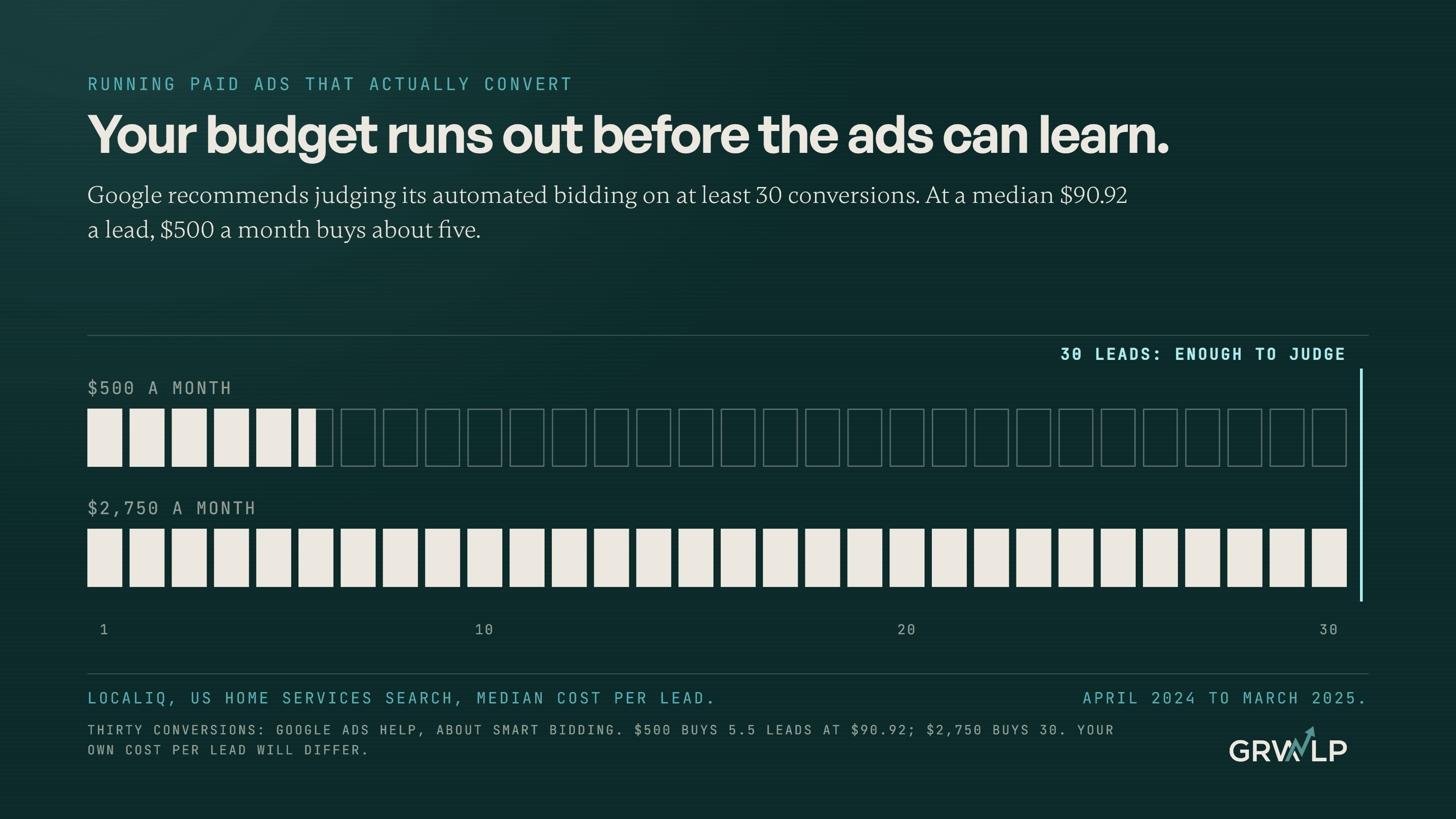
Google's own Smart Bidding page recommends judging results "over longer time periods that have at least 30 conversions, such as a month or longer (50 conversions for Target ROAS)." Smart Bidding is the automated bidding most small accounts end up on. Thirty conversions is not a rule to switch it on, but it is Google's own line for when there is enough to tell whether it is working.
We call the cost of reaching that line the learning bill: your cost per counted action, times 30. For a reference cost, LocaliQ, which sells advertising, publishes home services search benchmarks from 3,211 US campaigns run by its own customers between April 2024 and March 2025. Its median cost per lead is $90.92. The page does not define a lead, so treat it as a rough reference, not a price.
The learning bill at LocaliQ's median cost per lead
| Monthly budget | Leads a month at $90.92 | Time to reach 30 leads |
|---|---|---|
| $500 | About 5 | About five and a half months |
| $1,500 | About 16 | About two months |
| $2,750 | About 30 | About one month |
Run the same sum with your own numbers, in naira, dollars or pounds. If you count paying customers instead of leads, the bill is bigger, because only some leads pay. That is the honest trade: count something close to the sale, but frequent enough that your budget can buy 30 of it in a month.
If the sum says five months, you have three choices. Raise the budget, count an earlier action that happens more often, or spend less on more targeted searches and accept that you will judge the results by hand for a while. What does not work is spending $500 for one month and deciding.
Meta has its own learning period for ad sets. Its help page on the learning phase would not load on the machine we used to write this, and the figures other sites quote for it disagree, so we do not print one here. The logic is the same: the system needs enough of your counted action to learn from.
Who answers the lead when it arrives?
Someone, fast. A paid lead that waits until tomorrow is a lead you paid for twice.
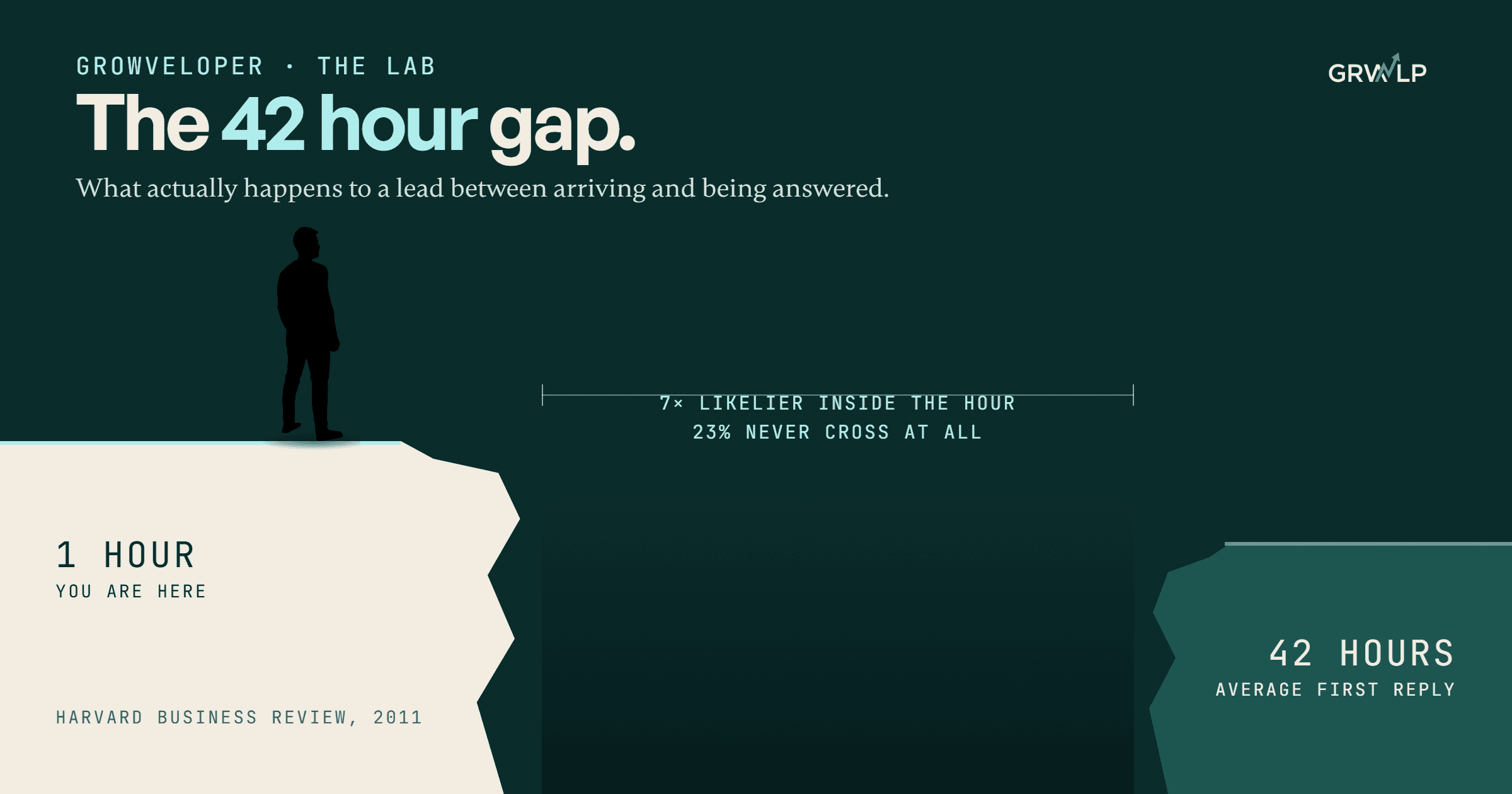
The best known study is still the 2011 Harvard Business Review analysis, The Short Life of Online Sales Leads, which audited 2,241 US companies and found an average first reply of 42 hours, with 23% never replying at all. Our piece on how fast home services companies should reply sets out what that study does and does not show. Picture a phone that rings into an empty office at 7pm, the evening the ad was cheapest. Automating lead follow up is how a one person business covers those hours without hiring.
When should I not run ads yet?
When any of the first four checks fails, or when the learning bill is more than you can spend in three months. In those cases the money does more good fixing the page, the reply or the offer first, or going into search listings and reviews that keep working after you stop paying.
Ads are a multiplier. They multiply whatever is already there, including a slow reply.
What did this look like on a real account?
When I ran paid media at VIP Creative Studio, one of its clients was a US credit union spending more than $16,000 a month across Google and Meta. The account counted a submitted credit card application, not a click and not a page view, and in one month it recorded 250 of them. That is more than eight times the 30 Google asks for, so the bidding had real results to learn from every month.
Most small businesses will never spend like that, and they do not need to. They need the same shape at their own size: count the action closest to a sale that still happens often enough to buy 30 of. We run ads this way as part of our growth marketing work, and the paid Growth Audit checks an existing account's tracking, page and reply before any more money goes in. Our interest is stated: we sell this. The sum works the same whoever runs your ads.
Run the sum before you run the ad. If the answer is five months, the ad was never the problem.
“The ad platform cannot learn from results you cannot afford to buy.”
Written by Oyekola Obajuwon