How do personal trainers get clients online?
How personal trainers get clients online: most still come by referral, so help the referred person find you, see a price and book.
TL;DR
Most personal trainers still get clients by referral, so getting clients online mostly means catching the person a friend sent you. Give them one page with your price, where you train and a booking link, a Google Business Profile if you meet clients in person, and a reply within the hour. Content and ads come after.
Last updated 7 October 2026. Written by Oyekola Obajuwon, founder of Growveloper, a growth studio in Lagos that builds the website, the marketing and the follow up for owner run businesses in Nigeria, the United States and the United Kingdom.
Most personal trainers still get clients by referral, so getting clients online mostly means catching the person a friend sent you. Give them one page with your price, where you train and a booking link, a Google Business Profile if you meet clients in person, and a reply within the hour. Content and ads come after.
That order runs against most of what you will read. The pages that answer this question are mostly written by fitness software companies, and social media sits near the top of nearly every list. Trainerize's guide to getting personal training clients, dated 14 January 2026, lists fourteen strategies, from defining your ideal client to sharpening your sales skills. All fourteen are reasonable. None of them says which three to do this week if you are one person with no budget, and that is the question this page answers.
Where do personal trainers' clients actually come from?
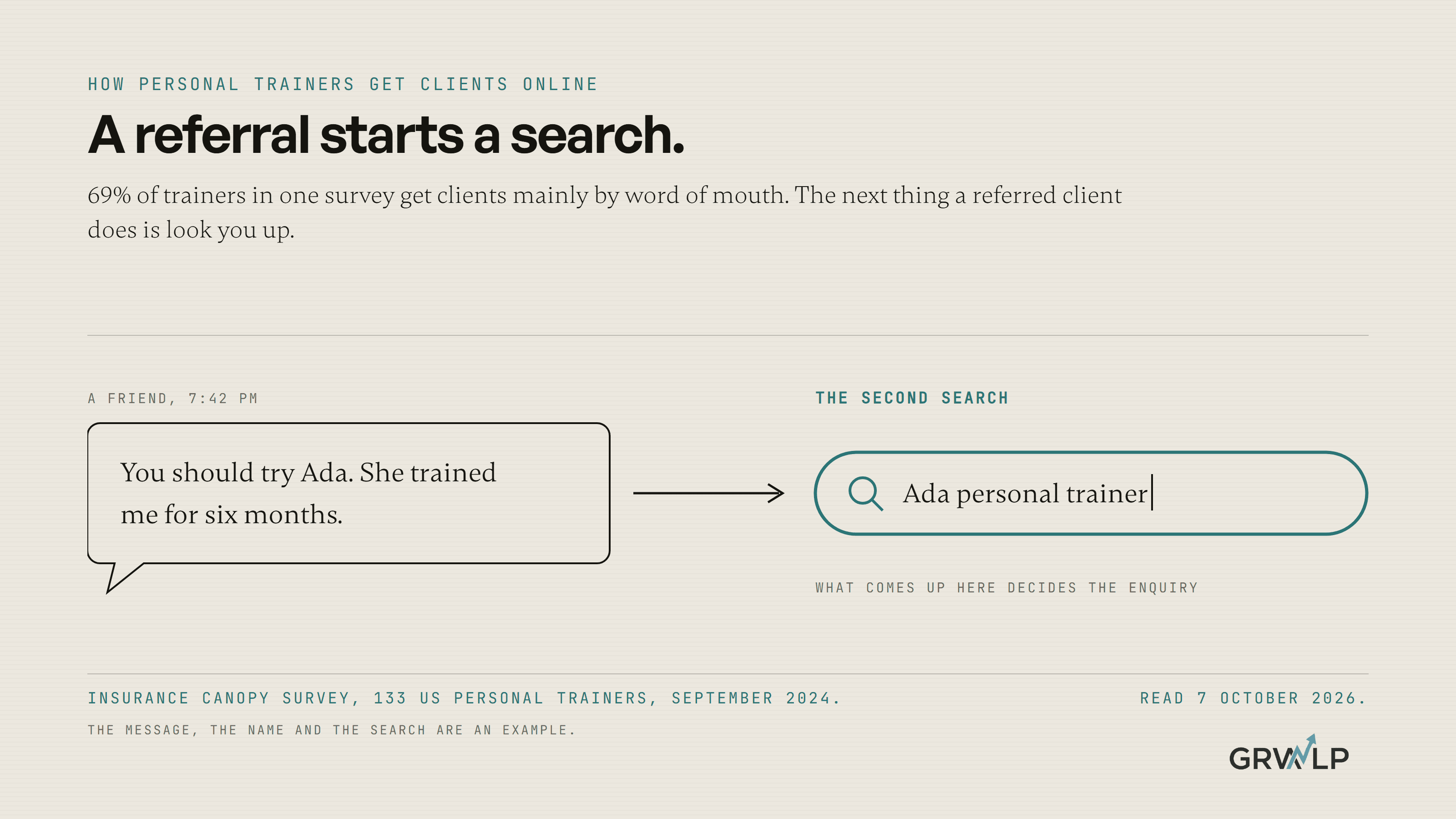
From other people, mostly. In a survey of 133 US personal trainers run in September 2024 by the insurer Insurance Canopy, 69% said they get new clients mainly through word of mouth referrals. Half of them, 50.4%, said a quarter or fewer of their clients come from online sources at all.
It is a small survey, and it asked trainers rather than clients, so treat it as a lean, not a law. But it points at something the tactic lists miss. A recommendation does not end the search. It starts a second one, for your name.
We call this the second search. The friend's text arrives with your name in it, and the next thing the person does is type that name into Google or Instagram to see if you are real, near, and affordable. What they find in the next minute decides whether the referral becomes an enquiry. So the online work that matters first is not reaching strangers. It is being findable, and bookable, for the people your clients already sent.
Do I need a website as a personal trainer, or is Instagram enough?
Instagram shows people who you are. It is a poor place to make them a client, because a booking that lives in direct messages lives next to everything else. The message sits under a pile of other chats until the session ends, and by then the person has asked someone else.
We have seen that pattern up close in a different business. When we built for RideOn Nigeria, a Lagos chauffeur service, customers booked through WhatsApp and the admin team worked from "spreadsheets and chat threads". The fix was not more posting. It was one place where every booking landed, with the customer's details attached. A trainer needs the small version of that: one page with what you offer, where, roughly what it costs, and a button that books a first session or a call.
Our page for personal trainers and fitness studios describes what we build for that, if you would rather not build it yourself.
Can an online coach have a Google Business Profile?
Not if the coaching is only online. This is where the most repeated tip on every list splits in two.
Google's Business Profile rules on eligibility say "a business must make in-person contact with customers during its stated hours", and list "Brands, organizations, artists, and other online-only businesses" as not eligible. Its page on service-area businesses says a business qualifies if it "has a physical location that customers can visit, or travels to customers where they are." So a coach who trains only on a screen is told no by the one listing everyone tells them to set up, while a trainer who comes to your house is told yes.
Which trainers Google will list, and where each should start
| Kind of trainer | Google Business Profile? | First front door |
|---|---|---|
| Studio or gym you train clients in | Yes, at that address | The profile, with reviews, plus one page to book |
| Mobile trainer who travels to clients | Yes, as a service-area business with the address hidden | The profile with your service area, plus one page to book |
| Online-only coach | No, Google lists online-only businesses as ineligible | Your own page, found by your name, plus where your clients already gather |
If you train in person even part of the week, set up the profile for that work and ask happy clients for reviews. Our guide to getting more Google reviews covers when to ask and how to make it one tap.
What should a personal trainer do first, with no budget?
Three things, in this order, before any content plan or ad.
1. Search your own name
Do the second search yourself, on your phone. Type your name, then your name plus "personal trainer" and your area. Whatever comes up is your shop window for every referral. If it is an old profile, a page with no price, or nothing, that is the first fix.
2. Build one page that answers three questions
Where do you train, what does it roughly cost, and how do I start? A starting price or a package price saves both of you a conversation with someone who could never afford it. Then one button: book a first session or a short call. Most visitors will see it on a phone, so check it there. Our guide to turning phone searches into calls has the details that matter on a small screen.
3. Decide how fast you will reply
This is the step every tactic list skips. A trainer's day is sessions back to back, which means enquiries arrive while your hands are busy. Pick a promise you can keep, say within the hour, and set up an automatic first reply with your booking link so the person is never left waiting on silence.
Only then is it worth posting more, because posting sends people to the page and the reply you just built.
How fast should a personal trainer reply to an enquiry?
Fast, and faster than feels necessary. We found no study of reply times specific to fitness; the vendor pages we read do not address it at all. The broader research on lead response, which we go through in our piece on how fast a home services company should reply, points the same way for every service business: the first to answer usually wins.
What the trainers' own survey does say is what turns a reply into a client. In Insurance Canopy's numbers, about 62% said some kind of free initial assessment or special promotion worked best at converting enquiries, and 27.1% named a single free first consultation. So the reply should carry an offer, not just a hello: a time for a free first assessment, with the link to book it.
If enquiries come in on Instagram, WhatsApp and a form at once, our guide to connecting your website to WhatsApp, your CRM and your calendar shows how to make them land in one place.
When do personal trainers get the most new clients?
In the new year. In the same survey, 36.4% of trainers said they get most of their new clients between January and March. That makes October to December the time to do the work above: fix the page, gather reviews from this year's clients, and set the reply up, so it is ready when the January searches arrive rather than built in the middle of them.
Is personal training a growing market?
In the United States, yes. The Bureau of Labor Statistics occupational outlook for fitness trainers and instructors counts 388,400 jobs in 2025, with a median wage of $47,160 in May 2025, and projects 7% growth from 2025 to 2035, "much faster than the average for all occupations". It also counts 15% of the occupation as self-employed. More trainers means more people the referral could have gone to instead, which is one more reason the second search has to go well.
If you would like someone to look at what your second search shows and tell you what to fix first, there is a free call.
A friend's recommendation gets you the enquiry. The page, the price and the reply decide whether it becomes a client.
“A recommendation does not end the search. It starts a second one, for your name.”
Written by Oyekola Obajuwon