Does my small business website have to be accessible by law?
Yes in the US and UK, rarely in the EU, not yet in Nigeria, and no widget settles it for you.
TL;DR
In the US and the UK, yes: both laws cover any business that serves the public, websites included, whatever its size. In the EU, only if customers can buy or book on it and you are not a microenterprise (under 10 staff and under €2 million a year). Nigeria has no website rule yet. This is not legal advice.
Last updated 6 November 2026. Written by Oyekola Obajuwon, founder of Growveloper, a growth studio that builds the website, the marketing and the automation for owner run businesses in the United States, the United Kingdom and Nigeria. He has built websites for 5.5 years.
In the US and the UK, yes: both laws cover any business that serves the public, websites included, whatever its size. In the EU, only if customers can buy or book on it and you are not a microenterprise (under 10 staff and under €2 million a year). Nigeria has no website rule yet. This is not legal advice.
I build websites, not court cases, so I went to the laws themselves instead of the pages that rank for this question. Most of those pages are written by companies selling an accessibility widget, and it shows: they answer “is it the law” with “buy this”. The laws answer it differently in each country, and none of them is answered by a widget.
What does the law say in each country?
The answer turns on two things: where your customers are, and what your site lets them do. Size matters in exactly one place, the EU.
Does the law reach a small business website?
| Where | Does it reach your site? | What it asks |
|---|---|---|
| United States | Yes, if you serve the public | A site disabled customers can use; no set standard for businesses |
| United Kingdom | Yes, any service to the public | Reasonable adjustments, planned in advance |
| European Union | Only shops and booking sites, 10+ staff | The EAA's requirements since 28 June 2025 |
| Nigeria | No website rule yet | A general ban on disability discrimination |
Does the ADA apply to a small business website in the US?
Yes. The Justice Department's guidance on web accessibility says the Americans with Disabilities Act applies to businesses open to the public, and that it has held since 1996 that the law covers web content. There is no line in it for small businesses.
What there is not is a rulebook. The same page, dated 2022, says: "The Department of Justice does not have a regulation setting out detailed standards, but the Department’s longstanding interpretation of the general nondiscrimination and effective communication provisions applies to web accessibility." So the law says your site must work for disabled customers, and leaves how to you.
The one place the government did write a standard is for state and local governments. Its Title II rule adopts WCAG 2.1 Level AA, and an April 2026 rule pushed its deadlines to April 2027 for areas of 50,000 people or more and April 2028 for smaller ones. That rule does not bind your business, but it tells you which yardstick the government reaches for.
The risk is real and lopsided. Seyfarth Shaw counted 3,117 website accessibility lawsuits in federal court in 2025, up 27% from 2,452 the year before and 36% of all 8,667 federal ADA Title III suits. New York's courts had 1,021 of them and Florida's 961. If your customers are in those states, and you sell online, you are where the suits are.
What does the Equality Act ask of a UK small business website?
It asks you to make reasonable adjustments, and it asks you to make them before anyone complains. Section 29 of the Equality Act 2010 covers anyone providing a service to the public, paid or free, in England, Scotland and Wales. The Equality and Human Rights Commission's draft 2026 code of practice for services puts it in one line: "The obligation also applies to the provision of services on a website (section 29)."
The part owners miss is who the duty is owed to. Schedule 2 of the Act says that for service providers "the reference in section 20(3), (4) or (5) to a disabled person is to disabled persons generally". You are not waiting for one blind customer to write in. You are expected to have thought about blind customers already, and section 20 adds that where the barrier is information, a reasonable step includes giving it in an accessible format.
How far you have to go depends on what is reasonable for you, and the code says the resources of the business count. A sole trader is not held to a bank's budget. But the code's own example, a legal services firm whose website has all its text inside images, is a firm that fails, and that is a mistake a five person business can make as easily as a big one. If you are planning a redesign in the UK, it is the cheapest moment to get this right.
Does the European Accessibility Act apply to my small business?
Probably not, if you are small and your site only tells people about you. The European Accessibility Act (Directive (EU) 2019/882) has applied since 28 June 2025 to a list of services sold to consumers, and e-commerce is on it. Its definition of e-commerce is narrow: "services provided at a distance, through websites and mobile device-based services by electronic means and at the individual request of a consumer with a view to concluding a consumer contract". A site where a customer buys or books is that. A brochure site with a phone number is not.
Then comes the line most of the ranking pages bury. Article 4(5) reads: "Microenterprises providing services shall be exempt from complying with the accessibility requirements referred to in paragraph 3 of this Article and any obligations relating to the compliance with those requirements." A microenterprise, by Article 3, employs fewer than 10 people and has a turnover or balance sheet of €2 million or less.
So a five person online shop in Lisbon turning over less than €2 million owes the EAA nothing, while a five person plumber in Leeds owes the Equality Act reasonable adjustments. The exemption is written for microenterprises providing services; makers of the products the Act lists are treated separately. And a UK or US shop with 10 or more staff that sells to consumers in the EU is selling into the Act's reach, wherever its office is.
What about a small business website in Nigeria?
Nigeria has no law that sets rules for websites. The Discrimination Against Persons with Disabilities (Prohibition) Act, signed on 17 January 2019, has 58 sections, and their headings cover buildings, roads, transport, education, health, jobs and the new national commission. None mentions a website, an app or a digital service. Its five year grace period, as PLAC's factsheet explains it, was for public buildings and services.
Section 1 is wide, though: "A person with disability shall not be discriminated against on the ground of his disability by any person or institution in any manner or circumstance". A company that breaks it can be fined ₦1,000,000. Nobody has tested that against a website that I could find. My verdict for a Lagos business: no rule tells you what your site must do, so build it to the same standard as a UK one, because the work is the same and your customers abroad will hold you to it.
Will an accessibility widget make my site compliant?
No, and the US government has said so to the best known seller of one. In April 2025 the Federal Trade Commission approved a final order making accessiBe pay $1 million. The company had claimed its accessWidget plug-in could make any website compliant with the accessibility guidelines; the FTC's complaint said it did not.
The Justice Department's guidance says the same thing more gently. Automated checkers and overlays can help, it says, but they need to be used with care, and a clean report from one does not mean the site is accessible. Pair any scan with a check by hand.
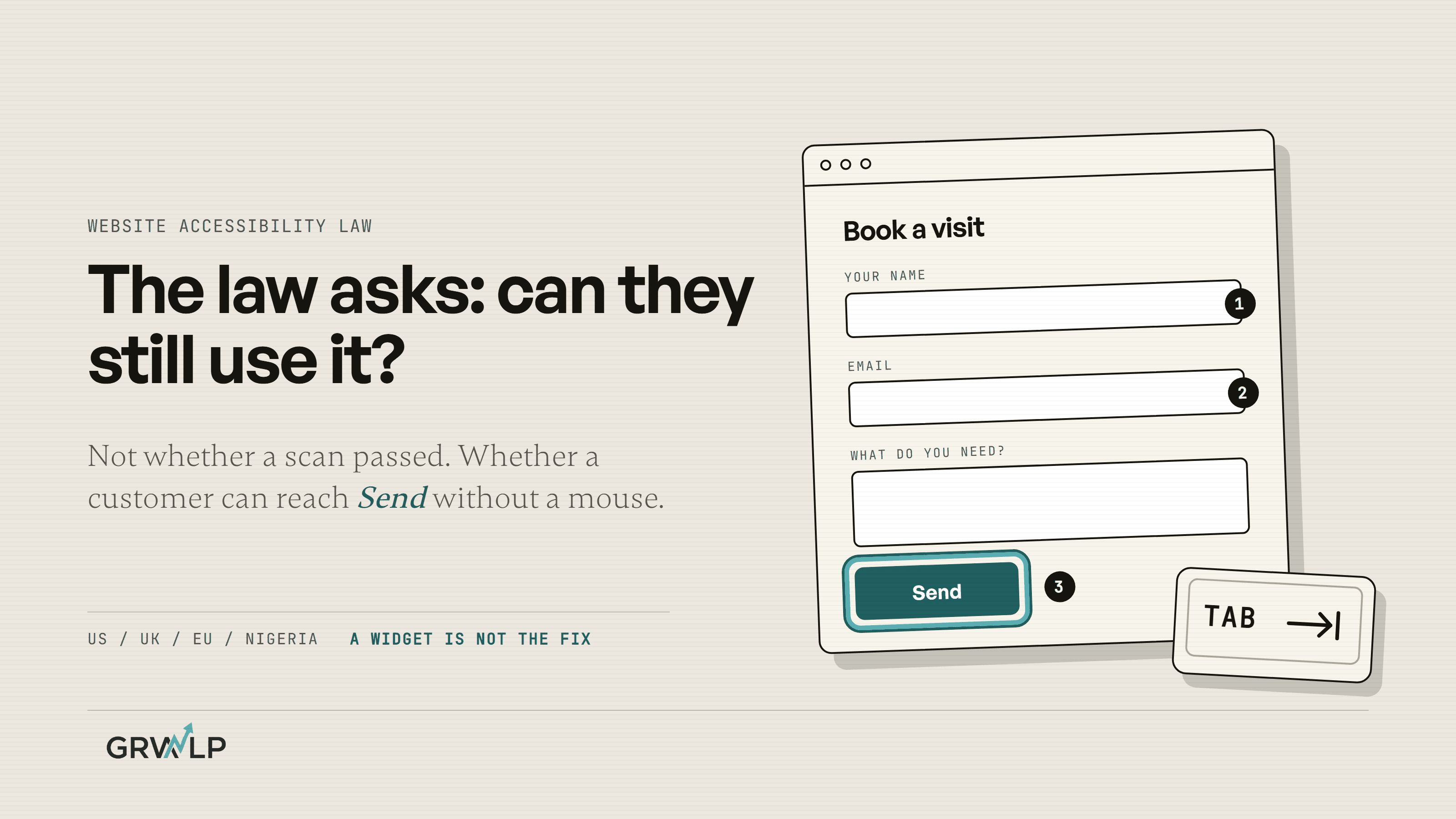
The law never asks whether your site passed a scan. It asks whether a customer who cannot see your screen can still buy from you. A script that paints a toolbar over the page does not change what is underneath it, and what is underneath is what a screen reader reads.
What should a small business fix first?
Fix the six things that break almost every site. WebAIM scanned the top million home pages in February 2026 and found detectable failures on 95.9% of them, up from 94.8% a year earlier. Six kinds of error made up 96% of everything it found.
The six, in the order you will meet them
Low contrast text sat on 83.9% of pages: pale grey on white is the classic. Missing alt text, the short description a screen reader speaks for an image, on 53.1%. Form fields with no label on 51%. Empty links on 46.3% and empty buttons on 30.6%, usually an icon with no words behind it. And a page that never says what language it is in, on 13.5%. These are the same barriers the Justice Department's guidance lists, almost one for one.
Start with the form
If your site has a contact or booking form, that is where the law and the money meet. When I rebuilt the VIP Creative Studio site, it went from one Wix page with no contact form at all to 13 pages in six weeks. A form a screen reader cannot label is a closed door with a lit sign over it.
Test it yourself in ten minutes
Unplug your mouse. Press Tab from the top of your home page and try to reach the form, fill it in and press send. If you lose track of where you are, or a button never lights up, a keyboard user is stuck in the same place. Then read WCAG 2.2, the current version of the guidelines, published 12 December 2024; meeting its AA level also meets 2.1. Add a line telling visitors how to report a problem, which the Justice Department suggests too.
If you are getting a new site built, put WCAG 2.2 AA in the brief, the way writing a brief for a web developer sets out, and ask how it will be tested. It is part of how I build on the web development side for local service businesses and shops alike, and the same goes for the other legal basics in the privacy policy and cookie banner. If you want a second pair of eyes on yours, a free 30-minute call, no pitch, and 20% off if we build, booked at cal.com/growveloper/30.
Every country that has an answer asks the same question: can a disabled customer use your site to do what everyone else does on it? A widget cannot answer that for you. Ten minutes with the Tab key can.
“The law never asks whether your site passed a scan. It asks whether a customer who cannot see your screen can still buy from you.”
Written by Oyekola Obajuwon
website accessibility law small business · ADA website compliance small business · Equality Act website accessibility · European Accessibility Act microenterprise · accessibility overlay · WCAG 2.2 · disability act Nigeria website