Website redesign for a small business in the UK: what should I keep and what should I change?
A UK small business website redesign: what to keep, what to change, the legal details that must survive, and what four agencies charge.
TL;DR
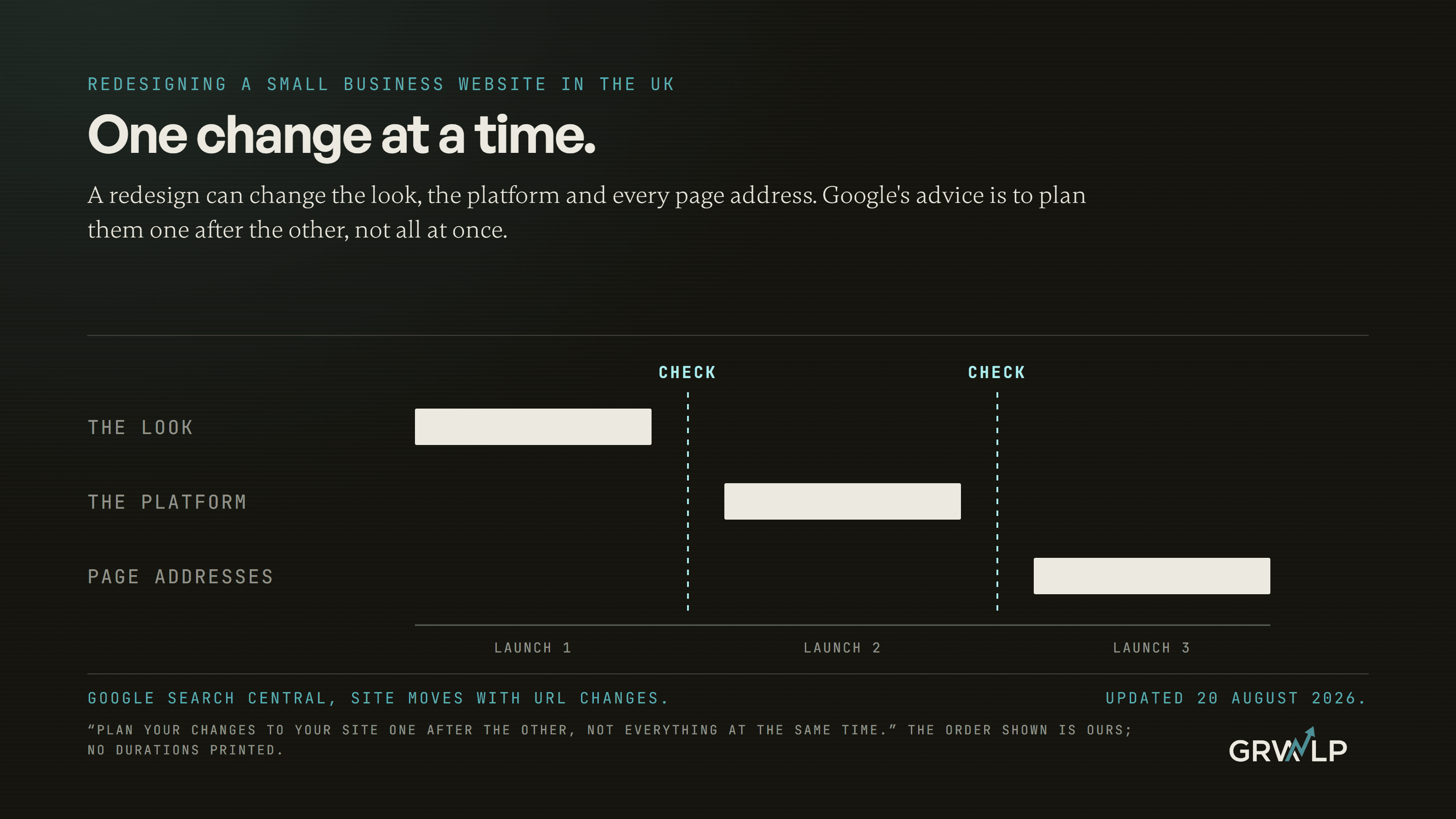
Keep every page address that brings visits or enquiries, your legal details, phone number and analytics. Change the design, speed and mobile layout first. Google advises making big changes one at a time, so a UK redesign that also changes the domain, the platform and every page address at once goes against Google's own advice.
Last updated 5 October 2026. Written by Oyekola Obajuwon, founder of Growveloper, a growth studio that builds the website, the marketing and the follow up for owner run businesses in the United Kingdom, the United States and Nigeria.
Keep every page address that brings visits or enquiries, your legal details, phone number and analytics. Change the design, speed and mobile layout first. Google advises making big changes one at a time, so a UK redesign that also changes the domain, the platform and every page address at once goes against Google's own advice.
Most UK small businesses are past the first website. The government's UK Business Data Survey 2026, which asked 4,450 businesses between October 2025 and January 2026, found 84% of micro businesses and 92% of small ones have a website. So the question most owners are asking is not how to get a site. It is how to replace one without losing what the old one quietly does.
What should I keep when I redesign my website?
Everything people and search engines already use to find you. Before anyone sketches a new home page, write down what the current site does that you cannot afford to lose.
When we rebuilt the website for Baye Business Solutions, a cloud services company in Lagos, the work started with an audit that documented every broken link, every missing page and every gap. The method is the same in Leeds. The list is the brief, and anything not on it is at risk.
What to keep and what to change in a small business website redesign
| Part of the site | Keep or change | Why |
|---|---|---|
| Page addresses that bring visits | Keep exactly | Google has learned them; a changed address needs a permanent redirect |
| Pages that bring enquiries | Keep, then improve | Change the layout around the words that already work |
| Legal details in the footer | Keep, then check | UK law requires them on a company's website |
| Phone number, email, forms | Keep, then test | The new site must deliver every message the old one did |
| Analytics and cookie banner | Keep, then test the same day | The easiest thing to break and the hardest to notice |
| Look, speed and phone layout | Change first | The safest change, and the one visitors see |
Will a redesign hurt my Google rankings?
It can, and Google says how to keep the damage small. Its guide to site moves with URL changes, updated 20 August 2026, says "you may experience ranking fluctuations while Google recrawls and reindexes your site", and that for medium sized sites "it can take a few weeks or more" for Google to show the new addresses.
Where an address must change, Google recommends "HTTP permanent redirects if possible, such as 301 and 308", and says to keep them "for as long as possible, generally at least 1 year." A redirect is a forwarding instruction: anyone, or any search engine, asking for the old address is sent to the new one. Every changed address needs one, pointed at the closest new page, not the home page.
If you are leaving Wix as part of the redesign, our piece on moving off Wix without losing rankings covers the Wix specific traps.
Why should a redesign change one thing at a time?
Because a redesign is three projects wearing one invoice: the look, the platform the site runs on, and the page addresses. Google's guide is plain about this: "Plan your changes to your site one after the other, not everything at the same time." Its own example names three, a new domain name, a new CMS (the system you edit the site in) and a new layout, and says "do them one at a time."
The reason is simple. When rankings or enquiries drop after a launch that changed everything, nobody can tell which change did it.
We learned the smaller version of this on our own site. In September 2026 we updated how growveloper.com asks visitors for cookie consent. The pages looked exactly the same. But Google Analytics recorded nothing for about three weeks, because the consent signal never reached the tag that sends the data, and nobody noticed, because nothing looked broken. One change, invisible on the page, found only when we went looking. Now imagine it buried inside a new design, a new platform and a hundred new addresses.
So ask the agency which of the three your quote includes. If it is all three, ask whether the look can launch first on the addresses you already have.
What must a UK business website show after a redesign?
The details a new footer quietly drops. Check them on the new design before it goes live.
If you are a limited company
The Company, Limited Liability Partnership and Business (Names and Trading Disclosures) Regulations 2015 say in regulation 24: "Every company shall disclose its registered name on its websites." Regulation 25 adds the part of the UK the company is registered in, its registration number and its registered office address.
If you sell or take enquiries online
The Electronic Commerce (EC Directive) Regulations 2002, regulation 6, require your name, your geographic address, contact details including an email address, your registration number where you are on a public register, and your VAT number if you are registered. Where the site shows prices, they "shall indicate whether they are inclusive of tax and delivery costs."
The cookie banner
A new design often brings a new banner. The Information Commissioner's Office lists the exceptions to cookie consent, including one for statistics about how your site is used. It comes with conditions: visitors get clear information and a "simple and free" way to object, and the results are aggregate figures that identify no one. Ask your agency which of your tools meet those conditions, and which still need a yes from the visitor.
How much does a website redesign cost in the UK?
For a small business, the four UK agency price pages we read start between £500 and £1,500, and their small business tiers top out between £3,000 and £5,000. What each price includes is where they differ most.
What four UK agencies publish for a small business website redesign
| Agency | Small business price | What the page says it covers |
|---|---|---|
| Michael Wood | £500 to £1,500 refresh; £1,500 to £4,000 redesign | Refresh for sites that look dated; redesign for most service businesses |
| Neometa | £1,000 to £3,000 | Visual updates: graphics, typography, colours |
| Delivix | £1,500 to £5,000 | New look on the existing platform, mobile, basic SEO, possibly new pages |
| Dot it Media | £1,500 to £5,000 | 5 to 15 pages, SEO migration; a 301 redirect plan in every project |
The full pages are Michael Wood's, Neometa's, Delivix's and Dot it Media's. Only one of the four names a redirect plan in what every project includes. That is fine for a refresh that keeps every address. It is not fine for a redesign that changes them, so ask.
Michael Wood's page makes the other point worth knowing: "If the foundation is weak, a redesign often turns into a rebuild." Our own prices are published in dollars on our web development page, $2,000 to $10,000 and up, which puts us above the cheapest tiers here. If a refresh on the platform you already have is what you need, several of these will do it for less.
What should I ask a redesign agency before I sign?
Three questions, in writing.
Will any page address change?
If yes, ask for the list of old and new addresses before launch, and for every one to have a permanent redirect. If the answer is "we will sort the SEO", ask again.
How will I know nothing broke?
Ask what gets tested on launch day: every form, the phone link on a mobile, the email delivery and a visit showing up in your analytics. StatCounter's UK figures put mobile at 53.56% of web traffic in September 2026, so test on a phone first. Our piece on making a website load faster covers what to measure there.
What will I own, and what can I edit?
Ask who holds the domain, the hosting and the login after launch, and what you can change yourself. Our pieces on the year two question and a website you can edit yourself cover both.
If you want a second opinion on a redesign quote you already hold, there is a free call. We will tell you if the cheaper quote is the right one.
Change what your visitors see. Keep what Google, the law and your customers already know where to find.
“A redesign is three projects wearing one invoice. Buy them one at a time.”
Written by Oyekola Obajuwon