How do I write a brief for a web developer?
What a brief for a web developer must answer, what to leave out, a one page template, and a test that shows it is finished.
TL;DR
Write one page that answers what a developer would otherwise guess. What you sell and to whom, the one thing every visitor should do, what happens after they do it, the pages, the accounts you already own, your budget and your date. Leave the colours and the code to them, then send it to three developers.
Last updated 16 October 2026. Written by Oyekola Obajuwon, founder of Growveloper, a growth studio that builds the website, the marketing and the follow up for owner run businesses in the United States, the United Kingdom and Nigeria.
Write one page that answers what a developer would otherwise guess. What you sell and to whom, the one thing every visitor should do, what happens after they do it, the pages, the accounts you already own, your budget and your date. Leave the colours and the code to them, then send it to three developers.
That is the whole job. The rest of this page is what each of those lines means, a template you can copy, the parts most owners write too much about, and a test that tells you the brief is finished before you pay anyone.
What should a brief for a web developer include?
Answers to the questions a developer will otherwise answer for you. Every gap in a brief gets filled, and it gets filled by someone who does not know your business and is paid by the hour or by the scope.
What a website brief must answer, and what happens when it does not
| Part of the brief | What to write | What the developer guesses without it |
|---|---|---|
| The business | What you sell, to whom, in which towns or countries | Who the site is for |
| The one action | Call, book, request a quote or buy | Which button gets the space |
| After the action | Who gets the enquiry, where, how fast | Where form emails go |
| The pages | Each service, each area, about, contact | A standard five page site |
| What exists now | Your current address, logo, photos, words | That everything starts from zero |
| The accounts | Domain, hosting, analytics, Google profile, in whose name | Whose name new ones go in |
| Budget and date | A range, and the date with its reason | Both, upwards |
The three rows owners skip most often are the middle three. After the action decides whether an enquiry reaches a person or sits in an inbox nobody opens. What exists now decides whether the addresses that already bring you visitors survive the rebuild. The accounts decides whether you own the website when it is finished, which our guide to whether you own a website a developer built covers line by line. If you are not sure whose name your domain is in, the ICANN lookup will show you the registrar in about a minute.
Why does the brief matter so much?
Because the quote is priced on it, and every unanswered line is priced as risk.
A developer reading a vague brief has two choices. Quote high to cover what might be hiding, or quote low and send change requests later. Either way you pay for the silence. PMI's Pulse of the Profession study on requirements, published in August 2014, found that 47 percent of projects that failed to meet their goals did so because of inaccurate requirements management. That was research on large organisations with project managers and budgets for both. A small business with no brief at all is starting further back than they were.
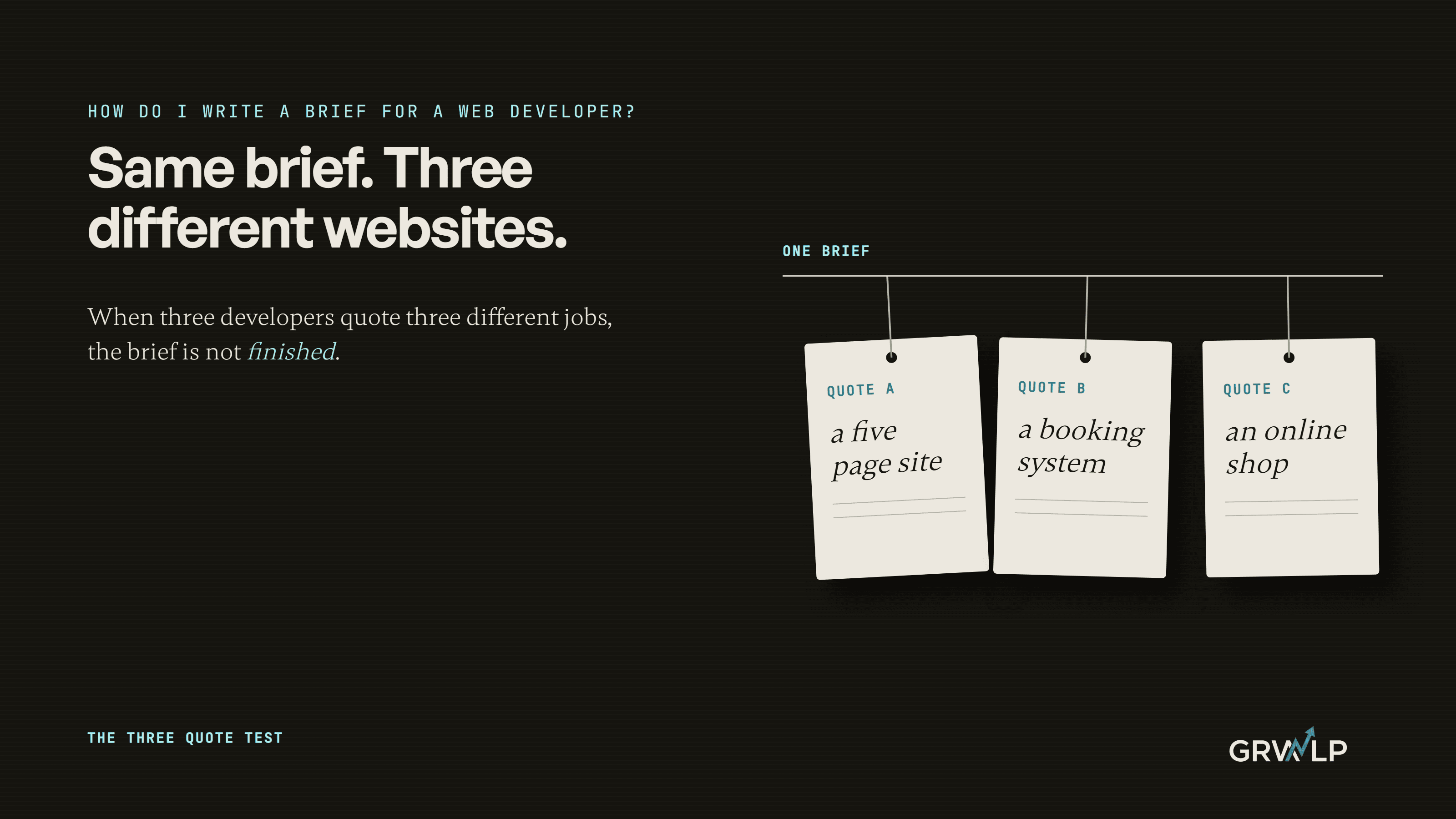
A vague brief does not get you a cheaper website. It gets you three different websites, priced.
What does a good brief look like? A one page template
Copy this, answer each line in a sentence or two, and stop when the page is full.
- The business: what we sell, to whom, and where.
- Why now: what is wrong with the current site, or why we need one at all.
- The one action: the single thing we want a visitor to do, and the button it lives on.
- After the action: who receives the enquiry, by email or WhatsApp or phone, and how fast we reply.
- The pages: one line per page, including each service and each town or area we serve.
- What we already have: our current website address, logo, brand colours if any, photos, reviews and written words.
- The accounts: who holds the domain, the hosting, Google Analytics, Search Console and our Google Business Profile.
- Who updates it: what we want to change ourselves after launch, such as prices, opening hours, photos or posts.
- Two sites we like: the address, and one sentence on what we like about each.
- Budget: a range we are comfortable with, in dollars, pounds or naira.
- Date: when it has to be live, and the reason, such as a launch, a season or a trade show.
- Who decides: the one person who approves the work, and how quickly they can reply.
Twelve lines. If a line does not apply, write does not apply rather than deleting it, so the developer knows you thought about it. Line 4 is the one most briefs leave out and the one that decides whether the site makes money, which is why it is the fourth check in our guide to a website that produces no leads.
What should I leave out of a website brief?
Most of the things owners write the most about.
The technology
Unless you have a reason, such as a team already trained on a system, do not name WordPress, Wix or anything else. Say what you need to do yourself after launch (line 8) and let the developer propose the tool and explain why.
Pages of colours and fonts
If you have a brand guideline, attach it. If you do not, one line is enough: we have a logo, nothing else. A developer can design from a logo. Three paragraphs of colour preferences tell them less than two sites you like and a sentence about each.
A list of every competitor
Two or three are useful, with one line on what each does better than you. Fifteen links with no comment are homework you have handed to the person you are paying.
A fixed list of features from another site
A booking system like the one on another site is better written as what has to happen: customers pick a time, we get an email, they get a reminder the day before. The developer can then tell you whether it needs a booking tool, a calendar link or a form.
What if I already have a website?
Then the brief has one more job: protect what already works.
Before you write anything, open Google Search Console, go to the Pages report, and export the list of addresses Google has indexed, then sort the Performance report by clicks. Those are the pages that bring you visitors, and their addresses go into the brief under line 6 with a note to keep each one or redirect it. Our guide to moving a site off Wix without losing rankings explains why that list matters more than the design.
Also note what the current site does that you want to keep, even if it is ugly. An enquiry form that works, a phone number customers already know, a page a local newspaper links to. A rebuild that loses those has cost you something before it has earned anything.
How do I know my brief is good enough?
Send the same brief to three developers and read what comes back. We call this the three quote test.
If the three quotes describe the same job at different prices, your brief worked. You are now comparing price, speed and the person, which is the comparison you wanted. If the three quotes describe three different jobs, one a five page site, one a booking system, one a shop, your brief left the important questions open and each developer answered them differently. Do not pick the cheapest. Go back to the template, find the lines they disagreed on, answer them, and send it again.
The test works the same in Lagos, Leeds or Louisville. In Nigeria, ask each developer whether the quote is in naira or dollars and what is included, as our guide to choosing a web developer in Lagos explains; a quote that leaves out hosting or the domain is a different job, not a cheaper one. For what the quotes should roughly add up to, our website cost guide has the published ranges.
What happened when we got a good brief?
A website in six weeks, with almost no back and forth.
When we built the website for VIP Creative Studio, a marketing agency that works with credit unions in the US, the brief arrived in two pieces. The first was a brand guideline the team's designer had already finished: the typeface, the orange and turquoise palette, the spacing, how buttons behaved. The second was a sentence about what every page had to do, which was push a visitor towards booking a discovery call. Their whole web presence at the time was a single Wix page with no contact form.
Nobody had to guess the look, and nobody had to guess the action. Every service page was built to end on that one button. The site went from one page to 13 pages in 6 weeks, and the team could change its own headlines and testimonials afterwards because who updates it had been answered before a line of code was written.
The opposite happened at Baye Business Solutions, a cloud services company in Lagos. There was no brief, because nobody there knew what the site was missing. So the first job was an audit of every broken link and missing page, and the audit became the brief. That is a fine way to start. It is just slower and more expensive than writing the twelve lines yourself.
What does the developer do with the brief?
Turns it into a plan you can check before any code is written.
On our side that is the first step on the web development page, Discovery and Architecture, which takes 1 to 2 weeks: "We map your goals, define what the site needs to do, agree on the tech stack, and design your content model and analytics schema before writing any code." A good brief shortens that step, because half the questions are already answered. A missing brief does not skip it. It just moves the questions to the middle of the build, where every answer costs more, as the timeline in our guide to how long a small business website takes shows.
If you would rather write it together, book a free 30 minute call, bring whatever you have, and leave with the twelve lines filled in. The brief is the part of the website you can write at the kitchen table.
A brief is not a description of the website you want. It is the list of things you refuse to let a stranger guess.
“A vague brief does not get you a cheaper website. It gets you three different websites, priced.”
Written by Oyekola Obajuwon
website brief · web developer brief · web design brief · hiring a web developer · small business website · website project