Do I need a website, or is social media enough for my small business?
Social media is enough until a stranger searches for what you do, or the app shuts your account. The test, and the smallest fix.
TL;DR
Social media is enough while every customer already knows your name. You need a website the day a stranger searches for what you do, or the day the platform shuts your account. A one page site you own, with your customers' contact details kept off the app, covers both.
Last updated 20 October 2026. Written by Oyekola Obajuwon, founder of Growveloper, a growth studio that builds the website, the marketing and the follow up for owner run businesses in the United States, the United Kingdom and Nigeria.
Social media is enough while every customer already knows your name. You need a website the day a stranger searches for what you do, or the day the platform shuts your account. A one page site you own, with your customers' contact details kept off the app, covers both.
Most pages on this question are written by people who sell websites, and they all say you need both. That is usually true, but it skips the useful part: when social alone is fine, what it costs when it stops being fine, and how small the fix can be.
Can a small business run on social media alone?
Yes, for a while, if the business only sells to people who already know it.
A caterer whose orders all come from past guests, a tailor whose clients send their friends, a trainer with a waiting list: each of these can run on an Instagram page and a WhatsApp number. The customer already has the name. They tap the profile, send a message, and the sale happens in the chat.
What social media does well is the warm part. It shows the work, keeps you in people's feeds, and gives them a quick way to message you. In GoDaddy's survey of 1,000 young US shoppers, reported in December 2024, 61% of Gen Z said they expect a business to be on Instagram. Being there is not optional any more. Being only there is the question.
When does social media stop being enough?
When a stranger has to find you. We call this the stranger test: could someone who has never heard your name find you, trust you and contact you, without a friend sending them your profile?
Social media is built for people who follow you. A stranger does not start on Instagram. They type caterer in Lekki or emergency plumber near me into Google, or they ask ChatGPT, and those answers are built from listings and websites. Our guide to getting your business found online puts the steps in order for an owner with little time, and social media is the fifth step there, not the first.
AI assistants are the same, only stricter. When Microsoft Clarity ran 62 ChatGPT questions across the five topics our work covers, in September 2026, every source cited was a directory, a software vendor or an article on a website. Not one was a social media post. Our guide to getting cited by ChatGPT has the full method.
Social media alone against a website you own
| The job | Social media alone | A website you own |
|---|---|---|
| Found by people who know you | Yes | Yes |
| Found by a stranger searching | Rarely | Yes, with your Google listing |
| Survives a closed account | No | Yes |
| Takes a booking or a payment | Only in the chat | Yes, in a form or a link |
If every row you care about is the first one, social alone is fine. The moment you want the second row, you need a page.
What happens if my Instagram or Facebook account is shut?
You lose the way to reach your customers, often overnight and often without being told why.
Meta's own terms of service, which cover Facebook and Instagram, say it plainly in section 4.2: "we may suspend or permanently disable your access to Meta Company Products". That sentence is part of the deal every business page agrees to.
Here is what it looks like when it happens. In November 2021 a family soap maker in Salisbury, England, lost its Instagram account after a hack. It had 36,000 followers and, the local radio station reported, over 95% of its sales came through it. The owner's words: "Without the account, we hardly do any sales."
In New Zealand the same year, two women who sold clothes only on Instagram had their stores removed, the Otago Daily Times reported, one without being told which rule she had broken. One of them described starting over: "If you're restarting with, you know, 10-15 followers you're probably not going to make many sales for a long time".
Notice what each of them lost. The posts were never the loss. The phone numbers were. Tens of thousands of people who wanted the soap, and no way left to tell them where to buy it.
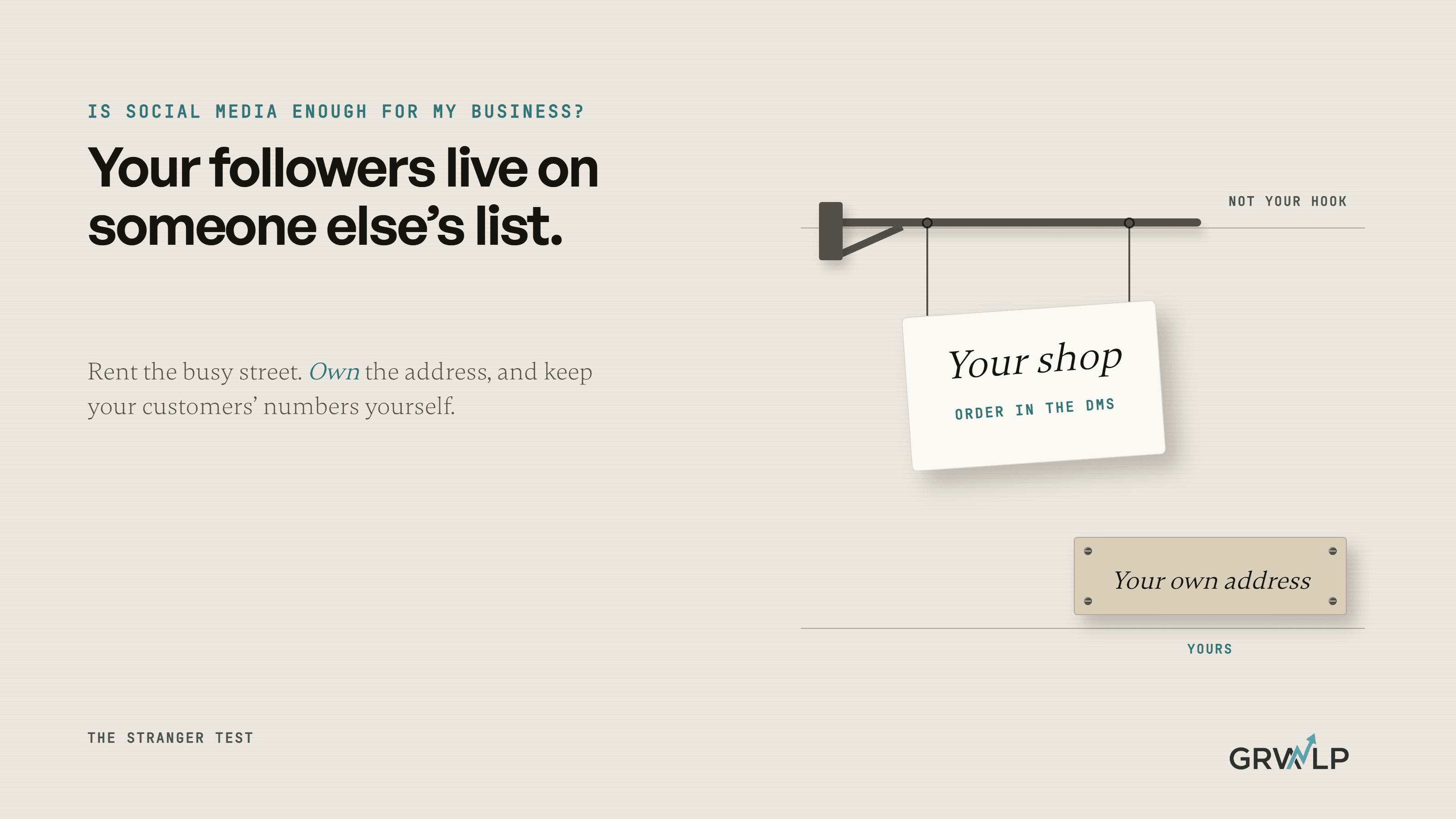
Your followers are not your customers' phone numbers. They are a list someone else keeps for you.
Do customers trust a business without a website?
Fewer of them, and the ones who check are the ones about to buy.
In the same GoDaddy survey, 80% said they research a small business online before buying from it for the first time. The red flags they named are telling: 32.5% said a website with no contact details would put them off, and 31.5% said an unfinished or under construction site would. A half built site, in other words, can cost you more trust than having none.
For a business in Lagos the check often looks different. A buyer sees your Instagram, sends a WhatsApp message, and then searches your name to see whether you are real before they transfer money. A page with your name, your address or area, your phone number and a few real jobs answers that search in ten seconds.
What is the smallest website that covers the risk?
One page, on an address you own, plus a copy of your customers' contacts that lives outside the app.
The page needs five things: what you do and where, in the words a customer would type; photos of real work; your phone number and WhatsApp link; a short form or booking link; and your hours. That is enough to pass the stranger test and to be found when someone searches your name. More pages come later, one per service, when you want to be found for each service on its own.
The contact list matters just as much. Every customer who buys from you on social media should end up somewhere you control: a spreadsheet, your phone's contacts, an email list, a booking system. If the account goes tomorrow, you send one message saying where to find you now.
Two cautions. Buy the address in your own name, not your builder's; our guide to whether you own a website a developer built covers the logins to ask for. And keep it finished, even if it is small, because of that 31.5%. For what a bigger site costs and why, see our guide to what a small business website costs.
Should I spend on more followers or on a website first?
If strangers are not finding you, the website and your Google listing first. If they are finding you but not buying, the follow up first.
Followers help the warm side of the business. They do nothing for the person searching for what you do at ten at night with their card already out. And followers you paid to gain are still on someone else's list.
When we worked with RideOn Nigeria, a chauffeur service in Lagos, customers booked through WhatsApp and the admin ran on spreadsheets and chat threads. The build gave the business a public site and a booking platform with portals for customers, drivers and partners. Instagram kept growing alongside it, to over 5,700 followers with nearly 400 posts. Social media did not get replaced. It got somewhere to send people.
That is the order that works for most small businesses: social media to be seen, a page you own to be found and trusted, a list you keep so nobody can take your customers away. If you want help building that page so it brings in enquiries rather than just sitting there, our web development page shows how we build, our local services page shows what a trade business usually needs, or you can book a free 30 minute call.
Rent the busy street. Own the address.
“Your followers are not your customers' phone numbers. They are a list someone else keeps for you.”
Written by Oyekola Obajuwon
website vs social media · small business website · Instagram business · Facebook page · social media only business · one page website · Lagos small business