How do I get people to find my business online in 2026?
Google, Apple Maps, Bing and AI assistants each keep their own copy of your business. Filling in one does not fill in the others.
TL;DR
People now find a business in four places that do not share your details: Google, Apple Maps, Bing, and AI assistants such as ChatGPT. Fill in your free Google Business Profile first, then give each service its own page on your website, then claim Apple and Bing, then earn reviews. Social media comes after.
Last updated 25 September 2026. Written by Oyekola Obajuwon, founder of Growveloper, who builds the website, the marketing and the follow up for owner run businesses in Nigeria, the United States and the United Kingdom.
People now find a business in four places that do not share your details: Google, Apple Maps, Bing, and AI assistants such as ChatGPT. Fill in your free Google Business Profile first, then give each service its own page on your website, then claim Apple and Bing, then earn reviews. Social media comes after.
Most owners who tell us "people cannot find us" have done one of those things properly and assumed it covered the rest. It does not. Here is where people are actually looking, and the order to show up there when you only have a couple of hours a week.
Where do people look for a business in 2026?
Still mostly Google, but less than a year ago, and a new place has appeared fast.
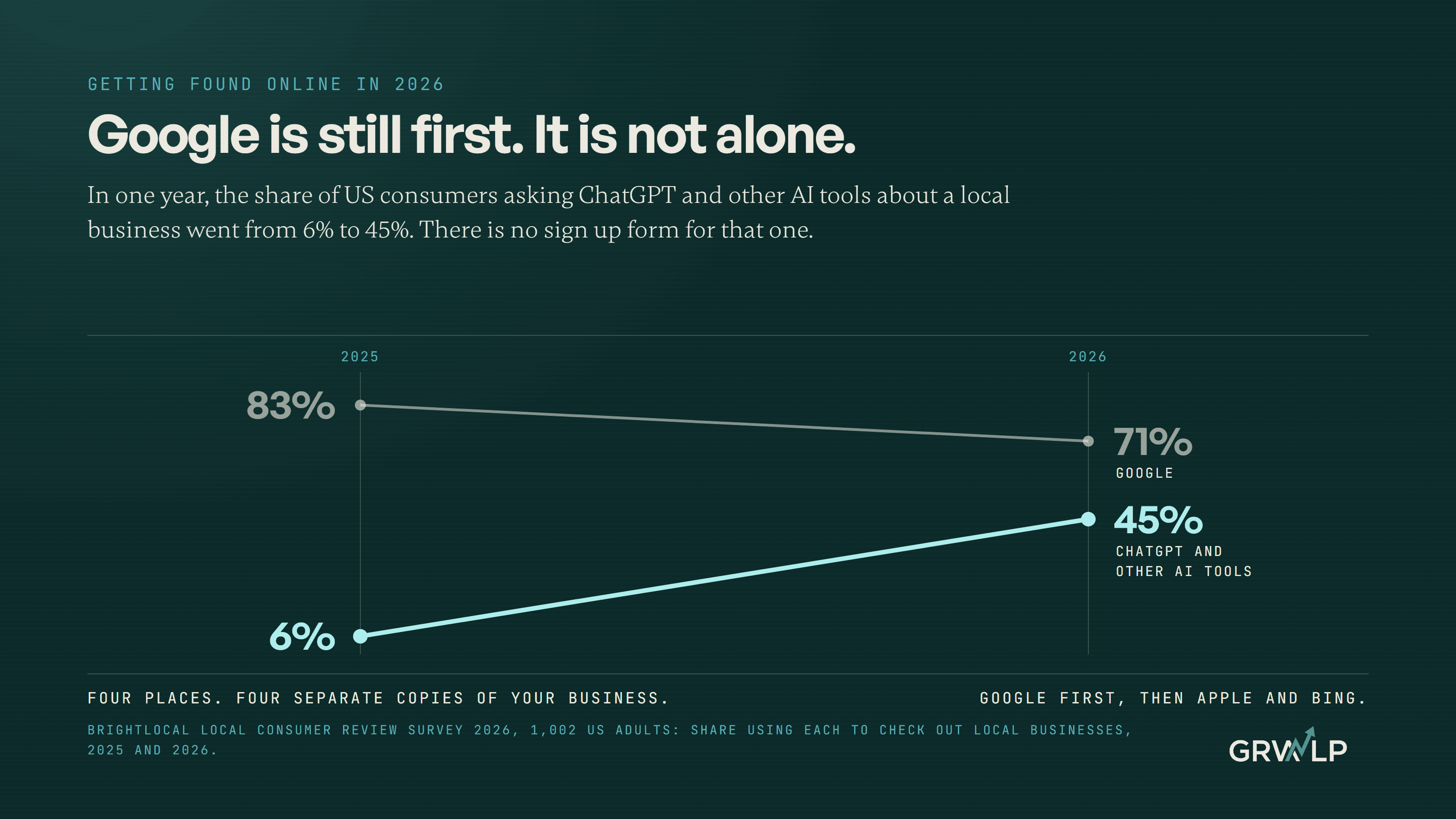
BrightLocal asks American consumers the same questions every year about how they check out local businesses. Its Local Consumer Review Survey 2026, a panel of 1,002 US adults published in February 2026, found Google used by 71%, down from 83% the year before. In the same twelve months, the share using ChatGPT and other AI tools for local business recommendations went from 6% to 45%.
Where US consumers go to check out a local business, and the listing you control there
| Where they look | Share of consumers, 2026 | Where your details come from |
|---|---|---|
| 71% | Your Google Business Profile | |
| 60% | Your Facebook page | |
| ChatGPT and other AI tools | 45% | No sign up. They read what the web says about you |
| Apple Maps | 27% | Apple Business, a separate free listing |
| Yelp | 25% | Your Yelp business page |
Read the right hand column. Every row is a different company holding its own copy of your business, and one row has no form to fill in at all.
Why is being found now four jobs instead of one?
Because the companies do not copy each other's homework.
Your Google Business Profile feeds Google Search and Google Maps. It does not feed Apple Maps, the maps app built into every iPhone. Apple runs its own free listing through Apple Business, where you set the name, hours and photos customers see in Maps.
Microsoft runs a third. In October 2025 it moved Bing Places to a new address, bing.com/forbusiness, with a faster way to import your listing from Google, and said deeper connections with Bing Maps and its Copilot assistant were coming. Bing matters more than its size suggests, because Microsoft's own assistant leans on it.
Call it the one listing myth: the belief that a complete Google profile means you are on the map everywhere. For local service businesses it bites hardest: a plumber can be first on Google Maps and missing from the Apple Maps app on the phone of the person standing outside a burst pipe.
What should I do first if I only have two hours a week?
Fill in the places people look, in the order most of them look there. The first step matters more than the other four put together.
1. Claim and verify your Google Business Profile
This is still where most people look, and it is free. Google's help page on verifying your business says you need to verify before you can edit your details or talk to customers, and that verification reviews can take up to five business days. Start it today so the clock runs while you do the rest. Our local SEO checklist for service businesses covers what to set once you are in, starting with the category.
2. Give each service its own page on your website
Your Google profile links to your website, and your website is where search engines and AI assistants check what you actually do. One page per service, each opening with what you do, where, and roughly what it costs, will be found for more searches than one page that lists everything. If people already arrive and still do not call, that is a different problem, and our guide to a website that does not produce leads walks through it in order.
3. Claim Apple Business and Bing Places
This is the step almost nobody does, and it is the quickest. Bing lets you import what you already set up on Google, so the work is mostly checking it. Apple's listing is separate and also free. Twenty minutes each, once, and you exist on two more maps.
4. Earn reviews every week
Reviews show up on all of these listings and they are what people read before they choose. The system is simple: ask when the job is done, send one direct link, remind once. The full workflow, with the messages, is in how to get more Google reviews.
5. Then pick one social channel
Facebook is the second most used place in BrightLocal's survey, so for a local business it is the obvious one. Post where your customers already are, not on every platform at once. Social is the fifth step, not the first, because a post that sends someone to a business they cannot find on a map has done half its job.
Can I sign up to be found by ChatGPT?
No. There is no form, no listing and no fee. AI assistants build their answers from what is written about you across the web: your own pages, your listings, your reviews, and articles that mention you. So everything above is also how you get into AI answers. There is no separate door.
We can tell you what that looks like from the inside, because we are doing it. Growveloper has listings on four business directories and, by that week, fourteen articles written to answer the exact questions owners ask AI assistants. When we measured ChatGPT's answers on our own topics with Microsoft Clarity on 24 September 2026, it named us zero times. Not once.
The same day, one search did quote us. Google's AI Overview for "three vendor tax" cited our article on the three vendor tax by name. That article describes a problem nobody else had put a name to, so Google had exactly one source to quote.
That is the lesson we would pass on. The AI answers name the business that says something nobody else says. If your website says what every competitor's says, the assistant has a hundred sources to choose from and no reason to choose yours. We wrote up what that takes in how to get your website cited by ChatGPT.
Do I still need a website if I have a Google profile?
Yes, if you want more than the people already searching your name. A Google profile holds your hours, photos and reviews. It cannot hold a page for every service, your prices, or the answer to the question a customer types before they know you exist. Those pages are also what AI assistants read. A profile without a website is a shop sign without a shop.
Is it different in Nigeria, the UK or the US?
The survey above is American, so the percentages are American. What carries across is the structure. Google Business Profile works in all three countries and is the first step everywhere. Apple says the features in Apple Business vary by country and region, so check what it offers where you are before you spend time on it. If most of your enquiries in Lagos already arrive on WhatsApp, the fifth step may be your WhatsApp Business profile rather than Facebook. Put your effort where your own customers already are, and ask the last ten of them how they found you.
How long does it take to be found online?
Longer than anyone selling it will tell you. Google verification can take up to five business days on its own. New pages on your website have to be found by Google before they can show up at all. When we reviewed our own site on 24 September 2026, six new pages for local trades had not been visited by Google three weeks after they went live, until we linked to them from every page. Treat it as a monthly habit, not a launch: set it up properly once, then keep the details true and the reviews coming.
What should I do this week?
Start your Google verification today, because it takes days. Then write down every service you sell and check whether each one has its own page. This weekend, import your Google listing into Bing and claim your Apple listing.
We should be plain about our interest: we build the website side and the follow up for owner run businesses, and there is a free call if you would rather talk it through. But you do not need us for the first three steps. You need an afternoon, and the four different companies that have each been keeping a copy of your business will finally have the right one.
“Filling in your Google profile does not put you on Apple Maps. Nobody tells you that, and it is the whole problem.”
Written by Oyekola Obajuwon