Do I own my website if a developer built it?
Who owns a website's code and design after you pay a developer in the US, UK and Nigeria, and the page that makes it yours.
TL;DR
Not automatically. In the US, the UK and Nigeria, copyright in a website's code and design starts with whoever wrote it, and paying the invoice does not move it. A written assignment, signed, does. Themes, plugins, stock photos and fonts stay licensed either way, and the domain is a separate question.
Last updated 13 October 2026. Written by Oyekola Obajuwon, founder of Growveloper, a growth studio that builds the website, the marketing and the follow up for owner run businesses in the United States, the United Kingdom and Nigeria.
Not automatically. In the US, the UK and Nigeria, copyright in a website's code and design starts with whoever wrote it, and paying the invoice does not move it. A written assignment, signed, does. Themes, plugins, stock photos and fonts stay licensed either way, and the domain is a separate question.
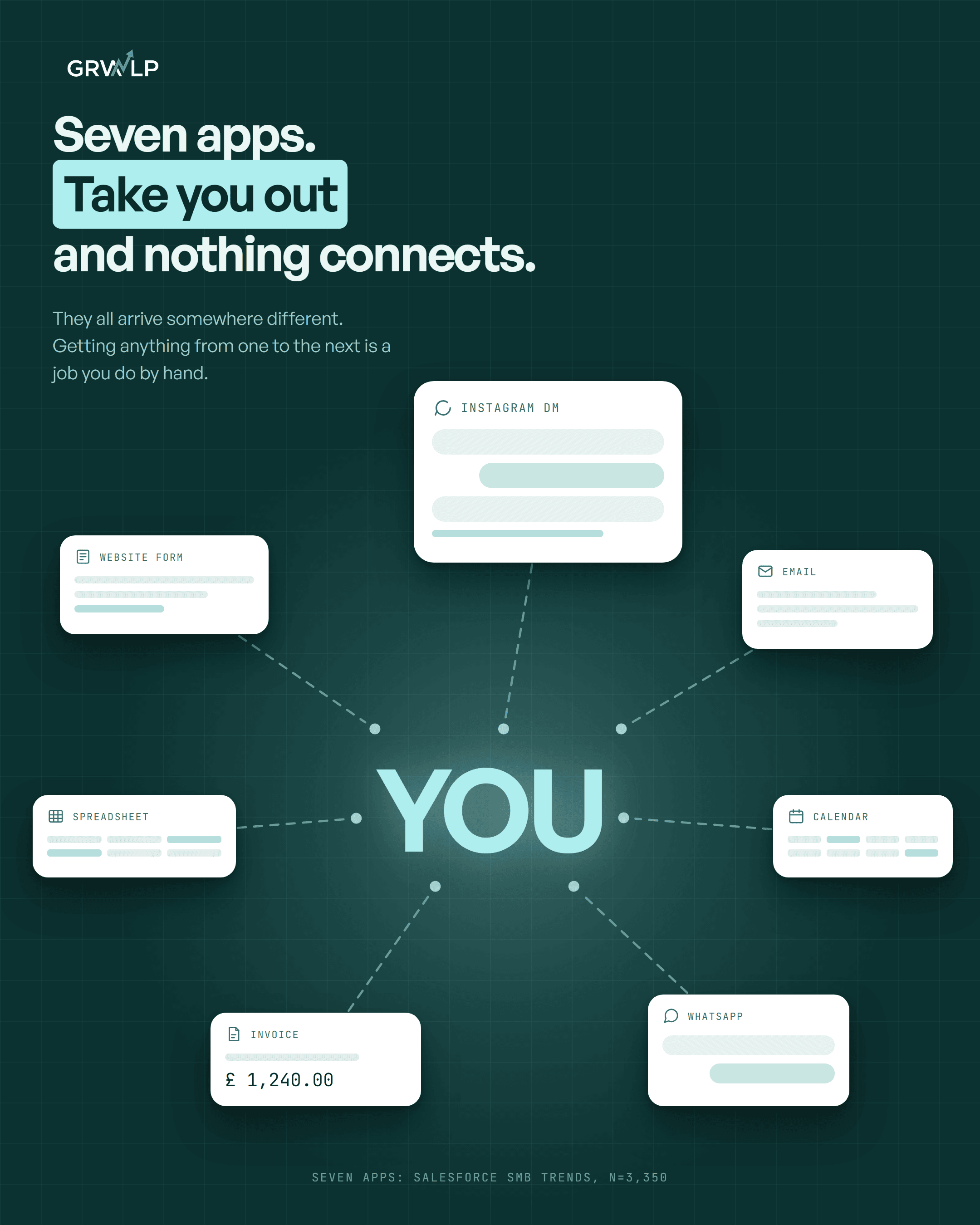
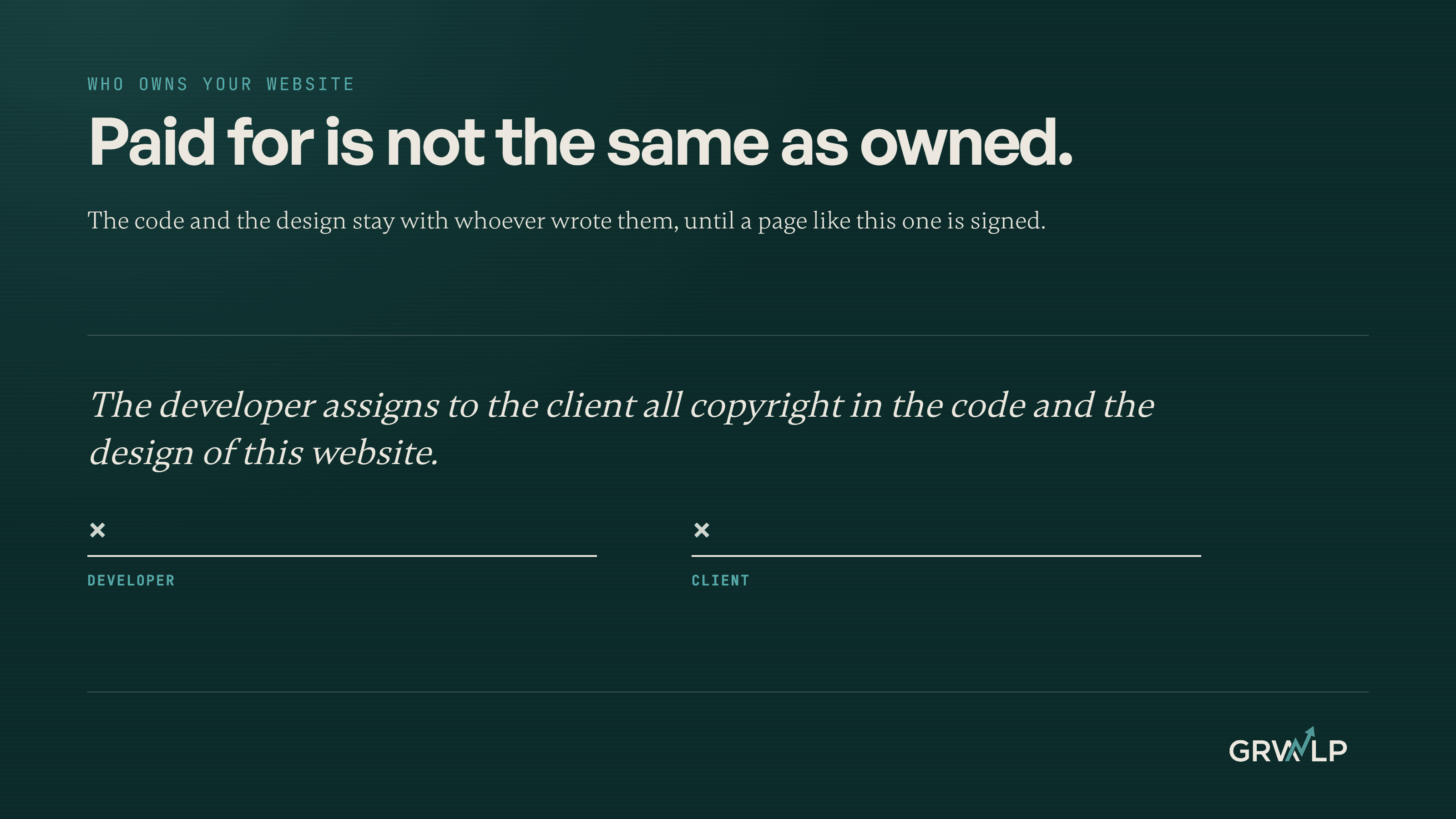
Most owners believe the opposite: I paid for it, so it is mine. We call that the invoice myth. The invoice says you paid. Only a signed page says you own it. This is not legal advice, and for a contract worth real money a lawyer in your country should read it. What follows is what the law and the vendors' own pages say, so you know what to ask for.
What exactly do I own when a developer builds my website?
"The website" is really six things, and each has its own owner.
The parts of a website and who owns each one by default
| Part of the website | Who owns it by default | What makes it yours |
|---|---|---|
| The domain name | Whoever registered it | Registration in your business's name |
| Hosting and editor accounts | Whoever opened them | Accounts opened in your name |
| The code and the design | The person who wrote it | A signed, written assignment |
| Words and photos you supplied | You | Nothing; they stay yours |
| Theme, plugins, stock photos, fonts | Their makers | Nothing; you get a licence |
| A site on Wix or Squarespace | Your content is yours, the platform is theirs | Nothing; plan the move early |
The first two rows are about accounts, and our guide to freelancers, agencies and studios covers the five accounts to check, the domain first. This page is about the rows people miss: the code, the design and the parts that were never for sale.
Who owns a website's code and design under the law?
In all three countries, the person who wrote it, unless they were your employee or you both signed something that says otherwise.
In the United States
The US Copyright Office's Circular 30 on works made for hire starts from the plain rule: "Ordinarily, the author is the person or persons who actually created the work." A "work made for hire" belongs to the person who paid for it, and there are only two ways to get one: an employee doing their normal job, or a commissioned work that fits one of nine listed categories, with a signed agreement saying so.
The nine categories run from translations to atlases: a contribution to a collective work, part of a film, a translation, a supplementary work, a compilation, an instructional text, a test, answer material for a test, and an atlas. A website is not on the list. If a work fails any of the requirements, the circular says, "it is not a work made for hire." So for a freelancer's website, ownership has to be transferred instead, and 17 U.S.C. 204 says a transfer "is not valid unless an instrument of conveyance, or a note or memorandum of the transfer, is in writing and signed by the owner of the rights conveyed."
In the United Kingdom
The Copyright, Designs and Patents Act 1988 is shorter about it. Section 11 says "the author of a work is the first owner of any copyright in it", and makes the employer the owner only where the work "is made by an employee in the course of his employment." A freelancer or agency is not your employee. Section 90 then says "an assignment of copyright is not effective unless it is in writing signed by or on behalf of the assignor", which means the developer is the one who has to sign.
In Nigeria
Nigeria's Copyright Act 2022, as published by the Nigerian Copyright Commission, says in section 28(1): "Except as otherwise provided in an agreement, copyright conferred by this Act, shall initially vest in the author." Section 30(3) adds that an assignment "shall have no effect unless it is in writing."
It is easy to read section 28 as handing commissioned work to the client. For a business, it does not. Section 28(2) gives commissioned work to government bodies, and section 28(3) covers people who privately commission a photograph, a portrait or a film, and even then gives them only a licence for non commercial use. A Lagos business that paid for a website gets neither. It needs the agreement that section 28(1) mentions.
What if we never signed anything about ownership?
Then the developer most likely still owns the copyright, and what you hold is permission to use what you paid for, of a strength nobody wrote down. Nigeria's Act says so directly in section 30(4): a non exclusive licence "may be written, oral, or inferred from conduct of the owner of copyright." In the US and the UK, what a court would read into your arrangement is a question for a lawyer, which is the problem in a sentence.
A licence lets you keep running the site. It may not clearly let you hand the code to a new developer to rebuild, sell it with the business, or stop the original developer reusing it for someone else. None of that comes up while everyone is friendly. It comes up when you fall out, when the developer disappears, or when a buyer's lawyer asks for proof.
The fix is cheapest now, while the relationship is good: ask for a one page assignment of copyright in the code and design you paid for, signed by the developer. If the domain or hosting is also in their name, our guide to moving a site without losing rankings explains the transfer.
Which parts of a website can I never own?
The parts the developer did not make. Most sites are built partly from things the developer bought or borrowed, and those come with a licence, never ownership.
A theme bought on ThemeForest is the clearest case. Its regular licence says "the author of the Item retains ownership of the Item but grants you the license on these terms", and the licence covers one end product. Free photos are licensed too: Unsplash's licence grants a "nonexclusive, worldwide copyright license", not the photo itself. Fonts are usually fine to use on a website; the Open Font License FAQ, which covers most free web fonts, answers the website question with "Yes! Go ahead!"
None of this is a problem. It only becomes one when nobody wrote down which parts are licensed, under whose account, and whether the licence moves with the site.
Can I take a Wix or Squarespace website with me?
Your words and pictures, yes. The site itself, mostly no. Wix's own help page on exporting a site says "the content you build on Wix belongs to you", and in the same paragraph that "your site must run on Wix's servers." Squarespace's export guide says "many features rely on our platform's JavaScript and CSS, so some content doesn't export", and its list of what stays behind includes store pages, portfolio pages, style settings and custom CSS.
We saw what that means with VIP Creative Studio. Their whole site was one Wix landing page. Leaving was never going to be a copy and paste. The new site was built as 13 pages on Next.js and Sanity, with more than 100 fields their team could edit and a guide written for non technical staff. Our piece on a website you can edit yourself covers what to ask for in that editor.
What should a web developer contract say about ownership?
Four lines, in plain words. If the contract you have been sent does not cover them, ask.
Who owns the code and design after payment
A clause assigning you the copyright in the code and design made for your site, once paid, signed by the developer. "Deliverables" alone is vague; name the code and the design.
What the developer keeps
A good developer will keep their own general tools, the building blocks they reuse for every client. That is normal. The contract should give you a permanent licence to use them in your site.
Which parts are licensed, and in whose name
A list of every theme, plugin, font and stock image, with the licence for each, bought in your business's name where the licence allows it.
Where the code lives at handover
A copy of the code in an account your business owns, so a new developer can pick it up without asking the old one.
We hold ourselves to the same test. Our own terms of service say ownership is set in each project contract and that "generally, you own the final deliverables after full payment." Generally is the word a contract should not leave in, so ask us, or anyone, for the clause itself. Our web development page promises full access to your editor, your code and your analytics on day one, and if you want help reading a contract you have been sent, book a free 30 minute call.
Paying for a website buys you the right to use it. Owning it takes one more page, signed by both of you.
“The invoice says you paid. Only a signed page says you own it.”
Written by Oyekola Obajuwon