What is a CRM, and does a five person business need one?
What a CRM actually is, the test that tells a five person business whether it needs one, and when a free plan is enough.
TL;DR
A CRM is one shared record of every lead and customer: who they are, what they asked, and who is dealing with them. A five person business needs one shared record, but not necessarily paid software. If two or three people handle enquiries, a free plan fits; HubSpot's free CRM allows two users and Zoho's three.
Last updated 21 October 2026. Written by Oyekola Obajuwon, founder of Growveloper, a growth studio that builds the website, the marketing and the follow up for owner run businesses in the United States, the United Kingdom and Nigeria.
A CRM is one shared record of every lead and customer: who they are, what they asked, and who is dealing with them. A five person business needs one shared record, but not necessarily paid software. If two or three people handle enquiries, a free plan fits; HubSpot's free CRM allows two users and Zoho's three.
Most guides to this question are written by companies that sell CRMs, and they end the same way: here are the warning signs, now buy one. This page gives you the test instead, and the number that decides whether you pay.
What is a CRM, in plain words?
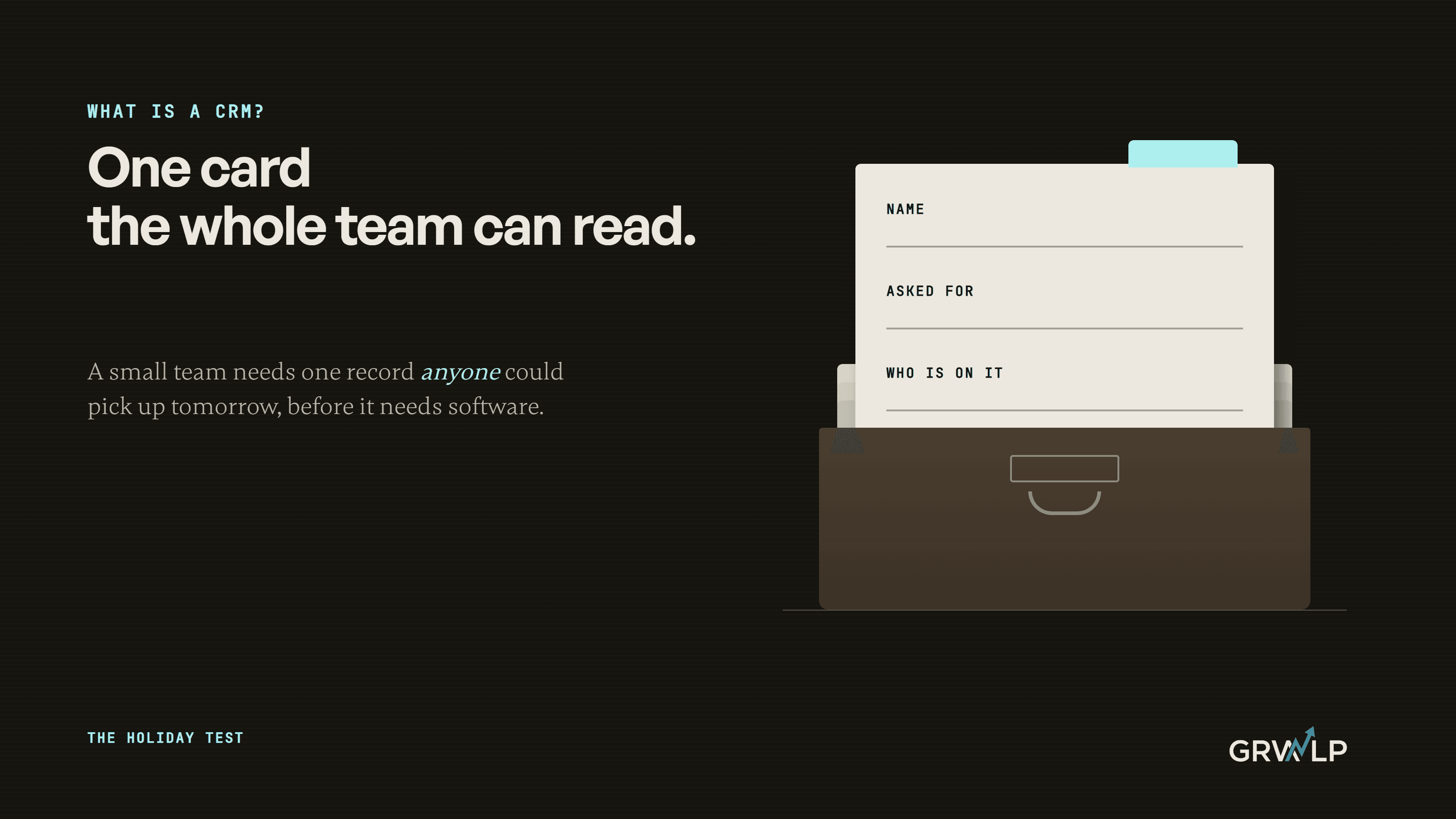
CRM stands for customer relationship management. Strip the name away and it is a shared list with a memory.
Each person who gets in touch has one entry. On it: their name and how to reach them, what they asked for, where they found you, every message since, and the name of the person on your team who is dealing with them. When anyone on the team opens it, they see the same thing.
That is the whole idea. The pipelines, dashboards and email tools that CRM software adds are useful, but they are built on top of that one shared record. Without the record, they are decoration.
Is a spreadsheet a CRM?
It can be, if it does the job. A spreadsheet that every enquiry goes into, with an owner on each row and a date for the next step, is doing what a CRM does.
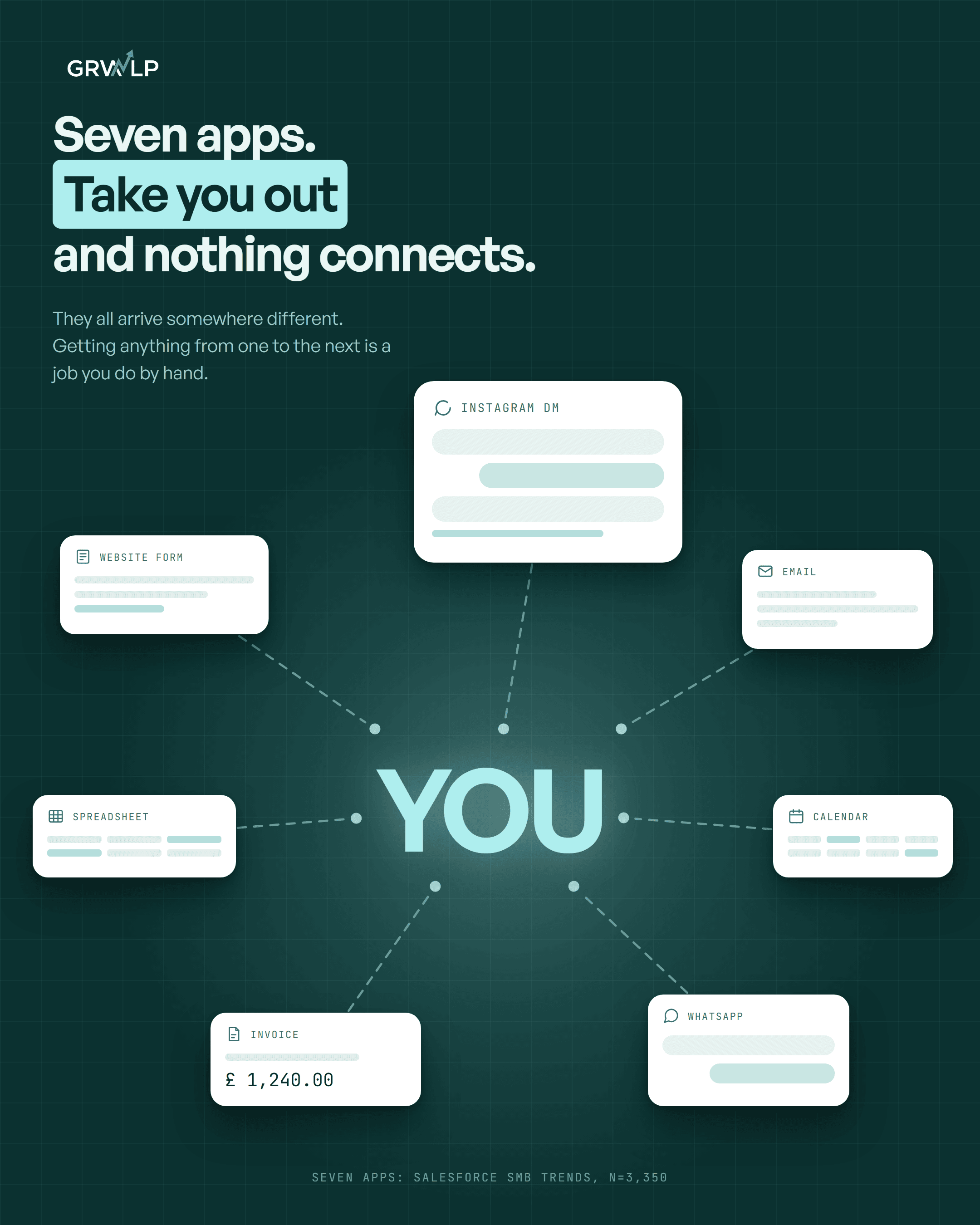
Where spreadsheets fail is not the format. It is that nobody is made to use them. An enquiry comes in on WhatsApp, someone replies from their phone, and the row never gets written. Two weeks later nobody knows whether that customer was quoted.
Software fails the same way. It is a symptom we name on our own AI and automation page: "Your CRM is full of stale data because nobody updates it manually". A paid CRM nobody updates is a more expensive spreadsheet nobody updates.
When does a small business need a CRM?
When the business stops fitting inside one person's head.
We call this the holiday test. If you went away for a week tomorrow, could someone else on your team pick up every open lead from what is written down: who asked, what they asked for, what was promised, and what happens next? If the answer is no, you need one shared record now, whatever you call it.
A one person business often passes without any tool, because the record is the owner's memory and inbox. The test starts failing the day a second person has to answer a customer the first person spoke to.
Does a five person business need a CRM?
Yes, it needs the shared record. Whether it needs to pay for one depends on a different number.
Count the people who pick up leads, not the people on the payroll. In a five person business, that is often two or three: the owner, someone who answers the phone or the inbox, maybe whoever sends quotes. The others need to see a customer's history now and then, but they are not working the list every day.
What a small team needs, by who handles enquiries
| Who handles enquiries | What you need | What usually fits |
|---|---|---|
| One person | A list kept up to date | Your inbox or a spreadsheet |
| Two or three people | One shared record, an owner on every lead | A free CRM plan |
| Four or more, or several channels | A shared record that fills itself | A paid CRM connected to your forms |
Is a free CRM enough for a small business?
For two or three people working leads, usually yes.
HubSpot's free CRM allows up to two users and 1,000 contacts, with no end date, according to its own product page. Zoho's CRM pricing page lists its free edition as free forever for three users. Both are the vendors' current terms, and vendors change them, so check the page on the day you sign up.
Paid plans are priced per user per month, so giving all five people a login costs five times one. Before you upgrade for seats, check who actually needs to edit records and who only needs to look.
The free plans run out in other ways too: automatic follow ups, reports and connections to other tools are where the paid tiers start. If you need those, our guide to automating lead follow up shows which pieces to wire first.
What does a CRM look like when it works?
When we started with RideOn Nigeria, a premium chauffeur service in Lagos, there was no one record. Customers booked on WhatsApp. The case study puts it in one line: "The admin team operated from spreadsheets and chat threads." The owner was based in Canada, running the business remotely.
We built the platform over four months, with an admin dashboard at its centre. That dashboard was not sold as a CRM, but it did the CRM's job: every customer, booking and driver in one place, the same for everyone who opened it. In the case study's words, "The owner can now manage the entire operation from Canada through the admin dashboard."
That is the holiday test passed at a distance of several thousand miles. Most five person businesses do not need a custom build to pass it. They need the same thing on a smaller scale: one place, kept up to date, that anyone can open.
What should I do first?
Pick where the record lives before you pick software. If your work is booked in slots, your booking tool may already be the record; if it is quoted, a CRM usually is. Our guide to connecting your website, WhatsApp, CRM and calendar explains how to choose the keeper, and what connected marketing actually means shows why two systems each keeping their own copy is where things break.
Then make it hard to skip. The best CRM is the one your website form writes to by itself, so nobody has to retype an enquiry. That is the kind of work on our AI and automation page, and a free 30 minute call is enough to tell you whether a free plan will do.
Run the holiday test this week. If nobody could cover for you, write things down before you buy anything.
“Count the people who pick up leads, not the people on the payroll.”
Written by Oyekola Obajuwon
what is a crm · crm for small business · do I need a crm · free crm · hubspot free crm · zoho crm free · lead tracking · small team