What is llms.txt, and does my website need one?
llms.txt is a reading list for AI tools. We published one, measured it, and here is what it did and did not do.
TL;DR
An llms.txt file is a short plain text file at the root of your website that lists your most important pages for AI tools to read. No major AI company has said it uses one, and Google says you do not need it. Add one only if it takes ten minutes. It will not get you cited.
Last updated 24 September 2026. Written by Oyekola Obajuwon, founder of Growveloper, who builds the website, the marketing and the follow up for owner run businesses in Nigeria, the United States and the United Kingdom.
An llms.txt file is a short plain text file at the root of your website that lists your most important pages for AI tools to read. No major AI company has said it uses one, and Google says you do not need it. Add one only if it takes ten minutes. It will not get you cited.
We know that last sentence from our own site, not from a theory. We published a full one, and we measured what happened.
What is an llms.txt file?
It is a reading list for AI tools, written by you, about your own site.
The idea was proposed by Jeremy Howard on 3 September 2024, and the llms.txt proposal is still where the format lives. The file sits at the root of a website, at the same address level as the home page, and it is written in markdown, the plain text format where a line starting with a hash is a heading.
The proposal asks for very little. A title with the name of the site is the only part that is required. After it comes a short summary set apart as a quote, then any notes you like, then sections of links to the pages that matter, each with a line saying what the page is.
It is often compared with two older files. A robots file tells search crawlers where they may and may not go. A sitemap lists every page so they can be found. An llms.txt file does neither. It says: if you only read a few pages here, read these, and here is what each one is for.
What does a real one look like?
Here is how ours is built, section by section. We are describing it rather than linking to it, because it is written for machines and you would be reading raw text.
What goes in an llms.txt file, using growveloper.com's own as the example
| Part of the file | Required? | What ours says |
|---|---|---|
| Title | Yes, the only required part | The name of the business |
| Summary quote | Recommended | One paragraph: a growth studio that combines web development, marketing and automation |
| Notes | Optional | Who runs it, where it is based, who it works with |
| Sections of links | Optional | Services, who it is for, six trade pages, three case studies, every article with a one line summary |
That is about as complete as a small business file gets. Every service page, every local trade page, every case study and every one of our articles is in it, each with a sentence explaining it.
Does ChatGPT or Google actually read llms.txt?
Google says plainly that it does not need one. Its page on AI features in Google Search says there are no additional requirements to appear in AI Overviews or AI Mode, and that you do not need to create new machine readable files, AI text files or markup to appear in them.
OpenAI, Anthropic and Perplexity have not said that their assistants use the file to decide what to quote. Their public guidance for website owners is about their crawlers and the robots file.
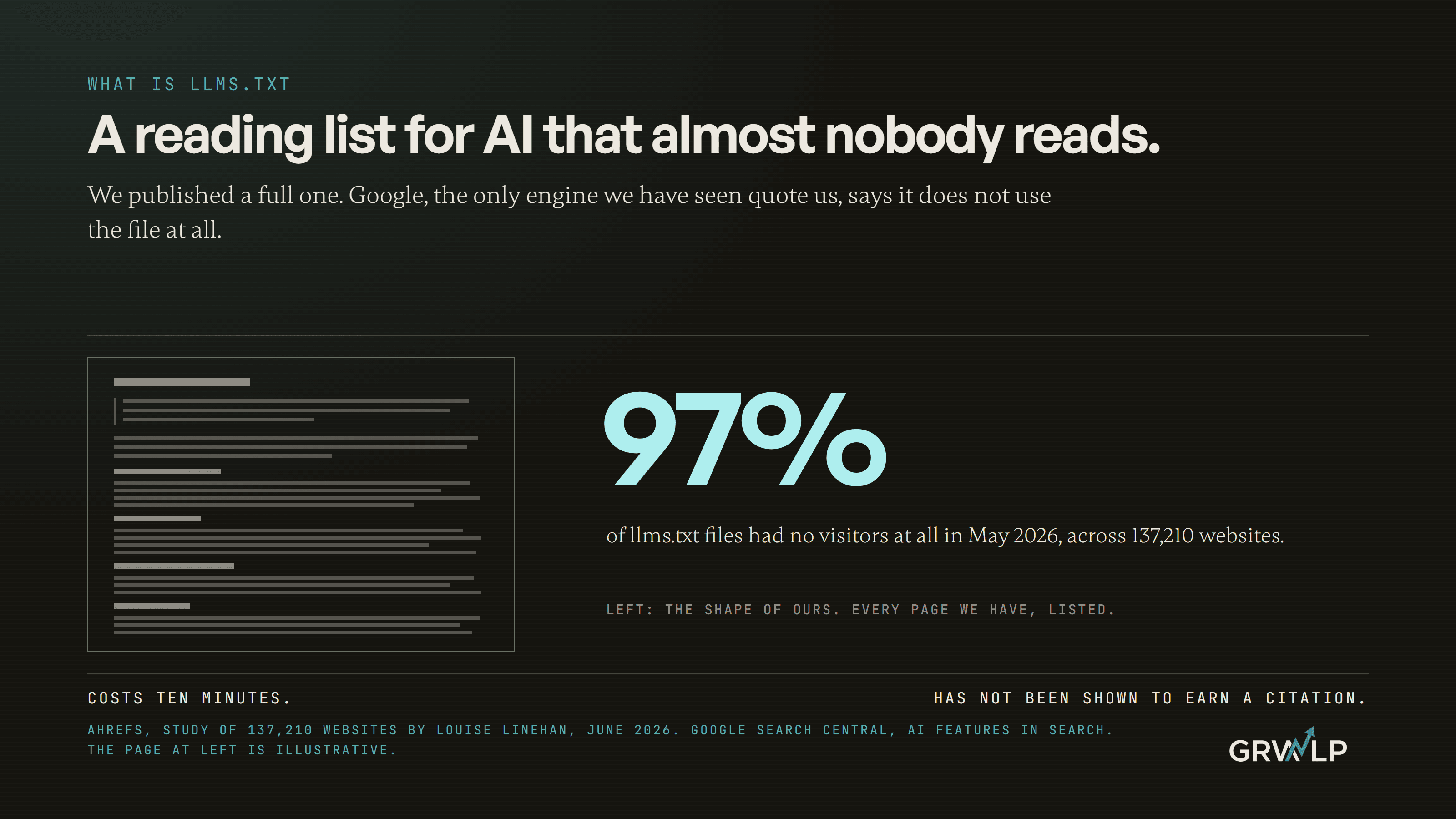
The best measurement of who does read these files comes from Ahrefs. Louise Linehan's June 2026 study of 137,210 websites found that 28% of them publish an llms.txt file, and that 97% of those files received no requests at all in May 2026. Of the few requests that did arrive, SEO audit tools made 21.7%. Bots that fetch pages for AI answers made 1.1%, and AI assistants 2.5%. Add every kind of AI tool together, including training crawlers, and it comes to 19.5%.
Read that as a picture, not a percentage. Picture a notice pinned to your front door that almost nobody walks past, and most of the few who stop are inspectors checking whether you have a notice.
What happened when we published ours?
Nothing we could measure, and something we did not expect.
Our file lists every service, trade page, case study and article on the site. By 24 September 2026 it listed fourteen articles written specifically to answer the questions AI assistants get asked. That day we regenerated Microsoft Clarity's AI visibility reports for all five of our topics. Every one read a 0% citation rate in ChatGPT's answers.
We also ran ten of those questions by hand through Google AI Mode and Perplexity. Zero of eighteen answers cited us.
Here is the part we did not expect. We have been quoted by an AI answer. Google's AI Overview quoted our article on the three vendor tax by name, when someone searched for that phrase. And Google is the one company that has said in writing it does not use llms.txt files.
So the only citation we can point to came from the system that ignores the file, and it came because the article owned an idea nobody else writes about. That does not prove our file does nothing. It proves that the file was not what got us quoted, and that is the only question you care about.
Does my website need one?
It depends on what it costs you, and it should never cost much.
Should you have an llms.txt file?
| Your situation | What to do |
|---|---|
| Your website platform makes one automatically | Leave it switched on, it costs nothing |
| You can write one yourself in ten minutes | Fine, once the basics below are done |
| Someone is charging you to make one | Decline, the evidence does not support paying |
| Your pages do not answer your customers' questions yet | Fix that first, the file will not help |
| Your site is not showing in Google at all | Fix that first, nothing will be quoted |
The line to take seriously is the third one. If a supplier tells you your site "needs" an llms.txt to show up in ChatGPT, ask them to show you one AI company that says it uses the file. There is not one to show.
If you are not sure whether your site passes the last two rows, that is something you can ask us about on a free call, and it is part of what our Growth Audit checks. You can also check the last row yourself by searching Google for your business name and your main service.
What matters more than llms.txt for AI answers?
The things with evidence behind them, and none of them is a file.
Your page has to be findable by ordinary search first. Google's same documentation says a page must be indexed and eligible to show in Google Search with a snippet before it can appear as a link in AI Overviews or AI Mode, and that there are no other technical requirements. It has to answer one clear question in its opening lines, in the words a customer would type. And it helps enormously to own something: a named idea, a number you measured yourself, a local detail nobody else has. That is what got our three vendor tax article quoted.
We set out the full method in what answer engine optimization is, explained where the term came from in what generative engine optimization is, and published our own starting zero in how to get your website cited by ChatGPT. If you want someone to do this work, it sits under answer engine optimization on our growth marketing page.
How do I make an llms.txt file?
If you decide to add one, keep it short and keep it true.
Write the name of your business as the title. Under it, write one paragraph that says what you do, for whom and where, the way you would say it to a customer. Then list your most important pages: your services, your prices page if you have one, your best case study or reviews page, and your contact or booking page. Give each one a single sentence explaining what it is.
Save it as a plain text file named llms.txt and place it at the root of your website. Some website builders let you add a file there and some do not; if yours does not, that is a sign of how little you are missing.
Then do the one thing most people forget, which is keeping it up to date. A reading list that points to a page you deleted is worse than no list.
Is llms.txt the same as robots.txt?
No. A robots file is a set of instructions that well behaved crawlers follow about where they may go, and it has been a standard for decades. An llms.txt file is a suggestion about what to read, and nothing is obliged to read it. If you want to stop AI crawlers from reading your site, the robots file is where that is done, not llms.txt.
Will llms.txt matter later?
It might. The proposal was updated in August 2026, documentation platforms now generate the files automatically, and more than a quarter of the websites Ahrefs studied already have one. Standards sometimes win by being everywhere before anyone uses them.
But a possible future is not a reason to pay for something today, or to do it before the work that already has evidence behind it. We are keeping ours, because it is already written and there is no evidence it does harm. We are not expecting it to do anything.
Write the reading list if you like. Just remember that the one time an AI quoted us, it came from the company that says it never reads one.
“The only time an AI answer has quoted us, it came from the one system that says it ignores the file.”
Written by Oyekola Obajuwon