What is generative engine optimization?
Generative engine optimization is making your pages easier for AI tools to quote. Where the term came from, what the study found, what to do.
TL;DR
Generative engine optimization, or GEO, is making your pages more likely to be quoted inside answers written by AI tools such as ChatGPT, Perplexity and Google's AI Overviews. The name comes from a 2023 research paper. In practice it is ordinary search work with three habits added: cite sources, include real numbers, and quote named people.
Last updated 24 September 2026. Written by Oyekola Obajuwon, founder of Growveloper, who builds the website, the marketing and the follow up for owner run businesses in Nigeria, the United States and the United Kingdom.
Generative engine optimization, or GEO, is making your pages more likely to be quoted inside answers written by AI tools such as ChatGPT, Perplexity and Google's AI Overviews. The name comes from a 2023 research paper. In practice it is ordinary search work with three habits added: cite sources, include real numbers, and quote named people.
That is the whole answer. The rest of this page is where the word came from, what the study behind it really found, and why the numbers you have been shown about it rarely agree.
What does generative engine optimization mean?
A generative engine is any tool that writes an answer instead of handing you a list of links. ChatGPT is one. Perplexity is one. The summary that now sits above the results on many Google searches is one.
Those tools still read web pages. They read a handful, pick the sentences that answer the question, and stitch them into a paragraph, sometimes with a small link back to where each sentence came from. Generative engine optimization is the work of making your sentences the ones that get picked.
So the question it answers is not "am I on page one?" It is "when an AI writes the answer, does it borrow my words, and does it say where it got them?"
Where did the term come from?
From one paper. That matters, because it means the word has a birth certificate and you can read it.
In November 2023 a group of researchers from Princeton University, IIT Delhi and collaborating institutions posted GEO: Generative Engine Optimization, led by Pranjal Aggarwal. It was peer reviewed and published at KDD 2024, one of the main academic conferences on data science. They built a test bench of thousands of real search questions across many subjects, rewrote web pages in different ways, and measured how often each version was quoted in the answers an AI produced.
Before that paper, nobody was selling GEO. Within a year there were agencies with it on their homepage. That is a fast journey for a word, and it is worth knowing the word started life as the title of an experiment, not the name of a profession.
What did the study actually find?
Four things, and the first two are in the paper's own summary, which we read in full.
The first is the headline. The paper's abstract says the right changes to a page can boost its visibility in generated answers by up to 40%. "Up to" is doing real work in that sentence. It is the best case, not the average.
The second is the caveat, and it is the part almost nobody repeats. The same abstract says the effect varies across subjects, and that different kinds of question need different approaches. A trick that lifted pages about history did not necessarily lift pages about law. Anyone quoting you a percentage for your business is quoting a laboratory result from somebody else's subject.
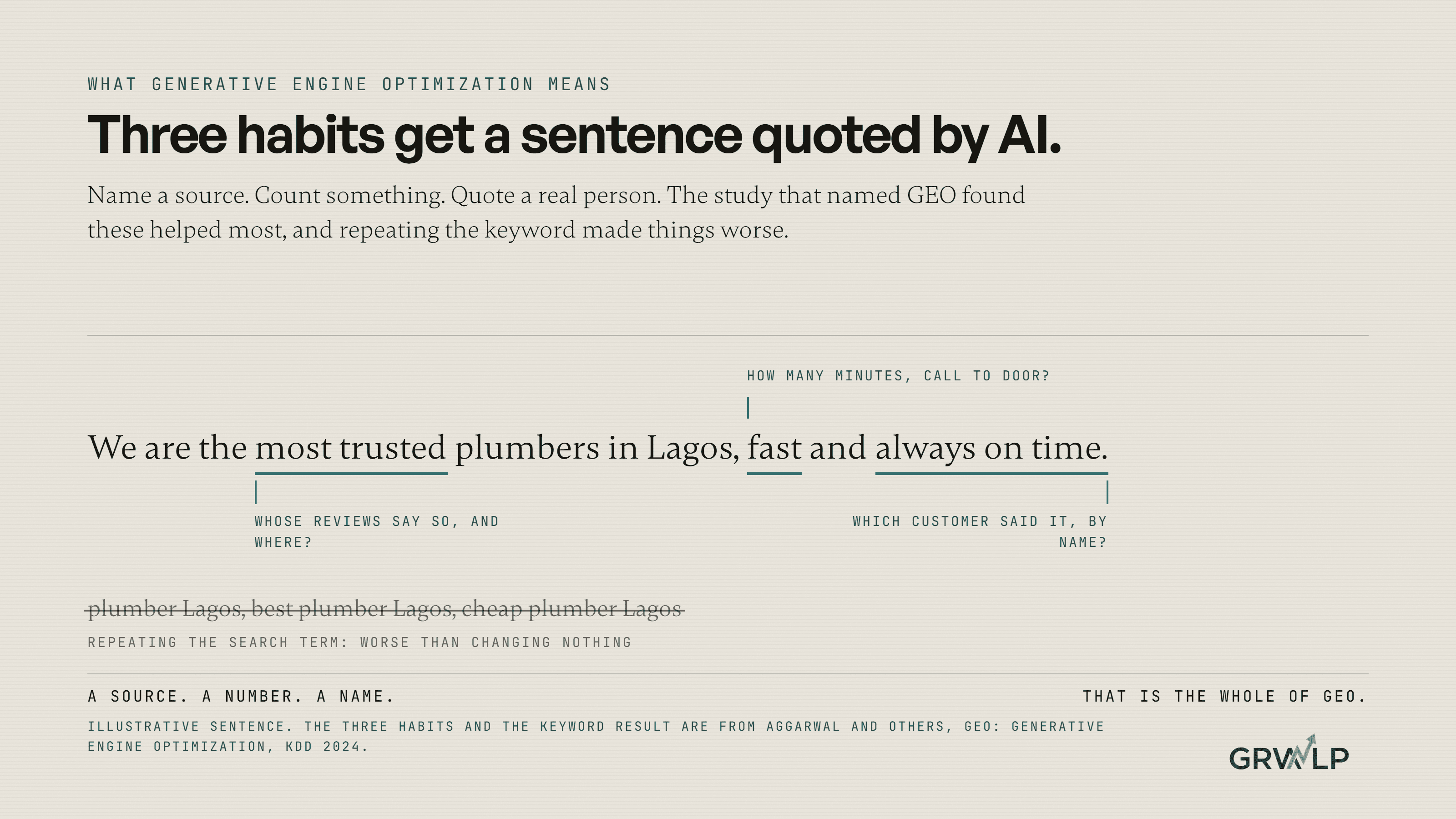
The third is which changes helped. Adding citations to named sources, adding quotations from named people, and adding statistics were among the strongest methods the study tested. All three have the same shape. They replace a claim the reader has to take on trust with one they can check.
The fourth is which change did not. Keyword stuffing, repeating the search term over and over, which is the oldest trick in search, did worse in the study than leaving the page alone.
What the GEO study tested, in plain words
| What the researchers did to a page | What that means on your website | Which way the result went |
|---|---|---|
| Cite sources | Name where each claim comes from | Helped, among the strongest |
| Add quotations | Quote a named person saying it | Helped, among the strongest |
| Add statistics | Swap a vague claim for a counted number | Helped, among the strongest |
| Keyword stuffing | Repeat the search term again and again | Worse than changing nothing |
Why do the numbers change every time I read about it?
Because almost everybody quoting them is quoting somebody else's summary, and the summaries disagree.
When we first researched this topic in July, the version going round said citations lifted visibility by about 40%, statistics by about 37% and quotations by about 30%. While preparing this article we found one summary putting statistics at 41% and citations at roughly 28%, and another saying the top three methods all landed somewhere between 30 and 40 percent. Same paper. Three different tables.
The likely reason is innocent. The researchers measured visibility in more than one way, for example how many of your words make it into the answer and how early they appear, and each measure produces its own set of numbers. Pick a different column and you get a different headline.
The consequence is not innocent. A number that changes depending on which blog you read cannot be the foundation of a sales pitch, and it is currently the foundation of quite a few. So this page prints the one figure the paper puts in its own summary, up to 40%, and the order the methods came in, which every version agrees on. If somebody shows you a slide with a precise per tactic percentage, ask which measure it came from. If they do not know, neither do you.
How is GEO different from SEO and AEO?
Barely, and that is good news for your budget.
Search engine optimisation, SEO, is being found in a list of links. Answer engine optimisation, AEO, is being quoted in a written answer. Generative engine optimisation is the same idea named after a different machine. The three overlap so much that Google's own guidance on its generative AI features says they run on its core search ranking and need no special markup or separate content.
We laid the three side by side, in the words an owner needs, in what answer engine optimization is and how a small business does it. The short version: if someone offers to bill you separately for SEO, AEO and GEO on the same website, you would be paying three times for one job.
What GEO adds is not a new job. It is evidence about which writing habits get borrowed, and that evidence is useful whatever you call it.
What does GEO look like on a small business page?
Take one sentence that nearly every small business website has some version of.
"We are one of the most trusted plumbers in Lagos, offering fast and affordable service."
An AI answering "who is a reliable plumber in Surulere" has nothing to borrow there. Every plumber says it. Now apply the three habits from the study, using your own numbers in place of the brackets.
A number: "Last year we answered [number] call outs in [area], and the average wait from phone call to arrival was [minutes]." A source: "We have [number] reviews on our Google Business Profile, with an average of [rating]." A named person: "'[Owner's name] came the same afternoon and fixed what two others could not,' wrote [customer name, with their permission]."
The first sentence is a claim. The other three are evidence, and evidence is what gets lifted. The difference is also exactly what a careful customer wanted to know before phoning you, which is the part that matters even if no AI ever reads the page.
This is also why so many small businesses are invisible to these tools before any optimisation starts. When we rebuilt the website for Baye Business Solutions, a cloud services company in Lagos, it offered eight service categories and had a page for none of them, so there was not a single sentence about any service for anything to quote. The Baye Business Solutions case study tells the rest. GEO cannot improve a page that does not exist.
Is it worth paying someone for GEO?
Pay for the writing, not the acronym.
The three habits in the study are things an owner can do alone, and nobody knows your numbers, your reviews and your customers better than you. What a good agency adds is the discipline of doing it to every important page, measuring whether it worked, and not stopping after two. That is a real service. It is the same service as good search work, and it should be priced that way.
Be wary of two things. A guaranteed percentage, because the study that named the field says results vary by subject. And a monthly fee for a tool that monitors your AI visibility when you currently have none, because it will report zero every month until the writing is done.
We should be honest about our own position here. On 9 and 10 September 2026 we ran 62 questions through ChatGPT across the five topics we sell into, and Growveloper was quoted zero times. We are now publishing one answer per question, two each weekday, this being one of them. Our own growth marketing page tells clients to expect first citations in 60 to 90 days. The full measurement, including who was quoted instead, is in how to get your website cited by ChatGPT. When our count moves, it goes on that page.
Can a small business really win at this?
Better than at ordinary search, and there is a number for that too.
A team comparing AI search tools with traditional search engines across 55,936 questions, in a paper submitted in December 2025, found that 37% of the websites the AI tools quoted were unique to them, never showing up in the traditional results for the same question. On a normal results page you queue behind whoever has had fifteen years to collect links. In a written answer, a clear page with real evidence has a door that does not depend on the queue.
That is an opening, not a promise. It is the reason an owner in Lagos, Leeds or Louisville should spend a morning on this rather than filing it under things only large companies do.
Where should I start?
With one page and thirty minutes.
Open the page on your site that should answer the question customers ask you most. Find three sentences on it that any competitor could have written word for word. Give the first one a number you counted. Give the second a source a stranger could check. Give the third the name of a real person who said it, with their permission.
That is GEO, the whole of it, as the study that named it would recognise it. If you want the rest of the system around that page, the site that loads it quickly and the follow up that answers the enquiry it brings, that is what growth engineering means, and the Growth Audit will show you where your own pages stand.
But start with the three sentences. Read each one back and ask a single question: could an AI quote this and be sure it was true? If the honest answer is no, a customer reading it could not be sure either.
“Keyword stuffing, the oldest trick in search, did worse in the study than leaving the page alone.”
Written by Oyekola Obajuwon