How do I ask a happy customer for a referral?
When to ask, the words to use, the message to hand over, whether to offer a reward, and what to do when a referral arrives.
TL;DR
Ask on the day the customer is happiest, usually when they thank you or see the result, not with the invoice. Name the kind of person you want, not anyone you know, and give them a short message they can forward. Thank every referral within a day, and never pay for a review the way you might for a referral.
Last updated 19 October 2026. Written by Oyekola Obajuwon, founder of Growveloper, a growth studio that builds the website, the marketing and the follow up for owner run businesses in the United States, the United Kingdom and Nigeria.
Ask on the day the customer is happiest, usually when they thank you or see the result, not with the invoice. Name the kind of person you want, not anyone you know, and give them a short message they can forward. Thank every referral within a day, and never pay for a review the way you might for a referral.
That is the method. The rest of this page is when exactly to ask, the words, the message to hand over, what rewards are allowed, and what to do on the day a name arrives.
Why ask for referrals at all?
Because a recommendation from someone they know is the advert people believe most, and almost nobody asks for one.
Nielsen's Trust in Advertising study for 2021, an online survey with a US sample of 2,000, found that "Recommendations from people they know (89%) is the most trusted channel". Referred customers also tend to stay. In a study of a German bank written up by Knowledge at Wharton, researchers followed 10,000 customers over 33 months. Referred customers were about 18% more likely to stay, and worth 16% to 25% more over time.
You will also see a claim that 83% of happy customers are willing to refer but only 29% do. It is everywhere, usually credited to Texas Tech University, and we could not find the study behind it. So it is not part of this argument. You do not need it. The everyday version is enough: the customer says we'll definitely tell people about you, means it, and forgets by the car park.
When is the best time to ask for a referral?
On the day something good just happened, and not on the day money changes hands.
The moments to ask for a referral, and the ones to avoid
| Moment | Ask? | Why |
|---|---|---|
| They thank you, unprompted | Yes, that day | They are already saying it |
| The result shows up | Yes, that week | The proof is fresh |
| They leave a good review | Yes, a few days later | Separate it from the review |
| With the invoice | No | It reads as part of the bill |
| After a complaint you fixed | Only if they say thanks | Fixed is not delighted |
The second row is the one most owners miss. A cleaner's thank you comes at the door. A roofer's comes after the first storm when the ceiling stays dry. A clinic's comes when the pain is gone. For many service jobs, the result arrives weeks after the work, and that is when the customer has something to say.
How do I ask without sounding needy?
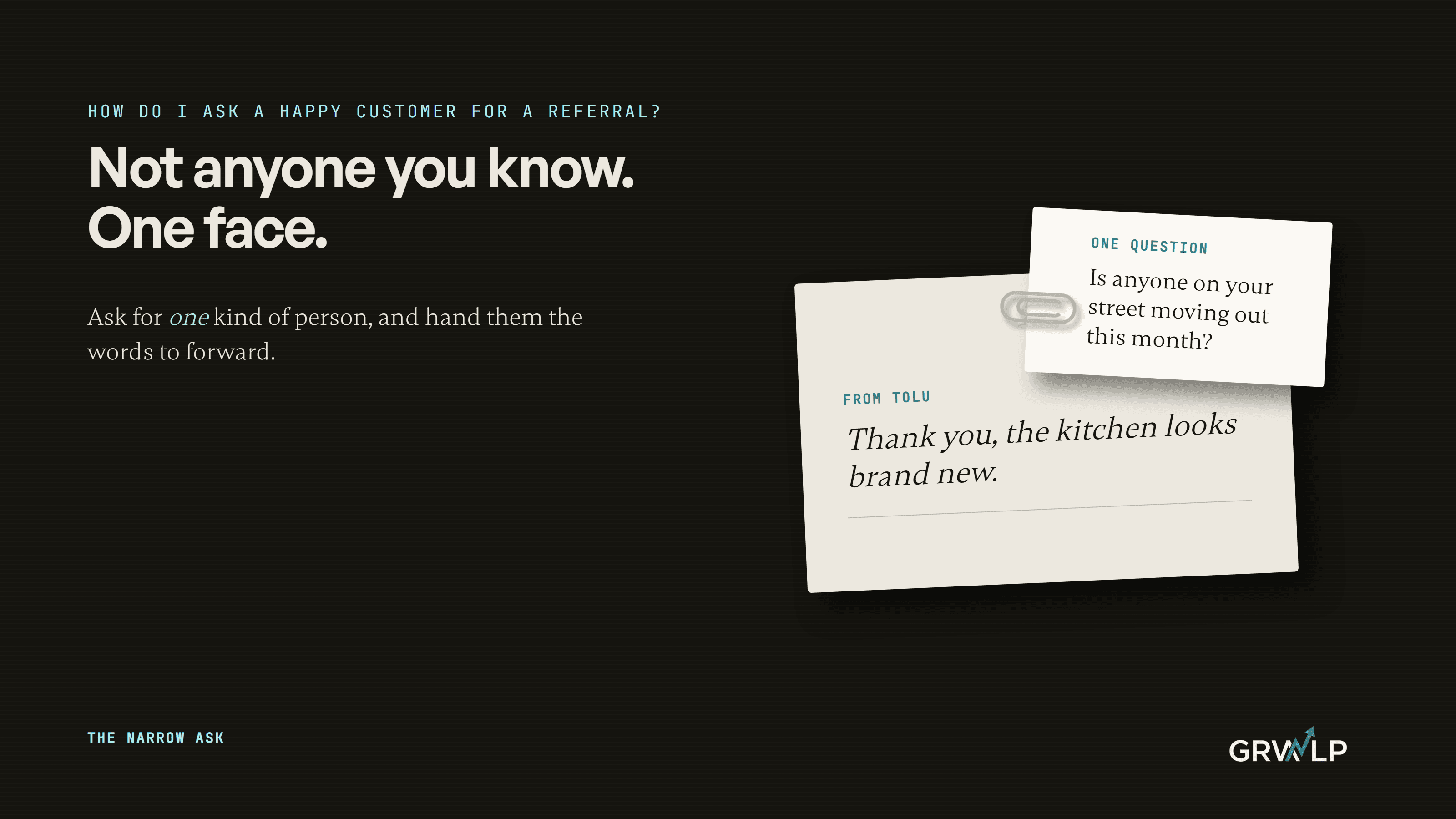
Ask for one kind of person, not for anyone. We call this the narrow ask.
If you know anyone who could use us, send them our way sounds polite and gets a polite nod. It asks the customer to search everyone they have ever met, and nobody does that standing in a doorway. The narrow ask names a person they can picture:
- A plumber: Do you know another landlord with a boiler older than ten years?
- A cleaner: Is anyone on your street moving out this month?
- A personal trainer: Who at work keeps saying they want to start again?
- A web developer: Do you know another owner whose website is older than their logo?
Each one fits a single face. The customer either thinks of someone or does not, and both answers are fine. Ask once, in your own words, and stop. If they cannot think of anyone, say thank you and mean it, because the question has done its job: the next time that kind of person comes up, your name comes with it.
What should a referral message say?
There are two messages, and most owners only write the first.
The ask, from you to the customer
Hi Tolu, thank you again for the note about the kitchen. It made our week. One small favour: do you know anyone on your street who is moving out this month? End of tenancy cleans are most of what we do. If someone comes to mind, I have put a message below you can forward as it is.
The message they forward
Hi, I used [your business name] for my kitchen and they were brilliant. They do end of tenancy cleans if you need one. Here is their number and their booking link: [link]. Tell them Tolu sent you.
The second message is the one that gets sent. A customer who has to write the introduction themselves will mean to, and then not. One who can copy, paste and press send will do it in the next ten seconds. Keep it under fifty words, put one link in it, and write it the way your customer talks, not the way your website does. On WhatsApp, which is how most referrals travel in Lagos, it should fit on one screen.
Should I offer a reward for referrals?
You can, for a referral. You must not, for a review. Those are different things.
A thank you for a referral is old and ordinary: a discount on the next job, a gift card, a free extra. The bank in the Wharton study paid 25 euro for every customer brought in, and the referred customers were still worth more. A reward does not make a referral fake, because the new customer still has to decide for themselves.
A review is different. Google's policy for reviews on Maps counts a business offering incentives such as payment, discounts, free goods or services in exchange for reviews as rating manipulation, which it does not allow. So the same discount that is a thank you on a referral is a breach on a review. Ask for them separately, on different days, as our guide to getting more Google reviews sets out, and never put the review link and the reward in the same message.
Whether to reward at all is your call. Many good referrers would be slightly embarrassed by money and delighted by a handwritten note. Try the note first.
What do I do when someone refers a customer?
Two things, both within a day: answer the new person, and thank the one who sent them.
The new person arrives warm, which makes a slow reply more expensive, not less. They already trust you a little, because someone they know vouched for you, and a reply three days later spends that trust. Our guide to how fast to reply to a new lead applies twice over here. Mention the referrer by name in your first line: Tolu told me you are moving out this month.
Then tell the referrer, whatever happens. Thank you for passing us to Ngozi. We are booked in for Saturday. Or: Thank you for thinking of us. It turned out the timing did not work, but I appreciate it. A referrer who never hears back assumes it went nowhere and does not do it again.
Can I automate referral requests?
The timing and the message, yes. The judgement about who is happy, no.
A follow up sequence can send the ask a set number of days after a job is marked complete, the way a review request does, and log every referral against the customer who sent it. Our guide to automating lead follow up covers the wiring, and the growth marketing page is where we build it for clients. But skip anyone who complained, anyone still waiting for the result, and anyone whose job went badly, even if it was fixed. An automatic referral ask to an unhappy customer is a good way to get a bad review instead, and our guide to replying to a bad Google review is the page you would need next.
What did we learn from a referral we did not ask for?
That the handover is a moment too.
When the platform we built for RideOn Nigeria, a chauffeur service in Lagos, changed hands in August 2026, the new owner later passed our name to an architect who needed work done. We had not asked. What we had done was finish the job and hand it over cleanly. That is the moment a customer is most sure the work was good, and it is a moment most owners never mark. If you build, install or fix something that ends with a handover, that is a fair day to make the narrow ask.
For more of what makes a local service business easy to recommend, see our local services page, or book a free 30 minute call and we will look at where your referrals come from now.
Ask for one face, hand them the words, and say thank you before you know if it worked.
“Anyone you know asks a customer to search their whole life. One kind of person asks them to remember one face.”
Written by Oyekola Obajuwon
customer referrals · asking for referrals · word of mouth · referral message · small business marketing · local service business