How should a local business reply to a bad Google review?
What Google's own rules allow, what the 2026 survey and the hotel study measured, and a four line reply written for the next customer.
TL;DR
Reply once, within a working day, and write it for the next customer who reads it, not for the reviewer. Name the specific complaint, say what is true, say what you will do, and move the rest to a phone call. Never put the customer's details in it, and only report the review if it breaks Google's rules.
Last updated 15 October 2026. Written by Oyekola Obajuwon, founder of Growveloper, a growth studio that builds the website, the marketing and the follow up for owner run businesses in the United States, the United Kingdom and Nigeria.
Reply once, within a working day, and write it for the next customer who reads it, not for the reviewer. Name the specific complaint, say what is true, say what you will do, and move the rest to a phone call. Never put the customer's details in it, and only report the review if it breaks Google's rules.
The reason most replies go wrong is that the owner writes to the one person who will never be persuaded. The reviewer has already decided. The person who has not decided is the one reading your reviews next month with your number half typed into their phone. We call that person the second reader. Every line below is written for them.
Should I reply to a bad Google review at all?
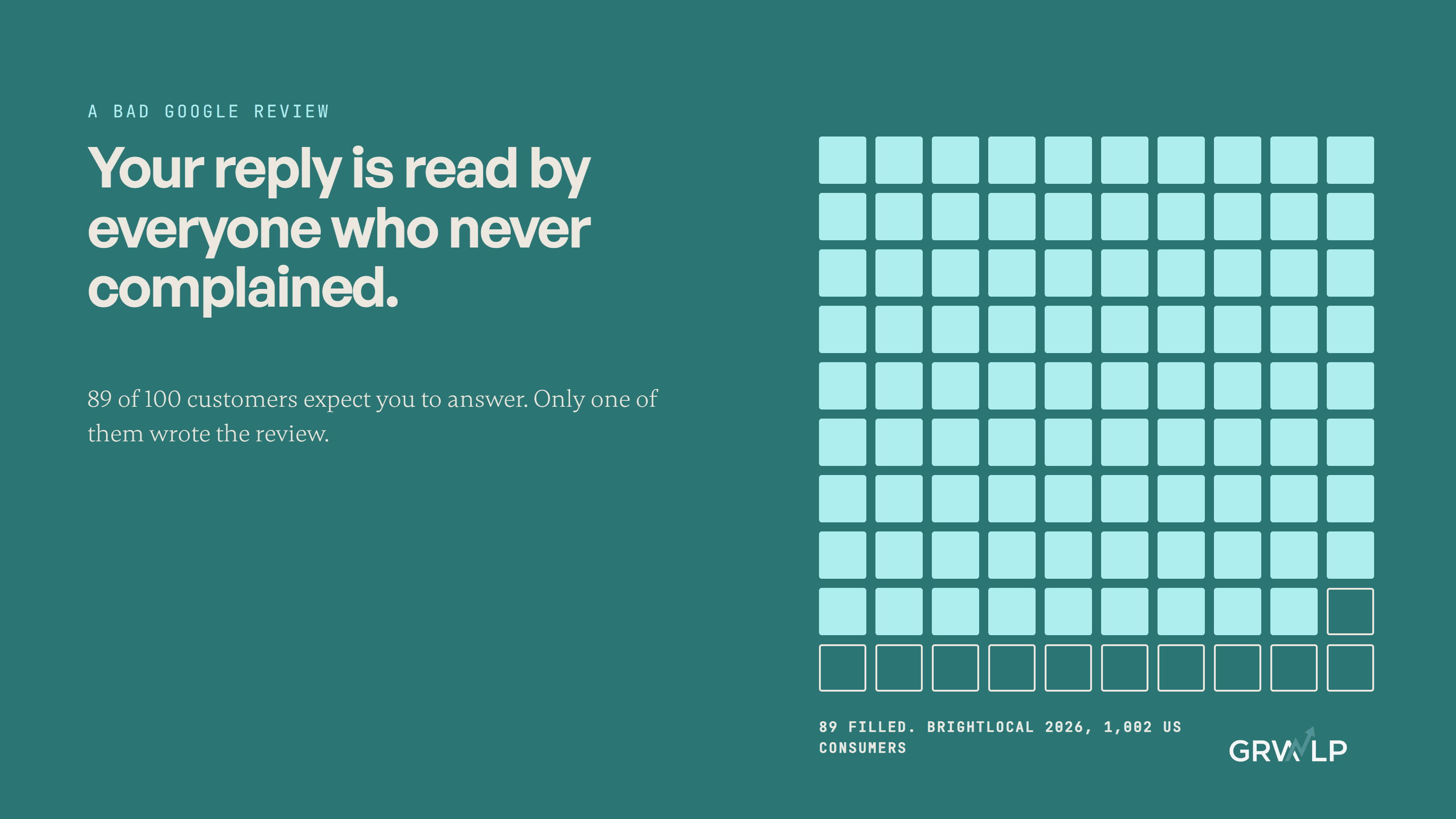
Yes. Two sets of numbers say so, and both state where they come from.
What customers expect from a business's replies, 2026
| What they expect | Share of consumers | Note |
|---|---|---|
| A reply to their review | 89% | the baseline expectation |
| A reply by the next day | 32% | up from 18% in 2025 |
| A reply within a week | 81% | the outer limit |
| More likely to use a business that replies to every review | 80% | |
| Put off by templated or generic replies | 50% |
BrightLocal's 2026 survey also found that 42% of consumers are unlikely to use a business that ignores its reviews entirely, and that replying only to the bad ones does not help much: 47% said they were likely to use a business that answered only its negative reviews, against 80% for one that answered them all.
The second set was measured, not asked. Davide Proserpio and Giorgos Zervas studied tens of thousands of hotel reviews on TripAdvisor for a 2017 paper in Marketing Science. Hotels that started replying went on to receive 12% more reviews, and their ratings rose by an average of 0.12 stars. The finding that matters for you is the one underneath: negative reviews became less frequent once managers replied, and the ones still written became longer. People with a complaint, seeing that the owner answers in public, were less inclined to post it and more inclined to explain it. That was hotels, not a plumber in Leeds or a clinic in Lekki, so take the direction and not the decimal.
How fast should I reply to a negative review?
Within one working day, and never within the first hour of reading it.
The first hour is when you draft the reply that argues. BrightLocal's 2026 figures give you room: 19% of consumers expect a reply the same day, 32% by the next day, 81% within a week. One working day sits inside what most people expect and outside the heat.
Two things from Google's own help page change how you use that day. First, a reply is public and sits under the review for as long as the review exists; your own name is hidden and it appears as the business. Second, Google checks replies before they post. The page says this usually takes up to 10 minutes, but can take up to 30 days, and the reviewer is notified when your reply appears. So the reply you type at eleven at night goes out with your business name on it, after a review by Google, straight to the person who was angriest at you. Sleep on it.
What should the reply say?
Four lines, in this order, under a hundred words.
The four lines of a reply to a bad review, and who each one is for
| Line | What it does | Who it is for |
|---|---|---|
| 1. The specific thing, named | Shows the review was read, not scanned | The reviewer and the second reader |
| 2. What is true, in one sentence | Owns the fault or corrects the facts, without arguing | The second reader |
| 3. What has changed | Turns a complaint into proof of a fix | The second reader |
| 4. A name and a number | Ends the public thread and opens a private one | The reviewer |
1. Name the specific thing
"You waited fifty minutes past the slot we gave you on Tuesday." Not "we are sorry you had a negative experience." The second reader can tell the difference in a second, and the 50% figure above is the cost of getting it wrong.
2. Say what is true
If it happened, say so in one sentence. If it did not happen as described, correct one fact, plainly, and stop. "Our records show the visit was on the 9th, not the 2nd, and the engineer arrived at 8:40 for an 8 to 10 slot." No adjectives about the reviewer.
3. Say what has changed
"Since then we text the customer when the engineer leaves the previous job." If nothing has changed, do not invent something; say what you will do for this customer instead.
4. Give a name and a number
"I am Tunde, I run the business, 0803 000 0000." The reviewer now has a person to talk to, and the second reader has seen that a person exists. Everything after this line happens on the phone.
Put together, for a Lagos plumber: "You waited fifty minutes past the slot we gave you on Tuesday, and the engineer did not call ahead. That is on us. Since then every engineer texts the customer when he leaves the previous job. I am Tunde, I run the business, and I would like to put this right: 0803 000 0000." Under seventy words, nothing to argue with, and a second reader who now knows two things about you.
What must never go in a reply?
Four things, and the first one carries a price tag.
The customer's details
In May 2022 the American Dental Association's news service reported a $50,000 civil money penalty imposed by the US Office for Civil Rights on a North Carolina dental practice that, in the regulator's words, "impermissibly disclosed a patient's protected health information on a webpage in response to a negative online review." One reply, the patient's name and treatment in it, fifty thousand dollars. That is US health privacy law, but the principle holds everywhere: Google's own content policy lists personal information among the content it removes, and the UK and Nigeria each have data protection law of their own. Treat anything the customer did not say in their own review as off limits in yours. That includes their full name, what they bought, what they paid and what you know about their situation.
An argument
The reviewer can see your reply and answer it, and so can everyone else. Correct one fact if you must, then stop. A thread of replies under a one star review is the worst page on the internet for your business, and you wrote half of it.
A deal tied to the stars
"Change it to five stars and we will refund you" is a trade, and Google's content policy lists rating manipulation among the things it removes. In the UK, the Competition and Markets Authority's guide for businesses, published 4 April 2025, names "concealed incentivised reviews" as content a business must take reasonable and proportionate steps to prevent and remove. Fix the problem for free. Then, if you like, ask once whether they would consider updating the review, with nothing attached.
A template
Half of consumers in BrightLocal's survey said a templated reply makes them unlikely to choose the business. The template pages that rank for this question are selling the one thing the second reader is trained to spot.
Can I get a bad Google review removed?
Only if it breaks Google's rules, and Google is blunt about that.
Google's own page on reporting reviews says: "You can report any review, but only those that violate Google policies are eligible for removal." Then: "Do not report a review just because you disagree with it or dislike it." Google, it says, "doesn't get involved in conflict between businesses and customers." Review evaluation "typically takes several days," and if the first report is refused you get a one time appeal through the Reviews Management Tool.
What does break the rules, from the content policy: fake engagement, meaning a review that does not reflect a genuine experience at the business; off topic content, such as "general, political, or social commentary or personal rants"; reviews written by someone with a conflict of interest, which the policy says may include current or former employment; harassment, hate speech and personal information. A review from a real customer who is wrong about what happened breaks none of them. It stays, and your reply under it is the only tool you have. Reply even while a report is pending, because the review is live the whole time the report is being read.
Does the reply change in Nigeria, the UK or the US?
The four lines do not. What changes is the line that moves it off the page, and the law standing behind the reply.
In the US, if you are a clinic, a dentist, a therapist or anyone else holding health information, the reply box is the one place a privacy penalty can start, and the $50,000 case is the proof. In the UK, the 2025 fake review rules reach the reviews you show on your own website as well as the ones on Google, so a written policy on how you handle reviews is now part of running the business. In Nigeria, where your customers already talk to you on WhatsApp, the fourth line is the WhatsApp number, and the same number has to answer; the build in our guide to a quote form with WhatsApp follow up puts every conversation in one record, so the person replying to the review can see what actually happened.
What did we see at RideOn?
Nothing that makes a war story, and I would rather say so than invent one. At RideOn Nigeria, a chauffeur and car rental service in Lagos, I built the booking platform and ran the brand. Over that time its Facebook reviews sat at 100% positive. I never had to write a reply to a one star review for them.
What I did build was the thing that stops most bad reviews before they are typed. Bookings moved off WhatsApp threads into a system where the customer, the driver and the time were one record, so a missed pickup, the kind of thing that becomes a one star review by lunchtime, had nowhere to hide. The hotel study above measured the same thing from the other end: reviews track the experience, and the owners who answer in public get fewer complaints to answer. The reply is the last line of defence. The booking system is the first. Our guide to getting more Google reviews covers the ask; this page covers the answer.
If you want someone to look at the whole chain, from the review request to the reply to the record behind it, our Growth Audit reads it end to end, and the local services page shows what we build for businesses whose customers call first. Or book a free 30 minute call and bring the review.
A bad review is one customer's day. Your reply is every future customer's first look at how you handle one.
“The reply is not for the reviewer. It is for the person reading it next year, deciding whether to call.”
Written by Oyekola Obajuwon