How do I check whether my marketing agency is doing a good job?
Count your own enquiries, then read your own ad account as its admin: who changed what, which searches you paid for, what counts.
TL;DR
Count your own enquiries for four weeks and hold the count next to what the agency reports. Then log in to your own ad account as an admin and read the change history and the search terms yourself. A good agency reports numbers that match your inbox, and leaves its fingerprints in your account every week.
Last updated 5 November 2026. Written by Oyekola Obajuwon, founder of Growveloper, a growth studio that builds the website, the marketing and the automation for owner run businesses in the United States, the United Kingdom and Nigeria. He has run Google and Meta ads for four years.
Count your own enquiries for four weeks and hold the count next to what the agency reports. Then log in to your own ad account as an admin and read the change history and the search terms yourself. A good agency reports numbers that match your inbox, and leaves its fingerprints in your account every week.
The usual advice is a scorecard filled in from the agency's own report. That lets the agency mark its own homework. The report is the agency's story about your money. The account is the record. You can read the record without learning to run ads.
What is the quickest way to tell if my marketing agency is working?
Count. For four weeks, write down every real enquiry the business gets: calls, form fills, WhatsApp messages, emails, walk-ins who say they saw an ad. Mark where each one says it came from, and which ones became paying customers. A notebook by the till is enough.
At the end of the month, hold your count next to the agency's report. If the report says 40 leads and your notebook says 9, one of you is counting the wrong thing, and it is not the notebook. If the two roughly agree, you are already ahead of most owners, because you now know the report means something.
Even agency-written guides back this. WebFX's guide to evaluating agency performance tells clients to confirm that the platform's numbers match what their own customer records show, and says an agency that resists that check is worth a second look.
Five checks you can run without trusting the report
| Check | Where you look | What a good agency looks like |
|---|---|---|
| Your own count | Your inbox, phone, WhatsApp, till | Reported leads roughly match real ones |
| Who owns the account | Google Ads, Admin, Access and security | You are an Admin, in your own name |
| What was changed | Change history, User column | Steady, varied work, by a named person |
| What you paid for | Search terms report | Searches a customer would type |
| What counts as a lead | Goals, Conversions, primary actions | Only real enquiries or sales |
Do I own my ad account, and why does it matter?
You should, and you can check in two minutes. In Google Ads, open the Admin menu, then Access and security, and find your own email address. Google's page on access levels shows why the level matters: only an Admin can give or remove access, unlink a manager account, or link the account to Google Analytics. If you are a read-only user, or not on the list at all, the agency holds the keys to the history your money paid for.
Look at the Managers tab on the same screen too. That is where the agency's own manager account shows up. Google notes that if a linked manager account has ownership, its admins can also edit who has access to yours. That is normal for agencies. You still want your own Admin login beside it, so leaving never means starting from zero.
Do the same in Google Analytics. Google's help on managing Analytics users says: "To add or modify users or user groups, you need to have the Administrator role at the account or property level." Be that Administrator. If you are not sure the website counts enquiries at all, the guide to tracking website enquiries in Google Analytics walks through it. It is the same idea I wrote about for owning the website your developer built: whatever you pay for should sit in your name.
How can I see what my agency actually changed?
Open the change history. Google's page about change history says it lists the changes made to your account, campaigns and ad groups over the past two years, and the User column shows the email address of the person who made each one. Changes made by Google's own systems show up under names like Google Ads system, so you can tell the agency's work from the machine's.
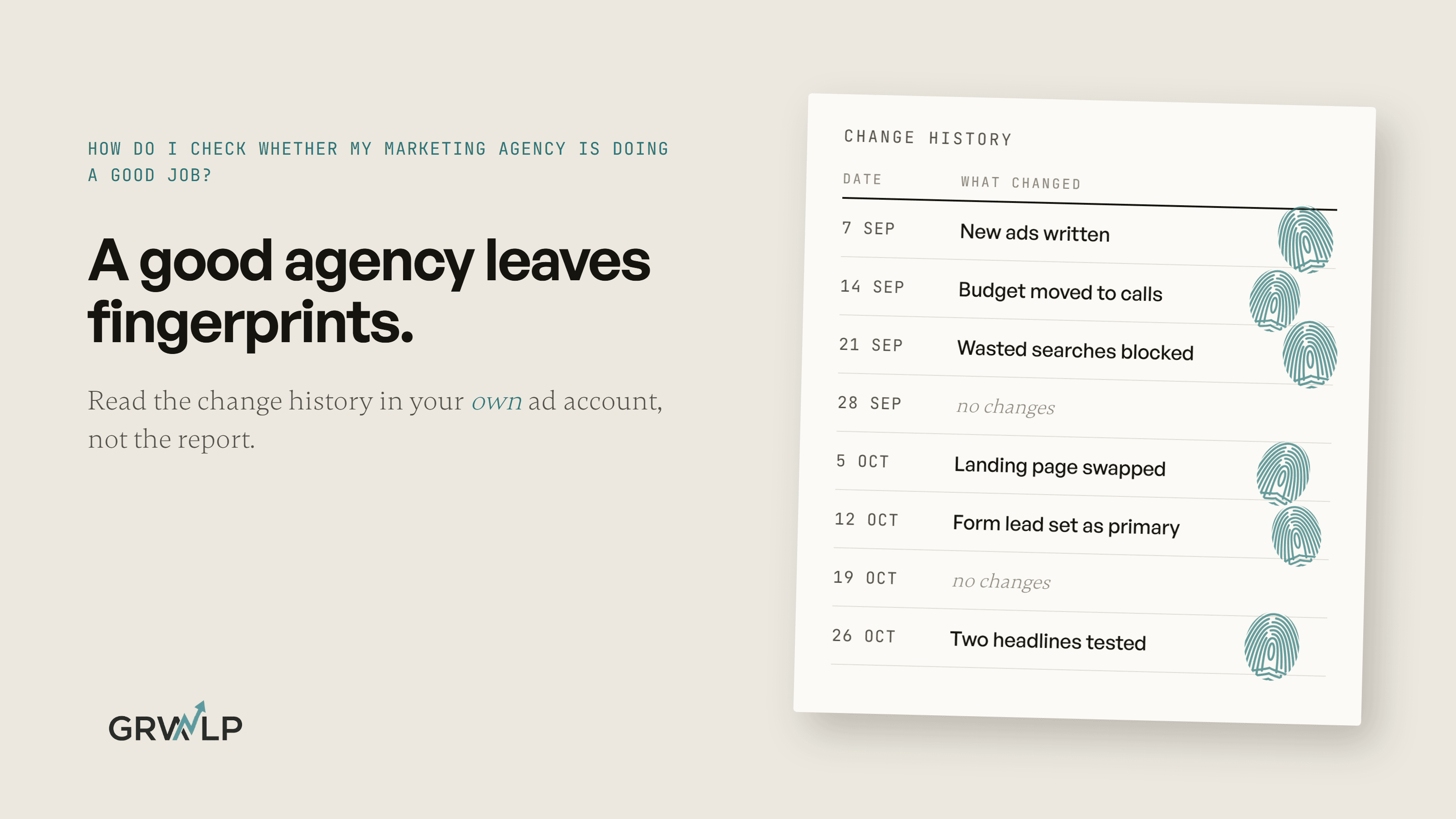
Filter to the last three months and read it like a diary. A working agency leaves fingerprints: new ads written, budgets moved toward what sells, searches blocked, landing pages swapped. Three bid nudges and a month of silence is maintenance, whatever the monthly call says. Google adds one honest caveat: "Sometimes, not all account-level settings changes or changes made by Google representatives during consultations are listed." So a thin log is a question to ask, not a verdict on its own.
Meta keeps a similar record. Meta's Marketing API reference describes an activity record on every ad account, with the time of each change and the name of whoever made it. If you cannot find it in Ads Manager, ask the agency to show you on a call.
What should I look for in the search terms report?
The words people actually typed before they clicked your ad. Google's page on the search terms report draws the line simply: a keyword is what the agency added to the account, a search term is what a person typed. You pay for the second.
Open it under Campaigns, Insights and reports, Search terms. Sort by cost, and read the top twenty out loud. A plumber should hear emergency plumber near me, not plumbing apprenticeship or how to fix a tap myself. Every search that could never become a customer is money the agency should have blocked with a negative keyword, a word that tells Google never to show the ad for it.
The credit union account I took over at VIP Creative Studio ended up with more than 500 negative keywords. Each one was a search the ad had no business paying for. That list is boring to build, and it is exactly the kind of work that shows up in the change history and nowhere in a pretty report.
Is the conversions number in my agency's report real?
It is real, but it counts whatever someone told it to count. In Google Ads, only actions set as primary are reported in the Conversions column. Google's page on primary and secondary conversion actions says secondary ones are kept out of it: "These conversion actions are for observation only."
So go to Goals, then Conversions, and read the list of primary actions. A form sent, a call from the ad, a booking, a purchase: those are enquiries. A page view, a button click or a scroll is not, and if one of those is primary, the headline number in your report is mostly people looking. It also matters for the money, because primary actions are what Google's automated bidding chases. Tell it to find page views and it will find plenty. My piece on what a monthly marketing report should contain shows how to put the enquiry count on top, where it belongs.
Does a high optimisation score mean my agency is good?
No. Google's page about optimization score is clear about what it is: "Optimization score is an estimate of how well your Google Ads account is set to perform." It runs from 0 to 100%, and it moves when recommendations are applied or dismissed. It measures how far the account follows Google's suggestions. It does not count a single customer.
I can say that with some feeling. On that credit union account I took over, the score reached 99.9%. I would never have put it in front of the client as proof. The number that mattered was 250 credit card applications in one month. If your agency leads its report with the optimisation score, ask for the applications, the bookings, the orders. If those are missing, the score is decoration.
When should I leave my marketing agency?
Leave when one of three things is true after your month of counting. The reported leads do not match yours and the agency cannot explain the gap. They will not make you an Admin of your own ad account. Or the change history shows nobody touching the account for weeks while the invoice keeps arriving.
If the numbers match and are simply low, that is a different talk. Agree one target in writing, an enquiry count or a cost per customer, and a date to judge it by. Give it one quarter. A good agency will welcome the clarity, because it is the first time anyone measured them on something they can win.
If you do move, how to choose a marketing agency for a local service business covers what to ask the next one, and how Google Ads that convert are set up shows what the account should look like when it is done well. If you want a second pair of eyes before deciding, the marketing work I do starts with a free 30-minute call, no pitch, and 20% off if we build, booked at cal.com/growveloper/30.
Trust the agency that wants you to look.
“The report is the agency's story about your money. The account is the record.”
Written by Oyekola Obajuwon
is my marketing agency doing a good job · evaluate marketing agency · Google Ads change history · search terms report · agency reporting · ad account ownership · small business marketing agency