What does a fintech startup's website need before launch?
A fintech site is a regulated advert from day one. Here are the lines US, UK and Nigerian regulators read before you launch.
TL;DR
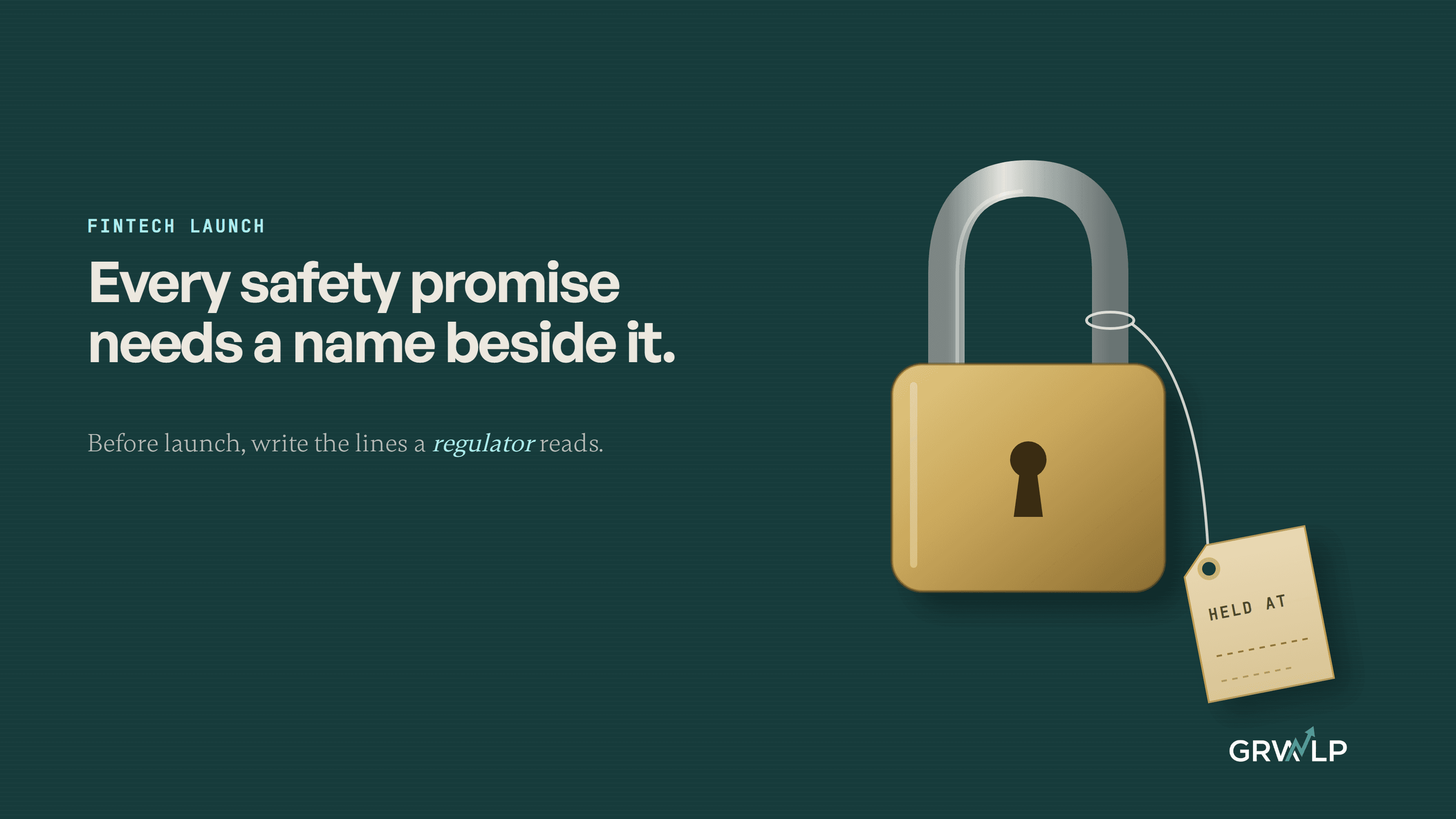
A fintech website needs the lines a regulator reads: who holds the money, what is and is not insured, and who approved the promotion. In the US that means never implying you are the insured bank. In the UK, a promotion for investing needs an authorised firm behind it. In Nigeria, digital lenders register with the FCCPC.
Last updated 27 October 2026. Written by Oyekola Obajuwon, founder of Growveloper, a growth studio that builds the website, the marketing and the follow up for owner run businesses and startups in the United States, the United Kingdom and Nigeria.
A fintech website needs the lines a regulator reads: who holds the money, what is and is not insured, and who approved the promotion. In the US that means never implying you are the insured bank. In the UK, a promotion for investing needs an authorised firm behind it. In Nigeria, digital lenders register with the FCCPC.
Most launch checklists for a fintech site read like any startup's: a clear headline, a price, screenshots, a sign up button. All true. But the day a fintech site goes live it is also an advert for a financial product, and the people reading it closely are not only customers.
What does a fintech website need that other startup sites do not?
Everything a SaaS startup's first website needs, plus a handful of sentences that a regulator, a partner bank or an ad platform will check word by word. They are short. They are also the lines most template sites get wrong, because a template is written to sound safe, and sounding safe is exactly what the rules police.
The line each market reads before launch
| Where and what | The line the site must get right | Whose rule |
|---|---|---|
| US, money held at a partner bank | You are not the bank; name the insured bank | FDIC, since January 2025 |
| UK, investment products | An authorised firm makes or approves it | FCA, section 21 |
| UK and other markets, Google ads | Verified by Google before ads run | Google Ads policy |
| Nigeria, digital lending | Registered and approved by the FCCPC | FCCPC, DEON Regulations |
None of this replaces a lawyer who knows your licence. It tells you which sentences to put in front of one before launch, rather than after a letter arrives.
Can a fintech say its customers' money is FDIC insured?
Only with the bank's name beside it, and only if you say plainly that you are not that bank.
The FDIC's final rule on misrepresenting deposit insurance applies to any person, non-banks included, and has had to be complied with since 1 January 2025. Three parts of it land on a fintech landing page. Using the FDIC's name, its advertising statement or its imagery in a way that suggests a non-bank is insured is a misrepresentation unless it sits next to the name of one or more insured banks. If you talk about deposit insurance for your customers, you must clearly and conspicuously say that you are not yourself an FDIC insured institution. And if you lean on pass-through insurance, you must say that conditions have to be met for it to apply.
Read the second one again. Saying nothing about who you are is itself the misrepresentation. A hero line that says Your money, FDIC insured with the partner bank in a grey footer is the page the rule was written for.
In practice that means one sentence high on the page, near the insurance claim, that names you as a technology company, names the bank that holds the deposits, and links to how the cover works. If the same page offers anything that is not a deposit, an investment or a crypto balance, the rule also expects you to say that those are not insured, are not deposits and may lose value.
Does a UK fintech website need FCA approval?
If the site invites people to invest, yes, unless you are authorised yourself. Section 21 of the Financial Services and Markets Act means, in the FCA's words on its page on approving financial promotions, that "a person must not communicate an invitation or inducement to engage in investment activity" unless that person is authorised or the promotion has been approved by an authorised firm, a section 21 approver.
You cannot pick any regulated friend to sign it off. "A firm can only approve a financial promotion if the FCA has granted the firm permission to do so." The approver checks that the promotion is fair, clear and not misleading, and that test reaches your headline, your returns chart and your sign up page, not only the small print.
If you are authorised, show it. The FCA describes the Financial Services Register as "a public record of firms, individuals and other bodies that are, or have been, authorised by us or the PRA." A firm reference number in the footer lets a careful customer check you in a minute, and the careful customer is the one you want.
Can a fintech startup run Google ads?
Not straight away in the UK. Google's Financial Services Verification policy requires advertisers to be verified by Google before running ads to people who appear to be looking for certain financial services, in a list of countries that includes the United Kingdom. In the UK, verification rests on FCA authorisation, or on an FCA authorised firm standing behind your ads.
So the launch plan cannot be site live on Monday, ads live on Monday. Put verification on the calendar before the launch date, and build the landing page to say the same things your verification says. When the ads do run, the ones that convert send people to a page that answers the question in the ad, not to the homepage.
When I ran a credit union's Meta and Google ads at VIP Creative Studio, more than US$16,000 a month under NCUA regulation, the credit union was itself the regulated institution, so the insured line was its own to say. A fintech that keeps customer money at a partner bank sits in the opposite seat, and its ads and pages have to say so.
What does a Nigerian fintech need before it launches a lending product?
Registration with the Federal Competition and Consumer Protection Commission, and to be on its list. The FCCPC's Digital, Electronic, Online or Non-Traditional Consumer Lending Regulations, 2025, the DEON Regulations, cover digital lenders, and the Commission publishes the digital money lenders it has approved.
If you read about these rules earlier this year, read again. A court's interim order in April 2026 made the FCCPC suspend them. On 20 July 2026 the Commission said the court had discharged that order and that the Regulations are "once again fully operational and enforceable". A launch plan written in May may be working from a pause that has ended.
Before the site goes live, check your company on the approvals list by the exact name your site and your app store listing use. A customer can make the same check, and a lender missing from the list is the first thing they will notice.
What does the product have to back up?
Every promise on the site has to be something the product enforces. On RideOn Nigeria, the four portal platform I built alone, identity checks ran through Dojah, payments ran through the platform, and access was split by role at four layers. Those were the things the site could honestly say, because they were the things the code did.
The same goes for a fintech. Bank level security, verified users and your money is protected are each a claim someone may ask you to prove. Write the ones your product can show, put a name or a document beside each, and cut the rest. A badge you have not earned is the same problem as an insured line you cannot claim.
Who should build and check a fintech website?
Someone who will put the regulated lines in the build plan from day one, and a lawyer who reads them before launch. If you are briefing a developer, put those lines in the brief so they are designed in, not squeezed into the footer the night before.
That is work I do on the web development side of Growveloper, and the fintech page covers what we build for regulated products. The offer is a free 30-minute call, no pitch, and 20% off if we build, booked at cal.com/growveloper/30.
The safest fintech website is not the one with the most badges. It is the one where every promise has a name beside it.
“Saying nothing about who you are is itself the misrepresentation.”
Written by Oyekola Obajuwon
fintech website · fintech startup · FDIC insured claim · FCA financial promotions · section 21 approver · Google financial services verification · FCCPC digital lending · launch checklist