Are lead sites like Angi, Thumbtack and Checkatrade worth it for a home service business?
Lead sites can pay, but on a shared lead an average trade only breaks even. Work out your break even win rate before you sign.
TL;DR
Only if the sum works for your trade. Divide what a lead costs by the profit on a typical job: that is the share of leads you must win just to break even. Most lead sites send one enquiry to several trades, so an average business breaks even and the fastest reply takes the profit.
Last updated 28 October 2026. Written by Oyekola Obajuwon, founder of Growveloper, a growth studio that builds the website, the marketing and the follow up for owner run businesses in the United States, the United Kingdom and Nigeria.
Only if the sum works for your trade. Divide what a lead costs by the profit on a typical job: that is the share of leads you must win just to break even. Most lead sites send one enquiry to several trades, so an average business breaks even and the fastest reply takes the profit.
The sales call never puts it that way. It talks about how many homeowners search the site every month. The number that decides whether you make money is smaller, and you can work it out before you sign anything.
How do I work out whether a lead site will pay for my business?
Divide the price of one lead by the profit you make on a typical job from it. The answer is the share of leads you have to turn into paid work just to get your money back.
Say a lead costs £30 and a typical job leaves £150 after materials and wages. £30 divided by £150 is 20%, so you need to win 1 in 5 leads to break even. Win more than that and the site makes you money. Win fewer and you are paying to quote.
The sum moves fast. If the lead costs £45 instead, you need 30%, nearly 1 in 3. If the job is a bigger one worth £300 to you, the same £30 lead needs only 10%, 1 in 10. That is why the same site can be good for a roofer and a loss for a handyman. The same works in dollars: a $60 lead against $300 of profit is the same 1 in 5.
Use your real numbers. The profit is what is left of the job after the materials and the hours, not the price on the invoice, and the win rate is jobs paid for divided by leads paid for, over a month or more.
What does sharing a lead do to the sum?
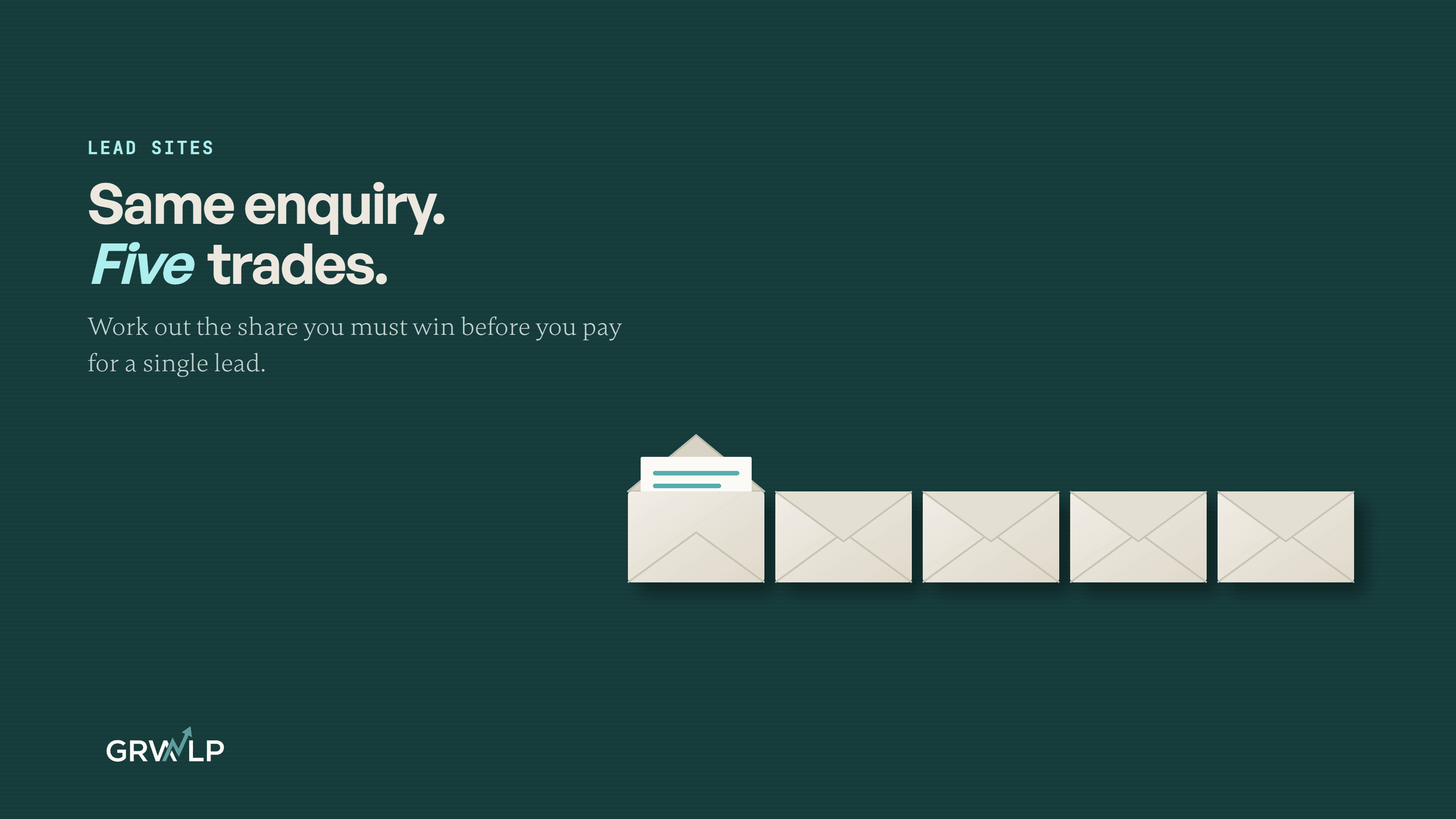
It sets your likely win rate before you have lifted the phone. If a site sends the same enquiry to five trades and the customer hires one, the even share is 1 in 5. In the example above, 1 in 5 is exactly the break even. An average business on that site earns nothing.
Bark says how many in its own terms for professionals: "A Customer may choose to submit a general request to up to 5 unspecified Professionals, which is referred to as a General Bark." On Checkatrade, Whito's study of what Checkatrade really costs found member accounts reporting each enquiry going to 3 to 5 trades, and notes that Checkatrade publishes no cap.
On a lead shared five ways, being average costs you money. Being first is where the profit is. The trades that do well on these sites are rarely the cheapest. They are the ones who reply while the customer is still holding the phone, which is why I wrote a separate piece on how fast a home services company should reply to a new lead.
What do Checkatrade, Bark, Angi and Thumbtack cost?
Each charges in a different way, and the advertised price is rarely the one you pay.
How the lead sites charge, from their own terms or a dated study
| Site | How you pay | Who else gets the enquiry |
|---|---|---|
| Checkatrade (UK) | Advertised from £59 a month, 12 months, real price quoted per trade and area | Members report 3 to 5 trades; no published cap |
| Bark (UK and US) | Credits bought in advance, spent per contact | A general request goes to up to 5 professionals |
| Angi and Thumbtack (US) | Not quoted: their help pages would not open | Not quoted, for the same reason |
Whito puts typical all in spend for active Checkatrade members at £100 to £300 a month, and marks that figure as member reported, not published. Read the term as carefully as the price: Whito lists the minimum as 12 months, renewing automatically, cancelled by phone.
I could not read Angi's or Thumbtack's own pricing pages for this piece, so I have not quoted a lead price for either. The sum above works the same with whatever your account says a lead costs. Put that number in, not the one on a review site.
Can I get my money back for a lead that goes nowhere?
Usually not for the common case, which is a customer who simply never replies. Bark's terms are plain about it: "We will not, for example, offer any return of Credits if the Contact(s) we provide you with are correct, but where the Prospective Customer chooses not to respond to your introduction". Returns on Bark cover things like a wrong phone number, reported within a time limit, and come back as credits, not cash.
In the US, the Federal Trade Commission finalised an order against HomeAdvisor, the lead business behind Angi, in April 2023. The FTC's release says the company had used "a wide range of deceptive and misleading tactics in selling home improvement project leads to service providers", and the order bars false or misleading claims about its leads, "including that they concern individuals who are ready to hire a service provider". The company agreed to pay up to $7.2 million. Whatever any site says on the sales call, judge it on your own win rate, not on the promise that the customer is ready to hire.
When should I keep a lead site, and when should I leave?
Keep it while your win rate stays comfortably above your break even, measured over at least two months. Leave, or refuse to sign, when it does not, and before an automatic renewal locks you in for another year.
Three signs say leave sooner:
You win less than the even share
If five trades get each lead and you win fewer than 1 in 5, the others are faster or cheaper. Fix your reply time first; if that does not move it, the site is not for you.
The jobs are too small for the lead price
A lead price that is a big slice of a small job needs a win rate nobody gets. Turn off the small job types if the site lets you, or leave.
You have no channel of your own
A business that gets every customer from one lead site is renting its phone line. The enquiries that come to you alone, from your Google Business Profile, your Google reviews and your own website, are the ones nobody else is quoting on.
What should I build instead of relying on lead sites?
An enquiry path that belongs to you: a local search presence that puts you in the map results, a website that turns a phone search into a call, and a follow up that replies inside minutes, every time. That is the work on the local services page, and the same follow up is what wins on a lead site too. If you are weighing a lead site against an agency or Google's Local Services Ads, I compared all three in how to choose a marketing agency for a local service business.
If you want the sum run on your own numbers, the offer is a free 30-minute call, no pitch, and 20% off if we build, booked at cal.com/growveloper/30.
A lead site sells you a place in a queue. Whether it pays depends on how fast you get to the front.
“On a lead shared five ways, being average costs you money. Being first is where the profit is.”
Written by Oyekola Obajuwon
are lead sites worth it · Angi leads · Thumbtack leads · Checkatrade cost · Bark leads · shared leads · home service business · tradesperson marketing