Is a paid website and marketing audit worth it for a small business?
When a paid audit pays back, when it does not, what one costs in the US and UK, and five free checks to run first.
TL;DR
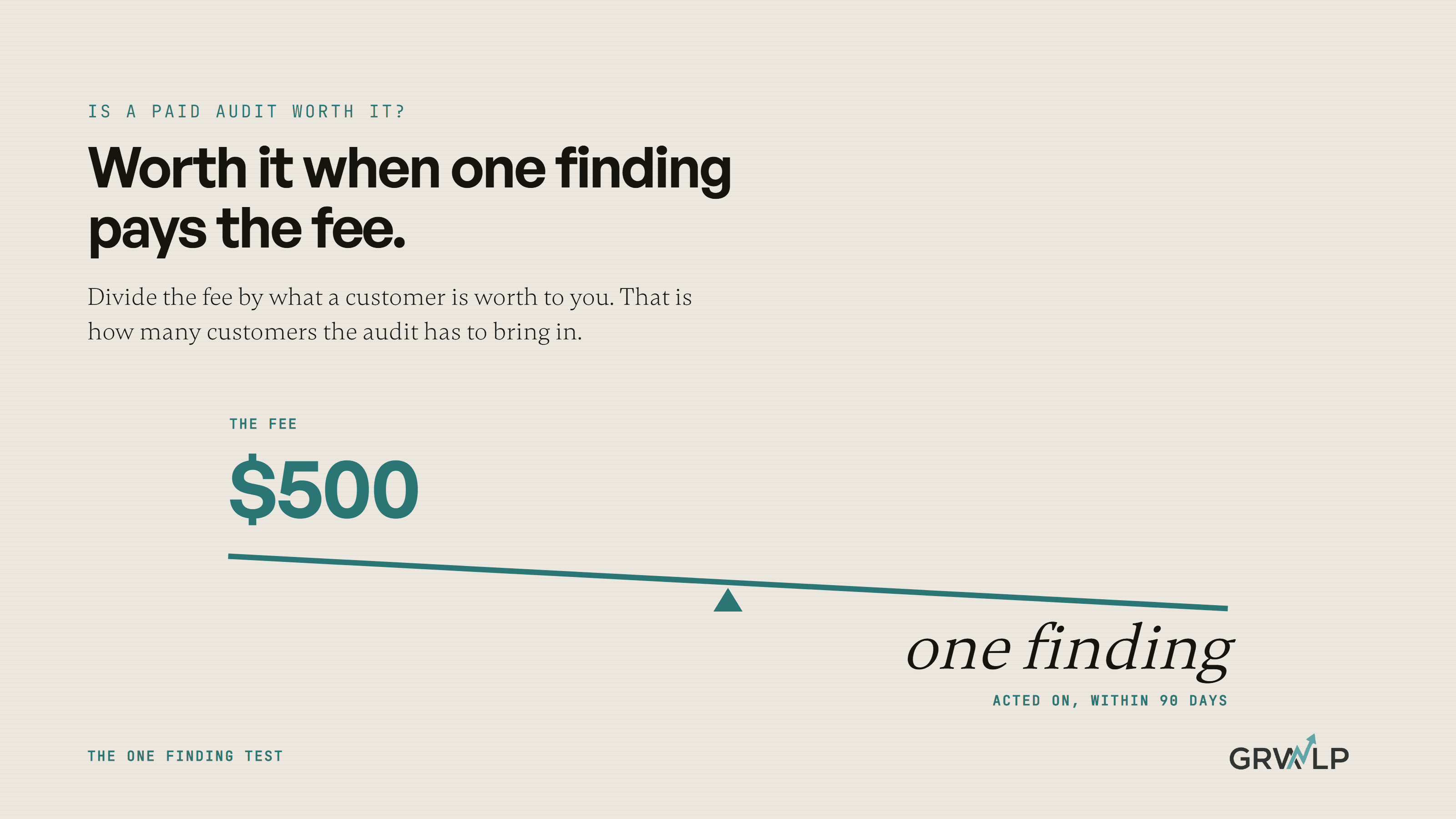
A paid audit is worth it when you have traffic or ad spend to examine, the free checks have not told you why enquiries are low, and you will act on the findings within 90 days. Otherwise start with the free checks below. In WebFX's survey of 250 US businesses, 43% paid $101 to $750 for one.
Last updated 15 October 2026. Written by Oyekola Obajuwon, founder of Growveloper, a growth studio that builds the website, the marketing and the follow up for owner run businesses in the United States, the United Kingdom and Nigeria.
A paid audit is worth it when you have traffic or ad spend to examine, the free checks have not told you why enquiries are low, and you will act on the findings within 90 days. Otherwise start with the free checks below. In WebFX's survey of 250 US businesses, 43% paid $101 to $750 for one.
One thing before the detail. We sell an audit. So does every page that ranks for this question. Read all of us, this page included, the way you would read a mechanic telling you the car needs a service, and then do the sum in the middle of this page with your own numbers. We call that sum the one finding test: an audit is worth its fee when a single finding, acted on, would earn the fee back.
What does a paid audit check that free tools do not?
Free tools tell you what is wrong with the website. A paid audit is supposed to tell you which of those things is costing you customers, and in what order to fix them.
Five checks you can run free before paying anyone
| Check | Free tool | What it cannot tell you |
|---|---|---|
| How fast the page loads on a phone | PageSpeed Insights | Whether slowness is why people leave |
| Which searches bring you clicks | Google Search Console | Which searches bring you customers |
| Whether enquiries are counted | Google Analytics key events | Whether the count is right |
| Where visitors stop and give up | Microsoft Clarity recordings | Why they stopped |
| Calls and direction requests | Google Business Profile | Whether anyone answered the call |
Run PageSpeed Insights on your home page and your most visited service page. Open Search Console and sort by clicks. Check that your contact form, your phone number and your WhatsApp button each register as a key event in Google Analytics, which is the first step in our guide to what a good conversion rate is. Watch ten recordings in Clarity. Then send yourself an enquiry from your own website and time the reply, which is the fourth check in our guide to a website that produces no leads.
If those five checks show you the problem, you do not need an audit. You need an afternoon. If they show you five problems and you cannot tell which one matters, that is the job an audit does: it connects the ad to the page to the form to the inbox to the reply, and puts the leaks in order of money.
How much does a website and marketing audit cost?
Less than the agency quotes suggest, if you go by what businesses say they paid.
What a website or marketing audit costs, from published figures
| Who | Price | What it covers |
|---|---|---|
| WebFX survey, 250 US businesses, the band 43% paid | $101 to $750 | An SEO audit, priced mostly by site size |
| Clutch listings, via SeoProfy, 2025 | $100 to $5,000, most under $2,500 | A technical SEO audit |
| UK freelance consultant, Whito 2026 | £300 to £800 | One or two channels, about 4 to 8 hours |
| UK small agency, Whito 2026 | £1,000 to £2,500 | A review aimed at hiring that agency |
| UK large agency, Whito 2026 | £3,000 to £5,000 and up | Several channels, 4 to 6 weeks |
| Growveloper Growth Audit | $500, credited against a project signed within 60 days | Website, marketing and automation, 2 weeks |
WebFX's figure is the only one here built from what buyers reported rather than what sellers list, and it says website size moves the price more than anything else. SeoProfy's page carries the Clutch listings and says free audits "usually cover only the surface." Whito's UK page is the most candid of the three, because it says in print that a small agency's audit is "aimed at businesses considering hiring that agency" and that its recommendations will tend to favour the services that agency sells. Our own Growth Audit is $500, takes two weeks from the day we have access, and the fee is credited against any project signed within 60 days, which makes it a door into our work as much as a report. We say so because the next section applies to us too.
We searched for a Nigerian price list and found none that states where its numbers come from. Lagos agencies quote against the dollar bands above; if you are quoted in naira, ask what the price includes, as our guide to choosing an SEO agency in Nigeria shows four agencies charging the same monthly fee for four different jobs.
When is a paid audit not worth it?
In four cases, and most small businesses asking this question are in one of them.
Nothing is being counted yet
If there is no analytics on the site and no form that lands anywhere, an audit's first page will say "install analytics." Our own audit page says it plainly: if you do not have analytics set up, that is a finding in itself. You do not need to pay $500 to be told that. A free call will tell you, and so has this page.
You can already see the leak
If your test enquiry sat unanswered for two days, or your phone number is not tappable on a phone, or your only traffic is your own staff, you have found the finding. Fix it. Pay for an audit when the obvious things are done and the enquiries still do not come.
Nobody will act on it within 90 days
A report nobody acts on is the most expensive kind of free. Whito's page makes the same point from the seller's side: the value is in the ranked plan and the follow through, not the page count. If the next quarter is already full, keep the money until it is not.
The audit is step one of someone's sales process
An audit sold by an agency is, in Whito's words, aimed at businesses considering hiring that agency. That is not a reason to refuse one. It is a reason to ask, before paying, whether you keep the report if you never hire them, and whether the findings would still make sense if you took them to someone else.
When does a paid audit pay for itself?
When one finding covers the fee. Here is the sum, with your numbers.
The one finding test
Take the audit fee. Divide it by what one new customer is worth to you over a year. The answer is how many extra customers the audit's findings would have to bring in to break even. For a $500 audit and a business where a customer is worth $400, that is two customers. For a clinic where a patient is worth $5,000, it is one patient in ten years. For a shop where a sale is worth $20, it is 25 sales, and you should probably run the free checks instead.
Then look at the findings an audit usually returns and ask whether any one of them could plausibly do that. The common ones, from our own work: a form whose emails go to an inbox nobody opens; a phone number that is text, not a link, on a phone; an ad campaign sending clicks to the home page instead of the service page; a tracking tag that stopped firing after a website update; a booking tool that nobody connected to the calendar. Each of those is one fix, and each has turned one enquiry into none for as long as it stood.
What did an audit style check find on our own website?
A count that had stopped.
From 3 September to 24 September 2026, Google Analytics on growveloper.com recorded nothing. The site was up, people were visiting, and the chart was flat at zero. The cause was a cookie consent setting that never passed the visitor's answer through to Google Tag Manager, so the analytics tag never fired. It was found during a review of the site's search and AI visibility, fixed the same day, and three weeks of decisions had been made on an empty chart. The first finding is often that nothing was being counted. That one was ours.
It was not the first time. At Baye Business Solutions, a cloud services company in Lagos, I started with no analytics, no Google tracking and no intake forms, and eight categories of service with no page for any of them. No audit in the world could have told that business its conversion rate. The first job was to make a number exist. That is the point of the four cases above: an audit measures what is there. If nothing is there yet, build the counting first and audit it later.
What should a real audit give you, and how do you tell it from a sales pitch?
Five things, whoever sells it, including us.
A ranked list, with each item carrying what it will take to fix and roughly what it is costing you now. A price before access, and read only access when it comes: analytics, Search Console and the ad accounts, never ownership or admin rights. A fixed delivery date. Everything you paid for left in your hands if you never hire them, which is the reason our own page says you keep the report, the video and the roadmap. And, from the audit page's own words, someone willing to tell you on the call that you are not ready yet.
If an auditor cannot say what the first finding will probably be before they start, they have not looked at your site. If every finding points to a service they sell, read the Whito line again. And if the report arrives without the money attached to each item, it is a list, not an audit. Our marketing service begins with the same audit and research step before any strategy, so the first thing a client gets from us is a finding, not a plan.
If you would rather talk it through first, book a free 30 minute call, bring the results of the five free checks, and we will tell you which of the four cases you are in. Sometimes the answer is that you do not need us yet.
Pay for an audit to find the thing you cannot see. If you can already see it, spend the money fixing it.
“The first finding is often that nothing was being counted.”
Written by Oyekola Obajuwon