Website and online booking for a private clinic: what patients expect
What a private clinic's website and booking need: the rating, the fee and a real time to book, on a page that does not leak.
TL;DR
Patients expect your rating, your fee and the next free appointment, then booking in a few taps. Two rules land on that page: in England a rated clinic must show its CQC rating on its website, and in the US the tracking bulletin says an ad tag on a booking page may collect health information.
Last updated 6 October 2026. Written by Oyekola Obajuwon, founder of Growveloper, a growth studio that builds the website, the marketing and the follow up for owner run businesses in the United States, the United Kingdom and Nigeria.
Patients expect your rating, your fee and the next free appointment, then booking in a few taps. Two rules land on that page: in England a rated clinic must show its CQC rating on its website, and in the US the tracking bulletin says an ad tag on a booking page may collect health information.
Most advice on clinic websites stops at the first sentence. Booking software makers wrote most of the pages that come back for this question, and they are right that patients want to book online. What they skip is that the booking page is the one page on your site that patients and regulators read for the same thing.
What do patients look at before they book a private clinic?
The rating, the price and whether they can book without phoning. Two recent surveys put numbers on it, and both come from companies that sell software to clinics, so read them as a direction rather than a census.
What patients told two surveys about choosing a clinic
| What patients said | Who asked, and when | What to put on the page |
|---|---|---|
| 61% say booking online is extremely or very important when choosing a new provider | Kyruus with Wakefield Research, 1,000 US healthcare consumers, July 2023 | A Book button that opens a real diary |
| 96% consider cost when making healthcare decisions | The same survey | A fee, or a starting fee, beside the service |
| 75% would not book with a provider rated below 4.0 stars | rater8, nearly 1,000 US adult patients, published June 2026 | Your rating and recent reviews next to the Book button |
| 66% say a provider's replies to reviews influence their trust | The same rater8 survey | Replies under your reviews, including the bad ones |
The Kyruus figures come from a July 2023 survey run with Wakefield Research. The rater8 report adds one more line worth knowing: 36% of patients cited AI tools such as ChatGPT as an influence on which provider they chose. A star rating is something the patient checks before they check your address.
What should the online booking flow include?
As few steps as it takes to get a confirmed time, and nothing the clinic does not need before the visit.
A private clinic booking flow, step by step
| Step | What the patient needs | What to leave out |
|---|---|---|
| Choose the service | The name they would use, and the fee | Internal service codes |
| Choose a time | Real free slots, soonest first | "Request a time and we will call you" |
| Who is coming | Name, phone or email, date of birth if needed | Full medical history before the visit |
| Confirm | Time, address, what to bring, how to cancel | A second account to create |
| Remind | A message the day before | Marketing messages they did not ask for |
"Request a time and we will call you" is not online booking. It is a contact form with a calendar drawn on it, and it puts the patient back in the phone queue they were trying to skip. If your booking tool also has to talk to your calendar, your CRM and your WhatsApp, our piece on connecting a website to WhatsApp, a CRM and a calendar covers which system should hold the booking.
Should a private clinic show its fees on the website?
Yes, as a fee or a starting fee for each service, with what changes it. Nearly every patient in the Kyruus survey said cost shapes their decisions, and a fee they cannot find is a phone call they may not make. A consultation fee and a "from" price for treatments is enough. You do not need to publish every possible combination.
Does a clinic in England have to show its CQC rating on its website?
Yes, if the Care Quality Commission has rated it. Regulation 20A of the Health and Social Care Act 2008 (Regulated Activities) Regulations 2014, in force since 1 April 2015, says every website "maintained by or on behalf of a service provider" must show the Commission's website address, the place on it where the latest assessment can be read, and the most recent rating of the provider's overall performance.
It also says how. The rating must be "legible", "displayed conspicuously in a place which is accessible to service users", and shown with the date the Commission gave it. A rating buried in the footer of the about page does not meet that. Next to the Book button does.
None of the booking software and agency pages that came back in our searches for this question mentions the rule. The Commission's own guidance pages would not open from the machine we used, so check them for the current display widget and any deadline after a new rating is published.
Can a US clinic put the Meta Pixel or Google Analytics on its booking page?
Be careful. This is the section to read twice, and we are not lawyers.
First, whether the federal health privacy law, HIPAA, applies to you at all. The Centers for Medicare and Medicaid Services' page on covered entities, updated 16 March 2026, puts it simply: "Providers who submit HIPAA transactions, like claims, electronically are covered." If your clinic sends insurance claims electronically, read the rest of this section as written for you.
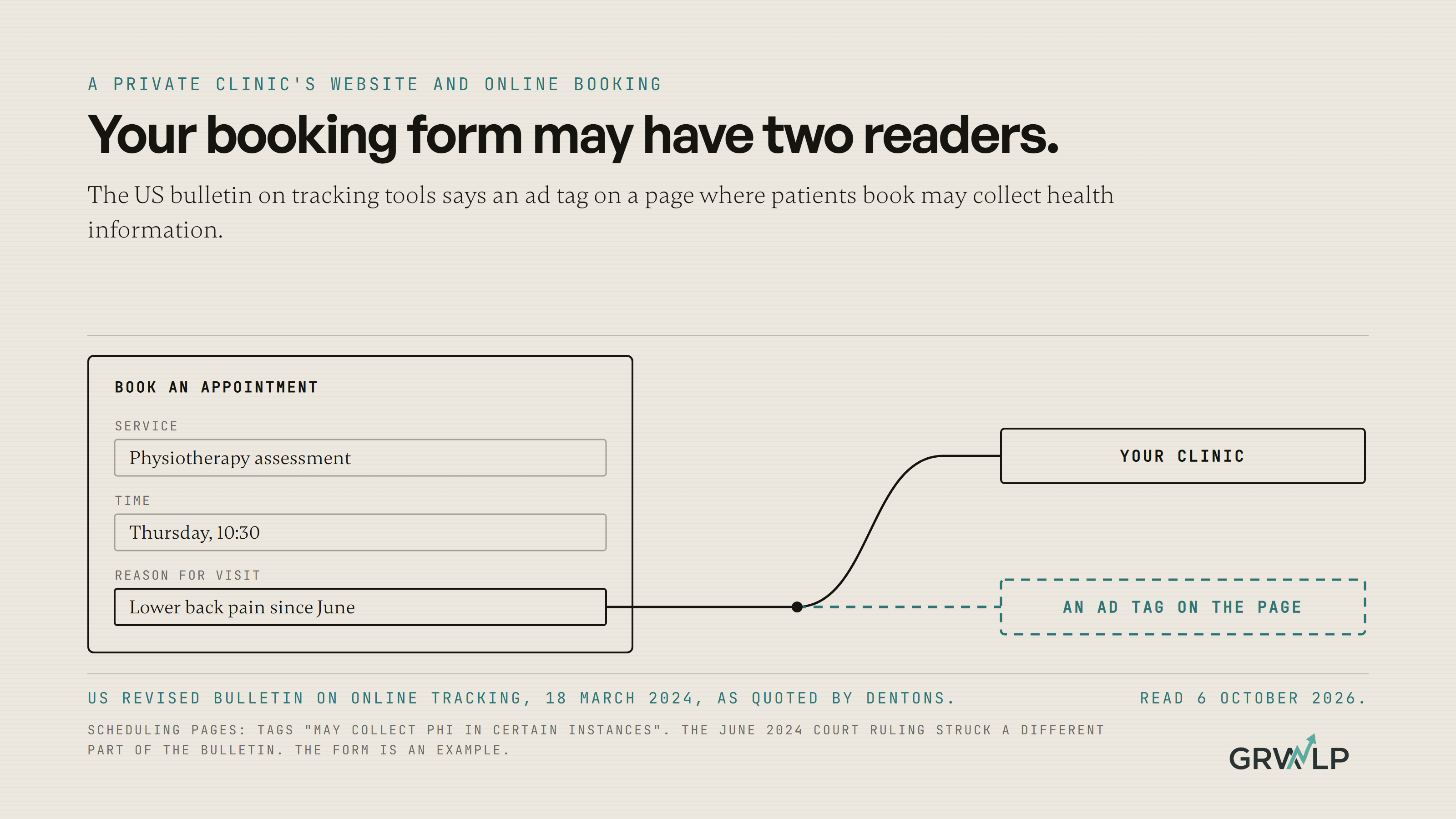
Second, what the government has said about tracking tools. The Department of Health and Human Services published a revised bulletin on online tracking tools on 18 March 2024. Law firm Dentons, in its reading of the revised bulletin on 5 April 2024, quotes it: "tracking technologies on a regulated entity's unauthenticated webpage that permits individuals to schedule appointments or use a symptom-checker tool without entering credentials may collect PHI in certain instances." PHI is protected health information. Think of the reason for the visit, typed into a box that an advertising platform can also read.
Third, what the court changed. In June 2024 a federal court in Texas struck one part of the bulletin: the part that treated an IP address plus a visit to a public page about a health condition or a provider as protected information. The opinion itself, dated 20 June 2024, draws the line: "The Court's analysis concerns only the Proscribed Combination." Holland and Knight's reading of the ruling notes that it does not specifically address scheduling pages.
The practical answer: keep advertising and analytics tags off the booking flow unless your lawyer and your booking software vendor have told you, in writing, what each tag collects there. Count bookings from the booking system itself instead. That is the only count that cannot be wrong about who booked.
Why check what your website sends, not just what it shows?
Because tags are invisible, and a page can look finished while doing something you never chose.
We learned this on our own site. For about three weeks in September 2026, growveloper.com's analytics recorded nothing, because one consent setting was not reaching our tag manager. Every page looked fine. We wrote it up in our piece on improving a website's conversion rate. Ours failed by sending too little. A clinic's booking page can fail the other way, by sending too much, and it will look exactly as finished.
So ask whoever built your site for a list of every tag on the booking pages and what each one receives. If nobody can produce that list, that is your answer.
How should reviews and replies sit on a clinic website?
Close to the Book button, with your replies visible. The rater8 survey's 66% is about replies, not stars. Our guide to getting more Google reviews covers the asking, and for clinics the natural moment is the follow up message after the appointment. Then answer every booking request quickly, which our piece on how fast to reply to a new enquiry sets out with the study behind it.
What has Growveloper built for private clinics?
Nothing published yet, and we would rather say so. Our private clinics page describes how we approach the website, the local search and the follow up for clinics, and our web development page publishes our prices. If you want a second look at your own booking page before changing anything, there is a free call.
Patients book the clinic that shows its rating, its fee and its next free time, on a page that keeps what they typed between the two of you.
“The booking page is where a patient tells you why they are coming. Check who else is listening.”
Written by Oyekola Obajuwon