Which repetitive jobs in a small business can AI actually do today?
Which repetitive small business jobs AI can do alone today, which it should only draft, and which need no AI at all.
TL;DR
AI can do the repetitive jobs where a mistake is cheap to undo: sorting enquiries, drafting replies, summarising calls, pulling details off invoices and first drafts of posts. Where a mistake costs money or trust, such as prices, refunds, promises and hiring, AI drafts and a person sends. Many jobs called AI are just rules.
Last updated 12 October 2026. Written by Oyekola Obajuwon, founder of Growveloper, a growth studio that builds the website, the marketing and the follow up for owner run businesses in the United States, the United Kingdom and Nigeria.
AI can do the repetitive jobs where a mistake is cheap to undo: sorting enquiries, drafting replies, summarising calls, pulling details off invoices and first drafts of posts. Where a mistake costs money or trust, such as prices, refunds, promises and hiring, AI drafts and a person sends. Many jobs called AI are just rules.
Most answers to this question are lists of twenty jobs, written by companies that sell the tools, ending on a line about a human still checking. That is true, and it leaves you guessing which jobs need the check. This page gives you one test that sorts any job, including the ones no list mentions.
Which repetitive jobs can AI do on its own today?
Here is how the common ones sort. "Drafts" means AI writes it and a person reads it before it goes out.
Repetitive small business jobs and what AI can do with them today
| Job | Can AI do it? | What it still needs |
|---|---|---|
| Sorting and tagging new enquiries | Yes, on its own | A daily look at the urgent pile |
| Summarising calls and meetings | Yes, on its own | Names, numbers and dates checked |
| Pulling details off invoices and receipts | Yes, on its own | Totals checked against the document |
| Replying to enquiries | Drafts | A person checks prices and promises |
| Answering questions in a website chat | Only from your written answers | A hand over to a person |
| Posts, emails and product descriptions | Drafts | Your facts, your edit, your voice |
| Quoting a price for a job | Not alone | Your price rules; you approve odd jobs |
| Booking reminders and invoice chasers | Not an AI job | A plain rule in your booking tool |
| Shortlisting job applicants | No | A person decides |
The top three are the safe place to start. The middle rows are where AI saves the most time, as long as someone reads before sending. The last rows are where owners get hurt, or overpay for AI they did not need.
What is the undo test?
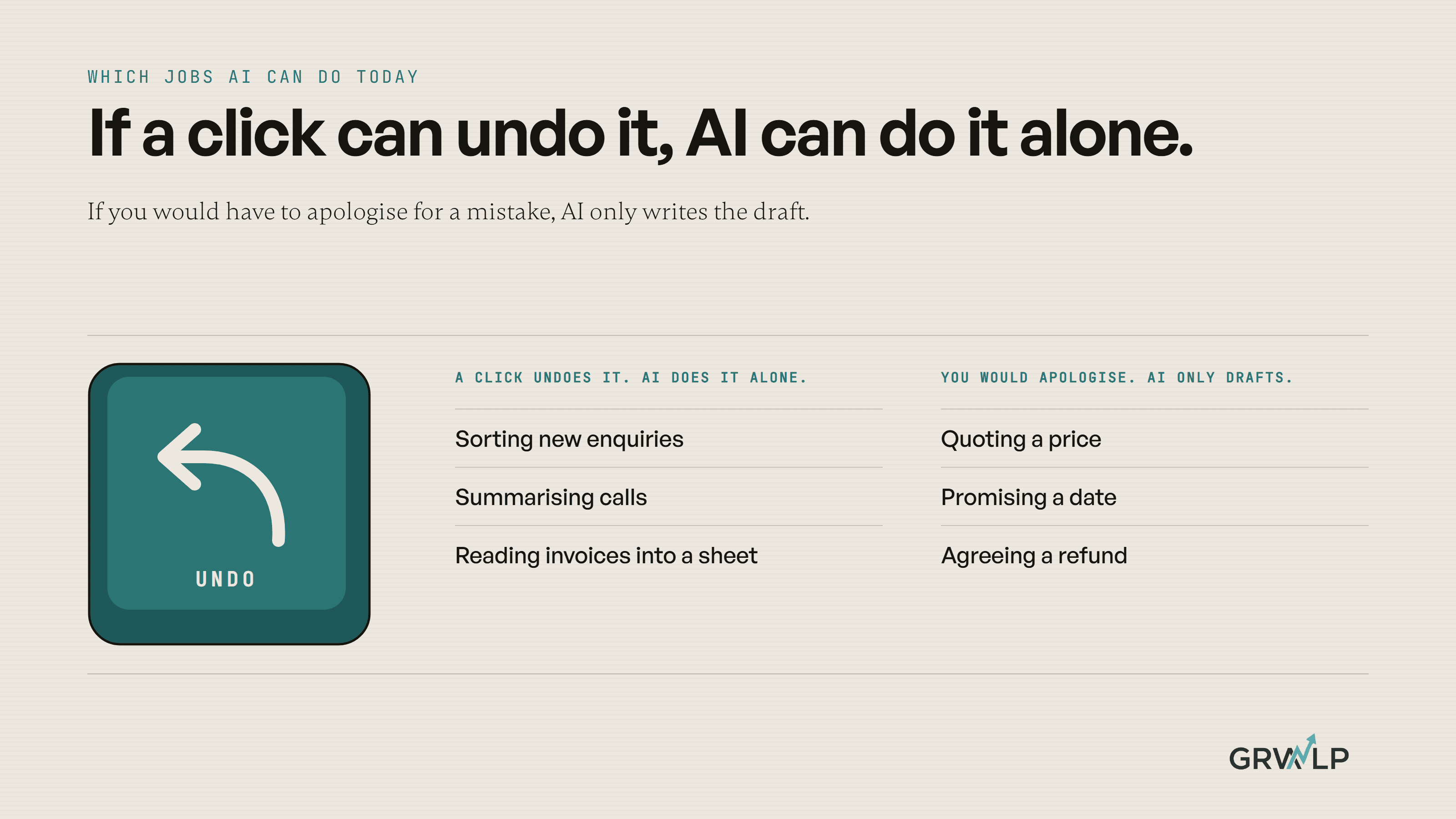
Ask one question about any job: if the AI gets this wrong, how hard is it to undo?
We call this the undo test. A wrong tag costs one click to fix. A wrong price costs a customer, or a refund, or both. A wrong line in a call summary gets caught when you read it; a wrong promise in an email to a customer has already been read by them.
So the rule has three outcomes:
- Cheap to undo: let AI do it alone, and check a sample now and then.
- Expensive to undo: let AI draft, and have a person send.
- Never changes: skip AI and write a plain rule, which does the same thing every time.
The test works on jobs no list has heard of, because it asks about your business, not about the tool.
Can an AI chatbot answer my customers on its own?
Only from answers you wrote, and only if you accept that whatever it says, you said. A Canadian tribunal made that plain in 2024.
A customer, Mr Moffatt, asked Air Canada's website chatbot about bereavement fares, the reduced fares some airlines offer when someone travels because of a death. The chatbot told him he could book now and apply for the reduced fare afterwards, within 90 days of buying the ticket. That was wrong: Air Canada's own policy did not allow claims after travel, and it refused the refund. In the tribunal, Air Canada argued, in the tribunal's words, that "the chatbot is a separate legal entity that is responsible for its own actions."
The tribunal disagreed. "It should be obvious to Air Canada that it is responsible for all the information on its website," it wrote, as quoted in McCarthy Tetrault's summary of Moffatt v Air Canada. According to Daily Hive's report of the decision, the airline was ordered to pay $650.88 in damages, plus interest and tribunal fees.
The chatbot was not on trial; the airline was. That is the undo test in a courtroom. A chatbot answering opening hours fails cheaply. A chatbot answering refund rules, prices or policy fails in a way you pay for. If you use one, feed it only your own written answers, and give it a clear way to hand the conversation to a person.
Will AI make me or my staff faster?
Yes, and most of all on the jobs you are newest at. The largest study we know of followed 5,179 customer support agents at one company after it introduced an AI assistant. Erik Brynjolfsson, Danielle Li and Lindsey Raymond, in NBER working paper 31161, found it raised productivity "by 14% on average, including a 34% improvement for novice and low-skilled workers," but "with minimal impact on experienced and highly skilled workers."
That last part matters for an owner. The reply you have written a thousand times, AI barely speeds up. The job you do twice a year and dread, a job advert, a first draft of a refund policy, a supplier complaint, is where it saves the most. Start there, and check those drafts hardest, because they are also the ones you are least able to spot errors in.
Which repetitive jobs don't need AI at all?
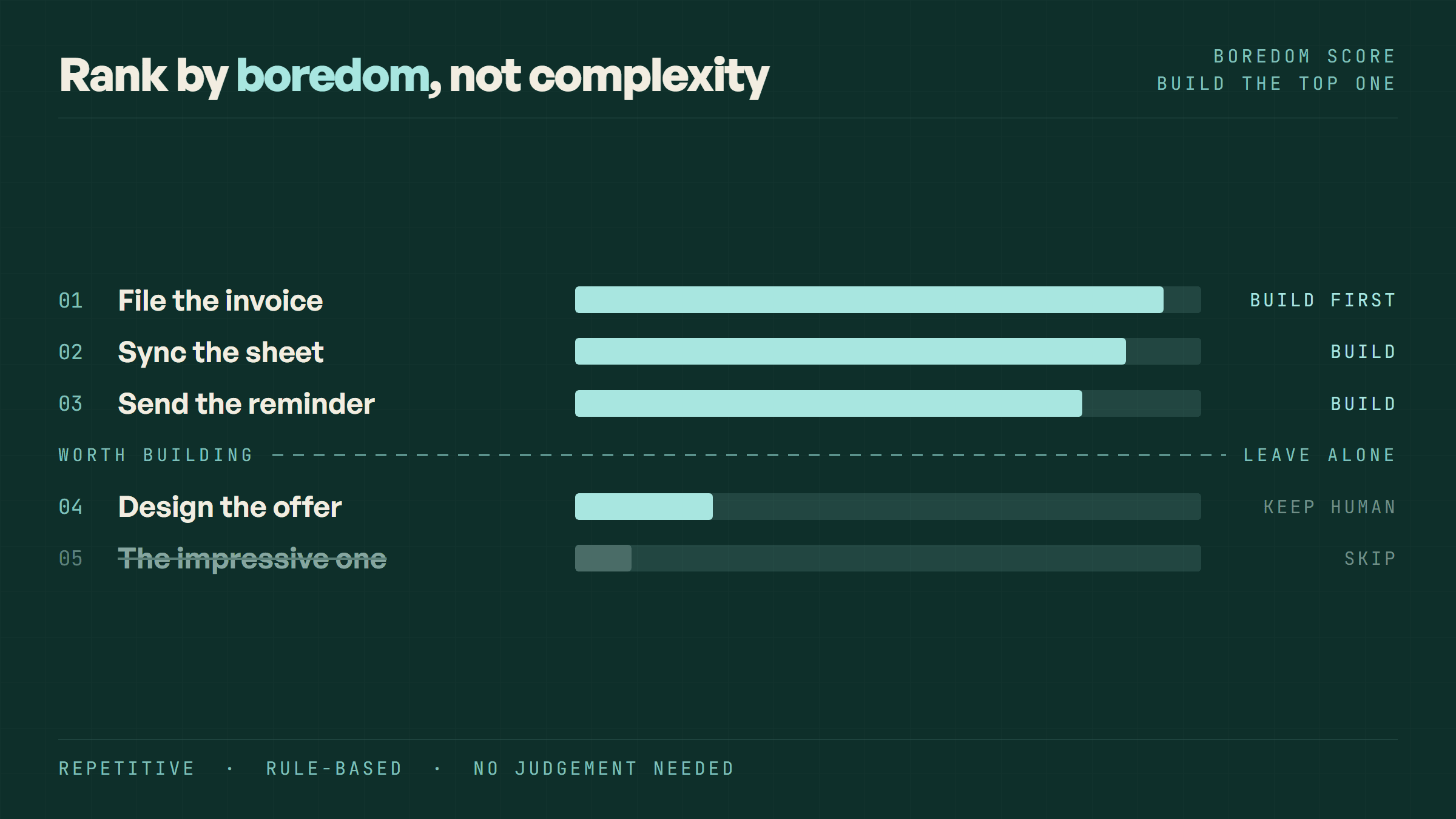
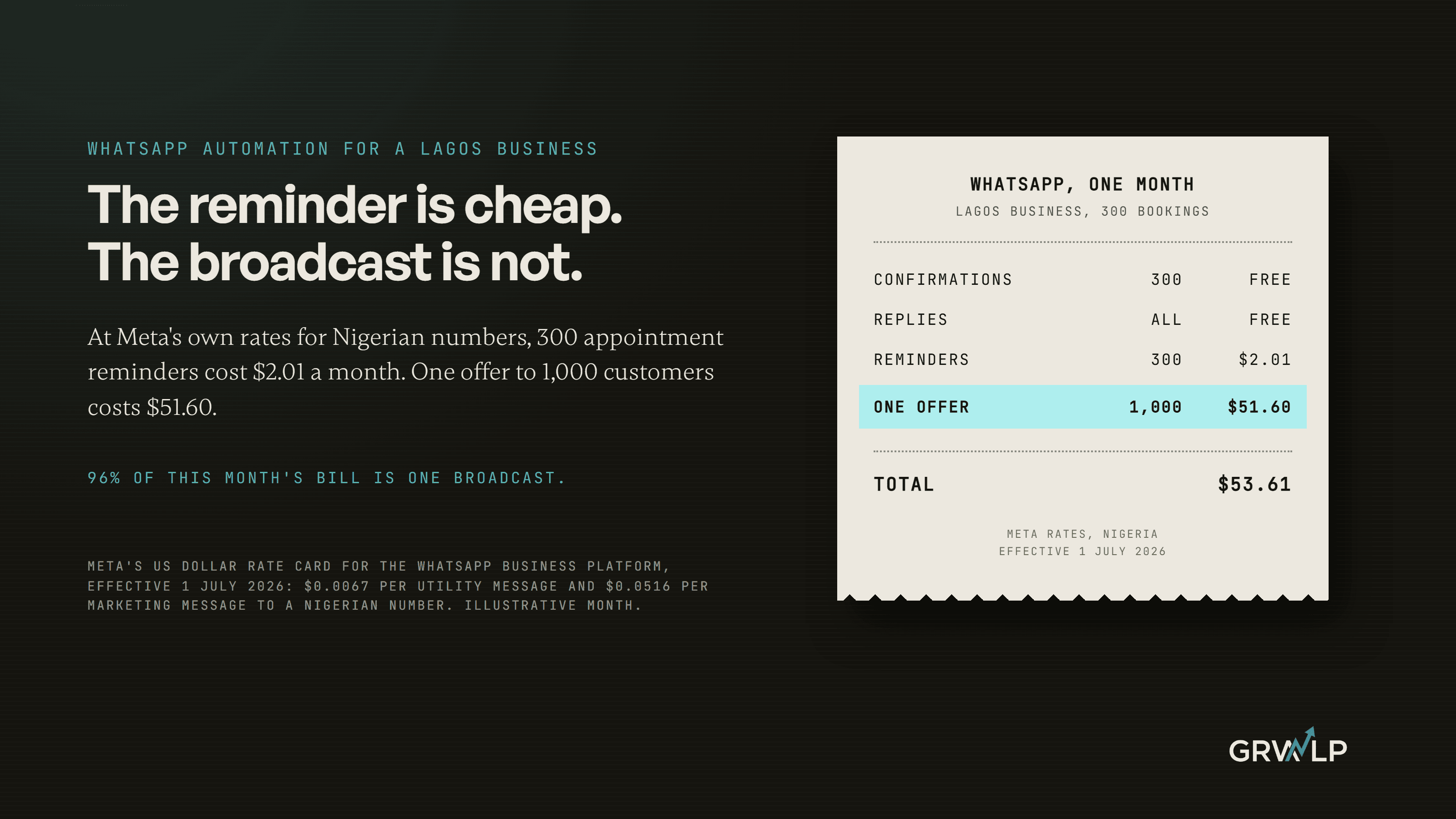
The ones that happen the same way every time. Reminders, follow ups, handing work to the next person: these need a rule, not a model that writes something new each time.
When we built the booking platform for RideOn Nigeria, a chauffeur service in Lagos, two of the most useful pieces had no AI in them. A booking that waited went out to 10 drivers, then 25, then 60, until one accepted. An email that failed was tried again after 5 minutes, then 30, then 2 hours, up to a limit. Nobody at RideOn had to remember to try again. The rule did, every time, the same way.
Plain rules are cheaper to run and easier to trust than AI for this kind of work. Our guide to what a small business should automate first ranks these boring jobs, and Zapier or a custom integration covers the tools that run them.
How many small businesses actually use AI?
Fewer than the headlines suggest, especially the smallest. The US Census Bureau's report of May 2026 found that 19.8% of US businesses used AI as of 3 May 2026, and that use among firms with four or fewer employees stayed under 20% and did not change significantly over the period. The Census changed its question in November 2025 to cover AI "in any business function," so older figures do not compare cleanly.
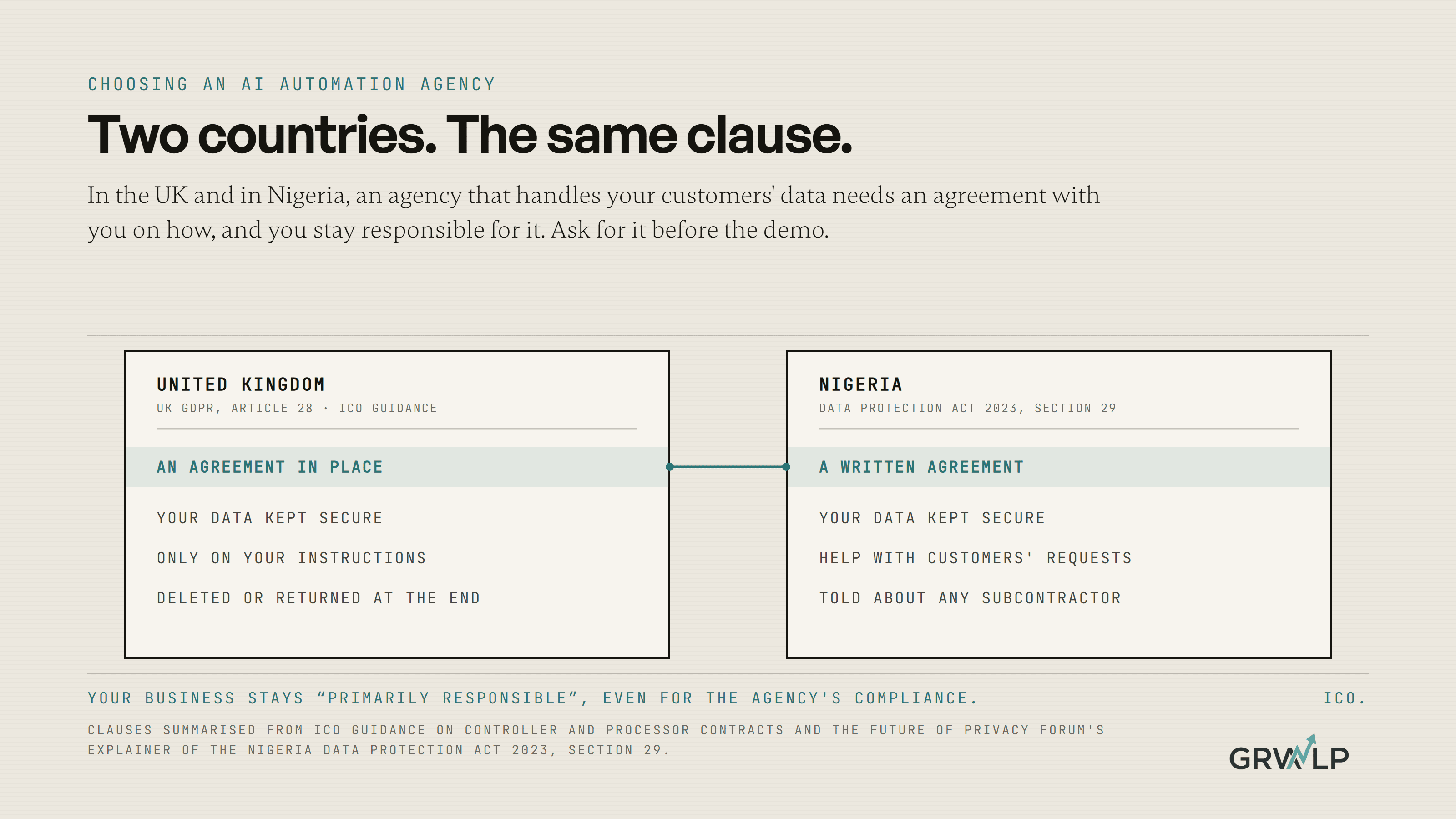
For the UK, our guide to choosing an AI automation agency in Nigeria or the UK has the Office for National Statistics figures. We have found no Nigerian figure with a stated sample, so we will not print one. In all three countries the point is the same: you are not late, and your first AI job can be small.
Where should a small business start with AI?
Pick one job from the top of the table and run it as drafts for two weeks. Count how often you change what the AI wrote before it goes anywhere.
If you rarely change it, and a mistake would be cheap to undo, let it run on its own. If you change it often, it stays a draft, which still saves the typing. If the job never varies, replace the AI with a rule. Our AI and automation page describes how we map and build these, and if you want help sorting your own list, book a free 30 minute call.
Let AI take the jobs a click can undo, and keep your own hand on the ones you would have to apologise for.
“A wrong tag costs one click to fix. A wrong price costs a customer, or a refund, or both.”
Written by Oyekola Obajuwon