WhatsApp automation for businesses in Lagos: what is possible and what it costs
What a Lagos business can automate on WhatsApp for free, what Meta charges per message to Nigerian numbers, and what providers charge to build it.
TL;DR
A Lagos business can automate greetings, away messages and quick replies for free in the WhatsApp Business app. Automatic confirmations, reminders and replies from your website need Meta's WhatsApp Business Platform, which charges per delivered template to a Nigerian number: $0.0067 for a reminder, $0.0516 for a marketing message. Replies inside 24 hours are free.
Last updated 1 October 2026. Written by Oyekola Obajuwon, founder of Growveloper, a growth studio in Lagos that builds the website, the marketing and the follow up for owner run businesses in Nigeria, the United States and the United Kingdom.
A Lagos business can automate greetings, away messages and quick replies for free in the WhatsApp Business app. Automatic confirmations, reminders and replies from your website need Meta's WhatsApp Business Platform, which charges per delivered template to a Nigerian number: $0.0067 for a reminder, $0.0516 for a marketing message. Replies inside 24 hours are free.
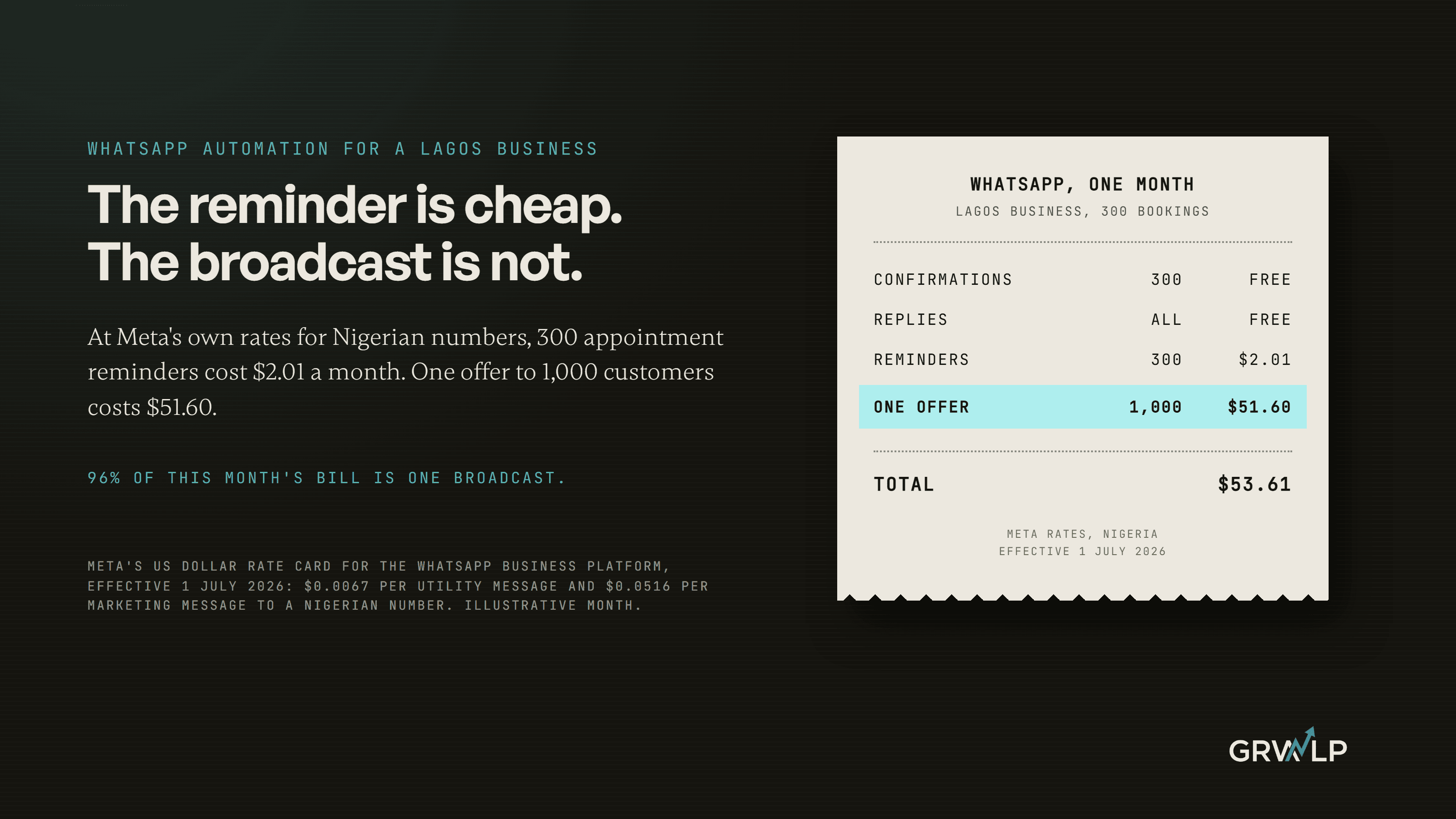
At those rates, reminding 300 customers about tomorrow's appointment costs about two dollars a month. One promotional message to 1,000 customers costs about fifty two. Neither number appears on the pages a Lagos owner finds when they ask who builds WhatsApp automation. Those pages quote a build fee and a monthly fee, and the owner has no way to tell how much of either is the messages themselves.
What can I automate on WhatsApp without paying anything?
More than you might expect. The free WhatsApp Business app has its own small set of automations built in:
Greeting messages
A message sent automatically when a customer writes to you for the first time. WhatsApp's help centre covers how to use greeting messages.
Away messages
A message sent automatically when you are busy or outside your hours, so a customer who writes at 9pm hears something before morning. The help centre page on how to use away messages shows where to set them.
Quick replies, labels and a catalogue
Saved answers to the questions you type ten times a day, labels to sort chats into new, quoted and paid, and a catalogue of what you sell with prices.
All of this runs on your phone and needs no developer. What the app cannot do is act on its own when something happens somewhere else: send a confirmation when someone fills in the form on your website, or remind a customer the day before a booking. For that, a person has to tap send, or you need the Platform. A click to chat link that opens a WhatsApp conversation from your website is also free, and our piece on connecting WhatsApp to a CRM and a calendar explains where it fits.
When does a Lagos business need the WhatsApp Business Platform?
When software, not a person, has to send the message. The Platform, often called the WhatsApp Business API, is Meta's service for businesses whose systems send and receive WhatsApp messages by themselves. You need it when:
A form should trigger a WhatsApp reply
Someone requests a quote on your website and gets a WhatsApp confirmation within seconds, while you are on a job.
A booking should trigger a reminder
The day before an appointment, the customer gets a reminder without anyone remembering to send one.
An order should trigger an update
Paid, packed, dispatched, delivered, each sent as it happens.
Before any of that, the customer has to agree to hear from you. Meta's opt in rules say businesses "must clearly state that a person is opting in to receive communication from the business" and must name the business they are opting in to. A plainly worded tick box on your booking form does it.
What does WhatsApp automation cost per message in Nigeria?
Meta charges per message, and only for some messages. Its pricing page for the WhatsApp Business Platform says "you are only charged when a template message is delivered". A template is a message written in advance and approved by Meta, which is what you must use to start a conversation. Replies are different: "all non-template messages are free within an open customer service window", the 24 hours after a customer last wrote to you.
The rate depends on where the customer's phone number is from, not where you are: "charges for messages are based on the country calling code of the recipient WhatsApp phone number." Nigeria has its own row on Meta's rate card.
What Meta charges per delivered message to a Nigerian number
| Message | What it is for | Price per message |
|---|---|---|
| Reply inside 24 hours | Answering a customer who wrote to you | Free |
| Utility, inside 24 hours | A confirmation sent while the chat is open | Free |
| Utility, outside 24 hours | A reminder, an order update, a receipt | $0.0067 |
| Authentication | A one time code | $0.0067 |
| Marketing | An offer, a promotion, a broadcast | $0.0516 |
A marketing message to a Nigerian number costs nearly eight times a utility message. That one ratio should shape what you automate first. Meta also publishes no naira rate card, so whatever you pay in naira moves with the exchange rate on the day.
Messages to a customer abroad are charged at their country's rate, not Nigeria's. If half your customers are in the diaspora, check their rows on the same card.
What would a month actually cost?
Take a Lagos business with 300 bookings a month: a salon in Lekki, a clinic in Surulere, a cleaning company in Yaba. Each booking gets a confirmation the moment the customer messages, a reminder the day before, and once a month the business sends an offer to the 1,000 customers who opted in.
A worked month of WhatsApp messages for a business with 300 bookings
| What is sent | How many | Meta's charge |
|---|---|---|
| Confirmations while the chat is open | 300 | Free |
| Replies to customers' questions | However many | Free |
| Reminders the day before | 300 | $2.01 |
| One offer to opted in customers | 1,000 | $51.60 |
| Total for the month | $53.61 |
The reminders, the part that saves you no shows, cost two dollars. The single broadcast is about 96% of the bill. So the first automation to build is the cheap one that protects bookings you already have, and the broadcast is the one to send sparingly.
What do Nigerian providers charge to build WhatsApp automation?
Two providers publish prices, and they disagree by roughly ten times.
Musskart Technology, based in Asaba with an office in Abuja, lists a one off build of ₦300,000 to ₦1,500,000 and a run fee of ₦30,000 to ₦120,000 a month that "covers hosting, the AI usage, WhatsApp Business API messaging costs, monitoring and ongoing tweaks". A guide published on 14 March 2026 by Janus Compliance puts a basic FAQ chatbot at ₦1.5 to 3 million, a full AI chatbot at ₦3 to 8 million, and the monthly running cost for a typical mid sized business at ₦100,000 to ₦300,000.
Both fold Meta's message charges into the monthly fee. Put that next to the worked month above. For a business that mostly sends reminders, Meta's own charge is a few dollars, so most of any monthly fee is paying for something else: hosting, the AI, the provider's platform, support. That may be worth it. But ask for it to be written out line by line, with Meta's charge as its own line.
Can I put an AI chatbot on WhatsApp in 2026?
Yes, for your own business, with one line you should read for yourself. Meta's terms for the WhatsApp Business Platform, last updated 23 September 2026, say providers of "general-purpose artificial intelligence assistants" and similar technology "are strictly prohibited" from using the Platform to offer that technology "when such technologies are the primary (rather than incidental or ancillary) functionality".
In plain terms: a chatbot whose whole product is the AI, a general assistant on WhatsApp, is out. A salon whose assistant answers questions about its own prices and books its own appointments is using AI as part of its service, which is the case the wording leaves open. The same terms forbid using WhatsApp data to train AI models, except to fine tune a model for your exclusive use. If a provider sells you an AI bot, ask them which side of that line it sits on, in writing.
Who builds WhatsApp automation in Lagos, and what should I ask them?
Several firms, including us. Before choosing any of them, ask four questions:
Which messages will be templates, and which will be free replies?
The answer tells you what your Meta bill will be, using the table above.
What does the monthly fee pay for, apart from Meta's charges?
Hosting, AI usage, the provider's platform and support should each be a line.
Whose WhatsApp Business account and number is it?
It should sit in your own Meta business portfolio, so you can leave the provider without losing your number. The same rule applies to whoever builds your website: the keys belong in your name.
What happens when a message fails?
A reminder that silently does not send is worse than no reminder, because you think it went.
Building these is part of our AI and automation work for local service businesses and other owner run firms, quoted as one fixed price once the workflow is scoped, and usually live in one to four weeks. We should also say what we have not done: we have not published a WhatsApp Platform build for a client. The Lagos build we can point to went the other way. RideOn Nigeria, a chauffeur service in Lagos, took its bookings on WhatsApp before we built it a platform with its own booking app, so the bookings moved off WhatsApp altogether. Sometimes that is the right answer too, and our guide to a quote form with WhatsApp follow up shows the middle path, where the website holds the record and WhatsApp carries the conversation.
If you want a second opinion on a quote you already have, there is a free call. Bring the quote. We will hold it up against Meta's rate card with you.
On WhatsApp, the reminder is cheap and the broadcast is not. Build the cheap thing first.
“On WhatsApp, the reminder is cheap and the broadcast is not. Build the cheap thing first.”
Written by Oyekola Obajuwon