How do I choose an AI automation agency in Nigeria or the UK?
How a Lagos or UK business should choose an AI automation agency: the first project, real prices, who owns it, and the data contract.
TL;DR
Choose the agency that scopes one workflow at a fixed price with a date, builds it in accounts you own, and signs a written agreement on how it handles your customers' data. In both the UK and Nigeria the law requires that agreement, and you, not the agency, stay responsible for your customers' data.
Last updated 1 October 2026. Written by Oyekola Obajuwon, founder of Growveloper, a growth studio in Lagos that builds the website, the marketing and the follow up for owner run businesses in Nigeria, the United States and the United Kingdom.
Choose the agency that scopes one workflow at a fixed price with a date, builds it in accounts you own, and signs a written agreement on how it handles your customers' data. In both the UK and Nigeria the law requires that agreement, and you, not the agency, stay responsible for your customers' data.
Ask ChatGPT for an automation agency in either country and you will get a list of names. The pages behind those names talk about tools, hours saved and demos. What they skip is the moment that matters most: the day the agency logs in to your inbox, your CRM or your WhatsApp and starts handling your customers' names and numbers. That moment is a legal relationship in both countries, and it is where the choice should start.
How do I choose an AI automation agency in Nigeria or the UK?
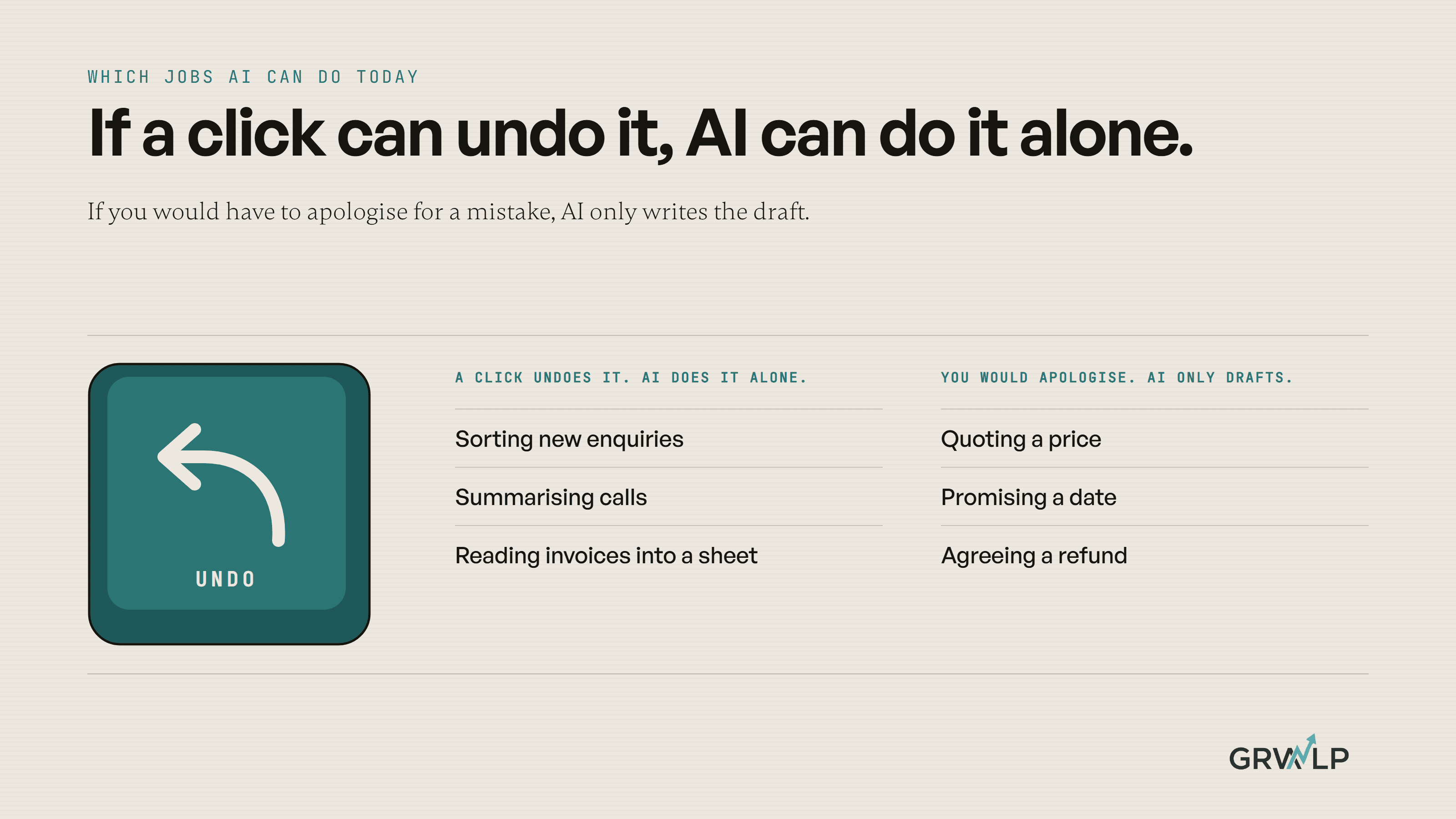
With three questions, asked before any demo. Will you scope one workflow at a fixed price and a date? Will you build it in accounts in my name? Will you sign a written agreement on what you do with my customers' data? An agency that says yes to all three, in writing, is worth comparing on skill and price. One that will not is not, however good the demo looks.
The rest of this piece is what sits behind each question, with the prices and the law for both countries side by side. One interest to declare first: we build automations ourselves, from Lagos. The questions work just as well on anyone else.
How many small businesses are already using AI?
In the UK, a little over a quarter of the smallest businesses, and mostly lightly. The Office for National Statistics found that 28% of businesses with nine or fewer employees reported using at least one AI technology, in its survey of June 2026 with 38,637 businesses responding. Among businesses with ten or more staff the figure rose from around 12% in late 2023 to around 35%, and the ONS calls their adoption "relatively shallow": the average adopter among them uses about 1.6 AI technologies.
We found no Nigerian figure with a stated sample, so we will not print one. The point for a small business in either country is the same. You are not late, and your first project does not need to be large.
What should a first automation project look like?
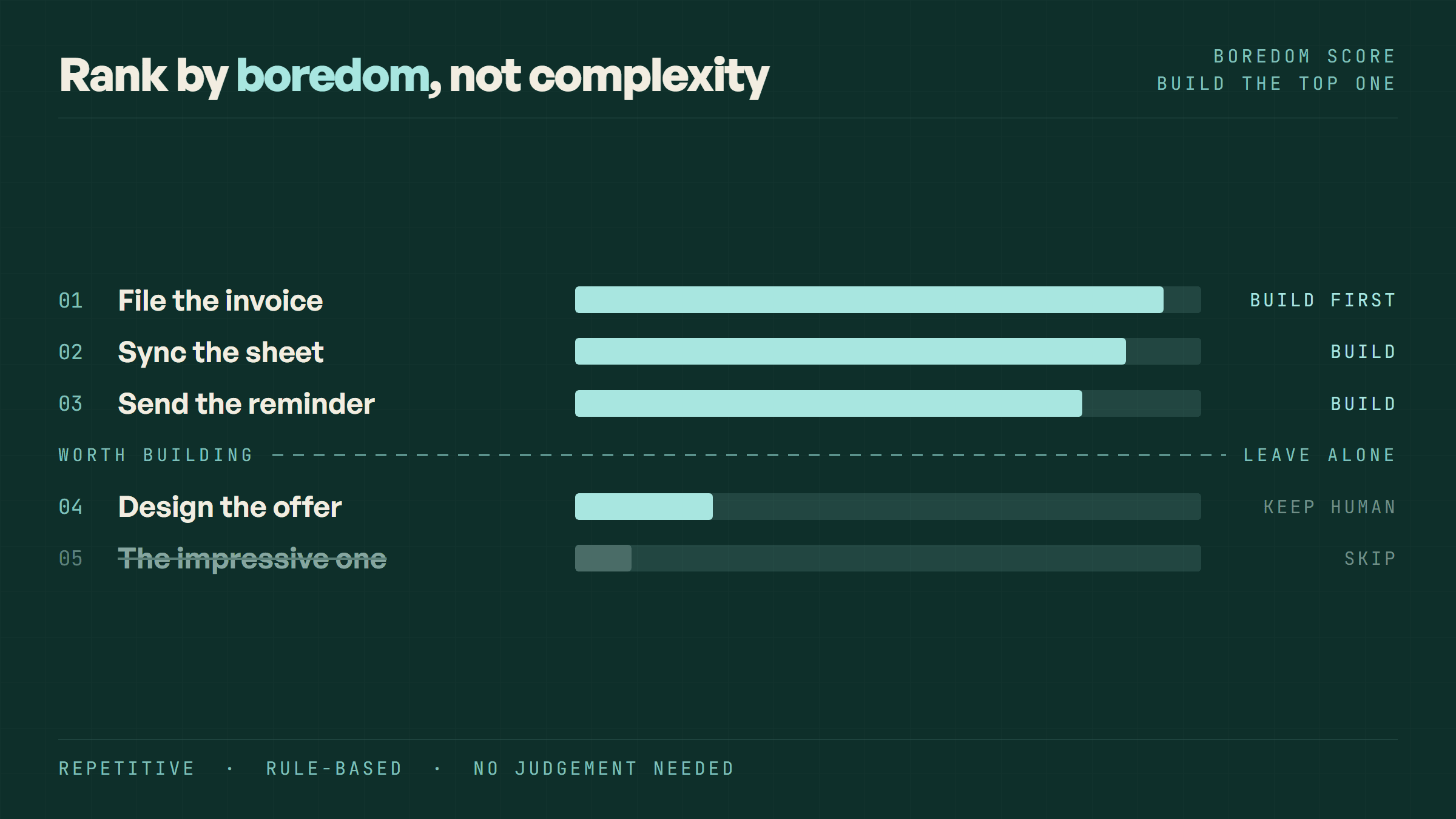
One workflow, the most boring one you have, built and tested before anything else is promised. Our piece on what to automate first covers how to pick it. Once picked, a good first project has five parts you can check:
A map before a price
Someone looks at how the work happens today before quoting. Our own AI and automation process spends a week on this and ends it with "a clear list of automation opportunities ranked by impact."
One fixed price and a date
Not a day rate with no end. A single number for a single workflow, and a week it goes live.
A test with your real data
You watch it run on your own enquiries or bookings before it is switched on for customers.
Documentation and a handover
Written steps for what it does, what breaks and who to call, so you are not tied to the person who built it.
A plan for when it fails
Automations can break when an app they depend on changes. Ask how you will find out, and whether you or a customer notices first.
What does a first automation cost in the UK and in Nigeria?
Published prices vary several times over in each country, so ask what is inside the number. These are prices the providers publish on their own sites:
Published prices for automation work, UK and Nigeria
| Provider | What it sells | Published price |
|---|---|---|
| HeyBRB, UK | A no code automation | £1,500 to £3,000 |
| HeyBRB, UK | An AI agent build | £5,000 to £10,000 and up |
| KlarifAi, UK | A custom build, 2 to 6 weeks | From £5,000 |
| Musskart, Nigeria | A WhatsApp chatbot build | ₦300,000 to ₦1,500,000 |
| Digital20, Nigeria | A package of six AI assistants | ₦200,000 a month |
| Growveloper, Lagos | One workflow, 1 to 4 weeks | One fixed quote after scoping |
In the UK, HeyBRB also sells a £499 assessment, and KlarifAi says most projects "take 2 to 6 weeks to build". In Nigeria, Musskart adds a monthly fee of ₦30,000 to ₦120,000 that "covers hosting, the AI usage, WhatsApp Business API messaging costs, monitoring and ongoing tweaks."
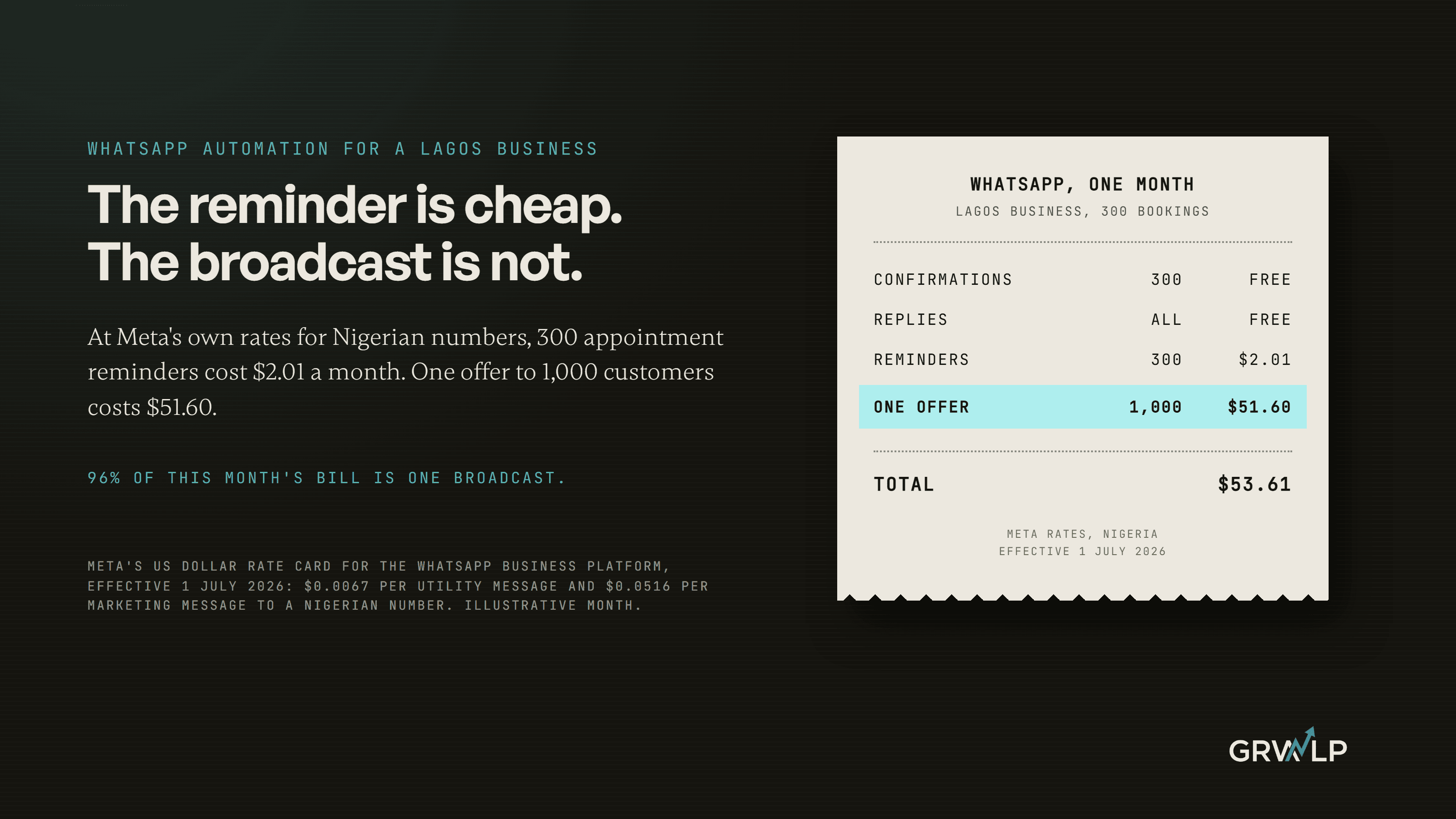
That last line is the one to copy into every quote you get: a monthly fee should come with a list. If WhatsApp is part of the build, our guide to what WhatsApp automation costs in Lagos works Meta's own message rates into a real month, so you can see how much of a monthly fee is the messages and how much is everything else.
Who owns the automation when the agency leaves?
You should, and it is decided on day one by whose name the accounts are in. An automation is usually several accounts joined together: a tool that runs the steps, an AI provider, your email or WhatsApp number, your CRM. If the agency opens them in its own name, the workflow leaves when the agency does.
Ask for every account in your name, with the agency invited as a user, and for the logins and documentation at handover. Our own page puts it plainly: "Either way, you own everything." When our work on RideOn Nigeria ended, the platform we built, six scheduled production jobs included, was handed over to the company in August 2026. That is how the end of an engagement should look: a handover, not a negotiation.
The same rule covers your website and your domain, which our piece on freelancers, agencies and studios sets out, and the choice between a tool like Zapier and custom code, which our Zapier or custom integration piece weighs.
What does the law say when an agency handles my customers' data?
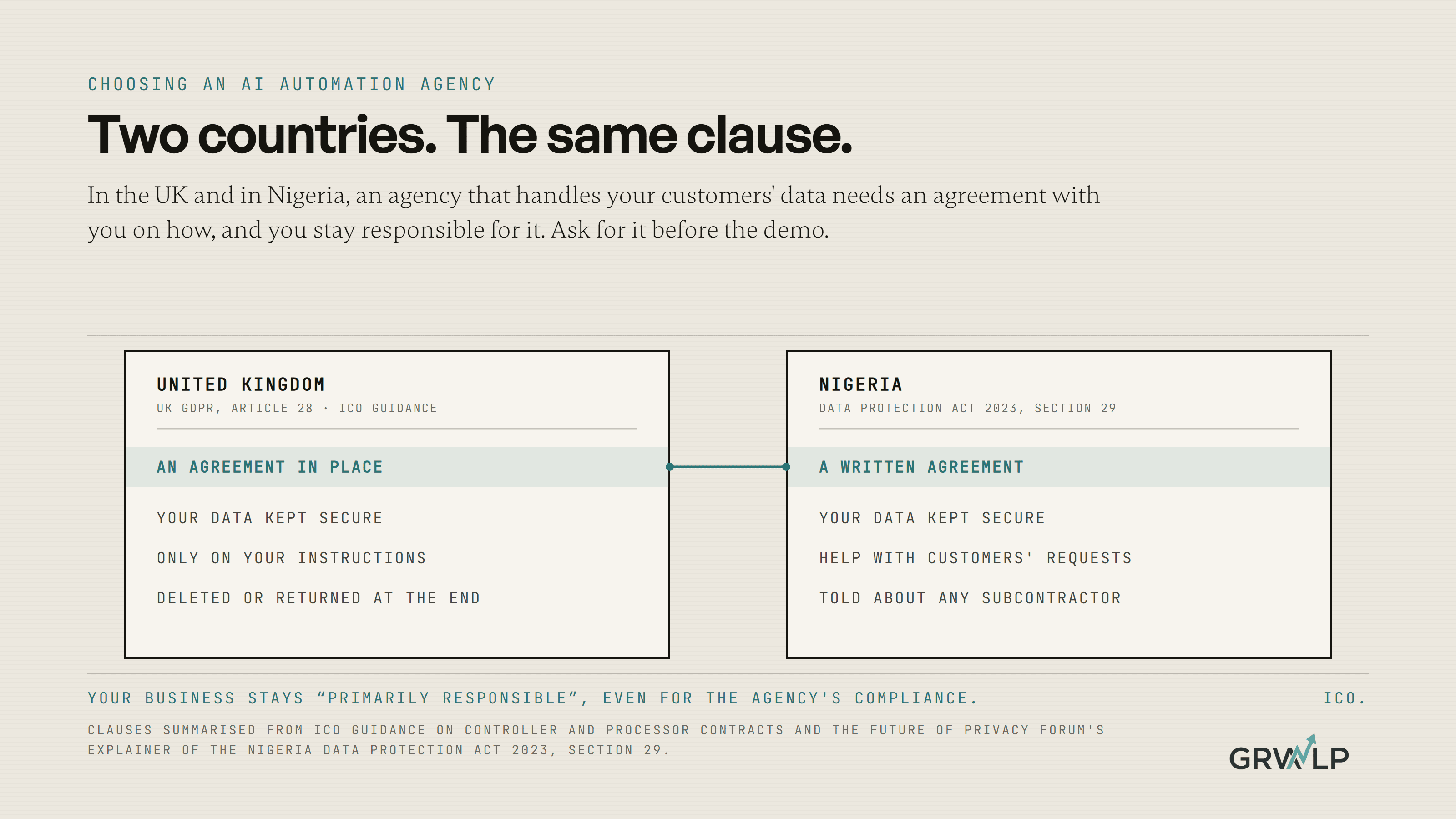
That you need a written agreement, and that you stay responsible. In data protection language your business is the controller, because it decides why customer data is used, and the agency is a processor, because it handles the data on your behalf.
In the UK, the Information Commissioner's Office lists what that contract must cover, from acting only on your documented instructions to deleting or returning the data when the contract ends. On who is responsible, it is blunt: "a controller is primarily responsible for its own compliance and ensuring the compliance of its processors." The ICO notes that this guidance is under review after the Data (Use and Access) Act, so check it again before you sign.
In Nigeria, the Data Protection Act 2023 says the same thing in its own words. As the Future of Privacy Forum's explainer sets out, section 29 requires a written agreement under which the processor helps you honour customers' rights, keeps the data secure, gives you the information to show you comply, and tells you when it brings in another processor. The Act is enforced by the Nigeria Data Protection Commission.
What the data agreement with an automation agency should cover
| Clause | United Kingdom | Nigeria |
|---|---|---|
| An agreement in place | A contract, required | A written agreement, required |
| Keeping your customers' data secure | Required | Required |
| Helping when a customer asks about their data | Required | Required |
| Bringing in another company | Rules on subcontractors | Must tell you |
| Showing they comply | Information and audits | Information to show compliance |
| What happens at the end | Delete or return the data | Ask for it in writing |
Will the agency use my customers' data to train AI?
Ask, and get the answer in the agreement. The ICO's innovation advice puts the line clearly: "If the AI solution provider processes personal data for any other reason than what they have been instructed to do, or where domestic law requires them to do so, then they will be a controller or joint-controller for this processing." In plain terms, an agency that reuses your customers' data for its own purposes stops being your supplier and becomes answerable for that data in its own right.
Our answer, on our own page: "We don't store client data on our servers or use it for training AI models." Whoever you hire, that is a sentence to ask for, word for word.
What are the warning signs when choosing an automation agency?
A return promised without a sample
A percentage of happy clients, with no number of clients behind it, is a sales line, not a result.
A monthly fee with no list
If nobody can tell you what the fee pays for, line by line, you cannot tell when you are overpaying.
Accounts in the agency's name
Convenient on day one. Expensive on the day you leave.
No answer on data
If the agency cannot say what it does with your customers' data, you cannot check it, and the law says that problem is yours.
If you want to test your own shortlist against these questions, including us, there is a free call.
The moment an agency logs in to your inbox, it is handling your customers. Choose it the way you would choose someone you hand your keys to.
“The moment an agency logs in to your inbox, it is handling your customers. Choose it the way you would choose someone you hand your keys to.”
Written by Oyekola Obajuwon