Marketing for roofing contractors: what actually works after a storm?
What works for a roofing company after a storm: the checks homeowners are told to run, the deductible laws, and what to prepare before hail.
TL;DR
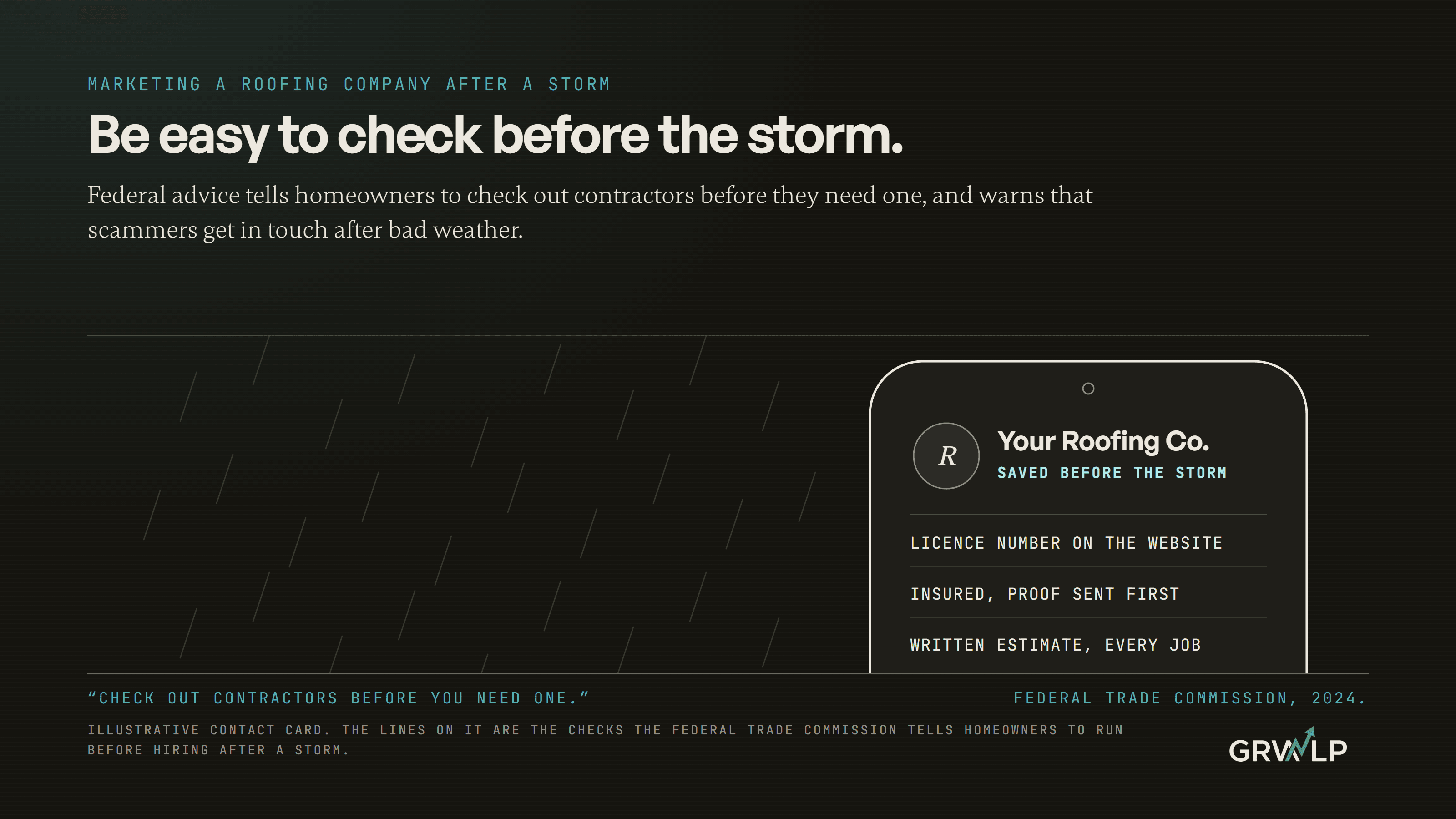
What works after a storm is what you did before it. The Federal Trade Commission tells homeowners to check out contractors before they need one. So be the roofer they can check: licence and insurance on your website, written estimates, fair payment terms, replies within minutes, and never an offer to cover the insurance deductible.
Last updated 2 October 2026. Written by Oyekola Obajuwon, founder of Growveloper, a growth studio in Lagos that builds the website, the marketing and the follow up for owner run businesses in the United States, the United Kingdom and Nigeria.
What works after a storm is what you did before it. The Federal Trade Commission tells homeowners to check out contractors before they need one. So be the roofer they can check: licence and insurance on your website, written estimates, fair payment terms, replies within minutes, and never an offer to cover the insurance deductible.
Ask a roofing marketing agency what works after a storm and you will hear about speed. Hail maps, ads switched on within hours, crews knocking on doors in the hit streets. We opened ten of the pages that rank for this question. Every one was written by an agency or a software company, and not one quoted the official advice the homeowner on the other side of the door has been given about you.
What do homeowners get told about roofers after a storm?
To be careful, mostly. The FTC's page on preparing for a weather emergency while avoiding scams, from May 2024, says that "after any weather event or natural disaster, it's common that unlicensed contractors and scammers may get in touch." It warns that they "often won't give you a written contract and will try to get you to pay in full, in advance."
Then it tells homeowners what to do, and the first line is the one that should change how you market: "Check out contractors before you need one." Find contractors who are licensed and insured, confirm the licence with the state or county, and, when it is time to hire, "ask the contractor for ID, proof of insurance, and references."
Read that as a roofer. The official advice is to choose you on a clear day and to doubt whoever turns up after the hail. Every item on the FTC's list is something your website can answer before the homeowner has to ask.
What homeowners are told to check, and where your answer should already be
| What the FTC tells homeowners | What your website and first reply should show |
|---|---|
| Check out contractors before you need one | A roofing page that is easy to find and save, with reviews |
| Confirm the licence with the state or county | Your licence number, written out, on every page |
| Ask for proof of insurance and references | A line saying you send both before any visit |
| Get a contract and all promises in writing | A written estimate, every time, before any work |
| Scammers want payment in full, in advance | Your payment terms in plain words, never all upfront |
| Anyone insisting on cash, gift cards or wire is a scammer | The ways customers can pay you, card included |
If you already do all six, the work is writing it down where a homeowner on their phone can see it. Our guide to turning phone searches into calls covers the tapping half of that page.
Can a roofer offer to pay the insurance deductible?
Not in Texas, Colorado or Minnesota, and not without saying so loudly in Florida. "We pay your deductible" is the oldest storm offer there is, on yard signs, door hangers and websites, and it is exactly what the law in those states names.
Texas puts it in section 27.02 of its Business and Commerce Code: a contractor expecting to be paid from an insurance claim may not advertise or promise to "pay, waive, absorb, or otherwise decline to charge or collect" the deductible. Breaking it is a Class B misdemeanour. Any contract of $1,000 or more that you expect insurance to pay must carry a printed notice, in at least 12 point bold type, that Texas law requires the homeowner to pay the deductible.
Colorado's roofing law says a roofing contractor paid from an insurance policy "shall not advertise or promise to pay, waive, or rebate all or part of any insurance deductible." Minnesota's says a residential contractor shall not "advertise or promise to pay, directly or indirectly, all or part of any applicable insurance deductible," and must hand the homeowner a written notice of those rules with its initial estimate.
Florida went further and then pulled back. In 2021 it banned roofing adverts that encourage homeowners to make an insurance claim, a federal judge halted that part on free speech grounds, and, as Insurance Journal reported in June 2022, the legislature replaced the ban with a rule: an advert that encourages a roof claim is prohibited if it lacks a disclaimer stating that the homeowner pays the deductible. Offering to waive the deductible became a third degree felony.
What four states say about the deductible in a roofer's marketing
| State | The rule | What it means for your marketing |
|---|---|---|
| Texas | No advertising or promising to pay, waive, absorb or rebate it | Insurance paid contracts of $1,000 or more carry the printed notice |
| Colorado | No advertising or promising to pay, waive or rebate any part of it | Take it off signs, flyers and pages |
| Minnesota | No advertising or promising to pay any part of it | Give the written notice with your first estimate |
| Florida | Waiving it is a felony; claim adverts need a disclaimer | Any "file a claim" advert says the homeowner pays the deductible |
This turns the usual storm advice upside down. The offer roofers copy from each other every hail season is, in these states, a breach of the law printed on a sign for anyone to photograph. Saying the opposite costs nothing: you pay your own deductible, it is the law, and a roofer who offers to cover it is telling you something about the rest of the job. That line belongs on your storm page. This is not legal advice, and other states have their own laws, so check yours before the season.
Does it matter whether the homeowner called you or you knocked?
For the contract, less than most roofers think. The FTC's Cooling-Off Rule covers a sale of $25 or more made at the buyer's home, "including those in response to or following an invitation by the buyer." So a contract signed at the kitchen table can usually be cancelled within three business days, whether you knocked or were invited, and under section 429.1 you must hand over a notice of cancellation and refund everything within ten business days if they use it.
The exception is narrow. It covers a genuine emergency where the homeowner started the contact, and only if they give you a separate, dated, signed statement in their own handwriting describing the emergency and waiving the right to cancel. It is written for the emergency itself, the hole in the roof with rain coming in, and a roofer who stretches it to cover a full replacement sold on the same visit is taking a risk with someone else's signature.
The United Kingdom draws the same line with a longer clock. Under the Consumer Contracts Regulations 2013, a homeowner can cancel a contract made away from your premises within 14 days. The exception in regulation 28 covers "contracts where the consumer has specifically requested a visit from the trader for the purpose of carrying out urgent repairs or maintenance", and only the urgent repair itself. Patch the leak they called you about, and the new roof you quote on the same visit still carries its 14 days.
For trust, who made the first contact matters a great deal. The FTC's warning is about the people who get in touch. Your marketing's job is to make sure that, when the storm passes, you are the number they ring, not the van in the street.
How fast do roofers have to answer after a storm?
Fast, but the numbers these pages repeat are not solid enough to plan around. One roofing marketing page we read says searches spike "300-800% within 48 hours" and that "the first contractor to reach a homeowner gets 70% of those jobs." Neither has a source, a sample or a date on the page, so neither is in this article.
The best number we could follow home is smaller and older. Service Direct, a company that sells leads to contractors, surveyed 559 US homeowners through SurveyMonkey in April 2022. In its published results, 35% said answering their first call mattered most when booking a contractor, 60% made a hiring decision within 72 hours, and 85% contacted three or fewer contractors. That was homeowners in general, not storm customers, and the company has an interest in the answer, but it is a survey with a stated sample. For most of the homeowners in it, a contractor was one of three names, with about three days to win the job.
So set up the reply before the season, not on the day. An automatic text within minutes, a person within the hour, and a record of every call you missed, which is the setup in our piece on how fast a home services company should reply to a new lead. To know where the hail actually fell, you do not need to buy a map first. The Storm Prediction Center of the National Oceanic and Atmospheric Administration publishes each day's tornado, wind and hail reports with locations and hail sizes, free, with the warning that "all reports are considered preliminary."
What should a roofer have ready before storm season?
Everything the homeowner will check, written down and live, so the storm only decides when they call.
A roofing page that answers the FTC's list
Your licence number, your insurance, a line saying you send proof of both and references before any visit, your payment terms, and how you write estimates. Put your service area on it, so the right streets find you. Our local SEO checklist for service businesses covers the Google side of being found.
Reviews that are already there
A homeowner checking you out on a clear day reads what your last customers said. Ask at the final walk around, when they are looking at a finished roof, using the setup in our piece on getting more Google reviews.
Paperwork that obeys your state
An estimate template with the deductible notice your state requires, and a cancellation notice for any contract signed at the home. Write it once, in the calm, instead of at a kitchen table with a queue of calls waiting.
Ads that screen the wrong jobs out
If you plan to run Google's Local Services ads, Google's screening page for roofers asks for general and professional liability insurance and a state licence where the law requires one, and the ads charge by the lead. Our guide for HVAC companies explains why the job types and service area you tick now cost money if they are wrong.
Should I hire a roofing marketing agency?
Hire one that asks about your licence, your paperwork and your reply speed before it talks about leads. Any agency that offers to put "we pay your deductible" on your adverts in Texas, Colorado or Minnesota has just told you what it knows about your trade.
We build this as one system for roofing contractors: the website a homeowner can check, the local search and ads through our growth marketing work, and the automatic replies. We should say what we have not done: we have not published a roofing build for a client, and nothing on this page claims one. If you want a second pair of eyes on your storm page or your estimate template before the season, there is a free call.
The storm decides the day the phone rings. Whose number the homeowner rings was settled before it, on a clear day, by whoever made themselves easy to check.
“The storm offer roofers copy from each other every hail season is, in three states, a breach of the law printed on a sign.”
Written by Oyekola Obajuwon