How much does it cost to maintain a small business website each month?
The two bills inside every maintenance price, what each line costs, and the question that tells you which end of the range you are on.
TL;DR
Most small business websites cost about $30 to $300 a month to keep running, depending on who you ask. That is two bills: fixed running costs like the domain and hosting, usually the smaller part, and someone's time for updates, security and changes. The more moving parts your site has, the bigger the second bill.
Last updated 20 October 2026. Written by Oyekola Obajuwon, founder of Growveloper, a growth studio that builds the website, the marketing and the follow up for owner run businesses in the United States, the United Kingdom and Nigeria.
Most small business websites cost about $30 to $300 a month to keep running, depending on who you ask. That is two bills: fixed running costs like the domain and hosting, usually the smaller part, and someone's time for updates, security and changes. The more moving parts your site has, the bigger the second bill.
So when two quotes for the same site come back with one ten times the other, they are rarely pricing the same thing. One is pricing the bills. The other is pricing a person. This page splits the two, shows what each line costs, and gives you the question that tells you which end of the range you belong at.
What does website maintenance actually include?
Two different things that get sold under one name.
The first is running costs: the domain, the hosting, the email, any paid plugins or software the site depends on. These are bills. They arrive whether anyone touches the site or not.
The second is someone's time: installing updates, checking backups work, fixing what breaks, watching for security problems, and making the small changes you ask for, a new price, a new photo, a new page. This is labour, and it is where most of a maintenance fee goes.
A plan that does not say which of these it covers is a plan you cannot compare.
How much does each part cost?
The running costs are small. The time is what moves the number.
What a small business website costs to keep running
| Line | Typical cost | How it is billed |
|---|---|---|
| Domain | $10 to $25 | Per year |
| Hosting or website builder | $5 to $75 | Per month |
| Plugins and extensions | $0 to $500 | Per year |
| Security and backups | $0 to $300 | Per month |
| Developer support | $50 to $150 | Per hour |
Taken together, WebsiteSetup's guide lands at $30 to $250 a month for a small business site, or $360 to $3,000 a year. The managed host WPX gives a similar answer on its own guide: "On average, you can expect to spend $50 to $300 per month on website maintenance for a small business." Both are companies that sell hosting or advice, so read them as published ranges, not a survey.
Look at where the money sits. Hosting can start at $5 a month and a domain costs $10 to $25 a year. A plan priced in the hundreds of dollars a month, then, is mostly paying for a person's hours.
Why do maintenance quotes vary so much?
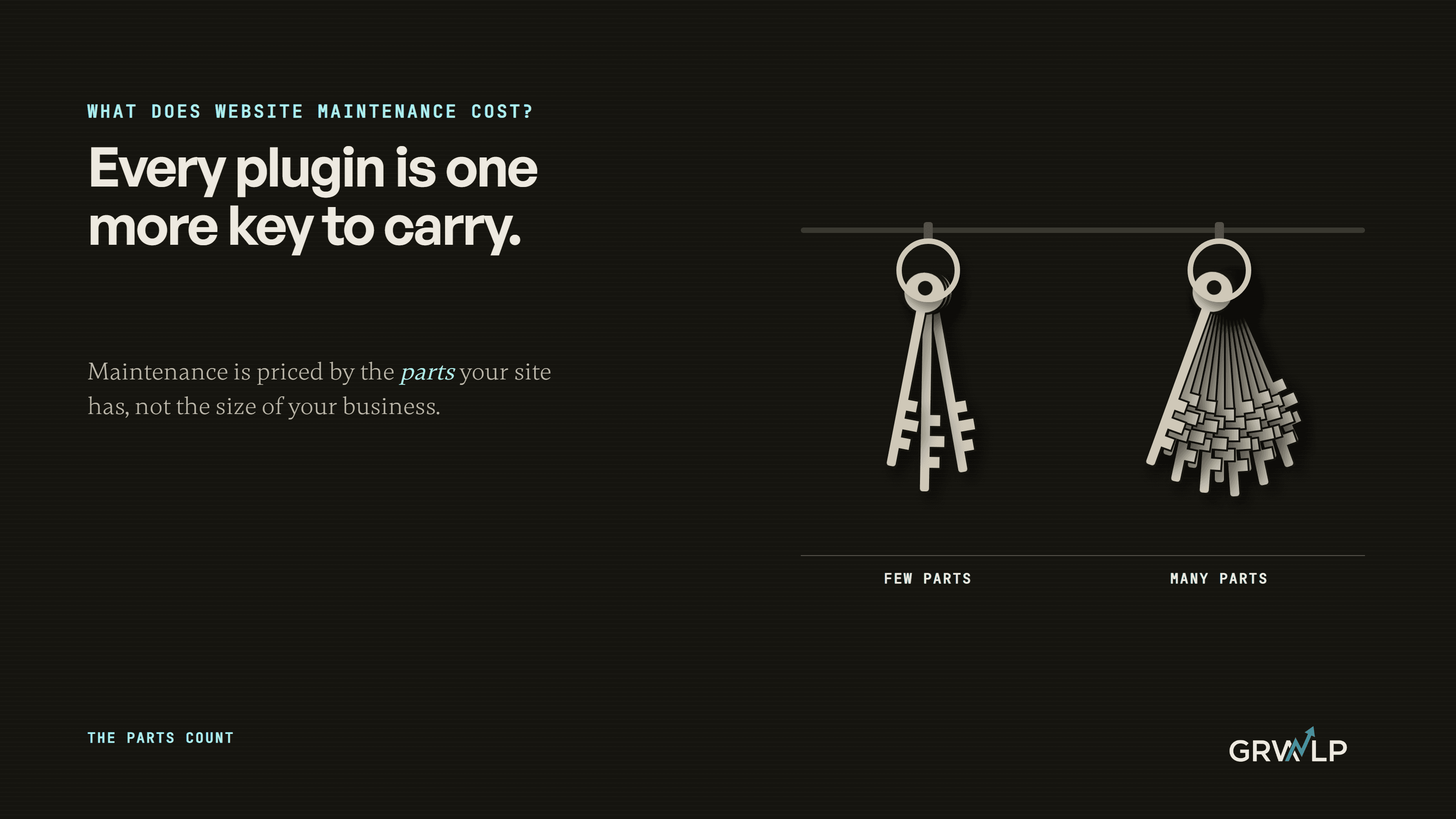
Because the number of moving parts varies. We call this the parts count: every plugin, theme, form tool, booking widget and connected app is one more thing that needs updating, and one more thing that can break when something else updates.
Security makes this concrete. Patchstack, a company that sells WordPress security, counted 11,334 new security holes in the WordPress world in 2025, a 42% rise on 2024, in its State of WordPress Security report. Its finding that matters for your bill: 91% of them were in plugins, not WordPress itself. And 46% had no fix from the plugin's developer by the time they were made public.
So a site with twenty plugins is twenty small doors someone has to keep checking. A site with three has three. That, more than the size of the business, is why one maintenance quote is ten times another.
Sites built on a builder like Wix or Squarespace move most of this onto the builder, which is why their maintenance is mostly the subscription. Sites built with fewer parts, the way we build on our web development page, have less to patch. Neither is free of upkeep. Something still has to watch the forms, the speed and the search listings.
Do I need a maintenance plan, or can I do it myself?
If you can make the small edits yourself and the site has few parts, you may only need the running costs and a person on call.
Here is the honest test. Over a normal month, what do you ask for? If the answer is a new price, a new photo and a changed opening time, you are paying a developer's hourly rate for jobs that should take you two minutes. Fix that first. A site you can edit yourself turns most of the second bill into your own five minutes; our guide to what a site you can edit yourself looks like shows what that means in practice.
When we rebuilt VIP Creative Studio's site off a single Wix landing page, the point was a site the team ran themselves. Their own words, on our development page: "Every headline, testimonial, and service description is editable from the CMS without touching code." A team that can do that is not paying anyone to change a headline.
What you should not do yourself, unless you know how, is the security side on a site with many plugins. Updates that clash can take a site down, and a site that goes down on a Friday evening loses the weekend's enquiries.
What should a website maintenance plan promise in writing?
Five things. If a plan will not put them on paper, it is a fee, not a plan.
What is included, by name
Updates, backups, security checks, uptime watching, and how many hours of changes a month. Small changes is not a number.
How fast they respond
A time, in hours, for when the site is down and for a normal request. Our own development page puts ours at 24 hours, in the same sentence as security patches and monitoring.
Where the backups live and when they were last tested
A backup nobody has restored is a hope. Ask when they last tested one.
Who holds the accounts
The domain, the hosting and the code should be in your name, with the maintainer added as a user. If the plan ends, you keep the site. Our guide to whether you own a website a developer built has the five logins to ask for.
What happens when you stop
How you get everything handed over, and how much notice either side gives.
You are not paying for the website to exist. You are paying for someone to be there when it breaks.
Is it different in the UK or Nigeria?
The structure is the same. Two things change on the invoice.
In the UK, check whether a quote includes VAT. The standard rate is 20% on GOV.UK. If your maintainer charges VAT and you cannot reclaim it, a price quoted before VAT is 20% higher on the invoice.
In Nigeria, many of the running costs, hosting, domains and software, are billed in dollars. When the naira moves, those lines move with it even if nothing about the site changed. Ask your maintainer which lines are in dollars and which in naira, and agree a review point rather than a surprise.
For what the site costs to build in the first place, see our guide to what a small business website costs. If yours feels slow and you suspect too many parts, our guide to making a website load faster is the place to start, and a free 30 minute call is enough to tell you which bill you are overpaying.
Count the parts before you compare the prices.
“You are not paying for the website to exist. You are paying for someone to be there when it breaks.”
Written by Oyekola Obajuwon
website maintenance cost · website maintenance plan · small business website · WordPress maintenance · website hosting cost · website retainer · website care plan