How much should a small business spend on marketing?
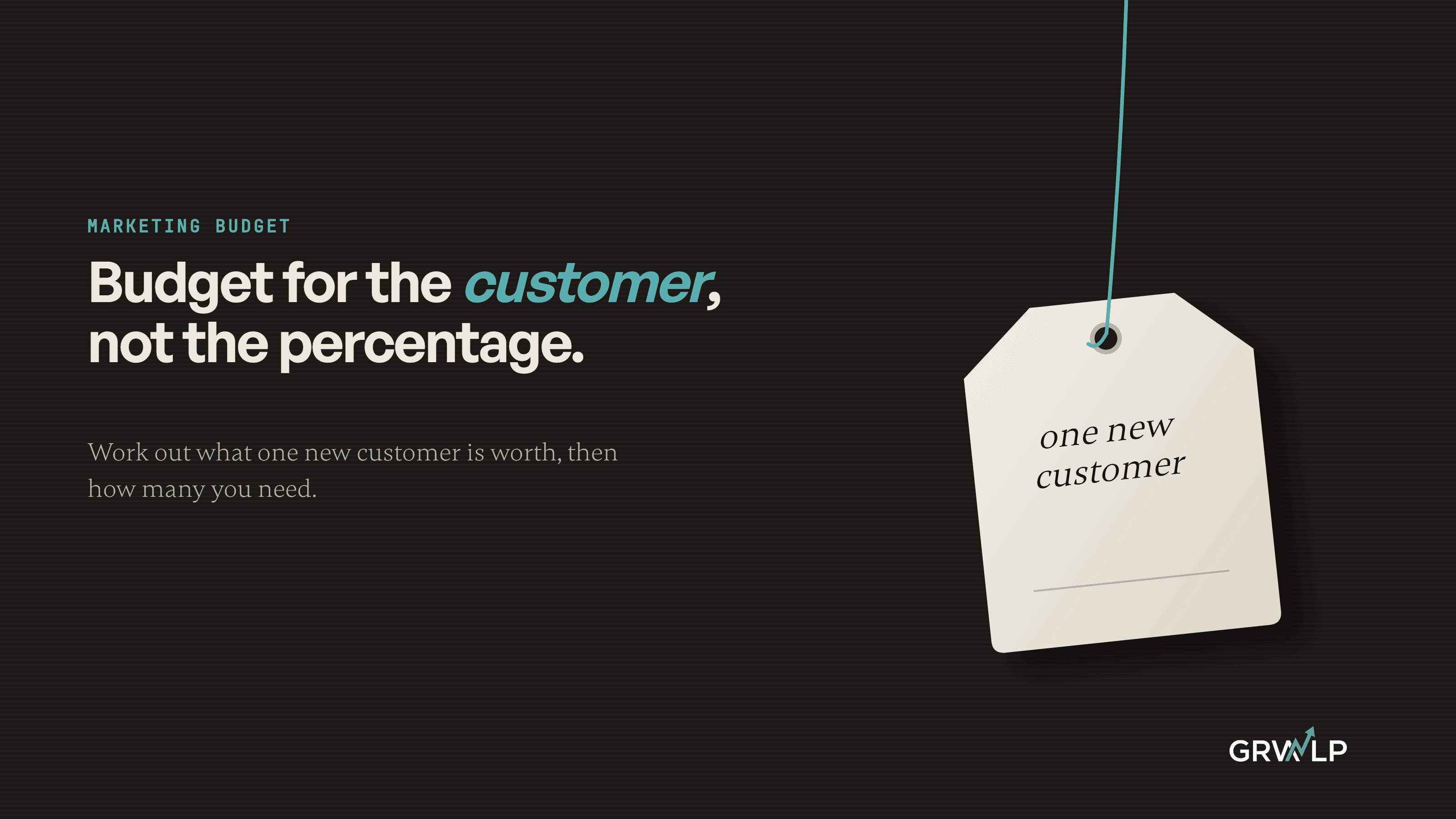
Set a marketing budget from what a new customer is worth and how many you need, then test it against the 7 to 8% rule.
TL;DR
Work it out from your customers, not your revenue. Decide what one new customer is worth, how much of that you will pay to win them, and how many you need a month, then multiply. For an established business that often lands near the 7 to 8% guides quote. For a new one it lands well above.
Last updated 28 October 2026. Written by Oyekola Obajuwon, founder of Growveloper, a growth studio that builds the website, the marketing and the follow up for owner run businesses in the United States, the United Kingdom and Nigeria.
Work it out from your customers, not your revenue. Decide what one new customer is worth, how much of that you will pay to win them, and how many you need a month, then multiply. For an established business that often lands near the 7 to 8% guides quote. For a new one it lands well above.
Ask ten websites this question and nine give you a percentage. The percentage is easy to quote and hard to argue with. It is also a description of other businesses, most of them bigger than yours.
What percentage of revenue should a small business spend on marketing?
The figure you will see most is 7 to 8% of revenue, usually credited to the US Small Business Administration. Read where it comes from before you use it. One widely read agency guide, HawkSEM's, puts it this way: "The U.S. Small Business Administration says typical marketing spending for profitable businesses making less than $5 million in sales annually is about 8% of the total revenue." The link on the agency's name goes to the SBA's general About page, which carries no percentage. I tried the SBA worksheet other guides point to and could not open it, so I will not put a number in the SBA's mouth.
The other figures have clearer homes, and each describes a particular kind of business:
A rule of thumb from a business bank
BDC, Canada's development bank for small firms, writes on its marketing budget page: "A common rule of thumb is that B2B companies should spend between 2 and 5% of their revenue on marketing." It puts businesses that sell to the public higher, at 5 to 10%. The same page reports a 2019 BDC survey of more than 1,400 Canadian businesses, where small business marketing costs averaged just over $30,000 a year.
What big companies spend
Gartner's 2026 survey of marketing leaders found 7.8% of company revenue going to marketing, as Marketing Dive reported in May 2026. Its 401 respondents were in North America, Europe and the UK, and most worked for organisations with annual revenue over $1 billion. That is a useful number for a bank. It tells a salon very little.
Why is a percentage of revenue the wrong place to start?
Because revenue is what marketing produces, so a percentage of it runs backwards. A busy business with a full diary gets its biggest budget in the months it needs customers least. A new business taking $4,000 a month gets about $280 at 7%, which might buy one new customer. A percentage of revenue gives the most money to the business that needs it least, and the least to the one just starting.
A percentage still has a job. Once you have a number from your customers, set it against your revenue as a sense check. If your budget comes out at 25% of takings for an established business, something in your sums, or your prices, needs a second look.
How do I work out my marketing budget from my customers?
Three questions, answered in order, and a calculator. You can do this on the back of an invoice.
What is one new customer worth to me?
Take what a typical customer spends with you over the time they usually stay, then keep only the part left after the direct costs of serving them: wages for the job, materials, the card fees. That leftover is what a new customer is worth. A one off job and a regular customer give very different answers, which is why a single percentage cannot cover both.
How much of that will I pay to win one?
My starting point is no more than a quarter of what the customer is worth. That leaves room for the months when marketing costs more than planned, and for the rent. It is a judgement, not a law: a business with high repeat rates can pay more; a business that sells once can pay less.
How many new customers do I need each month?
Count the customers you lose in a typical month, then add the growth you want. If you lose four a month and want two more, you need six. Multiply that by the price from the step before. That is your monthly budget.
Three ways to set a marketing budget
| Method | When it works | Where it breaks |
|---|---|---|
| A percentage of revenue | An established business checking its sums | A new business, or a full diary |
| What a customer is worth | Any business that knows its numbers | When you have no idea what a customer spends |
| What the channel needs | Paid ads with a learning period | Below the minimum, the channel never learns |
What does the arithmetic look like for a real kind of business?
Say a regular cleaning customer pays $120 a visit, twice a month, and the average one stays a year. That is $2,880 in sales. If 30% is left after wages and supplies, the customer is worth $864 to you. A quarter of that is $216, the most you would pay to win one.
You lose four customers a month and want to grow by two, so you need six. Six times $216 is $1,296 a month. If the business takes $18,000 a month, that is 7.2% of revenue: close to the rule everyone quotes, arrived at for a reason you can defend.
Now run the same business in its first year, taking $4,000 a month. The 7% rule says $280, about one customer a month, while the business is losing customers to people who have never heard of it. The method from the customer says it still needs six, so it needs about $1,296. If that money is not there, the honest answer is to cut the number of customers you aim for, not to pretend $280 will do the work of $1,296. A cleaning company's website that turns more visitors into bookings lowers the price of each customer, which is the other way to make the sum work.
Is there a minimum marketing budget that works?
For paid online advertising, yes. On the same BDC page, its adviser Jessica Horvath says to "plan for a minimum $1,000-a-month investment to be effective". Below a certain spend, the ad platforms never collect enough results to learn who to show your ads to. I worked through that floor for Google and Meta in naira in where a Lagos startup's first marketing budget should go.
Below that floor, the money works harder elsewhere: a complete Google Business Profile, more Google reviews, and a website that turns the visitors you already get into enquiries. Those cost your time more than your cash.
What should a marketing budget include?
Everything you pay to win a customer: ad spend, an agency or freelancer's fee, the tools, the website, and a fair price for your own hours. BDC's figures count website spending alongside online marketing, which is the right instinct. An owner who counts only ad spend will always think marketing is cheaper than it is.
If you are weighing an outside team against a hire, I set the full employer cost against a studio retainer in what a growth studio costs compared with an in house marketer.
What does this look like on a real account?
When I ran a credit union's Meta and Google ads at VIP Creative Studio, the spend was over $16,000 a month, an account I inherited and turned round. Each campaign brought in over 200 conversions, month over month. At that size, the share of the credit union's income tells you nothing about whether to spend the next dollar. Whether each result is worth more than it costs does, and that is the same question a cleaning company asks about its $216.
Should I spend more on marketing when sales are slow?
Only if fewer people are asking. If enquiries are steady and sales are slow, more marketing buys more enquiries that do not turn into customers; fix the reply and the follow up first. I set out how to tell which part has stopped in my business has stopped growing.
If you want someone to run these numbers with you, that is the work I do in growth marketing. The offer is a free 30-minute call, no pitch, and 20% off if we build, booked at cal.com/growveloper/30.
Spend what a customer is worth to win the customers you need. The percentage can be the check, never the plan.
“A percentage of revenue gives the most money to the business that needs it least, and the least to the one just starting.”
Written by Oyekola Obajuwon
small business marketing budget · how much to spend on marketing · marketing budget percentage of revenue · customer acquisition cost · marketing spend · owner run business