Where should a small business start with email marketing?
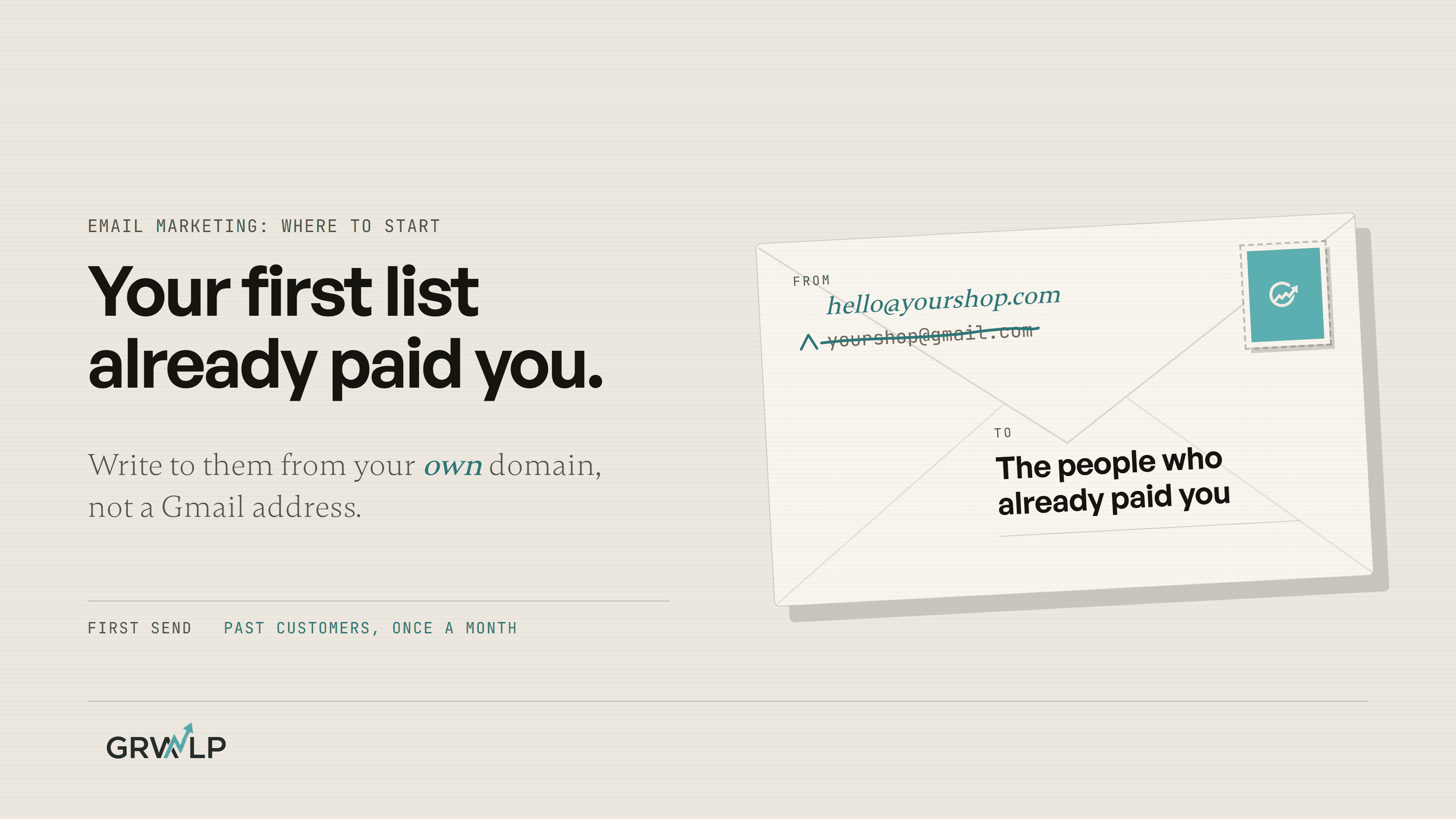
Start with customers who already paid you, sent from your own domain, one plain email a month. The tools and sequences can wait.
TL;DR
Start with the people who already bought from you, not a tool or a bought list. Send from an address on your own domain, because a Gmail or Yahoo address fails the inbox checks once an email tool sends it. Write one plain email a month with an unsubscribe link, and add a welcome email when strangers start signing up.
Last updated 6 November 2026. Written by Oyekola Obajuwon, founder of Growveloper, a growth studio that builds the website, the marketing and the automation for owner run businesses in the United States, the United Kingdom and Nigeria. He has worked on email lifecycle marketing for two years.
Start with the people who already bought from you, not a tool or a bought list. Send from an address on your own domain, because a Gmail or Yahoo address fails the inbox checks once an email tool sends it. Write one plain email a month with an unsubscribe link, and add a welcome email when strangers start signing up.
Most guides start with the tool. I would start with the list you already have and the address you send from, because those two decide whether anything you write lands in an inbox at all.
Who should a small business email first?
Your past customers. They know your name, they have already paid you once, and their addresses are already sitting in your inbox, your invoicing tool and your booking app. Your first email list is already in your sent folder. It is the people who paid you.
Pull those addresses into one spreadsheet: name, email, what they bought, and when. Add anyone who asked for a quote and gave you their email. Leave out anyone you only met at an event, people whose card you were handed, and anyone you found online. Those are strangers, and the rules for strangers are stricter.
A short list of people who know you beats a long list of people who do not. The people who know you open, reply and book. Strangers press the spam button, and that button is what the inbox providers count.
Am I allowed to email my past customers?
Usually yes, if you give them a way out on every email. The details change by country.
In the United States
The CAN-SPAM Act runs on opt-out, not opt-in. The Federal Trade Commission's compliance guide says a marketing email must carry your valid physical postal address and a clear explanation of how to opt out, and that you must honour an opt-out within 10 business days. It sets what the email must carry and how fast you stop, not a consent step before the first one.
In the United Kingdom
The rule is stricter. Marketing email to individuals needs their consent, under regulation 22 of the Privacy and Electronic Communications Regulations, with one exception that fits past customers exactly. You may email them without asking again if you got their address "in the course of the sale or negotiations for the sale of a product or service to that recipient", you only market similar products and services, and you gave them a simple, free way to say no when you took the address and in every email since. That last condition is the one small firms miss. If the checkout or the quote form never offered a way out, fix the form before you send.
In Nigeria
The Nigeria Data Protection Act 2023 gives every person the right to object to direct marketing at any time, in section 36, and the next line leaves no room: "Where the data subject objects to processing for direct marketing purposes, the personal data shall no longer be processed for such purposes." In practice, an unsubscribe link that works, and a reply asking to stop treated the same way.
If your email is a reminder for a booking someone already made, that is a service message, not marketing, and the line between the two is in how to get repeat bookings from past customers.
Should I buy an email list to get started?
No. Yahoo's own sender guidance says it in one line: "Don't purchase mailing lists or subscribe users by having an opt-in checkbox automatically checked on your website." Google's sender guidelines say the same thing more politely: "If you manage mailing lists or other email subscriptions, you should send email only to people who want to get messages from you."
A bought list is people who never heard of you. Some of them will press report spam, and a few reports are enough to send the rest of your email to junk, including the emails to the customers who wanted them.
What email address should I send marketing emails from?
From an address on your own domain, like hello@yourbusiness.com. Not yourbusiness@gmail.com.
This is the one that catches small businesses, and none of the getting started guides I read this week mentions it. When an email tool sends a message that says it is from a gmail.com address, the message comes from the tool's servers, not Google's. The receiving inbox checks whether the sending domain matches the from address. It does not match, so the check, called DMARC, fails. Mailchimp's help page on free email addresses explains that free email domains often tell inboxes to reject mail that fails, and says plainly that "we strongly recommend you switch to an email address from a private domain, like the one you use for work or for your website." MailerLite's help page gives the same advice. Google's own guidelines tell senders not to pose as a Gmail address, and say Gmail will begin using a DMARC quarantine policy.
So the first purchase in email marketing is not a tool. It is a domain and a mailbox on it, if you do not already have one. Your email tool will then walk you through a few DNS records that prove the mail is yours.
What do Gmail and Yahoo require from a small business sender?
Less than the scary articles say, but not nothing. Both companies split their rules into what every sender must do and what bulk senders must add. Google draws the bulk line at more than 5,000 messages a day to Gmail accounts, and most small businesses will never get near it.
What Gmail and Yahoo ask of a sender
| Requirement | Every sender | Bulk senders add |
|---|---|---|
| Prove the mail is yours | SPF or DKIM | SPF and DKIM, plus DMARC |
| Spam reports | Below 0.3% | Below 0.3% |
| Unsubscribe | Easy to find | One click, and a visible link |
| From address | Not posing as Gmail (Google) | Matches the domain you sign with |
Yahoo adds that bulk senders must honour an unsubscribe within two days. A good email tool handles the unsubscribe headers and gives you the records for SPF, DKIM and DMARC; your job is to add them to your domain and send to people who want the mail.
The number to remember is the spam line. 0.3% is three reports for every 1,000 emails. On a small list it is closer than it sounds: send one email to 300 people, have one of them press report spam, and that send ran at 0.33%. That is why the list of people who know you comes first.
Which email marketing tool should a small business start with?
Any tool that lets you verify your own domain, adds the unsubscribe link and headers for you, and has a plan you can start on for little or nothing. Mailchimp, MailerLite and Brevo all fit that description for a first list, and Brevo's pricing page offers a free plan. Prices and limits change often, so check the plan page the day you sign up.
Do not pick on templates. You will use one plain layout for months. Pick on whether it sets up your domain properly and whether you can move your list out if you leave.
What should the first email say?
One thing, written the way you would write to one customer. No banner, no four column layout, no issue number. Something like this:
A first email you can copy
Subject: A quick note from [your name] at [business]. Body: Hi [first name], you had [the job] done with us in [month]. I am starting a short monthly email with one useful thing for people like you, this month [the tip]. If you would rather not get it, the unsubscribe link is at the bottom, no hard feelings. [Your name].
That email does three jobs. It reminds them who you are, it gives them a reason to open the next one, and it offers the way out the UK rule asks for. Replies to it are the best sign you will get in the first month.
How often should a small business send marketing emails?
Once a month, at first. It is a promise you can keep, and keeping it matters more than the number. Yahoo's guidance names the mistake that breaks lists: "Don't start sending daily emails to subscribers of your weekly or monthly mailing." Tell people how often to expect you when they sign up, then send exactly that.
Move to every two weeks when you have more to say than one email holds, not because a guide said weekly performs better.
When does a small business need automated emails?
When strangers start signing up, add a welcome email that sends itself the moment someone joins. When enquiries arrive faster than you can follow up by hand, add a short follow-up sequence, which is what automating lead follow-up covers.
Nurture emails only have something to work with once there is a website collecting addresses and tracking showing who came back. When I worked with Baye Business Solutions, an IT company in Lagos, the Zoho nurture automation sat on top of a rebuilt website and analytics set up from zero, not in place of them. I am not going to give you open rates from that work, because they were never the point. The point is the order: somewhere for an address to land, a way to see what happened next, and then the emails.
If the addresses live in three places, put them in one shared record first; what a CRM is for a five person business explains how small that can start.
How do I know if my email marketing is working?
Count replies, bookings and sales that came from an email, not opens. An open tells you a mail app loaded the message; a reply tells you a person read it. Put the one number that matters next to your other channels in the monthly report you read, and give it three months before you judge it.
What should I do this week?
Buy or confirm your domain and set up a mailbox on it. Pull your past customers into one spreadsheet. Pick a tool and add the records it asks for. Write the first email above and send it to the people who paid you.
If you want help joining email to the website and the follow-up, that is part of my marketing work and the automation side: a free 30-minute call, no pitch, and 20% off if we build, booked at cal.com/growveloper/30.
The list you need is already in your sent folder. Write to it like you would write to one of them.
“Your first email list is already in your sent folder. It is the people who paid you.”
Written by Oyekola Obajuwon
email marketing small business · first email campaign · email list · Gmail Yahoo sender requirements · own domain email · soft opt-in UK · CAN-SPAM · NDPA direct marketing