How do I get repeat bookings from past customers?
When to ask for the next booking, how often to remind past customers, what to say, and when a reminder legally counts as marketing.
TL;DR
Ask for the next booking before the customer leaves, then remind everyone else when the job is naturally due again: a check up, an annual service, the gap between their last two visits. Keep a reminder for a booked appointment factual. A message asking someone to book again is usually marketing under UK and US rules.
Last updated 26 October 2026. Written by Oyekola Obajuwon, founder of Growveloper, a growth studio that builds the website, the marketing and the follow up for owner run businesses in the United States, the United Kingdom and Nigeria.
Ask for the next booking before the customer leaves, then remind everyone else when the job is naturally due again: a check up, an annual service, the gap between their last two visits. Keep a reminder for a booked appointment factual. A message asking someone to book again is usually marketing under UK and US rules.
A happy customer rarely needs persuading to come back. They need the next visit to be easier to book than to forget. That comes down to two moments: the end of this visit, and the day the next one is due.
When is the best time to get the next booking?
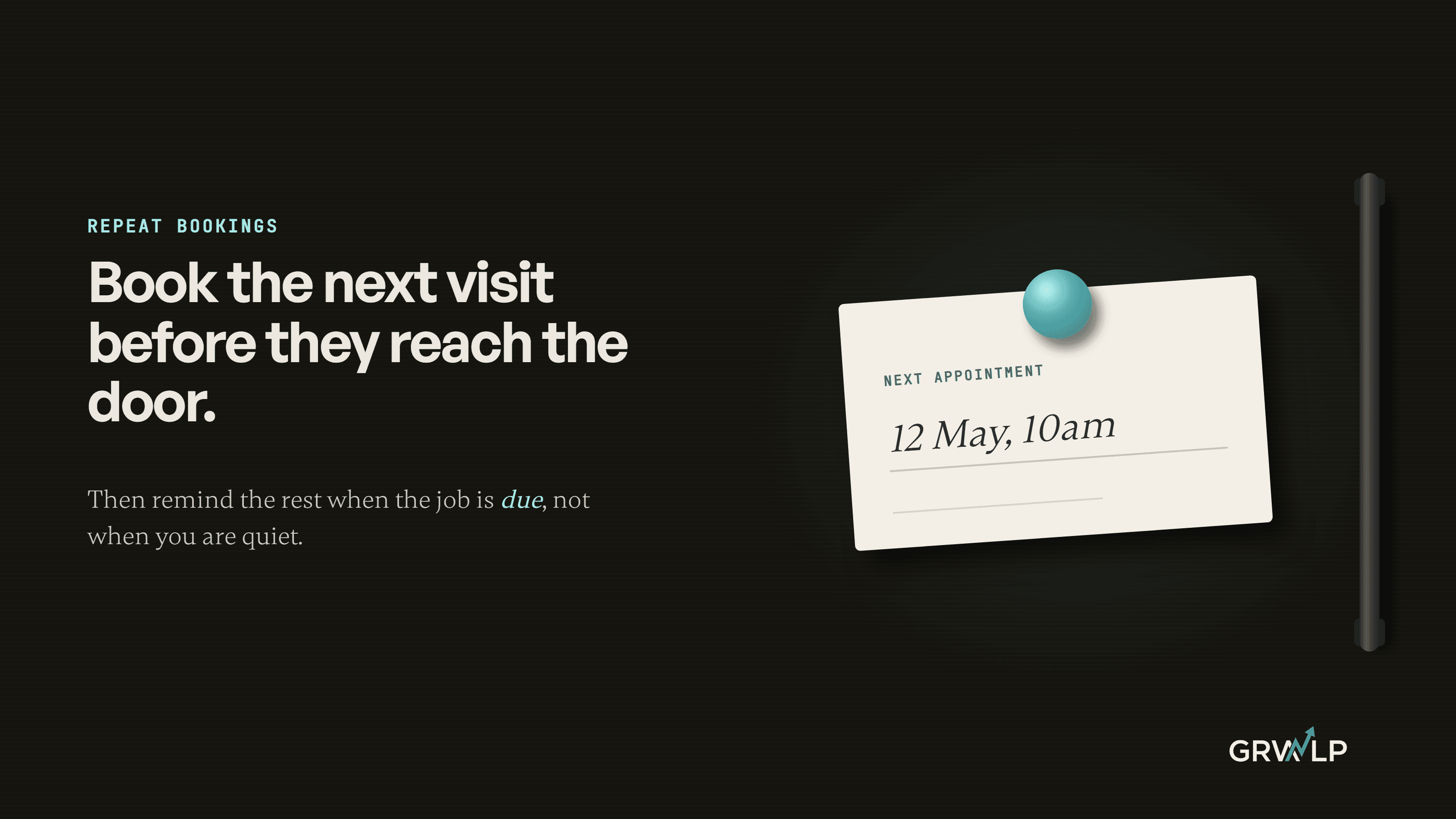
Before the customer leaves. They are standing in front of you, the result is fresh, and their diary is in their pocket. Offer a specific date rather than a vague see you soon: the same slot in six weeks, the same week next year. Put it in your booking system there and then, so the confirmation lands while they are still at the door.
A trade can do the same at a different scale. An engineer packing up after a boiler service can offer the same date next year; a cleaner can offer the next fortnight. Either answer is useful. A yes means there is nothing left to remind. A no tells you to remind them later, and roughly when.
How often should I remind past customers?
When the job is due again. That date is set by the job, not by your marketing calendar. The reminder should arrive when the job is due, not when you are quiet.
For some work, someone else has already set the clock.
Jobs where someone else sets the clock
| Job | When it comes round | Who sets it |
|---|---|---|
| Dental check up | Every 3 to 24 months for adults, set per patient | NICE guideline, England |
| Landlord gas safety check | Every year, on each appliance and flue | UK law |
| Car MOT | Each anniversary, once a car is over 3 years old | UK law |
| Cleaning, hair, training | The gap between the last two bookings | You, from your records |
NICE's guideline sets the longest interval between dental check ups for adults at 24 months and the shortest at three. GOV.UK tells tenants their landlord must have a registered engineer do an annual gas safety check on each appliance and flue. And the MOT rules put each test on the anniversary of the last one.
The UK government even runs the reminder itself. Its MOT reminder service sends free reminders by text or email. That is the whole system in one public service: a date that comes round, and a message before it does.
Where nobody sets the clock, your records do. Look at each regular customer's last two bookings. The gap between them is that customer's rhythm: five weeks for one, eight for another. A reminder a few days before the gap runs out lands just as they were about to think of it. It only works if every booking is written down in one place, which is why a clinic's booking page and a personal trainer's booking link matter more than they look.
What should a rebooking reminder say?
Three things: what is due, when you last did it, and one way to book. No newsletter, no menu of everything else you sell.
For a boiler service it can be as short as this: Hi Ada, it has been a year since I serviced your boiler. Shall I book the same week this year? Reply with a day that suits, or pick a time here. Then the booking link.
Send it from the number or address the customer already knows. And make sure it stops the moment they book. The same stop rule that keeps a paid customer from being chased for an invoice keeps a booked customer from being asked to book.
Is a rebooking reminder marketing?
Usually, yes, and that changes what you are allowed to send.
The UK's data regulator draws the line with an example a heating engineer will recognise. In the ICO's guidance for small organisations, a text saying "Our engineer will be round to service your central heating system at 10am on Tuesday" is a service message, and service messages do not count as direct marketing. Add "You can save money on your service by signing up to our Home Care plan" and the same text becomes marketing. The test is why you are sending it: "If you want to encourage a specific person to do something, such as buy a product or sign up to a campaign, it’s likely to be direct marketing."
So a reminder for an appointment already booked is a service message. A message asking someone to book again is asking them to buy, so treat it as marketing. Booking software files it the same way: Fresha's list of automated messages puts its Reminder to rebook under marketing message types.
In the UK you can still email or text past customers about similar services without asking again, under what the ICO calls the soft opt-in. Every condition has to hold: you got their details from them while selling to them, you only offer similar services, you gave them a way to opt out when you took the details, and every message after that offers one too.
In the US, the Federal Trade Commission's guide to the CAN-SPAM Act treats an email whose main purpose is to promote a product or service as commercial, and a commercial email has to explain clearly how to opt out. Its own example of a message that must comply is one sent to former customers announcing a new product line.
If you book customers on WhatsApp, the same split decides how your messages are classed. Meta's template categorization page describes utility templates as following up on something the customer did or asked for, and classes a template that mixes a utility update with a promotion as marketing.
One practical rule covers all three: keep the appointment reminder plain, offer the opt-out when you take the booking, and put an opt-out line on every message that asks them to book again.
Should I offer a discount to bring customers back?
Not by default. A reminder at the right moment does most of the work, and a habit of discounts risks teaching regulars to wait for the next one. Save offers for customers who have gone quiet well past their usual gap. And remember the ICO's heating engineer: the moment a reminder carries an offer, it is marketing in full.
How do I automate repeat booking reminders?
It is a date and a rule, nothing cleverer. Store the date each customer's next job is due, send a message a set number of days before it, and stop if they book. Some booking tools have it as a setting, such as Fresha's Reminder to rebook. The hard part is having one place where every booking lives; the sending is easy.
When I built the platform for RideOn Nigeria, one of its scheduled jobs ran every day and scanned the drivers' documents for the dates they expired. It worked because every document and its expiry date already sat in the platform. A rebooking reminder is the same job pointed at customers instead of drivers. It needs no AI either; as my piece on what AI can actually do argues, many jobs sold as AI are plain rules, and a rule does not improvise.
If your bookings are spread across WhatsApp, a paper diary and a spreadsheet, getting them into one place comes first. That is the kind of work I do for local service businesses and in AI and automation. The offer is a free 30-minute call, no pitch, and 20% off if we build, booked at cal.com/growveloper/30.
The best reminder is the one you never send, because the next visit was booked before they reached the door.
“The reminder should arrive when the job is due, not when you are quiet.”
Written by Oyekola Obajuwon
repeat bookings · repeat customers · rebooking reminders · customer retention · service business · appointment reminders · soft opt-in · local business