What does a growth engineer do in the first 30 days with a small business?
What a growth engineer should do in the first month with a small business, week by week, and how to check the month worked.
TL;DR
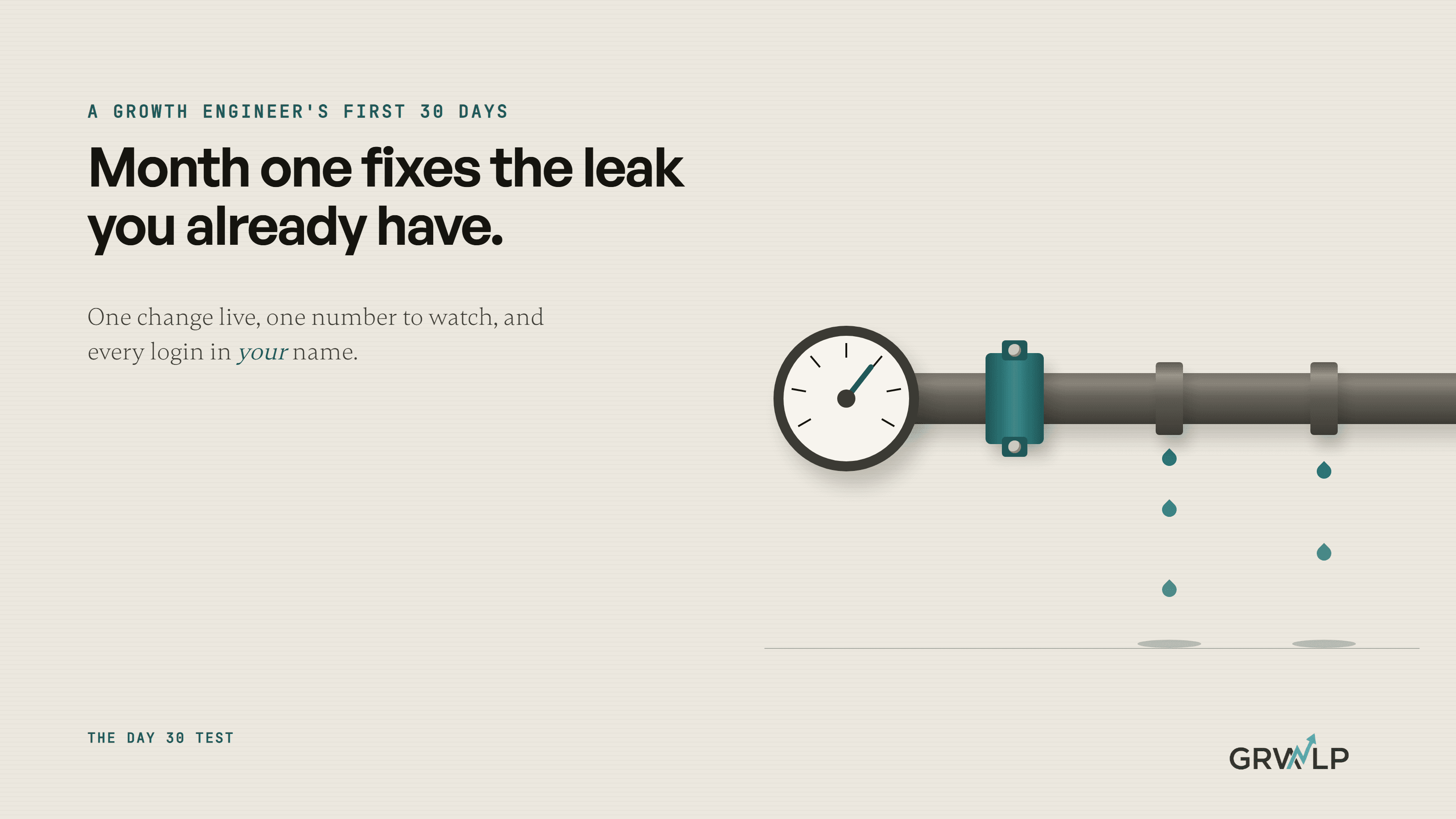
A growth engineer spends the first 30 days fixing what you already have before adding anything new. Week one: access in your name and a test enquiry from ad to reply. Weeks two and three: find the biggest leak and fix it. By day 30, one change should be live, measured and yours.
Last updated 22 October 2026. Written by Oyekola Obajuwon, founder of Growveloper, a growth studio that builds the website, the marketing and the follow up for owner run businesses in the United States, the United Kingdom and Nigeria.
A growth engineer spends the first 30 days fixing what you already have before adding anything new. Week one: access in your name and a test enquiry from ad to reply. Weeks two and three: find the biggest leak and fix it. By day 30, one change should be live, measured and yours.
Most answers to this question are written for someone else. Some are plans for a growth hire joining a funded software startup, with funnels, experiments and a team to report to. The rest are agency onboarding pages, where month one ends in a strategy document. If you run a business of five or fifty people and you have just hired one person or one studio to look after the website, the marketing and the follow up together, neither fits.
This is the month as it should look for you, and the test to run at the end of it.
What does a growth engineer actually do in the first month?
A growth engineer works on the whole path a customer takes: the ad or the search, the page, the form or the phone tap, the reply, and the record of who asked for what. Our guide to what growth engineering is covers the idea. The first month is where it shows.
A marketing agency starts with the campaigns. A developer starts with the site. A growth engineer starts by checking that the path between them works at all, because a new campaign that sends people down a broken path just buys more of the same loss. That is the whole reason to hire one studio instead of three agencies: somebody owns the joins.
So the month looks plain from the outside. Very little of it is new. Most of it is finding out what you already have, and fixing the worst of it.
What should happen in the first week?
Two things, and neither is exciting.
Access, in your name
Every account the work touches should be set up or confirmed in your name in week one: the domain, the hosting, the analytics, the ad accounts, the email and the customer list. The person working on them gets added as a user. Our web development page puts our own version plainly: "You get full access to your CMS, your code, and your analytics on day one."
This sounds like admin. It is the thing that decides whether you can ever leave. Our guide to owning your website when a developer built it goes through each login.
A test enquiry, from ad to reply
Then the growth engineer should become a customer. Fill in your own form. Tap your own phone number on a mobile. Send your own WhatsApp message. Then watch what happens: does it arrive, who sees it, how long until someone answers, and does your analytics count it?
A test enquiry is the cheapest diagnostic there is, and it can find the biggest problem before the audit has really started. A form that sends to an inbox nobody reads, or a key event that never fires, is a leak no campaign can fix. Our guide to tracking enquiries in Google Analytics shows how to run it.
How is the first fix chosen?
By money lost, then by effort. Weeks one and two are an audit: what is broken, what is missing, what each one is costing. Our marketing page gives that audit one to two weeks, followed by a plan you approve: "Every recommendation is tied to a measurable goal. You review and approve before anything goes live." For automation, our AI and automation page gives the mapping step a week, and the list it produces is ranked by impact.
The first fix is the item at the top of that list that can go live inside the month. Sometimes it is small. Our Growth Audit page says why we always list a few quick fixes: "We include these in every audit because some problems don't need a project. They need 20 minutes." Sometimes it is a whole form and reply flow. Either way, it should be live by week three, which is when our marketing page has execution starting.
If you want the order of checks behind that audit, our guide to a website that does not produce leads walks through them.
What should I have after 30 days?
Here is the test. We call it the day 30 test: on day 30, you should be able to point at three things.
The day 30 test
| Point at | What it looks like | Warning sign |
|---|---|---|
| One live change | A fix you can see on your site or in your inbox | A plan, and nothing live |
| The number for it | A count that moves when it works | A report with no enquiry count |
| The login for it | Every account in your own name | Logins only the studio holds |
Add one more thing you should be holding: a ranked list of what comes next, with days 31 to 90 in order. Our audit ends with a 30-60-90 day roadmap for the same reason.
A good first month is easy to check. You can point at what changed.
The warning sign to take most seriously is the first one. A month of meetings that ends in a document can be fine at a big company. For a small business paying monthly, it is a month of fees with nothing working harder than it was.
What can't be judged in 30 days?
Some things genuinely take longer, and an honest first month says so out loud.
Search rankings
Google's own SEO starter guide is plain about it: "Some changes might take effect in a few hours, others could take several months." A month of search work should show the fixes going in, not the rankings coming out.
Ad changes
Google's help page on the learning period says a changed bid strategy usually settles within one to two conversion cycles, the time it takes a click to turn into a conversion such as an enquiry or a sale, and should then be judged over two conversion cycles or two weeks, whichever is longer. If your customers take three weeks to decide, a change made in week two cannot be judged inside the month. Meta's ad system has a learning phase of its own.
So the first month gives you first numbers, not verdicts. What it should give you is the measurement that makes the later verdicts trustworthy.
What does the owner have to do?
Three things, and the month slips without them.
Give access on day one, so week one is spent working instead of waiting for passwords. Give an hour a week, at the same time each week. When we built for VIP Creative Studio, the rhythm was simple: "We worked with the full team in weekly Tuesday meetings." And name one person who can say yes, because a fix that waits two weeks for approval misses the month.
What does this look like on a real build?
Baye Business Solutions is a cloud services company in Lagos with about 25 employees. The case study does not split the work into days, but it shows the order. The first line of the approach reads: "Started with a full audit. Documented every broken link, every missing page, every gap." The website came next, and the measurement, Google Analytics and Microsoft Clarity, went in alongside it rather than after.
That order is the point. Find out what you have, put the measurement in early, then build. A first month that runs in that order makes everything after it easier to judge.
If you are about to hire someone for this, ask for the day 30 test in writing before you sign, and if you want to talk it through, a free 30 minute call is enough. On day 30, you should be able to point at it.
“A good first month is easy to check. You can point at what changed.”
Written by Oyekola Obajuwon
growth engineer · first 30 days · growth engineering · small business marketing · onboarding a studio · website and marketing audit · lead follow up · what to expect