Are Meta ads worth it for a local service business?
When Facebook and Instagram ads pay for a local service business, when Google wins, what a lead costs, and the sum that decides it.
TL;DR
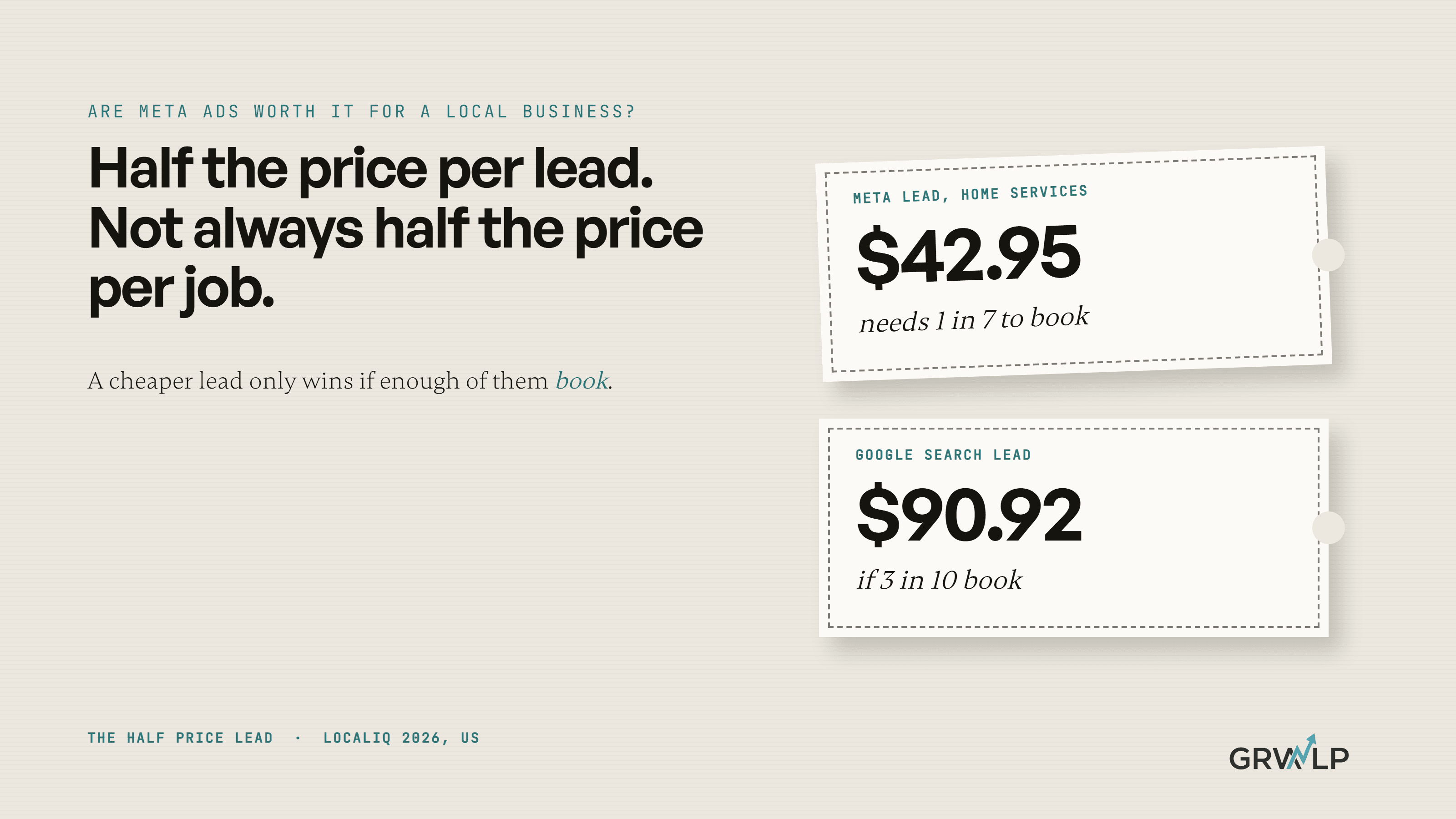
For planned jobs like cleaning, landscaping, beauty or fitness, often yes; for emergencies, rarely, because people search instead of scroll. LocaliQ's 2026 figures put a home services lead at $42.95 on Meta against $90.92 on Google search. A Meta lead at half the price only wins if at least half as many book.
Last updated 16 October 2026. Written by Oyekola Obajuwon, founder of Growveloper, a growth studio that builds the website, the marketing and the follow up for owner run businesses in the United States, the United Kingdom and Nigeria.
For planned jobs like cleaning, landscaping, beauty or fitness, often yes; for emergencies, rarely, because people search instead of scroll. LocaliQ's 2026 figures put a home services lead at $42.95 on Meta against $90.92 on Google search. A Meta lead at half the price only wins if at least half as many book.
That last sentence is the whole decision, and most pages selling Meta ads skip it. We call it the half price lead: a cheaper lead is only cheaper if enough of them turn into booked jobs. The rest of this page is which jobs Meta suits, what the leads cost, the sum with your own numbers, and what a small budget can still do.
Which local service businesses do Meta ads work for?
The ones people plan, not the ones people panic about.
Google shows your ad to someone who just typed plumber near me. Meta, which runs Facebook and Instagram, shows your ad to someone who was looking at their cousin's wedding photos. That is the whole difference, and it sorts local trades into two piles. Nobody scrolls Instagram looking for a plumber while water comes through the ceiling.
Which local jobs suit Meta ads, and which belong on Google search
| Kind of job | Meta worth testing? | Why |
|---|---|---|
| Emergencies: burst pipes, lockouts, no heat | Rarely | People search the moment it breaks |
| Planned and visual: cleaning, landscaping, remodelling | Yes | A photo sells it, booked days ahead |
| Recurring: fitness, lawn care, regular cleans | Yes | One customer pays many times |
| Personal: hair, nails, beauty | Test both | Meta leads cost more here, see below |
| Seasonal: servicing, roof checks before a storm season | In season | Reminds people before they need it |
If your phone rings because something broke, put the first money into Google search and your Google Business Profile, as our guide to Google Ads that actually convert explains. If people book you because they saw your work and thought they wanted the same, Meta is worth a test. Our local services page and the cleaning companies page show how the website side changes for each kind of trade.
How much does a Meta ads lead cost compared with Google?
Usually less per lead, and not always.
Cost per lead by trade, Meta lead ads against Google search, 2026
| Trade | Meta | Google search |
|---|---|---|
| Home and home improvement | $42.95 | $90.92 |
| Personal services | $38.09 | $54.60 |
| Health and fitness | $27.11 | $67.36 |
| Physicians and surgeons | $32.14 | $40.04 |
| Dentists | $61.56 | $72.97 |
| Beauty and personal care | $50.91 | $39.25 |
Both columns come from LocaliQ, which sells advertising, so read them as a rough guide rather than a price list. Its Facebook benchmarks put the average Meta lead across all industries at $27.39; its search benchmarks give the Google side. Neither page says how many campaigns the averages come from, and both are American. We found no UK or Nigerian figure with a stated sample.
Look at the last row. For beauty and personal care, a Meta lead costs about 30% more than a Google one in LocaliQ's figures. Every agency page that says Meta is the cheap option is talking about a different trade from yours, or not checking.
The half price lead: will cheaper Meta leads actually book?
Here is the sum. Take the Meta cost per lead and divide it by the Google cost per lead. Multiply the answer by the share of Google leads that book. That is the share of Meta leads that must book for Meta to cost the same per job.
For home services: $42.95 divided by $90.92 is about 0.47. If 3 in 10 of your Google leads book, which is a 30% Google booking rate in this worked example, your Meta leads need to book at 14.2%, about 1 in 7, to match. Book more than that and Meta is cheaper per job. Book fewer and the cheap leads cost you more.
That is not a trick question. Meta leads usually do book at a lower rate, because the person filled in a form between two videos rather than searching with a problem in front of them. The form fills itself; the diary does not. Jon Loomer, a long standing Meta ads practitioner, puts it plainly in his guide to Meta lead generation: "In some cases, a $50 cost per lead is a complete waste of money. In others, the average lead may be worth $250."
So count bookings, not leads. If a job is worth $300 to you and 1 in 5 Meta leads books, each booked job costs 5 leads, which is $214.75 at the home services price. That leaves room. If only 1 in 20 books, it does not. Our guide to what a monthly marketing report should contain shows how to put that one number at the top of the page.
Why are my Facebook leads bad?
Usually for one of three reasons, and the form is the first.
The form is too easy
Meta's lead ads let a person send their details without leaving Facebook or Instagram, often in a couple of taps. That is why the cost is low and why some leads do not remember you when you call. Add one question only a real customer can answer, such as their postcode or zip code, or the kind of job, and the bad leads drop with the cheap ones.
The targeting is wider than your service area
A lead from forty miles outside your area is not a lead. Set the location to the towns you actually serve and check it after every change.
The machine is finding form fillers, not customers
Brett McHale, quoted in LocaliQ's benchmarks, says of Meta's automated targeting: "You will likely see better metrics in your Meta advertising reports with Advantage+, but who are you actually advertising to?" Meta learns to find whoever fills in your form. If you only tell it about forms, it gets very good at finding people who fill in forms. Tell it which leads became jobs, and judge it on those.
And the fourth reason, which is not Meta's: nobody called back. A lead that waits a day for a reply is a coupon for a job you may never get. Our guide to how fast a home services company should reply sets out what the studies with stated samples say.
How much should a local business spend on Meta ads?
Enough to learn something, and less than Meta's own delivery would like.
Jon Loomer's advice for lead campaigns is direct: "Your goal should always be to get 50 optimized events per ad set per week." At the home services price that is $2,147.50 a week for one ad set, more than $9,000 a month. Most local businesses will never spend that, and that is fine. It means Meta's delivery will keep adjusting for longer, and that you should judge results over a month of booked jobs, not a week of cost per lead. Our guide to what has to be true before any ad calls this the learning bill and works it for Google.
What a small budget can still do: one campaign, one ad set, one area, one offer, a lead form with a qualifying question, and a person who calls every lead the same hour. Run it for four weeks. Then count the jobs. If the jobs cost less than they are worth, spend more. If not, the money goes to search, reviews and the website first.
In Nigeria, many owners run Meta ads that open a WhatsApp chat instead of a form, and pay in naira from a local card; our guide to a Lagos startup's first ad budget covers the payment side. The sum is the same. Count the chats that became jobs.
What did this look like on a real account?
When I ran paid media at VIP Creative Studio, one of its clients was a US credit union spending more than $16,000 a month across Google and Meta. What counted was what came out the other end, which for a credit union is an application, not a click or a form fill. The agency's founder described the change in the case study in his own words: "We moved from volume-driven tactics to an intentional, high-intent approach: better targeting, cleaner campaign structure, and a sharper focus on conversion quality."
A credit union is not a cleaning company. The lesson carries anyway. Meta will happily sell you volume. The account gets better the day you stop paying for volume and start counting the thing you actually wanted.
If you want a second opinion before you spend, our growth marketing service starts with exactly that sum, or book a free 30 minute call and bring your booking rate. Sometimes the answer is Google first.
Meta can fill your inbox. Only your booking rate can tell you whether it filled your diary.
“Nobody scrolls Instagram looking for a plumber while water comes through the ceiling.”
Written by Oyekola Obajuwon
Meta ads · Facebook ads · Instagram ads · local service business · lead ads · cost per lead · home services marketing