Should a service business show its prices on its website?
Should a service business show prices online? Which number fits which job, and the price rules in the UK, the US and Nigeria.
TL;DR
Yes, for most service businesses, if the number is honest. Show a fixed price for repeatable jobs, a starting price or a recent real job for variable ones, and a call-out fee and hourly rate for jobs you must see first. In the UK since April 2025, a consumer price must include any value added tax and every unavoidable charge.
Last updated 22 October 2026. Written by Oyekola Obajuwon, founder of Growveloper, a growth studio that builds the website, the marketing and the follow up for owner run businesses in the United States, the United Kingdom and Nigeria.
Yes, for most service businesses, if the number is honest. Show a fixed price for repeatable jobs, a starting price or a recent real job for variable ones, and a call-out fee and hourly rate for jobs you must see first. In the UK since April 2025, a consumer price must include any value added tax and every unavoidable charge.
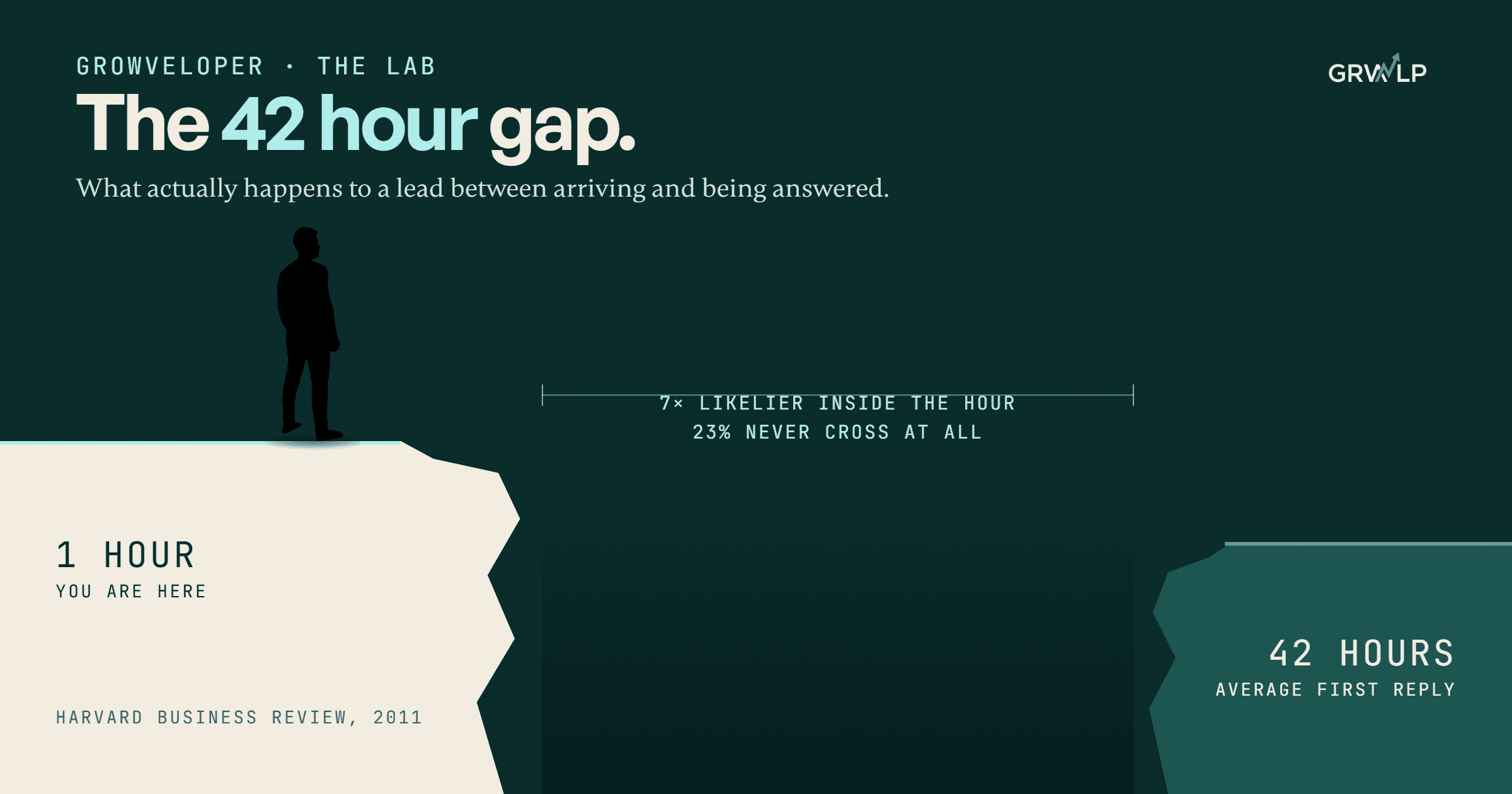
In August 2026 a UK researcher checked 200 small business websites, twenty in each of ten trades, for one thing: a number. Nineteen of the twenty photographers showed a price. Not one of the twenty plumbers did.
Most pages that answer this question are written by agencies and software companies, and they end on it depends. This one gives a verdict, the kind of number to show for each kind of job, and the rules that now decide what that number has to include.
Should a service business put prices on its website?
Yes, in most cases. A buyer early in the search is not looking for your final quote. They are cutting a list of five businesses down to two, and a page with no number gives them nothing to cut with.
Jakob Nielsen made this point back in 2006, in Show Prices for Common Scenarios for the Nielsen Norman Group. At the shortlist stage a shopper needs only a general idea of cost, and the site's job is to survive the cut. His fix for work that varies was sample prices for typical orders, down to a gardening service showing prices for a few common lot sizes.
The question also gets answered without you now. The UK study behind those plumbers puts it bluntly: "If your site carries no numbers, the answer comes from national averages, directories and whichever competitor did publish." As the study goes on to say, a customer who asks an AI assistant what a boiler service costs and then rings you arrives with somebody else's number in their head.
A price will filter some people out. They are the ones who would have said no anyway, only later, after a phone call or a site visit you paid for in time.
Which trades show their prices, and which hide them?
The only dated count we found is Whito's UK price transparency study. It checked 200 independent small business sites on 10 August 2026, taken from page one of local searches, with chains and directories left out. Any figure in pounds for the business's own work counted. Free quote did not.
UK small business websites showing any price, by trade
| Trade | Sites showing a price | Share |
|---|---|---|
| Photographers | 19 of 20 | 95% |
| Physiotherapists | 18 of 20 | 90% |
| Driving schools | 17 of 20 | 85% |
| Hair and beauty salons | 16 of 20 | 80% |
| Cleaning companies | 8 of 20 | 40% |
| Independent garages | 6 of 20 | 30% |
| Accountants | 5 of 20 | 25% |
| Electricians | 2 of 20 | 10% |
| Plumbers | 0 of 20 | 0% |
| Gardeners and landscapers | 0 of 20 | 0% |
Overall, 45.5% of the 200 businesses showed a price. Whito says its sample leans towards better marketed firms, so the true share is probably lower. It also sells research files rather than marketing, which is worth knowing when a study tells businesses what to publish.
It is tempting to read the table as hard jobs hide prices and easy jobs show them. Whito's reading is blunter: "The divide is not about the work. It is about habit." A hair colour changes from head to head too, and 16 of 20 salons still put a figure on the page.
Two more lines from the study stay with you. Fifteen of the 200 sites promised fixed or transparent pricing and showed no number at all. And a second check, on 2 October 2026, looked only for an emergency call-out price on 179 plumbers' sites across eight towns: 117 had none.
What price should I show if every job is different?
Pick the kind of number by the kind of job. Almost every service fits one of four rows.
Which number to show, by kind of job
| Kind of job | What to show | For example |
|---|---|---|
| The same job every time | The price | A physio session, a lesson |
| The same job in different sizes | A starting price and what moves it | A clean, by number of rooms |
| A job you have to see first | Call-out fee and hourly rate | A leak, a fault, a breakdown |
| Work built to order | Two or three recent real jobs | A rewire, a garden, a website |
The same job every time
If the job does not change, the price should not hide. A physio session or a driving lesson has one number, and that number belongs on the page.
The same job in different sizes
Show where the price starts and the one or two things that move it, such as rooms, square metres or hours. Our cleaning companies page lists pricing or price ranges among the things a cleaner's site should carry, beside the service area and the reviews, because the buyer wants a rough number for their size of job before they fill in a form.
A job you have to see first
You cannot price a leak you have not seen. You can price the visit. A call-out fee and an hourly rate, side by side, tell the customer exactly how the bill is built, and once you have seen the job the quote itself can go out fast. Our guide to automating quotes for a service business shows how.
Work built to order
When no two jobs look alike, show two or three real ones with their totals. Whito puts it well: "Real jobs with real numbers beat any pricing table for trust, and no competitor can copy them."
What does the law say about prices on a website?
This part changed recently, and none of the advice pages we read for this article mention it. We are not lawyers; what follows is what the regulators' own pages say, read on 22 October 2026.
In the UK
The UK's new consumer rules apply to practices from 6 April 2025. The Competition and Markets Authority's summary of its price guidance lists a page on your website as an invitation to purchase, and says: "In the invitation to purchase, you must give the customer the total price of the product."
Total means total. Value added tax (VAT) counts as a mandatory charge, and so does any fee the customer cannot avoid. A starting price is allowed, and the authority's own example is photography services from a stated amount, as long as it includes those charges and does not mislead. Where the total depends on the job, you must show what the customer needs to work it out, normally right next to the price. The fines reach 10% of turnover or £300,000, whichever is greater.
So a page for homeowners that shows an hourly rate plus VAT, or a call-out fee mentioned only on the phone, is exactly what the guidance tells businesses not to do.
In the US
There is no federal rule for most services. The Federal Trade Commission's fee rule, in force since 12 May 2025, covers live event tickets and short term lodging only.
California went further. Its honest pricing law, SB 478, took effect on 1 July 2024 and, in BakerHostetler's summary of the Attorney General's guidance, applies to virtually all industries: "All required fees or charges must be included into the total price for a good or service that is displayed to a consumer." If you serve customers in another state, check that state's rules before you publish.
In Nigeria
Nigeria's Federal Competition and Consumer Protection Act 2018 has a section on exactly this. Section 115 opens: "An undertaking shall not display any goods or services for sale without adequately displaying to the consumer a price of those goods or services." The price is to be in naira, and the business may not charge more than the price it displayed.
We could not find a case testing how that applies to a service business's website, so read it as the safe rule: a price you publish is a price you honour. It also answers a familiar Nigerian habit. In a 2018 BellaNaija column on sellers who tell buyers to send a direct message for the price, Tosin Abiodun wrote: "I also know some Instagram business owners do it because it gives them the opportunity to charge higher prices." Buyers suspect the same of a website that hides its number.
What is the invoice gap?
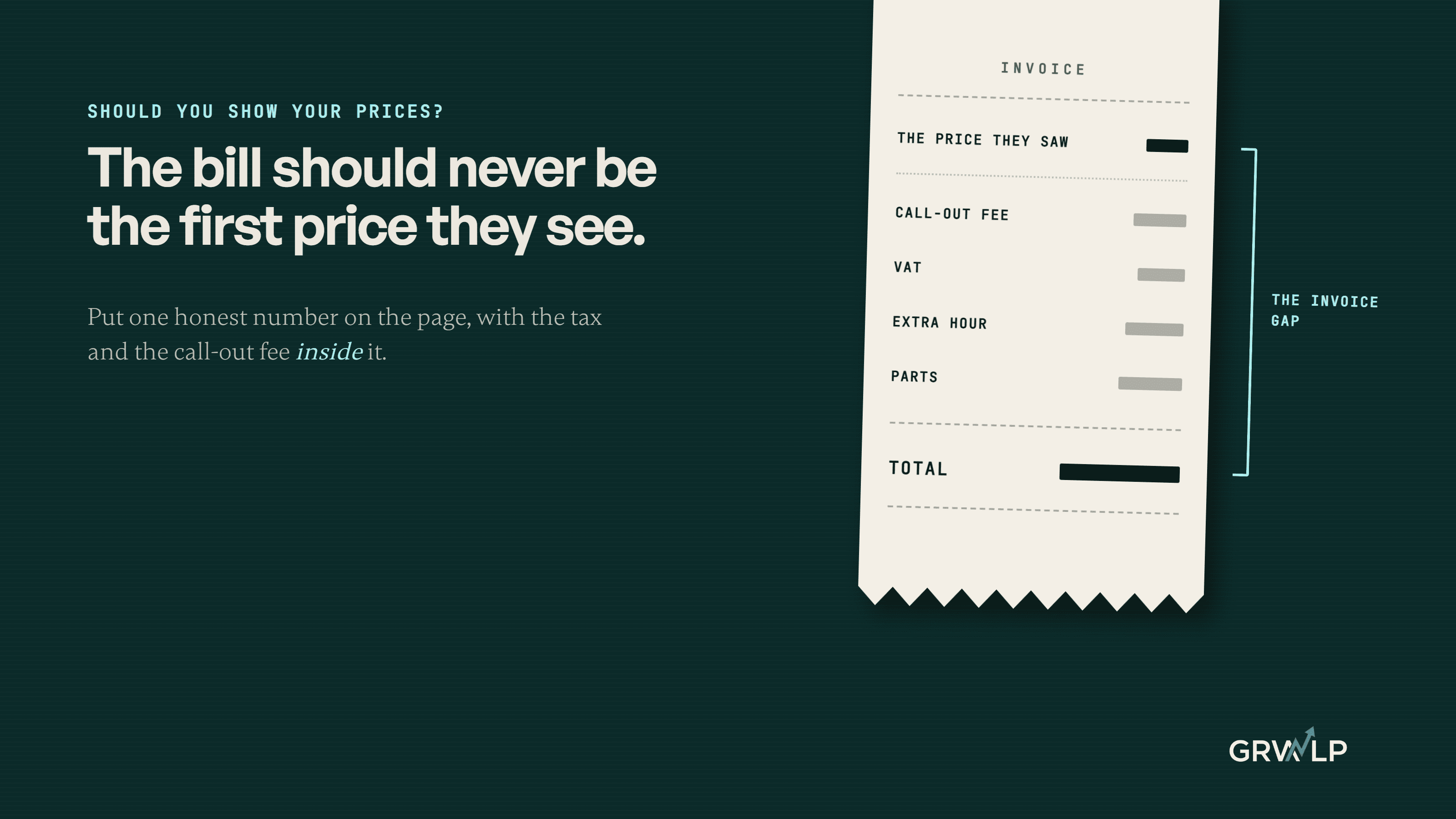
We call it the invoice gap: the distance between the first number a customer sees and the total on their invoice.
There are two ways to make it wide. Show no number, and the customer fills the gap with a directory average, a competitor's price or an AI assistant's guess. Show a teaser, a from price no real job ever costs, and the gap opens later, on the invoice, where it does the most damage. We wrote about the first one for solar installers as the price wall.
A missing price costs you the enquiry. A price the invoice beats costs you the customer.
Whito reckons the fix takes about an hour with your own job history. Look at what you invoiced this year and find the smallest job you do often. Its real price, with any tax and the call-out fee inside it, is your starting price. Next to it, say what makes a job cost more. Then put it on the page for that service, where the buyer is already reading about the job.
What do we show on our own website?
We practise half of this ourselves. Our Growth Audit page has one price on it, $500 flat, and the fee is credited toward any project signed within 60 days, so a buyer sees the number before they ever speak to us.
Our growth marketing page answers the cost question differently: "It depends on scope and channels. We'll give you a clear number after a discovery call." A retainer is work built to order, which puts it in the last row of the table above. The honest fix for that row is two or three real engagements with their totals.
Prices also need a page to sit on. When Baye Business Solutions, a cloud services company in Lagos, came to us, its old site had a problem the case study states in one line: "No pages for individual services despite offering eight categories." A price for a service with no page has nowhere to sit. The rebuild gave it eight or more service pages, each one the natural home for a starting price and what moves it.
Once the number is up, judge it by booked jobs, not enquiries. Fewer, better enquiries can be the price working. Our guide to tracking enquiries from your website shows how to count what arrives, and our local services page shows how we build for trades like these. If you want a second pair of eyes on which number to show, a free 30 minute call is enough.
Put one honest number on the page this week. The invoice should never be the first time a customer learns what you charge.
“A missing price costs you the enquiry. A price the invoice beats costs you the customer.”
Written by Oyekola Obajuwon
prices on website · should I show prices · service business pricing · price transparency · drip pricing · call-out fee · starting price · local service business