How do solar installers get more enquiries from their website?
How a solar installer's website wins more enquiries in 2026: a price on the page, current credit and VAT lines, and a shorter quote form.
TL;DR
Put your price range, credentials and current incentive rules on the website. US and UK consumer guides tell solar buyers to compare written bids and to avoid anyone who hides the price or pushes for a fast signature, so a site that says "book a survey for pricing" looks like the warning.
Last updated 5 October 2026. Written by Oyekola Obajuwon, founder of Growveloper, a growth studio that builds the website, the marketing and the follow up for owner run businesses in the United States, the United Kingdom and Nigeria.
Put your price range, credentials and current incentive rules on the website. US and UK consumer guides tell solar buyers to compare written bids and to avoid anyone who hides the price or pushes for a fast signature, so a site that says "book a survey for pricing" looks like the warning.
Most advice on solar marketing starts with the installer: claim your Google profile, collect reviews, reply fast. All true. But it skips the person on the other side of the form. A solar buyer arrives already holding a warning, and the website either matches it or answers it.
Why does a solar website get visits but few enquiries?
Because the visitor has been told to be careful, and solar sites often give them reasons to be.
In the US, the Federal Trade Commission's page on solar power for your home tells homeowners to "compare detailed bids from several companies" and to "never deal with a power or home repair company that pressures you for a quick decision". Its 2024 alert on solar scams goes further: "The federal government does not install solar systems in homes for free", and "Anyone who pressures you into a contract or demands up-front or immediate payment is a scammer."
So a homeowner on your site is not only asking whether you are good. They are checking whether you look like the thing they were warned about. A headline that says "free solar", a countdown on an offer, or a page with no price at all: each one fails that check before your reviews are even read.
Should a solar installer show prices on the website?
Yes. Show a starting range, in the units your buyers compare, and say what moves it.
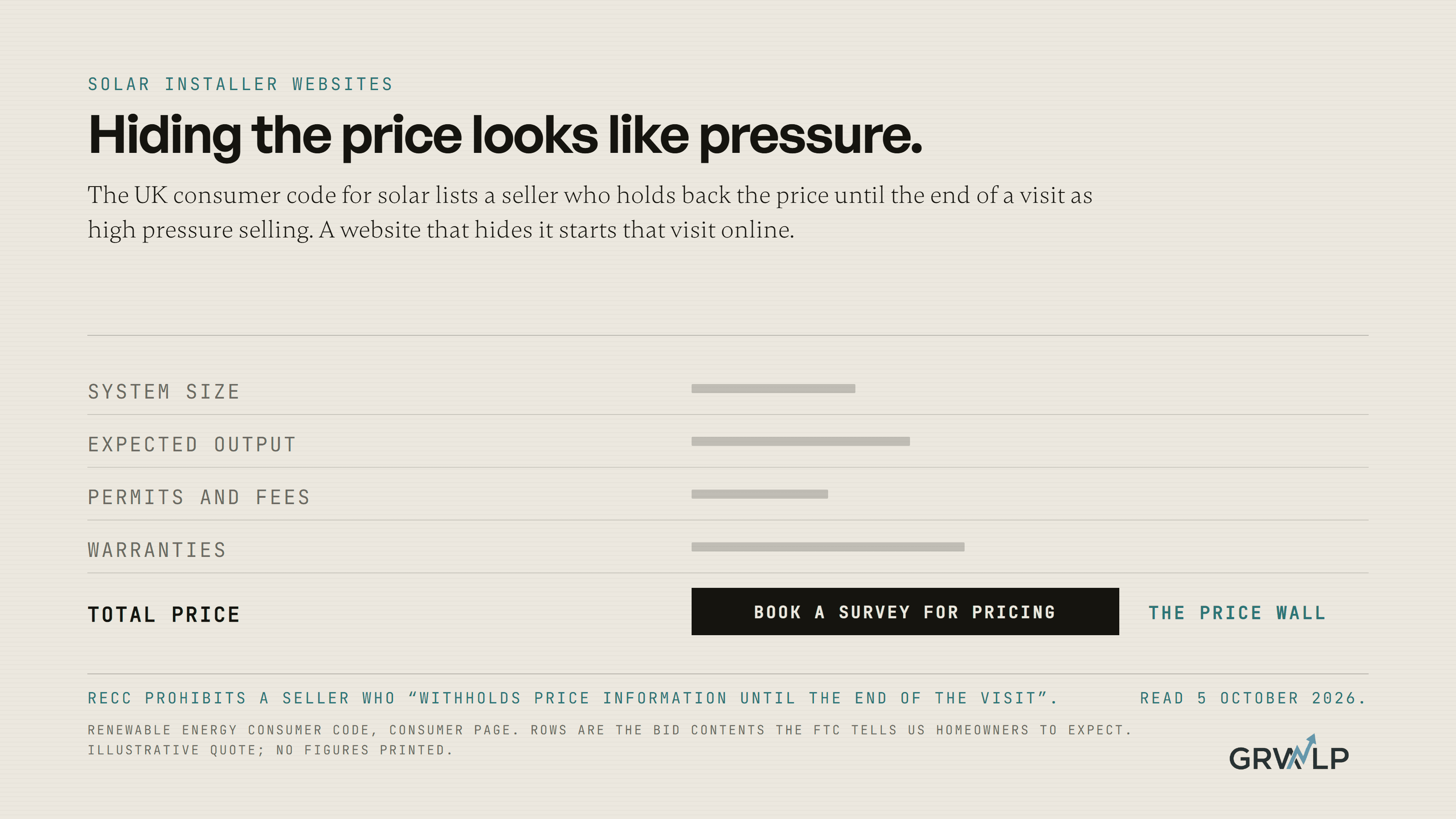
In the UK this is close to a rule. The Renewable Energy Consumer Code, which UK installers selling to homeowners can sign up to, lists the kinds of selling it prohibits. A representative who "withholds price information until the end of the visit" is on that list, next to one who "offers you a discount for signing the contract that day" and one who "claims that there is limited availability of the product".
We call it the price wall: a website that puts every number behind a home survey. On the page it feels like caution. To a buyer who has read the consumer code, it reads as the first step of the sales visit they were warned about, moved online.
A range is enough. For scale, EnergySage reported a median of $2.48 per watt for US installations in the first half of 2025, from quotes on its own marketplace, in its 21st marketplace report. That was before the federal credit ended, so treat it as a reference, not a price list. Your own range, for the systems you actually fit, is the number that matters.
We publish our own prices, on our web development page, for the same reason. A buyer who can see a number can decide you are worth a call.
Is the 30% solar tax credit still on your website?
Check today. In the US, the Internal Revenue Service's page on the Residential Clean Energy Credit, reviewed on 4 July 2026, says the 30% credit applies to property "installed anytime from 2022 through December 31, 2025", and that "The credit is not available for any property placed in service after December 31, 2025."
A site that still says the credit is there is wrong in a way the buyer can check in one search, and the FTC's guidance to solar businesses says plainly: "don't overpromise cost savings that might come through tax credits, rebates, or incentives". In the UK the lines are different, and one has an end date coming.
Incentive lines a solar website should get right in 2026
| Country | What the official page says | What to put on your site |
|---|---|---|
| US | The 30% residential credit is not available for property placed in service after 31 December 2025 | Remove any "30% tax credit" claim; state any local programme you rely on, with its own link |
| UK | Zero rate of VAT on installing solar runs from 1 May 2023 to 31 March 2027, then 5% | State the 0% VAT and its end date, and update it in April 2027 |
| UK | The Smart Export Guarantee needs an MCS certified installer using certified products | Show your MCS certificate number where the buyer can check it |
The VAT dates come from HM Revenue and Customs' notice on energy saving materials, which names solar panels. The export payment rule comes from MCS: a supplier "might ask for your MCS certificate" when the homeowner signs up.
What should a solar quote form ask?
Only what you need to send the written bid the buyer has been told to compare. The FTC's page tells homeowners to expect a bid that gives the system's "size and how much power it's expected to deliver", "the full cost of installation, including any building or electrical permit fees", and the warranties on the equipment and the workmanship. Work backwards from that.
Solar quote form fields, and why each one is there
| Field | Why you need it | Keep it easy |
|---|---|---|
| Postcode or ZIP code | Service area and local permits | One box |
| Monthly bill or yearly usage | Sizing the system | A range to tap, not an exact figure |
| Roof type and a photo | Whether a remote quote is possible | Photo optional |
| Battery, yes or no or unsure | Changes the price a lot | Three buttons |
| Best way to reach you | Phone, email or WhatsApp | One choice |
Every extra question is one more reason to close the tab. If a field does not change the bid, drop it. Our piece on building a quote form with WhatsApp follow up covers the build itself, and how to automate quotes covers which parts can run without you.
How fast should a solar installer reply to an enquiry?
Fast, but not pushy. The figure you will see on solar marketing pages, that 78% of buyers choose the first company to respond, comes with no source on any page we read, so we do not repeat it. The study that does exist is older and broader: a 2011 Harvard Business Review analysis of lead response, which we set out with its sample in our piece on how fast home services companies should reply.
For solar the first reply has a second job. It should restate what your written quote will include and when it will arrive. That is the reply a careful buyer is hoping for, and the opposite of a call that asks for a decision.
Where should licences, certificates and reviews go?
Next to the form, not on an "about us" page three clicks away. In the US, Google's Local Services screening page lists what it checks before a solar energy contractor can advertise there: general and professional liability insurance, and business and owner licences at state level. The FTC tells homeowners to ask "if the company has the licenses, certificates, or bonding required by your state, county, and city". Put the numbers where the buyer is deciding.
Then check that every link works. When we audited the old Baye Business Solutions site in Lagos, its Backup and Recovery link pointed to an unrelated domain. A certificate link that opens someone else's website is worse than no link at all.
Reviews belong there too. BrightLocal's Local Consumer Review Survey 2026 of 1,002 US adults found 97% read reviews when choosing a local business. Our piece on getting more Google reviews covers the asking. For a solar installer the right moment is commissioning, the day the system first runs.
What has Growveloper built for solar installers?
Nothing published yet, and we would rather say so. We build the website, local search and follow up for local service trades, and our solar installers page describes what that looks like for this trade. If you want a second pair of eyes on your own site before changing anything, there is a free call.
The installer who gets the enquiry is the one whose website already said what the warning told the buyer to ask.
“A solar buyer arrives already holding a warning. The website either matches it or answers it.”
Written by Oyekola Obajuwon